
高技术制造业

Search documents
申万宏观·周度研究成果(9.13-9.19)
赵伟宏观探索· 2025-09-21 03:14
Group 1: New Economic Dynamics - The high-tech manufacturing sector continues to show strong growth, indicating a new acceleration in economic dynamics [9][10] - Recent financial data shows a decline in credit balance and social financing, with M1 increasing slightly [17] - The impact of "anti-involution" is beginning to manifest in mid-to-lower production and investment sectors [21] Group 2: Gold Price Concerns - Recent trends indicate that gold price increases are primarily concentrated during U.S. trading hours, raising concerns about future price stability [12][11] - The differentiation in investment allocation among different regions may influence future gold price movements [12] Group 3: Fiscal Policy Insights - Broad fiscal spending is slowing down, prompting the need for potential countermeasures to address downward pressure on the economy [21][23] - The upcoming fiscal "second half" may focus on risk prevention, transformation promotion, and consumer protection [16] Group 4: Real Estate Market Trends - There is an improvement in new home transactions in first-tier cities, supported by industrial production recovery and high infrastructure investment [24] Group 5: International Cooperation - The BRICS summit emphasized the importance of multilateralism and international cooperation to address global challenges and promote economic development [29] Group 6: Monetary Policy Outlook - The recent FOMC meeting resulted in a 25 basis point rate cut, with increased expectations for further rate cuts in 2025 [30]


湖北1—8月经济运行平稳 高技术制造业增速14.2%
Chang Jiang Shang Bao· 2025-09-18 00:03
Economic Overview - Hubei province's economy shows a stable and positive trend across various sectors including industry, investment, consumption, foreign trade, and finance [1][2] Industrial Performance - The industrial added value above designated size in Hubei increased by 7.8% year-on-year, surpassing the national average by 1.6 percentage points [2] - High-tech manufacturing led the growth with an increase of 14.2%, contributing 27.2% to the overall industrial growth [2] - Specific sectors such as computer, communication, and electronic equipment manufacturing grew by 15.6%, while electrical machinery and equipment manufacturing rose by 16.7% [2] Investment Trends - Fixed asset investment in Hubei grew by 6.7% year-on-year, outpacing the national growth rate of 6.2% [3] - Manufacturing investment saw a significant increase of 13.3%, while infrastructure investment rose by 3.5% [3] - Private investment remained active, growing by 6.0%, and 11.9% when excluding real estate development [3] Consumption Insights - The total retail sales of consumer goods reached 17,241.19 billion yuan, with a year-on-year growth of 5.7%, higher than the national average [4] - The "old-for-new" policy significantly boosted sales in home appliances and furniture, with retail sales increasing by 25.2% and 61.3% respectively [4] - Online retail sales also experienced rapid growth, increasing by 19.2% [4] Foreign Trade Developments - Hubei's total import and export value reached 5,463.9 billion yuan, marking a year-on-year increase of 27.3% [4] - Exports amounted to 3,898.3 billion yuan, growing by 35.0%, while imports increased by 11.5% to 1,565.6 billion yuan [4] Fiscal and Financial Performance - Local general public budget revenue for Hubei reached 2880.53 billion yuan, reflecting a year-on-year growth of 7.9% [5] - Financial institutions in Hubei reported a total deposit balance of 99,997.0 billion yuan, growing by 9.2% since the beginning of the year [5]
国内高频 | 一线城市新房成交改善(申万宏观·赵伟团队)
赵伟宏观探索· 2025-09-16 16:03
Core Viewpoint - The article highlights improvements in industrial production, sustained high levels of infrastructure construction, and a rebound in real estate transactions, indicating a potential recovery in the economy [2][5][24]. Group 1: Industrial Production - Industrial production has shown improvement, with the blast furnace operating rate increasing by 3.5% week-on-week and 3.5 percentage points year-on-year to 83.9% [5][12]. - The chemical production chain has also seen a rise, with soda ash and PTA operating rates increasing by 1.1% and 5.5% respectively, year-on-year changes being +2.7 percentage points to 12.5% and +8.5 percentage points to 75% [12][16]. - The automotive sector has experienced an uptick, with the operating rate of semi-steel tires rising by 6% week-on-week and 5.8 percentage points year-on-year to 73.5% [12]. Group 2: Construction and Infrastructure - Infrastructure construction remains at a high level, with national grinding operating rates and cement shipment rates increasing by 4.3% and 1.2 percentage points respectively, year-on-year changes being +5.8 percentage points to 44.7% and +1.1 percentage points to 46.4% [16][22]. - The asphalt operating rate has slightly decreased by 1.8% week-on-week but remains at a high level year-on-year at 38.4% [22]. Group 3: Real Estate and Demand - Real estate transactions have improved, with the average daily transaction area of new homes rising by 9.6 percentage points year-on-year to 6.3 million square meters, particularly in first and second-tier cities [25][28]. - Port cargo throughput related to exports has shown strong performance, with year-on-year increases of 1.3 percentage points to 8.5% [32]. Group 4: Price Trends - Agricultural product prices have rebounded, with prices for eggs, vegetables, and pork increasing by 1.3%, 0.8%, and 0.3% respectively [57]. - Industrial product prices are showing divergence, with the Nanhua Industrial Price Index increasing by 0.1% week-on-week, while energy and chemical prices decreased by 0.2% [63].
前8个月北京高端制造活跃 新能源汽车产量同比增1.4倍
Zhong Guo Xin Wen Wang· 2025-09-16 09:04
Group 1: High-end Manufacturing in Beijing - In the first eight months of the year, Beijing produced 900,000 vehicles, a year-on-year increase of 20.9% [1] - Among these, the production of new energy vehicles reached 375,000 units, representing a growth of 140% [1] - The industrial production in Beijing showed a rapid growth with a 6.1% increase in the value added of industrial enterprises above a designated size [1] Group 2: Key Industries Performance - The computer, communication, and other electronic equipment manufacturing industries grew by 24.3% [1] - The automotive manufacturing sector experienced an 11.1% increase, while the electricity and heat production and supply industry grew by 4.9% [1] - Strategic emerging industries and high-tech manufacturing in Beijing saw value added growth of 17.4% and 9.6%, respectively [1] Group 3: Investment Trends - Fixed asset investment in Beijing (excluding rural households) increased by 10.0% in the first eight months [1] - Investment in equipment purchases, reflecting the expansion of production capacity, surged by 83.5% [1] - Investment in high-tech industries rose significantly by 58.2% [1] Group 4: Consumer Market Activity - The total market consumption in Beijing grew by 0.3%, with service consumption increasing by 4.4% driven by information services, transportation, culture, and entertainment [2] - The total retail sales of consumer goods reached 866.11 billion yuan [2] - Retail sales of upgraded products such as gold and silver jewelry, cosmetics, and sports and entertainment goods saw growth rates of 35.7%, 8.7%, and 3.2%, respectively [2]
中国8月新能源汽车产量同比增长22.7%
Di Yi Cai Jing· 2025-09-15 02:18
Core Insights - In August, the national industrial added value above designated size increased by 5.2% year-on-year and 0.37% month-on-month [1] Group 1: Industrial Performance - The mining industry added value increased by 5.1% year-on-year [1] - The manufacturing sector saw a growth of 5.7% year-on-year [1] - The electricity, heat, gas, and water production and supply industry grew by 2.4% year-on-year [1] Group 2: Subsector Highlights - The equipment manufacturing industry added value increased by 8.1% year-on-year, outperforming the overall industrial growth by 2.9 percentage points [1] - High-tech manufacturing added value grew by 9.3% year-on-year, exceeding the overall industrial growth by 4.1 percentage points [1] Group 3: Economic Type Analysis - State-controlled enterprises' added value increased by 4.7% year-on-year [1] - Joint-stock enterprises experienced a growth of 6.0% year-on-year [1] - Foreign and Hong Kong, Macao, and Taiwan-invested enterprises grew by 2.3% year-on-year [1] - Private enterprises saw an increase of 4.6% year-on-year [1] Group 4: Product Performance - The production of 3D printing equipment increased by 40.4% year-on-year [1] - The output of new energy vehicles grew by 22.7% year-on-year [1] - Industrial robot production rose by 14.4% year-on-year [1]
高技术制造业宏观周报:国信周频高技术制造业扩散指数继续回升-20250904
Guoxin Securities· 2025-09-04 05:44
Group 1: High-tech Manufacturing Index - The Guosen weekly high-tech manufacturing diffusion index A recorded 0.2, while index B was 52.2, continuing to rise from the previous week[1] - The semiconductor industry shows improved prosperity, with dynamic random access memory (DRAM) prices increasing by $0.033 to $1.9200[2] - Prices for lithium hexafluorophosphate, acrylonitrile, and 6-amino penicillanic acid remained unchanged, indicating stable conditions in these sectors[1] Group 2: Price Tracking and Policy Developments - The price of 6-amino penicillanic acid is stable at 190 RMB/kg, and acrylonitrile remains at 8,250 RMB/ton[2] - The National Standardization Administration and the Ministry of Industry and Information Technology announced a plan to establish a high-quality standard system for industrial mother machines by 2026[2] - The Chengdu production base for solid-state batteries by EVE Energy is expected to achieve an annual capacity of nearly 500,000 cells, with the first phase completed by December 2025[3] Group 3: Economic Indicators - Fixed asset investment year-on-year growth is at 1.60%, while retail sales growth is at 3.70%[5] - Monthly export growth stands at 7.20%, and M2 growth is at 8.80%[5] Group 4: Risks and Challenges - Potential risks include indicators failing due to structural adjustments in high-tech manufacturing and economic policy interventions[4] - Economic growth slowdown poses a significant risk to the sector's performance[4]
7月规上工业企业营收保持增长 制造业利润同比增长6.8%
Shang Hai Zheng Quan Bao· 2025-08-27 18:32
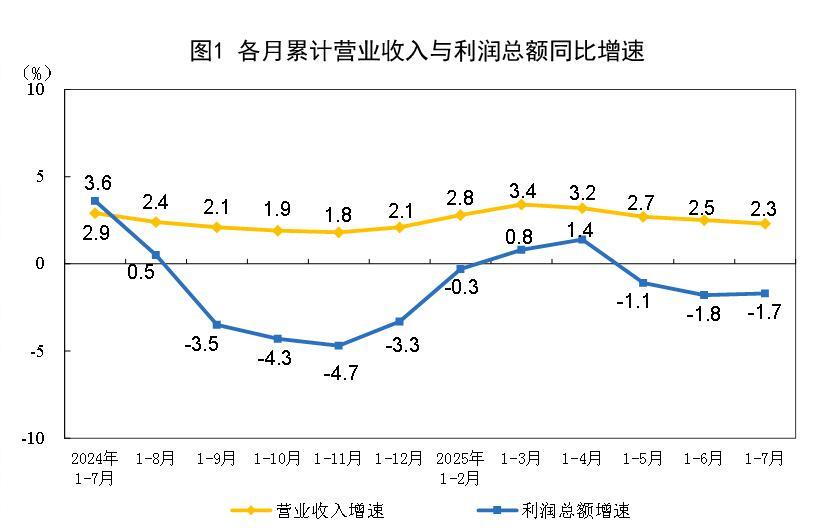
Core Insights - In July, the revenue of large-scale industrial enterprises increased by 0.9% year-on-year, while profits decreased by 1.5%, with the decline narrowing by 2.8 percentage points compared to June [1] - Manufacturing profits grew by 6.8% year-on-year in July, accelerating by 5.4 percentage points from June [1][2] - The profit improvement in July indicates structural recovery signals, with certain industries experiencing profit enhancements due to external environment improvements and internal policy support [1][2] Revenue and Profit Trends - From January to July, the revenue of large-scale industrial enterprises increased by 2.3% year-on-year, while profits decreased by 1.7%, with the decline narrowing by 0.1 percentage points compared to the first half of the year [1] - In July, medium and small-sized enterprises showed significant profit improvements, with profits turning from declines of 7.8% and 9.7% in June to increases of 1.8% and 0.5% respectively [1] Sector Performance - Manufacturing sector profits contributed significantly to the recovery of overall industrial profits, with raw material manufacturing profits rebounding from a 5.0% decline in June to a 36.9% increase in July [2] - High-tech manufacturing profits also improved, rising from a 0.9% decline in June to an 18.9% increase in July [2] - The aerospace and semiconductor sectors showed strong profit growth, with aerospace profits increasing by 40.9% and semiconductor-related sectors seeing profits rise by 176.1%, 104.5%, and 27.1% respectively [2] Policy Impact - The "Two New" policies have driven rapid profit growth in related industries, with significant increases in profits for sectors such as electronic and electrical machinery manufacturing [3] - Inventory growth for large-scale industrial enterprises decreased, with finished goods inventory at 6.67 trillion yuan, growing by 2.4%, which is a 0.7 percentage point decline from June [3] - Future expectations indicate a moderate recovery in industrial profits, supported by policy efforts and a return to normalcy in supply and demand [3][4]
前7月规上工业企业利润总额4.02万亿元,高技术制造业领跑
2 1 Shi Ji Jing Ji Bao Dao· 2025-08-27 08:02
Core Insights - In the first seven months of the year, the total profit of industrial enterprises above designated size in China reached 40,203.5 billion yuan, a year-on-year decrease of 1.7% [5] - The manufacturing sector achieved a profit of 30,235.8 billion yuan, marking a growth of 4.8% [5] - In July, manufacturing profits increased by 6.8%, with high-tech manufacturing profits rebounding from a decline of 0.9% in June to a growth of 18.9% [10] Industrial Profit Trends - The profit decline for industrial enterprises has been narrowing, with July showing a year-on-year decrease of 1.5%, an improvement of 2.8 percentage points from June [6] - The profit margins for industrial enterprises have improved, with gross profit turning from a decline of 1.3% in June to a growth of 0.1% in July [6] - The operating income for industrial enterprises in the first seven months was 78.07 trillion yuan, reflecting a year-on-year growth of 2.3% [5] Sector Performance - Among various sectors, the mining industry saw a significant profit decline of 31.6%, while the manufacturing sector's profit growth of 4.8% was notable [8] - Specific industries within manufacturing showed strong profit growth, such as the agricultural and food processing industry at 14.5%, and electrical machinery manufacturing at 11.7% [8] - High-tech manufacturing sectors, particularly in aerospace and semiconductor industries, demonstrated remarkable profit increases, with profits growing by 40.9% and 176.1% respectively [10] Policy Impact - The implementation of "two new" policies has positively influenced profit growth in related industries, with significant increases in sectors like electronic and electrical machinery manufacturing [9] - The government's focus on expanding domestic demand and promoting innovation is expected to support the ongoing recovery of industrial profits [10]
高技术制造业宏观周报:国信周频高技术制造业扩散指数保持不变-20250822
Guoxin Securities· 2025-08-22 02:59
Group 1: High-Tech Manufacturing Index - The Guosen weekly high-tech manufacturing diffusion index A recorded 0, while index B remained at 51.4, unchanged from the previous week[1] - The prices of lithium hexafluorophosphate and dynamic random access memory (DRAM) increased, indicating a rise in the prosperity of the new energy and semiconductor sectors[1] - The prices of acrylonitrile and 6-amino penicillanic acid decreased, reflecting a decline in the aerospace and pharmaceutical sectors[1] Group 2: Price Tracking and Policy Trends - The price of 6-amino penicillanic acid is 180 RMB/kg, down 32 RMB/kg from last week; acrylonitrile is 8,250 RMB/ton, down 100 RMB/ton[2] - DRAM price increased to $1.8140, up $0.072 from last week; wafer price is $2.81 per piece, up $0.03[2] - The Ministry of Industry and Information Technology announced measures to regulate the photovoltaic industry, aiming to curb low-price competition and promote the orderly exit of outdated capacity[2] Group 3: Industry Events and Risks - The 2025 World Humanoid Robot Games concluded on August 17, featuring 26 events and 487 matches with participation from 280 teams across 16 countries[3] - Risks include potential indicator failures due to structural adjustments in high-tech manufacturing, economic policy interventions, and a slowdown in economic growth[4]
1—7月辽宁省规模以上工业增加值同比增长3.9%,高技术制造业增长较快
Zheng Quan Shi Bao Wang· 2025-08-20 08:16
Economic Overview - Liaoning Province's economy showed overall stability from January to July, with industrial added value above designated size increasing by 3.9% year-on-year, and high-tech manufacturing added value growing by 7.8% [1] - The mining industry saw a significant increase in added value by 10.9%, while manufacturing and electricity, heat, gas, and water production and supply industries grew by 3.0% and 1.1%, respectively [1] Investment Trends - Fixed asset investment in Liaoning Province decreased by 3.5%, while manufacturing investment surged by 22.8%, with high-tech manufacturing investment rising by 37.0% [2] - Infrastructure investment fell by 1.7%, and real estate development investment dropped significantly by 25.7% [2] Retail and Consumption - The total retail sales of social consumer goods reached 597.72 billion yuan, marking a year-on-year increase of 5.5%, with significant growth in essential goods such as grain and oil, which rose by 17.0% [2] - Sales of upgraded consumer goods showed strong growth, with smart phones increasing by 130% and wearable smart devices by 98.2% [2] Trade Performance - From January to July, the total import and export volume in Liaoning Province reached 437.61 billion yuan, a slight increase of 0.4%, with exports growing by 13.6% to 234.78 billion yuan [3] - Key export categories included agricultural products, steel, and electromechanical products, with notable growth rates of 9.1%, 11.1%, and 8.9%, respectively [3] Price Trends - Consumer prices in Liaoning Province experienced a slight decline, with the Consumer Price Index (CPI) decreasing by 0.1% year-on-year [3] - The Producer Price Index (PPI) for industrial producers fell by 4.8%, indicating a decrease in industrial production prices [3]