
劳动力市场

Search documents
美联储理事:支持今年降息3次!关税传导预计美国通胀小幅回升
Sou Hu Cai Jing· 2025-08-10 08:47
美联储鲍曼预计今年将降息三次 鲍曼在预先准备的讲话中表示,她支持多次降息,这一观点因近期疲软的劳动力市场数据而得到强化。 今年以来,美联储的决策委员会一直维持利率不变,鲍曼在6月之前也支持这一做法。但在7月,她与理 事克里斯托弗·沃勒一起投了反对票,主张降息25个基点。 现在,她呼吁其他决策者在9月的美联储会议上开始降息。 她表示,这样做"有助于避免劳动力市场状况出现进一步不必要的恶化,并减少委员会在劳动力市场进 一步恶化时不得不采取更大幅度政策调整的可能性"。 鲍曼由特朗普于2018年任命为美联储理事。她还重申了自己的观点,即关税推动的价格上涨不太可能持 续性地推高通胀。 她在科罗拉多斯普林斯的堪萨斯银行家协会发表的预先讲话中说:"随着我对关税不会对通胀造成持续 冲击的信心不断增强,我认为物价稳定面临的上行风险已经减弱,在潜在通胀持续朝2%目标回落、总 需求疲软,以及劳动力市场显露脆弱迹象的情况下,我认为我们应当聚焦于就业目标所面临的风险。" 鲍曼和沃勒在9月可能会有更多人加入支持降息的阵营。 本周,旧金山联储主席玛丽·戴利、明尼阿波利斯联储主席尼尔·卡什卡利以及理事丽莎·库克都在新数据 公布后表达了担忧。 ...
刚刚!美联储,降息大消息
Zheng Quan Shi Bao· 2025-08-10 06:29
Core Viewpoint - The recent statements from Federal Reserve Vice Chair Michelle Bowman indicate strong support for three interest rate cuts within the year, with a call for a rate cut to begin in September, driven by weak labor market data and concerns over economic activity [1][2][3]. Group 1: Federal Reserve's Position - Michelle Bowman supports three interest rate cuts in 2025, emphasizing the need to address the weakening labor market [2]. - The likelihood of a 25 basis point rate cut in September is currently estimated at 88.9% by investors, with speculation shifting towards a potential 50 basis point cut [1]. - Recent comments from various Federal Reserve officials have leaned towards a dovish stance, advocating for immediate rate cuts due to signs of labor market deterioration [3][7]. Group 2: Economic Indicators - Upcoming economic data releases, including July CPI, PPI, and retail sales, are expected to provide critical insights for the Federal Reserve's monetary policy adjustments [4][5]. - Analysts are particularly focused on the impact of tariffs on inflation, with expectations of a moderate increase in core commodity prices due to tariff pass-through effects [5]. - The July non-farm payroll report showed only 73,000 new jobs added, significantly below expectations, and the unemployment rate rose from 4.1% to 4.2% [3]. Group 3: Market Reactions and Future Outlook - The market is closely monitoring the upcoming speeches from Federal Reserve officials, which may signal shifts in monetary policy focus from inflation to employment [6][7]. - Discrepancies within the Federal Reserve regarding economic assessments are evident, with a divide between those prioritizing inflation concerns and those focusing on economic slowdown risks [7].
刚刚!美联储,降息大消息!
券商中国· 2025-08-10 05:54
美联储副主席的最新讲话释放重磅信号。 美东时间8月9日,美联储副主席米歇尔·鲍曼表示,支持今年降息三次并敦促美联储在9月议息会议上启动降息。她认为,关税 政策推动的美国物价上涨不太可能持续推高通胀。 根据CME美联储观察的数据,当前投资者认为美联储在9月降息25个基点的可能性已经高达88.9%。因此,市场普遍认为,美 联储9月降息已几近定局,悬念已转向50个基点。 下周,美股市场将迎来一系列重磅数据,其中包括美国7月CPI数据、7月PPI数据和7月零售数据等。分析指出,这将为美联 储调整货币政策提供重要参考,或将对美联储降息前景产生扰动。 支持美联储年内降息三次 北京时间8月10日,美联储官网发布了负责监管的美联储副主席米歇尔·鲍曼的最新讲话稿,她表示,支持在2025年年内降息三 次,并指出这一立场因美国近期疲弱的劳动力市场数据而得到了强化。 在美东时间周六于科罗拉多斯普林斯向堪萨斯银行家协会发表的讲话中,鲍曼呼吁美联储在9月会议上开始降息。 她表示,这将有助于避免劳动力市场出现进一步不必要的恶化,并降低在劳动力市场进一步恶化时,委员会不得不采取更大 幅度政策纠偏的可能性。 鲍曼认为,关税政策推动的物价上涨不 ...


纽约金价7日上涨
Xin Hua Cai Jing· 2025-08-08 01:05
Group 1 - The core viewpoint of the article highlights the significant increase in gold prices, driven by central banks' continuous accumulation of gold reserves and strong technical factors, with gold futures for December 2025 rising by $49.3 to $3482.7 per ounce, marking a 1.44% increase [1] - Central banks' purchases of gold are identified as a key driver for the 30% increase in gold prices this year, with expectations that this trend will continue, although the pace of purchases may slow down as prices rise [1] - The article notes that the U.S. Department of Labor reported an increase in initial jobless claims to 226,000, exceeding market expectations, indicating a weakening labor market, which contributed to the rise in gold prices [1] Group 2 - On the technical side, December gold futures are noted to have a strong overall technical advantage for the bulls [1] - Silver futures for September also saw an increase, rising by 62.8 cents to $38.530 per ounce, reflecting a 1.66% gain [1]
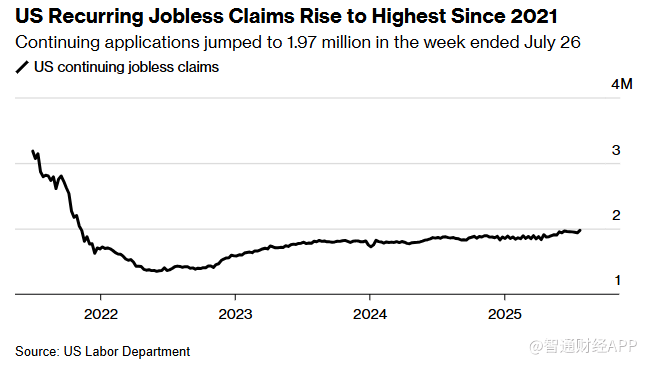
美国就业市场疲态尽显 续请失业金人数创2021年底以来新高
智通财经网· 2025-08-07 13:48
Group 1 - The number of Americans filing for continued unemployment benefits has surged to its highest level since November 2021, indicating a weakening labor market [1] - As of the week ending July 26, continued unemployment claims increased by 38,000 to 1.97 million, exceeding market expectations [1] - Initial unemployment claims for the week ending August 2 rose to 226,000, slightly above market expectations, suggesting that job seekers are facing more difficulties [1] Group 2 - Investors and economists are closely monitoring any signs of further deterioration in the labor market, especially after the July non-farm payroll report showed significantly fewer new jobs than expected [3] - The report led to downward revisions of employment data for May and June, increasing expectations for a potential interest rate cut by the Federal Reserve in September [3] - Despite a generally low level of layoffs this year, some large companies, including Merck and Intel, have announced layoffs, with Stanford University planning to cut over 300 jobs due to federal funding reductions [3] Group 3 - Another report indicated that U.S. labor productivity rebounded in the second quarter, aligning with economic growth and helping to mitigate wage-related inflation pressures [3]
英国央行行长:将采取一切必要措施实现2%的通胀目标
Sou Hu Cai Jing· 2025-08-07 12:31
Core Viewpoint - The Bank of England's Governor Bailey emphasizes that the central bank should not lower interest rates too quickly or excessively, indicating a cautious approach to monetary policy amid economic uncertainties [1] Economic Outlook - Inflation is not expected to rebound persistently, with different levels of price and wage pressures observed [1] - Wage growth is projected to slow to just below 4% by the end of the year, reflecting a cooling labor market [1] - There is an increased focus on the risks of second-round effects from inflation, particularly concerning food and energy prices, which are significant for consumers [1] Consumer Behavior - Consumers are exhibiting more caution than previously anticipated, which may impact overall economic activity [1] - The risks of economic activity declining are slightly elevated, suggesting potential challenges ahead for growth [1] Inflation Targeting - The central bank is committed to taking all necessary measures to achieve a 2% inflation target, indicating a strong focus on maintaining price stability [1]
Vatee万腾:美国非农数据回头看遭大幅下修,就业强劲表象松动?
Sou Hu Cai Jing· 2025-08-06 10:20
Core Insights - The recent employment data signals a potential weakening in the U.S. labor market, contrary to the prevailing perception of strength [1][3] - Goldman Sachs has revised down the non-farm employment numbers for May and June by a total of 258,000, marking the largest two-month adjustment since 1968 [1][3] - A significant downward revision of 550,000 to 950,000 is anticipated in the upcoming annual benchmark revision, which could reshape market views on labor market strength [1][4] Employment Data Adjustments - The monthly adjustment of 258,000 alters the market's assessment of employment growth for May and June, revealing cracks in the narrative of continuous job expansion [3][4] - The scale of the upcoming benchmark revision is expected to be unprecedented, potentially ten times larger than the previous adjustment of 50,000 in January 2023 [4] Diverging Indicators - Other employment-related indicators, such as the NFIB small business survey, JOLTS job openings data, and the ECI employment cost index, are showing signs of fatigue, indicating a slowdown in hiring and job demand [5] - This inconsistency in data is raising concerns in the market regarding the robustness of the labor market [5] Implications for Federal Reserve Policy - The Federal Reserve has previously relied on the narrative of a strong labor market to justify maintaining high interest rates; however, if the downward revisions are confirmed, it may necessitate a reassessment of economic resilience [5][6] - Current market expectations suggest a high probability (over 90%) that the Federal Reserve will begin to cut interest rates in September, which could accelerate if the labor market is found to be overestimated [6] Economic Outlook - The lagging effects of consecutive interest rate hikes over the past two years may be starting to manifest in the labor market, potentially leading to more dovish sentiments [7] - The downward revision of non-farm data challenges market consensus and could exert pressure on expectations for a soft landing of the U.S. economy, adding complexity to future Federal Reserve policy decisions [7]

特朗普想让美联储大幅降息?先得过FOMC票委这关
Jin Shi Shu Ju· 2025-08-05 12:45
Core Viewpoint - The focus on monetary policy decision-making is increasing due to President Trump's calls for significant interest rate cuts and his influence over the Federal Reserve's leadership [1][2]. Group 1: Federal Reserve Leadership Changes - Trump is expected to appoint a replacement for Fed Governor Kugler, who is resigning early, potentially influencing the Fed's direction on interest rates [1]. - If Powell resigns at the end of his term in May 2026, Trump will have another opportunity to fill a vacancy, which could lead to a majority of Trump-appointed members on the Fed Board [2][3]. - The appointment of new members could give the new chair significant leverage to pursue their agenda, but local Fed presidents are likely to vote based on macroeconomic conditions rather than political influence [3]. Group 2: Voting Dynamics and Economic Considerations - The Federal Open Market Committee (FOMC) requires a majority vote to change interest rates, emphasizing the need for economic rather than political justification for any rate cuts [1][2]. - Recent voting showed a 9-2 decision to maintain the current interest rate, indicating the importance of consensus among committee members [1]. - The upcoming voting members from regional Fed banks may present resistance to politically influenced decisions, focusing instead on economic fundamentals [4][5]. Group 3: Economic Outlook and Potential Rate Cuts - Predictions indicate that at least two rate cuts may occur in 2025, with the potential for increased support for cuts if labor market conditions worsen [5]. - Concerns about the credibility of the next chair could lead to rising inflation expectations and higher long-term interest rates if consensus is not achieved [5].
全球宏观论坛 - 解读行情:宏观数据、央行与利率变动-Global Macro Forum-Reading the Tape Macro Data, Central Banks, and Rates Moves
2025-08-05 08:17
Summary of Morgan Stanley Global Macro Forum Call Industry Overview - **Focus**: Global macroeconomic trends, particularly in the US economy and interest rates - **Key Participants**: Vishwanath Tirupattur, Michael Gapen, Seth Carpenter, Matthew Hornbach, Martin Tobias, James Lord Key Points Economic Indicators - **2Q GDP Performance**: Domestic demand has softened significantly, slowing to a 1.2% pace from 2.7% in the previous year [5] - **Labor Market Trends**: There is a sharp drop-off in labor demand, with downward revisions to May and June employment figures totaling 258,000 [40][7] - **Recession Signals**: A deceleration in nonfarm payrolls is more closely correlated with recession risk than revisions to prior data [11] Central Bank Policies - **Federal Reserve Outlook**: The expectation is that the Fed will maintain its current policy stance, with no rate cuts projected until March 2026 despite rising inflation [40] - **Global Central Banks**: The Fed and the Bank of Japan are expected to remain on hold, while the European Central Bank and the Bank of England may ease policies this year [40] Interest Rates and Market Dynamics - **Market-Implied Rates**: The market is pricing the Fed's policy trough rate to move well below 3.00% [15][40] - **Term Premiums**: Concerns regarding the quality of US economic data and a dovish bias from the FOMC are expected to keep term premiums elevated [40] - **USD Outlook**: Continued weakness in the USD is anticipated, with expectations that the bear market for the currency is not over [40] Treasury Issuance - **Composition of Treasury Issuance**: Bills have been crucial in financing Treasury's borrowing needs, and this trend is expected to continue, leading to a lower weighted average maturity (WAM) of marketable debt [28][31][40] Investment Strategies - **Recommended Positions**: - Long UST 5-year notes and FVU5 futures - Short 10-year TIPS breakevens - Long January 2026 fed funds futures - Stay short USD [40][41] Additional Insights - **Tariff Impact**: Evidence of tariff pass-through is becoming clearer, with prices of goods exposed to tariffs showing sharper increases [40] - **Inflation Concerns**: Inflation remains a significant concern for the Fed, with expectations of price pressures in heavily tariffed goods [40] Conclusion The call highlighted a cooling US economy with significant implications for labor demand and central bank policies. The anticipated trajectory of interest rates and the ongoing weakness of the USD present both risks and opportunities for investors. The focus on Treasury issuance and the impact of tariffs on inflation further complicate the macroeconomic landscape.
美联储会否在9月降息?
2025-08-05 03:15
Summary of Conference Call Notes Industry or Company Involved - The discussion primarily revolves around the U.S. economy and the Federal Reserve's monetary policy, particularly focusing on the implications of the "anti-involution" policy in various industries. Core Points and Arguments 1. **Anti-Involution Policy**: This policy aims to address issues of low prices and disorderly competition within specific industries, primarily targeting local governments and enterprises. It is not a macroeconomic policy but rather an industry-specific measure [2][3] 2. **Beneficiary Industries**: The industries benefiting from the anti-involution policy can be categorized into three groups: - **Group 1**: Industries with low economic activity but recovering profitability, such as wind power, rebar steel, and cement [2] - **Group 2**: Industries with bottoming fundamentals but strong expectations, including photovoltaic, general equipment, and medical devices [2] - **Group 3**: Industries with high economic activity but lacking real estate policy expectations, such as batteries and medical aesthetics [2] 3. **Federal Reserve's Interest Rate Decision**: There is a significant divergence in market opinions regarding the likelihood of a rate cut in September. However, based on economic data, the probability of a rate cut appears substantial [4][11] 4. **Economic Data Insights**: - The second quarter GDP data indicates a slowdown in U.S. economic activity, with internal demand weakening [4] - Personal consumption expenditures increased their contribution to GDP from 0.3% in Q1 to approximately 1% in Q2, while private investment stagnated, negatively impacting GDP [5] 5. **Employment Data**: The July non-farm payroll data showed a significant shortfall, with only 73,000 jobs added, indicating a sharp decline in hiring momentum [6] 6. **Labor Market Dynamics**: Job growth is concentrated in healthcare and social assistance, while goods production and federal government employment are major detractors [7] 7. **Labor Market Indicators**: The labor force participation rate has declined, and the unemployment rate has increased, particularly among Black workers. Long-term unemployment has risen, but hourly wages have been adjusted upward [8] 8. **Manufacturing and Inflation**: The manufacturing sector has shown signs of decline, with pressures on demand and employment. Inflationary pressures are expected to be manageable in the near term [10] Other Important but Possibly Overlooked Content 1. **Federal Reserve Chair Powell's Remarks**: Powell noted that the weakening supply-demand dynamics in the labor market pose risks, despite a stable unemployment rate [9] 2. **Market Reactions**: The rapid replenishment of the U.S. Treasury General Account (TGA) could lead to rising overnight financing rates, influencing the Fed's decision-making process regarding interest rates [10]