积极财政政策

Search documents
日元汇率大幅贬值!高市早苗力推放水政策,恐引发美国不满
Sou Hu Cai Jing· 2025-10-07 00:18
Group 1 - The election of Sanae Takaichi as the new leader of the Liberal Democratic Party in Japan marks a significant gender breakthrough in Japanese politics and reflects the structural challenges facing Japan's political economy in the post-Abe era [1] - Takaichi's economic policy is seen as an upgraded version of "Abenomics 2.0," advocating for a combination of active fiscal policy and sustained monetary easing, including plans to eliminate temporary fuel taxes and increase subsidies for healthcare and small businesses [1][2] - The market reacted positively to Takaichi's policies, with the Nikkei index surging by 4.83% on October 6, breaking the 48,000-point barrier and reaching a historical high, indicating optimism about liquidity expansion [2] Group 2 - In contrast to the stock market's positive response, the yen experienced a significant depreciation against the dollar, with a nearly 2% drop in a single day, reflecting deep concerns about the yen's future [4] - The depreciation of the yen complicates U.S.-Japan relations, as it undermines the effectiveness of the 15% tariffs imposed by the U.S. and raises questions about the stability of trade agreements established by previous administrations [4] - Japan's long-standing zero or negative interest rate policy is being challenged as the Bank of Japan has begun normalizing monetary policy, with interest rates rising from -0.1% to 0.25% in 2024, which will increase the burden of debt servicing on the government [6][7]


盛松成:短期内中国尚不具备“大幅”降息的基础 居民储蓄将更多流向金融投资
Sou Hu Cai Jing· 2025-09-26 05:52
Core Viewpoint - Chinese residents' savings are increasingly directed towards financial investments, particularly in high-quality projects that can generate stable cash flow, aligning with national strategic directions [1] Group 1: Investment Trends - Financial investments are becoming more attractive, especially in sectors related to technological innovation and high-quality development, such as new infrastructure and urbanization [1] - The underlying assets of these new projects are closely aligned with major national strategies [1] Group 2: Economic Environment - The external environment is providing support for Chinese asset prices, with expectations of continued interest rate cuts by the Federal Reserve [1] - There is still room for interest rate cuts in China, although a significant reduction is not anticipated in the short term [1] - The focus will remain on proactive fiscal policies complemented by moderately loose monetary policies in the near future [1]
前八月广义财政支出同比增8.2%,市场期待财政加力
Di Yi Cai Jing· 2025-09-25 12:41
Group 1 - The overall fiscal revenue in China for the first eight months of this year is approximately 17.5 trillion yuan, remaining stable compared to the same period last year [1][3] - The broad fiscal expenditure reached about 24.2 trillion yuan, showing a year-on-year growth of approximately 8.2%, with a deficit of about 6.7 trillion yuan, which is a 42% increase year-on-year [1][5] - The fiscal expenditure growth rate has slowed down significantly in August, with a year-on-year increase of only 6%, down 6.1 percentage points from July [6] Group 2 - The National Development and Reform Commission plans to establish new policy financial tools to address the capital shortage for project construction, with an expected scale of 500 billion yuan [2][7] - The new policy financial tools are designed to supplement project capital and leverage additional financing, focusing on areas such as technological innovation and consumption upgrades [7][8] - The issuance of local government special bonds has accelerated, with a net financing of 1.027 trillion yuan in the first eight months, which is an increase of 463 billion yuan year-on-year [5][10] Group 3 - Tax revenue for the first eight months is approximately 12.1 trillion yuan, showing a slight increase of 0.02%, marking the first positive growth in tax revenue this year [3][4] - The revenue from government funds is about 2.7 trillion yuan, a year-on-year decrease of 1.4%, primarily due to a decline in land sales revenue [4][5] - The fiscal policy is expected to become more proactive, with suggestions to issue an additional 1 trillion yuan in local government bonds to alleviate hidden debt risks [10][11]
宏观经济专题:“十五五”规划企业座谈会召开
KAIYUAN SECURITIES· 2025-09-22 12:13
Domestic Macro Policy - The Ministry of Finance emphasized the need for a more proactive fiscal policy to support employment and foreign trade, aiming to improve people's livelihoods and foster new growth drivers[2] - The "14th Five-Year Plan" focuses on industrial internet applications and typical scenarios of "Artificial Intelligence+" to boost emerging industries[12] - Shanghai has adjusted housing tax policies, exempting first-time homebuyers and second homes under certain conditions for residents with residence permits[18] Monetary Policy - The People's Bank of China is advocating for reforms in the global financial governance system, suggesting a shift towards a multi-currency international monetary system[14] - The Federal Reserve cut interest rates by 25 basis points, bringing the target range to 4.00%-4.25%, with a forecast of an additional 50 basis points reduction by year-end[23] Trade Relations - A constructive phone call between Chinese President Xi Jinping and U.S. President Trump highlighted the potential for mutual prosperity and cooperation between the two nations[21] Consumption and Investment - The Ministry of Commerce announced measures to expand service consumption, including a "Service Consumption Season" and support for cross-industry collaborations[16] - The new energy storage plan aims for a capacity of 180 million kilowatts by 2027, driving an estimated investment of approximately 250 billion yuan[13] Risk Factors - There is a risk of divergence in domestic and international monetary policies, with concerns that domestic policy execution may fall short of expectations[27]
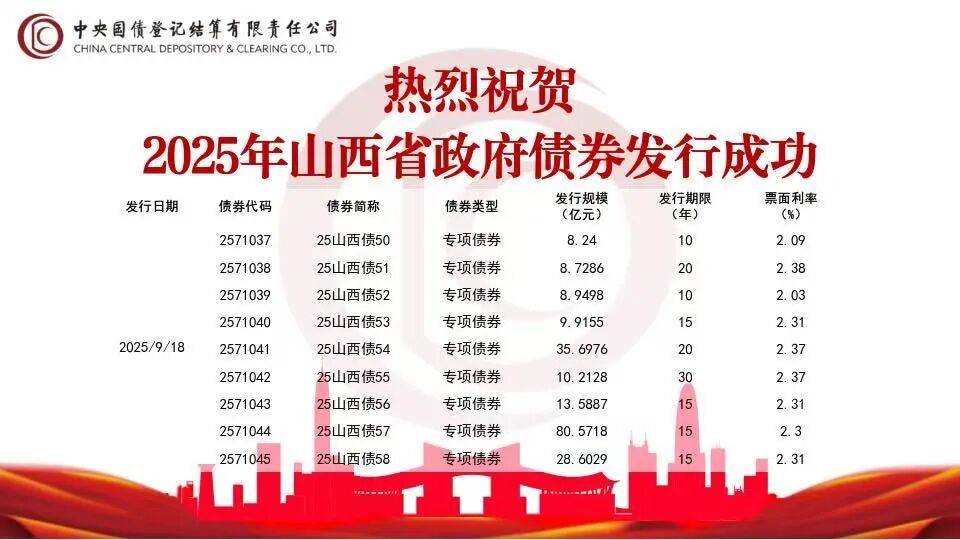
我省成功发行第八批政府债券204.51亿元
Sou Hu Cai Jing· 2025-09-18 12:52
Group 1 - The provincial finance department successfully issued the eighth batch of government bonds amounting to 20.451 billion yuan on September 18, with an average issuance interest rate of 2.3% and an average bid multiple of 24.83 times [1] - The total government bonds issued this year has reached 152.527 billion yuan, with 86.19 billion yuan being newly issued bonds, completing 96% of the quota assigned by the Ministry of Finance for new bond issuance [1] - All bonds in this batch are new special bonds, with 12.276 billion yuan allocated to supplement government fund resources and existing government investment projects, enhancing fiscal coordination capabilities [2] Group 2 - A total of 81.75 billion yuan is designated for the construction of 260 public welfare projects, aiming to achieve the goals set in the 14th Five-Year Plan [2] - The finance department plans to improve the quality and efficiency of local bond issuance while reinforcing budget constraints and ensuring compliance in fund usage [3] - The goal is to ensure that local government bonds are issued effectively, utilized properly, and yield quick results, providing solid financial support for stable economic development [3]
大国财政的担当:“十四五”时期我国财政治理成效回顾
Yuekai Securities· 2025-09-18 10:03
Economic Performance - During the "14th Five-Year Plan" period, China's fiscal governance achieved significant results, including stable growth through active fiscal policies, with a cumulative tax reduction of approximately 10.5 trillion yuan, averaging over 2 trillion yuan annually[5] - The general public budget revenue as a percentage of GDP fell to 16.3% in 2024, down 1.4 percentage points from 2020 and 5.4 percentage points from the peak in 2015[5] - The general public budget expenditure reached 28.5 trillion yuan in 2024, a 15.8% increase from 2020[5] Fiscal Policy Adjustments - The average budget deficit rate from 2021 to 2025 was 3.3%, which is 0.4 percentage points higher than the average during the "13th Five-Year Plan" period[6] - The broad deficit rate during the "14th Five-Year Plan" averaged 6.5%, exceeding the previous period's average by 1.7 percentage points[6] Structural Changes - Fiscal policies shifted focus from supply-side to demand-side, enhancing consumer spending and supporting a transition from an investment-driven to a consumption-driven economy[7] - The average growth rate of public budget expenditures related to people's livelihoods was 4.3% from 2021 to 2024, surpassing the overall public budget expenditure growth of 3.7%[8] Risk Management - By the end of 2024, the national government debt balance reached 82.1 trillion yuan, with an average annual growth of 15.2% since 2020[9] - The local government debt-to-GDP ratio was approximately 35.2% at the end of 2024, with an estimated total debt ratio of about 43.0% when including hidden debts[9] Policy Execution - The central government's deficit accounted for 85.9% of the total budget deficit in 2025, an increase of 11.9 percentage points from 2020[16] - Central government transfers to local governments increased by 18.0% in 2022 compared to 2021, ensuring effective policy implementation[16]
徐远:中国不会重蹈日本经济的覆辙!| 两说
Di Yi Cai Jing Zi Xun· 2025-09-18 07:40
Core Viewpoint - The discussion centers around whether China's economy could follow the path of Japan's economic bubble, with insights from economists on the current state of China's economy and the lessons learned from Japan's past experiences [1][3]. Group 1: Economic Comparison - After the 1985 Plaza Accord, Japan experienced a significant appreciation of the yen, leading to a short-term economic boom followed by a severe asset bubble burst, contrasting with China's current economic policies which have effectively avoided such a scenario [3]. - China's real estate prices surged rapidly but began to decline after 2021, indicating a proactive approach to prevent a housing bubble similar to Japan's in the early 1990s [3]. Group 2: Monetary Policy - China's monetary policy has remained relatively tight compared to Japan's historically loose monetary stance, which has helped prevent asset prices from reaching the levels seen in Japan during its bubble period [3]. - The Chinese government has learned from Japan's experience and has maintained a stable monetary policy to avoid excessive asset inflation [3]. Group 3: Fiscal Policy - Both economists express caution regarding the effectiveness of aggressive fiscal policies, citing Japan's experience where high government debt (250%-260% of GDP) did not lead to sustainable economic recovery [5]. - The short-term benefits of fiscal stimulus are acknowledged, but the long-term impact on market vitality and innovation remains questionable [5]. Group 4: Shift in Economic Logic - China's economic focus has shifted from high-speed growth to high-quality growth, emphasizing the importance of sustainable and quality-driven economic development [7]. - The belief is that China has absorbed lessons from Japan's economic history, suggesting that it is unlikely to repeat the same mistakes, with optimism for future economic prospects [7].

徐远:中国不会重蹈日本经济的覆辙!| 两说
第一财经· 2025-09-18 07:30
Core Viewpoint - The article discusses the resilience of the Chinese economy and its divergence from the historical path of Japan's economic bubble, emphasizing that China has learned from Japan's past mistakes in monetary and fiscal policies [1][3]. Group 1: Monetary Policy - China has maintained a relatively tight monetary policy, avoiding the excessive easing that characterized Japan's approach in the late 1980s, which led to asset bubbles [3]. - The Chinese yuan has been effectively controlled, preventing a significant appreciation similar to the Japanese yen post-1985 [3]. Group 2: Real Estate Market - The rapid increase in real estate prices in China has been followed by a decline since 2021, contrasting with Japan's unchecked real estate bubble in the early 1990s [3]. - Early intervention measures were taken in China to curb rising property prices, demonstrating a proactive approach to prevent a housing market collapse [3]. Group 3: Fiscal Policy - Both experts express caution regarding the effectiveness of aggressive fiscal policies, noting that Japan's government debt reached 250%-260% of GDP from 1985 to 1995 without reviving the economy [5]. - Fiscal measures can provide short-term boosts to GDP but may lack long-term effectiveness in fostering market vitality and innovation [5]. Group 4: Economic Development Logic - The focus of China's economic strategy has shifted from high-speed growth to high-quality growth, aiming to cultivate sustainable market-driven development [7]. - The lessons learned from Japan's economic history suggest that China is unlikely to repeat the same mistakes, with a belief in the potential for future economic improvement [7].

全国税收收入增速由负转正
第一财经· 2025-09-17 10:54
Core Viewpoint - The overall fiscal revenue in China has shown stability and growth in the first eight months of 2025, reflecting a positive economic trend, with tax revenue turning from negative to positive for the first time this year [3][4]. Fiscal Revenue - The total general public budget revenue reached 148,198 billion yuan, a year-on-year increase of 0.3% [3]. - Tax revenue amounted to 121,085 billion yuan, with a slight increase of 0.02% year-on-year, marking the first positive growth in tax revenue this year [3][4]. - The four major tax categories all experienced growth: - Domestic VAT: approximately 47,000 billion yuan, up 3.2% [5]. - Corporate income tax: approximately 32,000 billion yuan, up 0.3%, indicating a potential improvement in corporate profitability [5]. - Domestic consumption tax: approximately 12,000 billion yuan, up 2% [5]. - Personal income tax: approximately 11,000 billion yuan, up 8.9%, linked to increased property income for certain demographics [5]. Non-Tax Revenue - Non-tax revenue reached 27,113 billion yuan, growing by 1.5%, significantly lower than the 11.7% growth seen in the same period last year [6]. Government Fund Revenue - Government fund budget revenue totaled 26,449 billion yuan, a year-on-year decrease of 1.4%, with land use rights transfer income at 19,263 billion yuan, down 4.7% [7]. Government Debt and Expenditure - Net financing of government bonds reached 10.27 trillion yuan, an increase of 4.63 trillion yuan year-on-year, indicating increased government borrowing to support fiscal spending [9]. - General public budget expenditure was 179,324 billion yuan, up 3.1%, with significant investments in social security, education, and healthcare [11]. - Government fund budget expenditure was 62,602 billion yuan, a substantial increase of 30%, primarily directed towards major project construction to stabilize the economy [11].
国务院部署七大财政重点工作
第一财经· 2025-09-16 13:11
Core Viewpoint - The article discusses the recent report from the State Council regarding the execution of this year's budget, highlighting the flexible and proactive approach to fiscal macro-control, with an emphasis on timely adjustments based on changing circumstances [3][4]. Summary by Sections Fiscal Policy Focus - The report outlines seven key areas for future fiscal work, with the first being the effective utilization of a more proactive fiscal policy, including a total new government debt scale of 11.86 trillion yuan this year, an increase of 2.9 trillion yuan from the previous year [3][4]. Consumer Support Measures - The report emphasizes the implementation of interest subsidy policies for personal consumption loans and service industry loans to stimulate consumption, alongside ongoing special actions to boost consumer spending [4][5]. Employment and Trade Stability - The second focus is on supporting employment and foreign trade stability, with increased policy support for public employment services, vocational training, and helping enterprises maintain orders and expand markets [5][6]. New Growth Drivers - The third area is fostering new growth drivers by enhancing industrial innovation and technology supply, promoting key core technology breakthroughs, and supporting the transformation and upgrading of the manufacturing sector [5][6]. Social Welfare Enhancements - The fourth focus is on improving and safeguarding people's livelihoods, including subsidies for elderly care and childcare, with a budget of 1 billion yuan allocated for childcare subsidies [6][7]. Risk Management - The fifth area addresses the prevention and resolution of key sector risks, including managing hidden debt risks and ensuring basic livelihood protections, with a comprehensive debt management policy in place [6][7]. Fiscal Governance Improvement - The sixth focus is on enhancing fiscal governance effectiveness, including reforms in fiscal resource allocation, zero-based budgeting, and tax policy adjustments [7][8]. Fiscal Discipline - The seventh area stresses the importance of adhering to frugal fiscal practices, ensuring that new projects align with economic and financial capabilities [8].