红利资产

Search documents
南向资金持续净流入,港股央企红利ETF(513910)成“核心战场”
Mei Ri Jing Ji Xin Wen· 2025-07-10 05:31
Group 1 - The core viewpoint of the articles highlights the positive performance of Hong Kong stocks, particularly in the construction materials, steel, banking, and non-bank sectors, driven by significant inflows of southbound capital [1] - From July 7 to July 9, southbound capital net inflows into the Hong Kong stock market reached nearly 20 billion RMB, improving liquidity and boosting valuation recovery expectations for Hong Kong banks and energy sectors [1] - There has been a noticeable shift in trading style of southbound capital from aggressive to defensive, favoring high-certainty dividend assets amid reduced market risk appetite and declining risk-free interest rates [1] Group 2 - The policy framework established at the beginning of the year aims to expand the proportion of equity funds and guide long-term capital into the capital market, favoring low-volatility assets with stable dividend characteristics [1] - The Hong Kong central enterprise dividend ETF tracks an index with a dividend yield that remains 4.5% higher than the 10-year government bond yield, indicating that undervalued, high-certainty assets will continue to attract capital inflows in the long term [2] - Despite short-term profit-taking actions, the core logic for the continuation of the market trend remains intact, supported by the dual attributes of central enterprise background and high dividend returns [2]
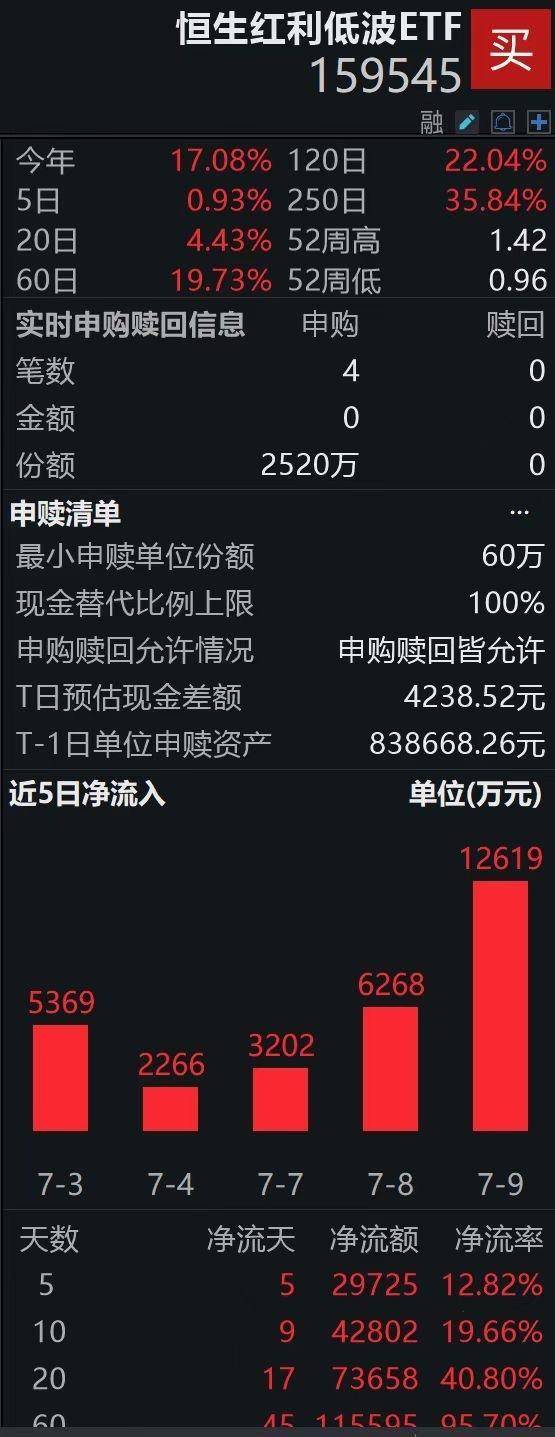
90家公司今日实施分红方案,恒生红利低波ETF(159545)盘中获净申购2520万份,连续5天获资金加仓
Sou Hu Cai Jing· 2025-07-10 03:44
Group 1 - The Hang Seng High Dividend Low Volatility Index (HSHYLV.HI) has increased by 0.61%, with notable movements in constituent stocks such as China Cinda (+2.8%) and Minsheng Bank (+5.2%) [1] - The Hang Seng Low Volatility ETF (159545) has seen significant capital inflows, totaling over 290 million in the last five days and over 730 million in the last 20 days [1] - As of July 9, the Hang Seng Low Volatility ETF (159545) reached a record fund size of 2.609 billion, ranking first among its peers [4] Group 2 - A total of 90 companies are implementing dividend distribution plans today, with 52 companies offering cash dividends of 1 yuan or more per 10 shares, and China Merchants Bank offering the highest at 20 yuan per 10 shares [7] - China Galaxy Securities suggests that in the current uncertain global environment, investors' demand for risk aversion will increase, making dividend assets attractive due to their stable cash flow and high dividend yield [7] - The Hang Seng High Dividend Low Volatility Index selects 50 high dividend, low volatility stocks from the Hong Kong Stock Connect, achieving a one-year dividend yield of 6.43% [7]

百亿私募半年“答卷”,梁文锋的幻方进入量化新“四大天王”
2 1 Shi Ji Jing Ji Bao Dao· 2025-07-09 12:36
Group 1 - The core viewpoint of the articles highlights the strong performance of billion-level private equity firms in the first half of 2025, with an average return of 10.93% among 50 firms, and 94% of them achieving positive returns [1][2] - Among the billion-level quantitative private equity firms, all 32 firms with performance data reported profits, with an average return of 13.72%, indicating a significant advantage in this sector [1][5] - The emergence of new leading quantitative firms, referred to as the "Four Kings," is noted, with management scales between 60 billion to 70 billion, while Lingjun has fallen to the second tier [1][6] Group 2 - The subjective private equity firms showed an average return of 5.51%, with some firms like Shenzhen Rido Investment and Shanghai Harmony Huiyi Asset Management performing well [3][4] - The market environment is described as resilient despite external disturbances, with a positive outlook for the second half of 2025, focusing on sectors like artificial intelligence, new consumption, innovative pharmaceuticals, and dividend assets [1][8] - The quantitative private equity sector has seen a significant increase in management scale, with 39 firms now classified as billion-level, and over 2300 new quantitative products registered in the year [7][8] Group 3 - The overall sentiment among billion-level private equity firms for the second half of 2025 is optimistic, driven by the resilience of Chinese manufacturing and trade, as well as the influx of international capital into the Hong Kong market [8][9] - Investment opportunities are expected to expand from new consumption and innovative pharmaceuticals to technology and cyclical industries, with a focus on AI, domestic semiconductor equipment, and high-end manufacturing [9]
低利率时代,红利资产才是「压舱石」
Sou Hu Cai Jing· 2025-07-09 11:10
Core Viewpoint - Dividend is a crucial factor determining investor returns, serving as a protector in bear markets and an accelerator in bull markets [19] Group 1: Current Market Environment - The current low interest rate environment is characterized by a 10-year Treasury yield of 1.644% and declining rates for traditional savings products, with rates for popular options like Yu'ebao dropping to 1.1% [2] - The demand for high dividend assets is increasing as traditional investment products fail to meet the needs of younger investors seeking stable, modest returns [2] Group 2: Dividend Assets Performance - High dividend assets are emerging as a "ballast" in the low interest rate era, with various dividend-focused ETFs gaining popularity among investors seeking stability [3][9] - The performance of dividend strategies has outpaced market indices, with the S&P 500 high dividend index achieving an annualized return of approximately 12% over the past 20 years, outperforming the S&P 500 by 1.5% [4] Group 3: Investment Strategies - The China Securities Dividend Index selects stocks based on consistent and stable dividend payments, focusing on companies with a history of cash dividends and a high average dividend yield [10][11] - The index's methodology ensures that higher dividend yield stocks receive greater weight, allowing investors to benefit from both stable income and potential capital gains [11] Group 4: Future Outlook - The low interest rate environment is expected to persist, making high dividend assets a reliable investment choice [15] - Analysts remain optimistic about dividend assets, with firms like CITIC Securities continuing to advocate for these investments amid market uncertainties [15][17] Group 5: Investor Behavior - Younger investors are increasingly favoring stable, low-risk investments, with a trend towards "living off interest" and seeking monthly dividend payouts [17][18] - The popularity of dividend-focused ETFs has surged, with significant growth in assets under management for products like the Hang Seng Dividend Low Volatility ETF, which has increased by 4.38 times this year [18]

指数基金产品研究系列报告之二百四十九:华富新华中诚信红利价值指数:从“红利低波“向”红利价值“的全面进化
Shenwan Hongyuan Securities· 2025-07-09 10:15
1. Report Industry Investment Rating No relevant content provided. 2. Core Viewpoints of the Report - Policy and capital drive the allocation opportunities of dividend assets. The new "Nine - Point Plan" stimulates dividend - paying willingness, and the implementation plan for long - term funds entering the market supports long - term allocation demand. As a result, the scale of dividend - related ETFs has been growing steadily [4][9][10]. - Dividend assets have a significant advantage in the interest - rate spread. The current 10 - year treasury bond yield is at a historical low of 1.66%, while the CSI Dividend Index dividend yield remains at a relatively high level of 5.58%. The compound interest effect of dividend assets can bring a cumulative excess return of 308.71% and an annual excess return of 4.75% [4][11][14]. - The Xinhua Zhongchengxin Dividend Value Index sets up double financial safety valves in the sample - stock access stage, constructs a "1 + 4" composite defense factor model, and has advantages such as high dividend yield, low volatility, and good anti - decline ability compared with mainstream broad - based indexes [4]. - The Huafu Xinhua Zhongchengxin Dividend Value Index Fund aims to closely track the target index, minimize tracking deviation and error, and achieve long - term investment returns consistent with the index performance. The current management fee and custody fee are 0.50% and 0.10% respectively [47]. 3. Summary According to the Directory 3.1 Low - Interest Era: Long - Term Allocation Value of High - Dividend Strategies 3.1.1 Policy and Capital Dual - Wheel Drive for the Allocation Opportunities of Dividend Assets in the Era - The new "Nine - Point Plan" stimulates the dividend - paying willingness of listed companies, and the implementation plan for long - term funds entering the market supports the long - term allocation demand for dividend assets. Under the dual - wheel drive of policy and capital, the scale of dividend - related ETFs has increased from 16.3 billion yuan in early 2021 to 119.8 billion yuan [9][10]. 3.1.2 Dividend Asset Interest - Rate Spread Moat: 5.6% Dividend Yield vs. 1.7% Treasury Bond Yield - In the low - interest environment, the quasi - fixed - income attribute and certainty premium of dividend assets are prominent. The 10 - year treasury bond yield has dropped to a historical low of 1.66%, while the CSI Dividend Index dividend yield remains at 5.58%. Dividend assets are suitable for risk - averse funds, and the compound interest effect can bring significant excess returns [11][14]. 3.2 Xinhua Zhongchengxin Dividend Value Index: Comprehensive Evolution from "Dividend Low - Volatility" to "Dividend Value" 3.2.1 Sampling Method: Double Financial Safety Valves Set in the Sample - Stock Access Stage, Focusing on the Sustainability of High Dividends - The index was released on January 5, 2024, with a base date of December 30, 2011, and a base point of 1000. It constructs a penetration - style dividend - quality quantitative screening system, requiring continuous three - year dividends and meeting payment - rate standards in the vertical dimension, and screening for refinancing dependence in the horizontal dimension to ensure the authenticity and sustainability of dividend returns [17]. 3.2.2 Adopting the "One - High and Four - Low" Five - Factor Stock Selection to Optimize the Traditional "Dividend Low - Volatility" Target Pool - The index innovatively constructs a "1 + 4" composite defense factor model, with high dividend yield as the core anchor point, superimposed with four defensive dimensions of low valuation, low volatility, low Beta, and low turnover, forming a multi - factor dynamic balance mechanism [26]. 3.2.3 Heavily Investing in Industries such as Banks and Transportation, with the Large - Cap Style Building a Low - Volatility Moat - The bank sector has a weight of 26.48%, and the transportation sector has a weight of 11.27%. These industries provide relatively stable dividend returns and show a defensive value orientation [28]. 3.2.4 Dynamic Balance between Dividend Income and Safety Margin - The core income of the high - dividend strategy comes from the high profit - distribution ratio and low price - earnings ratio of individual stocks. Compared with mainstream broad - based indexes, the index has the characteristics of low valuation and high dividends, with a latest dividend yield of 5.06% and a valuation of 8.70 times [37][41]. 3.2.5 A Scientific Investment Plan to Unlock Compound Excess Returns with Low - Volatility Assets - Compared with mainstream broad - based indexes, the index has a better holding experience, with significantly lower volatility and higher cumulative returns. Since the base date, the annualized volatility is only 18.21%, and the total return has significantly outperformed other mainstream broad - based indexes [43][45]. 3.3 Introduction to the Huafu Xinhua Zhongchengxin Dividend Value Index Fund - The Huafu Xinhua Zhongchengxin Dividend Value Index Fund (023746.OF) is issued by Huafu Fund, with a benchmark of 95% of the Xinhua Zhongchengxin Dividend Value Index return plus 5% of the after - tax bank current deposit interest rate. The fund managers are Zhang Ya and Li Xiaohua. The fund aims to closely track the target index and minimize tracking deviation and error [47]. 3.4 Fund Manager Information 3.4.1 Fund Manager Introduction - Huafu Fund Management Co., Ltd. was established on April 19, 2004, with a registered capital of 250 million yuan. It has become a new force in the domestic securities investment fund industry, with a clear development strategy, a rich product system, and a mature investment research model [51]. 3.4.2 Fund Manager Profile - Zhang Ya has a master's degree from Kent State University in the United States. She joined Huafu Fund in April 2017 and currently manages 7 products with a total scale of 1.1499 billion yuan. Li Xiaohua has a master's degree in economics from Nankai University. He joined Huafu Fund in October 2019 and currently manages 12 products with a total scale of 563.1 million yuan [52][56].
建筑装饰行业周报:继续推荐“建筑+”红利-20250709
Hua Yuan Zheng Quan· 2025-07-09 06:26
Investment Rating - The investment rating for the construction decoration industry is "Positive" (maintained) [4] Core Viewpoints - The construction sector is currently focusing on two main lines: dividends and "Construction+" strategies. The macro liquidity is abundant, and interest rates remain low, leading to a preference for low-volatility, high-dividend, and low-valuation assets. The value of dividend asset allocation continues to rise. Additionally, policies are continuously supporting construction companies to explore new growth avenues through mergers, restructuring, and transformation into new business areas such as new energy, smart manufacturing, digitalization, and operation services [4][12] Summary by Sections Key Recommendations - Recommended companies include Sichuan Road and Bridge, which is deeply involved in infrastructure construction in the Sichuan-Chongqing region, benefiting from a strong order backlog and high profitability. The company’s order scale is expected to reach 291.3 billion yuan by the end of 2024, providing solid growth assurance for the next three years. The dividend policy is continuously optimized, with a commitment to a dividend payout ratio of no less than 60% over the next three years, and a current dividend yield at a relatively high level in the industry [5][11][14] - Attention is also drawn to Jianghe Group, which has maintained its leading position in the industry despite the overall downturn. The company has a strong order expansion capability and is actively returning profits to shareholders, with a projected dividend payout ratio of nearly 98% in 2024, resulting in a dividend yield of approximately 9% [5][18][24] Market Performance - The construction decoration index increased by 0.63% during the week, with sub-sectors such as landscaping, steel structures, and decoration showing significant gains of 4.01%, 3.33%, and 2.13% respectively. A total of 96 stocks in the construction sector rose, with the top five performers being Chengbang Co. (+42.23%), Hangzhou Landscaping (+31.16%), Hopu Co. (+21.35%), Huilv Ecology (+15.65%), and Baijia Technology (+12.50%) [7][37] Structural Investment Opportunities - The report suggests three main lines for structural investment opportunities in the construction sector: 1. Continued investment in regional infrastructure, particularly in the central and western regions and along the "Belt and Road" initiative [7] 2. Valuation recovery of central and state-owned enterprises benefiting from stable dividends and governance improvements [7] 3. Growth potential through transformation and upgrading into new business areas such as smart manufacturing and digitalization [7][12]


传媒中期策略:基本面改善,看好IP、AI赋能
ZHONGTAI SECURITIES· 2025-07-08 10:47
Core Insights - The report highlights investment opportunities in the media sector for the second half of 2025, focusing on AI applications, IP commercialization, cultural exports, and dividend-yielding assets [5][6]. AI Applications - The report emphasizes the continuous iteration of AI technology, particularly in education, film, and gaming, predicting strong commercial prospects in these areas due to enhanced input-output capabilities of large models [8]. - Companies leading in AI applications include DouShen Education, Rongxin Culture, and others, which are expected to benefit from the growing demand for AI-enhanced educational tools and content creation [5][6]. IP Commercialization - The IP industry is identified as a high-growth sector with significant potential for commercialization, particularly in empowering both the digital and real economies [9][10]. - The report notes that the retail sales of licensed products in China are projected to reach 1550.9 billion yuan by 2024, indicating a strong market for IP-related products [15][46]. Cultural Exports - The report points out that China's overseas market infrastructure is well-established, with platforms like TikTok and AliExpress facilitating cultural exports, particularly in short films and IP-based products [19][16]. - The growth of cultural exports is supported by the increasing number of overseas stores and the efficiency of logistics services, which are expected to enhance the pace of cultural content going abroad [19][16]. Dividend-Yielding Assets - In a low-interest-rate environment, the report suggests that assets with strong cash flow and high dividend yields, such as publishing and media companies, are becoming increasingly attractive for investors [20][21]. - Companies like Xinhua Wenhui and others are highlighted as having significant dividend advantages, making them appealing investment opportunities [6][20]. Gaming Industry - The gaming sector is projected to grow significantly, with a total market size of 141.1 billion yuan in early 2025, driven by mobile gaming [70][71]. - Government policies are increasingly supportive of the gaming industry, with initiatives aimed at promoting innovation and easing regulatory processes [71][72]. Short Video Market - The short video market is expected to reach a scale of 504.4 billion yuan by 2024, with a significant user base projected to exceed 6.62 billion [86][87]. - The report indicates that the growth of short video applications is being driven by both domestic and international demand, with notable increases in user engagement and revenue [89][90].
兴证全球基金隋毅:定价是投资中最重要的事
Xin Lang Ji Jin· 2025-07-08 07:16
Group 1 - The core viewpoint emphasizes the importance of deep research and understanding in the pharmaceutical industry, which can lead to better investment decisions and outcomes [1][2][3] - The investment framework is based on pricing, which serves as the foundation for industry and company comparisons, ultimately leading to the selection of long-term value investment companies [5][12] - The transition from a research role to an investment role presents challenges, particularly in understanding macroeconomic factors that have become increasingly relevant to the pharmaceutical sector [9][11] Group 2 - The pharmaceutical industry encompasses various asset types, including cyclical, manufacturing, consumer, and technology, providing diverse investment opportunities even during market downturns [2][11] - The successful investment in a company during a market panic was attributed to extensive research and a deep understanding of the company's fundamentals, leading to a contrarian investment recommendation [2][3] - The focus on pricing is crucial, as different valuation levels can significantly impact risk and expected returns, with a preference for investments that are undervalued [4][6][12] Group 3 - The investment strategy aims for a diversified portfolio across industries, although there is currently a higher allocation to the pharmaceutical sector due to accumulated knowledge and experience [5][7] - The understanding of what constitutes a "good business" is multifaceted, involving both growth rates and competitive advantages, which are essential for long-term sustainability [15] - The electronic industry is identified as a key area of focus, with confidence in domestic companies' capabilities in technology and innovation, despite the challenges of the sector [14]
长期资金入市背景下,上半年获资金追捧的红利低波动ETF(563020)、恒生红利低波ETF(159545)等产品再迎布局时点
Mei Ri Jing Ji Xin Wen· 2025-07-08 06:45
Group 1 - The core viewpoint of the articles highlights the increasing popularity and performance of dividend-related ETFs amidst market volatility, with significant inflows and historical scale achievements [1] - In the first half of the year, dividend-related ETFs attracted over 17 billion yuan in net inflows, bringing their total scale to over 140 billion yuan [1] - The Hang Seng Dividend Low Volatility ETF (159545) and the Dividend Low Volatility ETF (563020) received net inflows of 1.5 billion yuan and 1 billion yuan respectively, reaching historical highs in scale [1] Group 2 - The current global uncertainty has led to a heightened demand for risk aversion among investors, making dividend assets attractive due to their stable cash flow and high dividend yield [1] - The policy environment continues to encourage listed companies to distribute dividends, which is expected to attract more funds to the dividend sector in the medium to long term [1] - June marks the peak period for annual dividend distributions, making it a favorable time for positioning in dividend assets as many companies implement dividends during this month [1] Group 3 - E Fund is noted as the only fund company that implements low fee rates across all its dividend ETFs, including products like E Fund Dividend ETF (515180), Dividend Low Volatility ETF (563020), and Hang Seng Dividend Low Volatility ETF (159545) [2]
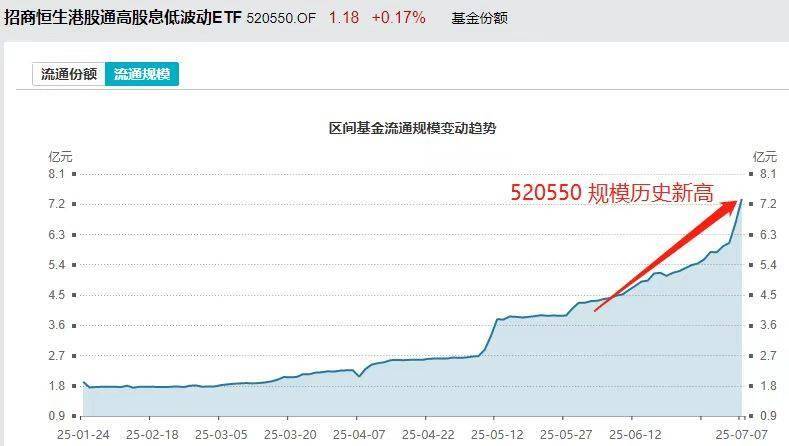
全面爆发!港股红利低波ETF(520550)单日多项指标同步历史新高
Sou Hu Cai Jing· 2025-07-08 01:54
Core Insights - Southbound capital inflow continues to increase, with related securities also seeing significant volume growth [1] - The Hong Kong Dividend Low Volatility ETF (520550) recorded a net inflow of nearly 70 million yuan on July 7, with a trading volume of 1.31 billion yuan, and its net asset value reached 1.1806, marking a new high since its listing [1] - According to China International Capital Corporation, southbound capital has increased holdings across various sectors in Hong Kong stocks since the beginning of the year, indicating a strategic allocation trend from mainland China [1] Investment Trends - There is a notable rotation in southbound capital, shifting from information technology in Q1 to new consumption in early Q2, and recently focusing on healthcare and financial sectors, reflecting the market's preference for high-growth sectors [1] - The current interest in high-dividend sectors is emphasized in a high-volatility environment, showcasing a defensive value approach [1] - According to China Merchants Securities, dividend assets still hold allocation value during the interest rate cut cycle, with H-shares in the infrastructure sector showing potential for valuation convergence with A-shares [1] ETF Characteristics - The Hong Kong Dividend Low Volatility ETF (520550) offers the lowest market fee rate (comprehensive fee rate of 0.2%), which reduces holding costs [1] - Its monthly dividend mechanism and T+0 trading feature enhance capital efficiency [1] - The ETF's holding structure includes mature industries like finance and energy to create a safety net, while a 5% weight limit per stock helps diversify risks and avoid "dividend yield traps" [1]