产品创新

Search documents
老凤祥(600612):25H1业绩承压,渠道产品调整进行时
Huachuang Securities· 2025-09-17 03:45
Investment Rating - The report maintains a "Strong Buy" rating for the company with a target price of 69.61 CNY [2][8] Core Views - The company experienced revenue and profit declines in H1 2025 due to high gold prices and a high base from the previous year, with revenue down 16.5% year-on-year to 33.36 billion CNY and net profit down 13.1% to 1.22 billion CNY [2][8] - The company is actively adjusting its product offerings and channels, focusing on quality over quantity, with a net increase of 9 marketing outlets in Q2 2025 [8] - The company launched new products targeting younger consumers and is collaborating with Alibaba to develop co-branded products [8] Financial Summary - For H1 2025, the company reported a gross margin of 8.7%, a decrease of 0.5 percentage points year-on-year, attributed to high gold prices affecting consumer demand [8] - The company’s operating expenses remained stable, with sales, management, and financial expense ratios at 1.3%, 0.6%, and 0.3% respectively [8] - The projected net profits for 2025-2027 are 16.6 billion CNY, 18.3 billion CNY, and 20.2 billion CNY respectively, with corresponding P/E ratios of 17, 15, and 14 [8][9]

保险资管行业:上半年业绩向好,第三方业务与外资入局成焦点
Huan Qiu Wang· 2025-09-17 02:33
Core Insights - The insurance asset management industry in China has shown significant growth in the first half of 2025, with five major firms reporting a total revenue of 7.788 billion yuan, a 14.78% increase year-on-year, and a total profit of 3.884 billion yuan, up 30.7% from the previous year [1][3][4] Group 1: Revenue and Profit Growth - China Life Asset Management achieved a revenue of 3.554 billion yuan, a 23.4% increase from 2.88 billion yuan in the same period last year [3] - Other firms like Taikang Asset Management reported revenues exceeding 3 billion yuan, while PICC Asset Management, Sino-Italian Asset Management, and Allianz Asset Management reported revenues of 864 million yuan, 216 million yuan, and 146 million yuan respectively, with Allianz showing a year-on-year growth of approximately 37% [3][4] - Allianz Asset Management turned a profit of 13.3624 million yuan in the first half of the year, recovering from a loss of 6.51 million yuan in the same period last year [3] Group 2: Drivers of Growth - The growth is driven by three main factors: the release of industry dividends due to steady premium income and a recovering capital market, a shift in business models towards third-party operations, and upgrades in risk control and investment research capabilities [3][4] - The insurance asset management sector is increasingly focusing on third-party business, which has been rising in proportion, indicating a shift from traditional internal funding management to attracting external funds [5][6] Group 3: Trends in Third-Party Business - The total asset management scale in China's asset management industry reached approximately 163.16 trillion yuan by the end of 2024, with insurance funds accounting for 33.26 trillion yuan, the largest share in the industry [5] - Companies like China Life Asset Management and Taikang Asset Management are actively expanding their third-party business, with China Life managing over 930 billion yuan in third-party assets and Taikang managing over 4.5 trillion yuan in total assets, including 2.6 trillion yuan in third-party assets [6][7] Group 4: External Influences and Market Dynamics - The entry of foreign investment firms is intensifying competition and collaboration within the insurance asset management sector, with recent approvals for new foreign asset management companies [8] - The influx of foreign firms is expected to enhance market transparency and regulatory alignment, pushing domestic firms to adopt differentiated strategies and improve their service capabilities for high-quality development [8]

外卖补贴退坡 新茶饮如何留住消费者?
Zheng Quan Shi Bao· 2025-09-15 22:33
Core Insights - The takeaway from the recent news is that the takeaway subsidy war has significantly impacted the new tea beverage industry, with both positive short-term sales growth for participating brands and long-term concerns regarding pricing and profitability [1][5][8] Group 1: Impact of Subsidy War - Brands actively participating in the subsidy war have seen a notable increase in sales, while those not participating have experienced a decline in same-store data [1][2] - For instance, Mixue Group reported a revenue of 14.875 billion yuan, a year-on-year increase of 39.3%, with net profit rising 44.1% to 2.718 billion yuan, leading the industry [2] - Naixue's Tea indicated that third-party delivery platforms contributed approximately 44.2% to direct store revenue, with a year-on-year increase in delivery revenue of 7.5% [2] Group 2: Concerns and Challenges - The subsidy war has raised concerns about long-term sustainability, as it may lead to consumer price dependency and affect the pricing structure of brands [1][5][6] - Companies like Bawang Chaji, which chose not to participate in the subsidy war, reported a significant decline in same-store performance, with a 25% drop in average monthly GMV [3][7] - The pressure on franchisees to share subsidy costs has created a situation where increased revenue does not translate into increased profits, leading to operational challenges [5][6] Group 3: Future Strategies - As the subsidy war cools down, brands are focusing on product innovation and operational efficiency to retain consumers and stabilize pricing [8][9] - Companies are investing in new product development, with Tea Baidao reporting that new product sales accounted for 28% of total sales in the second quarter [8] - The industry is shifting from rapid expansion to quality improvement, with a focus on optimizing store models and controlling costs for sustainable growth [9]
2024年跨境电商产品创新能力白皮书
Sou Hu Cai Jing· 2025-09-15 13:30
Core Insights - The 2024 Cross-Border E-Commerce Product Innovation Capability White Paper indicates that the cross-border e-commerce industry is transitioning from "extensive growth" to "refined operations," as traditional strategies of "product selection + minor innovation" can no longer meet the personalized demands of consumers [1][7] - The report highlights the challenges and opportunities faced by cross-border e-commerce sellers, emphasizing the need for product innovation and user insights throughout the product development process [1][7] Group 1: Development Stages of Cross-Border E-Commerce Sellers - The product capability of cross-border e-commerce sellers has evolved through four stages: 1. Wild Stage: Reliance on traffic dividends and low-cost procurement, focusing on discovering high-cost performance products, but these products are easily imitated [1][11] 2. Exploration Stage: Emphasis on product diversification and supply chain expansion, integrating resources from industrial belts, but facing complexities in supply chain management and homogenization issues [1][11] 3. Advancement Stage: Achieving differentiation through VOC analysis and competitor improvements, yet facing mismatched analytical systems and decision-making convergence due to information transparency [1][11] 4. High-Level Stage: User-oriented approach requiring overcoming three major difficulties: insight skills, language and cultural barriers, and effective user pool resources [1][11] Group 2: Current Challenges in Product Innovation - The industry faces low success rates in product innovation, with an average of 7 concepts leading to only 1 product launch, and less than 10% of launched products meeting performance targets [1][38] - Over 76% of sellers report that more than half of their new products do not meet expectations, primarily due to internal management failures such as lack of user insights, lack of product uniqueness, and resource dispersion [1][38] - More than half of the sellers are purely trade-oriented, with 56% having operated for 5-10 years, primarily targeting the U.S. market and using Amazon as the core platform [1][7] Group 3: Recommendations for Product Innovation - The white paper proposes a four-step method: define target groups, identify scenarios, find opportunities, and conduct validation, guiding sellers to innovate products based on segmented demographics and scenarios [1][7] - Emphasizing that user insights should permeate the entire product development process is crucial for achieving sustainable development and breaking through homogenization [1][7]

天风证券-安井食品-603345-产品创新驱动增长,渠道定制化加速渗透,静待旺季反弹-250915
Xin Lang Cai Jing· 2025-09-15 12:37
Core Viewpoint - The company reported a slight increase in revenue for the first half of 2025, but a significant decline in net profit, indicating challenges in profitability despite stable sales growth in certain product lines [1][2]. Group 1: Revenue and Profit Analysis - In H1 2025, the company achieved revenue of 7.604 billion yuan, a year-on-year increase of 0.8%, while net profit attributable to shareholders was 676 million yuan, down 15.79% year-on-year [1]. - For Q2 2025, revenue reached 4.005 billion yuan, reflecting a year-on-year growth of 5.69%, but net profit fell by 22.74% to 281 million yuan [1]. - Revenue breakdown for H1 2025 shows frozen prepared foods at 3.759 billion yuan (down 1.9%), frozen dishes at 2.416 billion yuan (up 9.4%), and other categories showing mixed results, with significant declines in certain segments [1]. Group 2: Channel Performance - Revenue from various channels in H1 2025 included 6.043 billion yuan from distributors (down 1.2%), 555 million yuan from direct sales (up 7.2%), 423 million yuan from supermarkets (down 1.8%), and 583 million yuan from new retail and e-commerce (up 20.9%) [1]. - The company is focusing on channel expansion into lower-tier markets and enhancing collaboration with major retail clients for customized product offerings [1]. Group 3: Profitability Metrics - The gross margin for H1 2025 was 20.5%, down 3.4 percentage points year-on-year, while the net margin was 8.9%, down 1.9 percentage points [2]. - In Q2 2025, the gross margin decreased to 18%, a decline attributed to rising raw material costs, particularly for shrimp and fish paste [2]. Group 4: Investment Outlook - The company anticipates a potential recovery in revenue growth in H2 2025 due to seasonal demand and new product launches, with a focus on innovation and efficiency in the long term [3]. - Revenue projections for 2025-2027 are estimated at 15.9 billion, 16.8 billion, and 18 billion yuan, with corresponding net profits of 1.47 billion, 1.6 billion, and 1.72 billion yuan [3].


安井食品(603345):产品创新驱动增长,渠道定制化加速渗透,静待旺季反弹
Tianfeng Securities· 2025-09-15 12:12
Investment Rating - The investment rating for the company is "Buy" with a target price not specified [6]. Core Views - The company reported a revenue of 76.04 billion yuan for H1 2025, a year-on-year increase of 0.8%, while the net profit attributable to the parent company was 6.76 billion yuan, down 15.79% year-on-year [1]. - The second quarter of 2025 saw a revenue of 40.05 billion yuan, reflecting a year-on-year increase of 5.69%, but the net profit attributable to the parent company decreased by 22.74% to 2.81 billion yuan [1]. Product Analysis - In H1 2025, revenue from various product segments was as follows: frozen prepared foods (37.59 billion yuan, -1.9% YoY), frozen dishes (24.16 billion yuan, +9.4% YoY), frozen rice and noodle products (12.41 billion yuan, -3.9% YoY), and agricultural products and others (1.81 billion yuan, -4.6% YoY) [2]. - The company is focusing on product line expansion, including high-end development of fresh-keeping packaging and new product series such as tender fish balls and shrimp slides [2]. Channel Analysis - Revenue from different sales channels in H1 2025 was as follows: distributors (60.43 billion yuan, -1.2% YoY), direct sales (5.55 billion yuan, +7.2% YoY), supermarkets (4.23 billion yuan, -1.8% YoY), and new retail and e-commerce (5.83 billion yuan, +20.9% YoY) [3]. - The company is actively promoting channel penetration into lower-tier markets and has established deep cooperation with major traditional supermarkets and new retail channels for customized product development [3]. Profitability Analysis - In H1 2025, the gross margin was 20.5%, and the net margin was 8.9%, reflecting a decrease of 3.4 percentage points and 1.9 percentage points year-on-year, respectively [4]. - The decline in gross margin is attributed to rising procurement prices for raw materials such as shrimp and fish paste [4]. Investment Recommendations - The report suggests that the upcoming consumption peak in H2 2025, combined with the launch of new products and breakthroughs in channel customization, may lead to a recovery in revenue growth [5]. - Long-term growth is expected to be driven by innovation and efficiency, particularly through the transformation of the C-end market and deep cooperation in customized product development across various channels [5]. - Revenue projections for 2025-2027 are estimated at 159 billion yuan, 168 billion yuan, and 180 billion yuan, with corresponding net profits of 14.7 billion yuan, 16.0 billion yuan, and 17.2 billion yuan [5].
晨光生物:研发投入持续加大 中药与保健品业务稳步发展
Quan Jing Wang· 2025-09-15 09:02
Group 1 - The event "2025 Hebei Listed Companies Investor Online Collective Reception Day" was held on September 15, focusing on the collective performance explanation of the 2025 semi-annual reports [1] - Morning Light Bio (300138) reported a significant increase in R&D expenses in the first half of the year, primarily due to increased material costs associated with customized and application-oriented product development [1] - The company plans to maintain its R&D investment to drive product innovation and has obtained 11 drug registration certificates and 2 traditional Chinese medicine formula granule filings in the traditional Chinese medicine sector [1] Group 2 - Morning Light Bio is expanding its market through various methods such as centralized procurement, contract manufacturing, and agency, indicating a positive outlook for future market conditions [1]

百润股份20250912
2025-09-15 01:49
Summary of Baijiu Co. Conference Call Company Overview - **Company**: Baijiu Co. - **Industry**: Alcoholic Beverages, specifically focusing on pre-mixed cocktails and whiskey Key Points and Arguments Pre-mixed Cocktails Business - In the first half of 2025, the overall pre-mixed cocktail business declined by approximately 9%, while the "Mild Drunk" series achieved double-digit growth. The "Strong Refreshing" and "Refreshing" series experienced double-digit and single-digit declines respectively, indicating a shift in market preferences [2][3] - New products such as jelly cocktails and high-alcohol pre-mixed cocktails were launched in Q3 2025, with a sales target of 60 million yuan, aimed at stabilizing and improving performance [2][3] - The pre-mixed cocktail business has grown from around 1 billion yuan in 2018 to a projected 25-30 billion yuan by 2024, with significant contributions from the "Mild Drunk" and "Strong Refreshing" products [3][4] Whiskey Business Development - Baijiu Co. is actively developing its whiskey business, having launched products like "Bailide Blended Whiskey" and "Laizhou Single Malt Whiskey." The company expects to complete 85% of terminal distribution by the end of Q3 2025, although initial sales feedback has been lukewarm [2][5] - The Chinese whiskey market is estimated to be worth 5 to 6 billion yuan, with an average annual growth rate of 21% over the past 8 to 9 years. However, foreign brands dominate the market, accounting for over 70% of market share [2][7] - Baijiu Co. aims to leverage its local distribution system to change the current market dynamics dominated by foreign brands [2][8] Market Potential and Strategy - The company has over 500,000 barrels of base liquor reserves and is innovating by using Chinese yellow wine barrels for whiskey production. There is a potential resonance effect between pre-mixed cocktails and whiskey in consumer cultivation [2][9] - The whiskey market in China is still in its early stages, and significant marketing efforts are required to enhance consumer acceptance and penetration [12][15] - The company has invested heavily in project barrels since 2020, with a production capacity of 31,000 tons for vodka and 5,000 tons for whiskey, indicating strong production capabilities [4][13] Future Outlook - The recovery of the pre-mixed cocktail business depends on consumer spending power and the success of innovative product collaborations [4][14] - If whiskey products can generate significant incremental growth, the company's market value could increase substantially. The company has a comprehensive product matrix and is focusing on brand innovation to stabilize and gradually improve performance [6][11] - The potential for whiskey sales to reach half the size of the pre-mixed cocktail market (12.5 to 15 billion yuan) is anticipated as consumer awareness and distribution channels improve [11] Marketing and Consumer Engagement - Effective marketing strategies are crucial for whiskey, which requires time for consumer acceptance. The company plans to utilize thematic marketing to create buzz and engage younger consumers [15] - Key sales periods such as Mid-Autumn Festival, National Day, and Chinese New Year are critical for assessing market performance and consumer response [12][15] Additional Important Insights - The company has a strong innovation capability in new consumer categories, and monitoring its development dynamics is essential for potential investment opportunities [16]

方正富邦基金汤戈:掘金固态电池“从0到1”发展机遇
Zhong Guo Zheng Quan Bao· 2025-09-14 20:14
Core Viewpoint - The solid-state battery industry is at a critical turning point, transitioning from laboratory experiments to commercial mass production, with increasing clarity in technology routes and growing policy support, indicating a potential market breakout [1][2] Industry Outlook - The A-share market has shown strong performance this year, with investor enthusiasm on the rise. The outlook for 2026 remains optimistic, supported by confidence in liquidity and corporate performance improvements [2] - Solid-state batteries are expected to become one of the main market trends, driven by their high safety and energy density advantages, with applications in electric vehicles, consumer electronics, robotics, and low-altitude aircraft [3] Market Potential - The solid-state battery market has significant growth potential, with expectations that it could replace approximately 20% of the high-end lithium battery market in the long term, leading to substantial growth for related upstream and downstream companies [3] Investment Opportunities - The solid-state battery sector is characterized by performance improvement and growth elasticity, with some companies already showing revenue and profit recovery. The investment opportunities in the solid-state battery supply chain are expected to follow a systematic layout along the logic of "equipment first - material breakthroughs - scenario expansion," with current opportunities focusing more on the equipment segment [3][4] Investment Philosophy - The investment philosophy emphasizes a combination of deep industry research and broad market coverage, allowing for the identification of long-term value industries and companies while adapting to market changes [4][5] - The investment process includes three key stages: value discovery through deep industry research, mean reversion during industry nascent or reversal phases, and dynamic selection of investment products based on market conditions [4][5]
【苹果】库克谈iPhone17Pro首次引入VC均热板设计 Only Apple can do?
Sou Hu Cai Jing· 2025-09-14 12:55
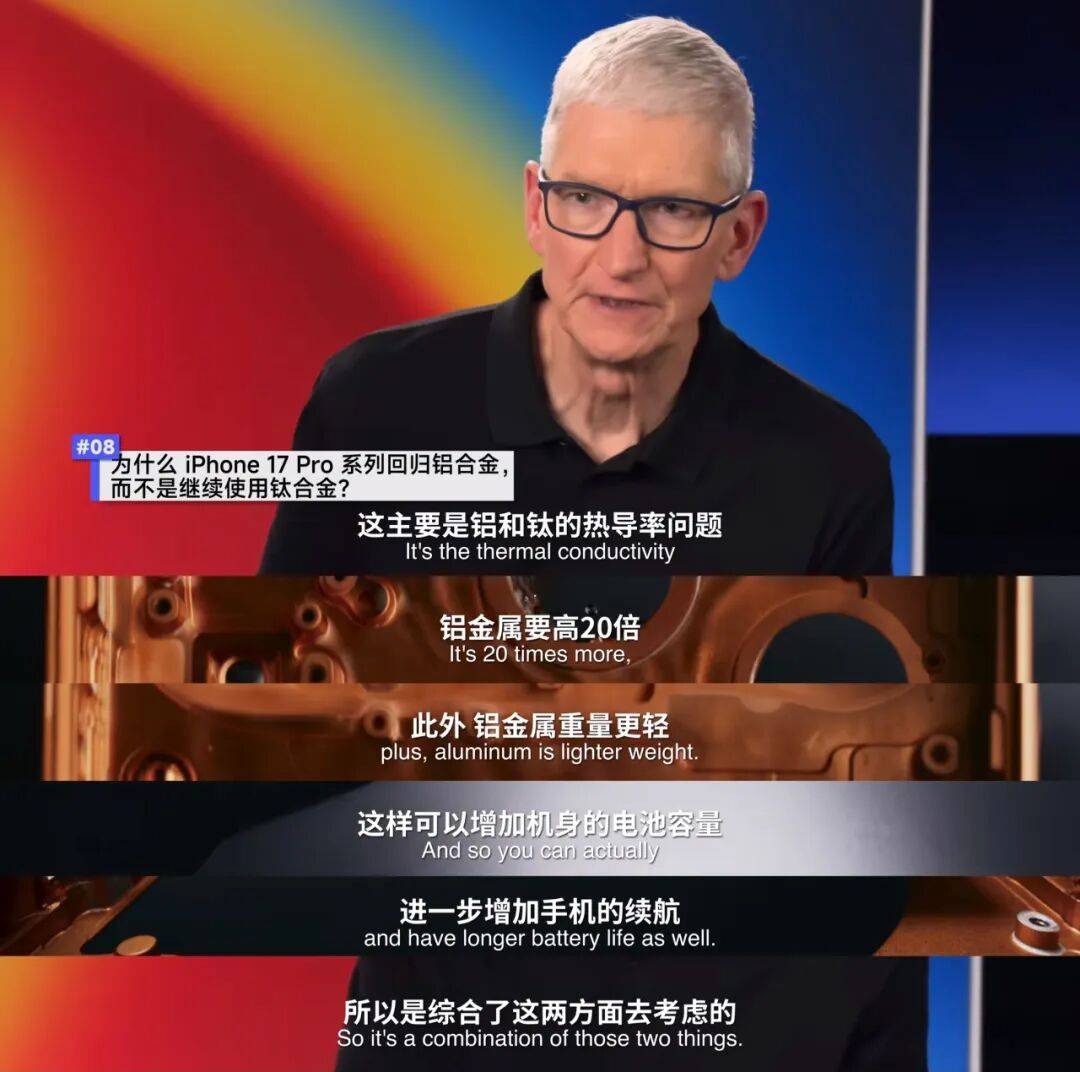
Core Insights - Apple has launched the new iPhone 17 series, featuring the iPhone 17 Pro series with an aluminum unibody design and a new VC thermal plate cooling system [1][5] Group 1: Design and Innovation - The iPhone 17 Pro series utilizes an aluminum unibody design, which is preferred over the titanium frame used in the previous 15 Pro and 16 Pro series due to aluminum's 20 times higher thermal conductivity and lighter weight, allowing for increased battery capacity [3] - The introduction of the VC thermal plate design in the iPhone 17 Pro series is highlighted as a unique innovation by Apple, suggesting that it may be a feature that only Apple could achieve [5]