Workflow
反内卷
icon
Search documents
ETF日报|商业航天突传重磅!军工ETF(512810)上探2.8%!资金博弈业绩主线?创业板人工智能ETF单日获净申购超3亿份
Sou Hu Cai Jing· 2026-01-19 13:42
Market Overview - On January 19, A-shares showed mixed performance with the Shanghai Composite Index performing strongly while the ChiNext Index experienced a pullback. The total trading volume in Shanghai, Shenzhen, and Beijing reached 2.73 trillion yuan, a significant decrease of 324.3 billion yuan from the previous trading day [1] Commercial Aerospace Sector - The commercial aerospace sector received significant news with the successful validation of crewed spacecraft landing buffer technology, leading to a surge in related stocks. The General Aviation ETF Huabao (159231) saw an intraday increase of over 3%, ultimately closing up 2.2% [1] - The aerospace sector experienced a strong rebound after recent volatility, with stocks like AVIC and Aero Engine Corporation hitting the daily limit. The General Aviation ETF closed at a strong position, recovering its 10-day moving average [10][12] Chemical Industry - The chemical sector is currently at a dual turning point in capacity and inventory cycles, with expectations of entering an upward phase. The Chemical ETF (516020) saw a significant increase of 3.06%, reaching a new high since August 2022 [1][4] - The chemical ETF has shown a cumulative increase of 52.03% since the beginning of 2025, outperforming major indices like the Shanghai Composite Index (22.74%) and the CSI 300 Index (20.32%) [7][8] - Prices of refrigerants have surged, with R507 and R404 reaching 46,000-49,000 yuan/ton and 43,000-45,000 yuan/ton respectively, reflecting strong demand and tightening supply [9] AI Sector - The AI sector continues to attract significant investment, with the ChiNext AI ETF Huabao (159363) receiving a net subscription of 322 million yuan on January 19, following a total inflow of 1.679 billion yuan over the past five days [2][16] - The focus on AI applications and computing power is expected to drive further growth, with the AI sector's performance anticipated to remain strong in the first half of the year [19] Investment Recommendations - Analysts suggest focusing on sectors with high earnings growth potential, such as technology (AI computing and applications), chemicals, and pharmaceuticals, as the market enters a period of concentrated earnings announcements [4][18] - The Chemical ETF is recommended for investors looking to capitalize on the rebound in the chemical sector, which includes significant holdings in leading companies [9][10]
【招银研究|宏观点评】圆满收官——中国经济数据点评(2025年全年及12月)
招商银行研究· 2026-01-19 12:29
Overview - The core viewpoint of the article is that China's economy in 2025 is characterized by a deepening supply-demand imbalance, with strong supply and weak demand, as well as a resilient external demand compared to internal demand. The GDP is projected to exceed 140 trillion yuan, with nominal growth of 4% and real growth of 5% [1][4]. Economic Structure - The economic operation in 2025 shows three main features: a deepening supply-demand imbalance, stronger external demand than internal demand, and initial success in price governance. The industrial added value increased by 5.9%, which is higher than GDP, investment, and consumption growth rates [4][5]. - The contribution rates to GDP growth from final consumption expenditure, capital formation, and net exports are 52%, 15.3%, and 32.7%, respectively [1]. Consumption - The total retail sales of consumer goods grew by 3.7% in 2025, with a "front high and back low" rhythm. The growth rates for goods and catering were 3.8% and 3.2%, respectively, indicating stronger performance in goods [12][15]. - In December, the retail sales growth rate dropped to 0.9%, reflecting a further weakening of growth momentum. Durable goods consumption faced significant pressure, with home appliances down by 14.3% [15][18]. Fixed Asset Investment - Fixed asset investment decreased by 3.8% in 2025, primarily due to declines in infrastructure (-1.5%) and real estate investment (-17.2%). Private investment continued to shrink for the third consecutive year, with a significant drop of 6.4% [18][20]. - Real estate sales showed a smaller decline compared to investment, with sales area and amount down by 8.7% and 12.6%, respectively, indicating a slight recovery in sales [20][21]. Foreign Trade - In 2025, exports maintained resilience with a cumulative growth of 5.5%, while imports showed no growth. Exports to the US fell by 19.9%, while exports to non-US regions grew by 9.9%, becoming the main support for overall export growth [29][30]. - In December, exports increased by 6.6%, driven by strong performance in automobiles and integrated circuits, which grew by 71.7% and 47.7%, respectively [29][30]. Supply Side - Industrial production growth accelerated in 2025, with the industrial added value increasing by 5.9%. The contribution rate of industry to economic growth reached 35%, up by 1.8% from 2024 [31][35]. - In December, industrial production showed a year-on-year growth of 5.2%, with a notable increase in high-tech industries [31][35]. Inflation - Inflation showed moderate recovery in 2025, with the CPI remaining flat year-on-year and core CPI rising to 1.2%. The PPI contracted by 2.6%, influenced by supply-demand balance and rising international metal prices [36][37]. - In December, CPI rose by 0.8%, marking the fourth consecutive month of increase, while PPI contracted by 1.9% [36][37]. Outlook - Looking ahead to 2026, it is expected to be a pivotal year for the "14th Five-Year Plan," with a GDP growth target of around 5%. Industrial production is anticipated to grow steadily, supported by resilient external demand and a recovery in consumption [40].
商业航天突传重磅!军工ETF(512810)上探2.8%!资金博弈业绩主线?创业板人工智能ETF单日获净申购超3亿份
Xin Lang Cai Jing· 2026-01-19 11:31
Group 1 - A-shares showed mixed performance on January 19, with the Shanghai Composite Index performing strongly while the ChiNext Index experienced a pullback, and total trading volume in Shanghai, Shenzhen, and Beijing reached 2.73 trillion yuan, a significant decrease of 324.3 billion yuan from the previous trading day [1][23] - The commercial aerospace sector received significant news with the successful validation of crewed spacecraft landing buffer technology, leading to a rise in the General Aviation ETF Huabao (159231) by 2.2% [1][10] - The chemical sector is entering an upward cycle as large-scale chemical products are at a dual turning point of capacity and inventory, with the Chemical ETF (516020) surging by 3.06%, reaching its highest closing price since August 2022 [1][5][30] Group 2 - The AI sector continues to attract substantial investment, with the ChiNext AI ETF Huabao (159363) seeing a net subscription of 322 million units on January 19, following a total of 1.679 billion yuan in net inflows over the previous five days [2][24] - The focus on the domestic AI industry chain is evident, as the Science and Technology Innovation AI ETF Huabao (589520) also experienced net inflows totaling 156 million yuan over the same period [2][24] Group 3 - The National Bureau of Statistics reported that China's GDP for 2025 is projected to be 14,018.79 billion yuan, with a year-on-year growth of 5%, marking the successful completion of the "14th Five-Year Plan" [4][26] - Analysts suggest that the market's risk appetite may improve following the release of macroeconomic data, with potential incremental policies expected to be introduced [4][26] - The chemical sector has shown strong performance since 2025, with the Chemical ETF (516020) index rising by 52.03%, significantly outperforming major A-share indices [5][29] Group 4 - The price of refrigerants has surged, with R507 and R404 reaching 46,000-49,000 yuan/ton and 43,000-45,000 yuan/ton respectively, reflecting increased overseas demand and tightened domestic supply [8][30] - The chemical industry is expected to experience a recovery in profitability and valuation in 2026, driven by supply-demand rebalancing and new production capabilities in AI computing and advanced manufacturing [8][30] Group 5 - The commercial aerospace sector is experiencing a rebound, supported by strong policy backing and improving industry trends, with significant investments in satellite technology and related fields [14][15] - The profitability of leading companies in the commercial aerospace index has shown improvement, with expected growth in earnings for 2026 [15]
氟化工引爆行情,龙头股涨停!化工ETF(516020)单日狂飙3%,收盘价续创近3年新高!
Xin Lang Cai Jing· 2026-01-19 11:19
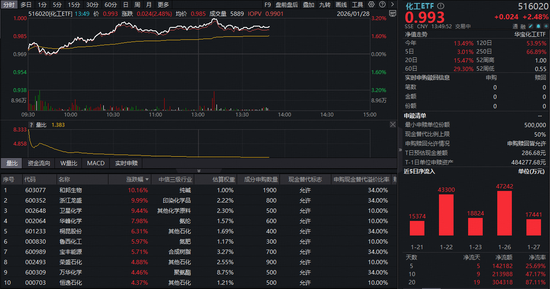
Group 1 - The chemical sector continues to perform strongly, with the Chemical ETF (516020) rising by 3.06% and reaching a new high since August 2022 [1][8] - Key stocks in the sector include Haohua Technology, which hit the daily limit, and Junzheng Group, which surged over 8%, along with several others rising more than 6% [1][8] - Since 2025, the Chemical ETF has shown a cumulative increase of 52.03%, significantly outperforming major indices like the Shanghai Composite Index (22.74%) and the CSI 300 Index (20.32%) [1][10] Group 2 - Prices of refrigerants have surged, with R507 and R404 reaching 46,000-49,000 yuan/ton and 43,000-45,000 yuan/ton respectively, reflecting a 3,000 yuan/ton increase [4][11] - The price increase is attributed to a combination of strong overseas demand and tightening domestic supply, which is expected to enhance the revenue and profit margins of refrigerant producers [4][11] - The chemical industry is anticipated to experience a recovery in profitability in 2026, following a period of adjustment and rebalancing in supply and demand [4][11] Group 3 - The Chemical ETF (516020) tracks the CSI Sub-Industry Chemical Theme Index, with nearly 50% of its holdings in large-cap leading stocks, including Wanhua Chemical and Salt Lake Industry [12] - The ETF provides an efficient way to invest in the chemical sector, covering various themes such as AI computing, anti-involution, and new energy [12] - Investors can also access the Chemical ETF through linked funds, which offer different fee structures for subscriptions and redemptions [12]
黑色金属日报-20260119
Guo Tou Qi Huo· 2026-01-19 11:00
1. Report Industry Investment Ratings - Thread steel: ★★★, indicating a clearer long - trend and a relatively appropriate investment opportunity currently [1] - Hot - rolled coil: ☆☆☆, suggesting a short - term long/short trend in a relatively balanced state with poor operability on the current market, and it's advisable to wait and see [1] - Iron ore: ★☆☆, meaning a bullish bias, with a driving force for upward trend but poor operability on the market [1] - Coke: ★☆☆, representing a bullish bias, with a driving force for upward trend but poor operability on the market [1] - Coking coal: ☆☆☆, indicating a short - term long/short trend in a relatively balanced state with poor operability on the current market, and it's advisable to wait and see [1] - Manganese silicon: ★☆☆, suggesting a bullish bias, with a driving force for upward trend but poor operability on the market [1] - Ferrosilicon: ☆☆☆, meaning a short - term long/short trend in a relatively balanced state with poor operability on the current market, and it's advisable to wait and see [1] 2. Core Viewpoints - The overall steel market is in a state of range - bound oscillation. Iron ore, coke, and coking coal are expected to be weakly volatile in the short term. Manganese silicon and ferrosilicon are experiencing price declines and need to focus on cost support and the impact of "anti - involution" [2][3][4] 3. Summary by Related Catalogs Steel - The steel futures market declined today. The apparent demand for thread steel increased, production slightly decreased, and the inventory accumulation slowed. The demand for hot - rolled coil improved, production slightly increased, and inventory continued to decline. Steel mill profits were marginally repaired, but due to insufficient downstream acceptance capacity, blast furnace复产 slowed, and hot metal production decreased. Domestic demand remained weak overall, while steel exports remained high. Steel prices followed the cost center down and were mainly in range - bound oscillation [2] Iron Ore - The iron ore futures market weakened significantly today, and the basis recently narrowed. On the supply side, the global iron ore shipment volume decreased week - on - week but was still stronger than the same period last year. Shipments from Australia and Brazil decreased significantly but were still higher year - on - year, while non - mainstream shipments increased week - on - week. The domestic arrival volume decreased, but it increased significantly compared with the same period last year. On the demand side, hot metal production stopped increasing and started to decline. The inventory of imported ores in steel mills increased, and the expectation of winter storage replenishment demand still existed. It's expected to be weakly volatile in the short term [3] Coke - The coke price oscillated during the day. The first round of price increase is expected to be implemented this week. Coking profits were average, and daily production slightly decreased. Coke inventory increased slightly, and the purchasing willingness of traders improved slightly. Overall, the supply of carbon elements was abundant, and downstream hot metal production remained at a low level. The coke futures price had a premium, and the price was likely to follow a weak oscillation [4] Coking Coal - The coking coal price oscillated during the day. The customs clearance volume of Mongolian coal was 1465 vehicles yesterday. The production of coking coal mines increased significantly, and the spot auction transactions improved. The terminal inventory increased significantly, and the total inventory of coking coal increased slightly. Overall, the supply of carbon elements was abundant, downstream hot metal production remained at a low level, and the price was likely to be weakly volatile [5] Manganese Silicon - The manganese silicon price oscillated downward during the day. There were structural problems in the manganese ore port inventory. The demand for cheaper semi - carbonate ore was likely to increase. The hot metal production decreased seasonally, the weekly production of manganese silicon decreased slightly, and the inventory decreased slightly. Attention should be paid to the impact of "anti - involution" and the cost support [6] Ferrosilicon - The ferrosilicon price oscillated downward during the day. Affected by relevant policy documents, the price was relatively strong. The market expected a decline in power costs and semi - coke prices. The hot metal production rebounded to a high - level range, the export demand decreased, and the production of magnesium metal increased month - on - month. The overall demand was still resilient. The supply of ferrosilicon decreased significantly, and the inventory decreased slightly. Attention should be paid to the impact of "anti - involution" and the cost support [7]
全年经济增长目标顺利完成
ZHONGTAI SECURITIES· 2026-01-19 10:26
Report Summary - The annual GDP growth rate in 2025 was 5%, achieving the annual target. Exports grew by 5.5%, consumption by 3.7%, and investment declined by 3.8%. Compared with 2024, the economic structure was further transformed, with high-tech industries standing out. The growth rate of total retail sales of consumer goods increased by 0.2 pct, exports decreased by 0.3 pct, and investment growth declined by 7 pct [3]. - In December, the production of the manufacturing industry improved significantly, while the growth rate of the mining industry declined. The year-on-year growth rates of the mining, manufacturing, and production and supply of electricity, heat, gas, and water industries were 5.4%, 5.7%, and 0.8% respectively, with changes of -0.9 pct, +1.1 pct, and -3.5 pct compared to the previous month [1]. - The service industry's business climate improved, especially the producer services. In December, the production index increased by 5% year-on-year, up 0.8 pct from the previous month. Among service industries, information software, leasing and business services, and the financial industry increased by 14.8%, 11.3%, and 6.5% respectively, with growth rates up 1.9 pct, 2.9 pct, and 1.4 pct from the previous month [2]. - In December, the growth rate of the three major investment categories declined, but the investment growth rate of some high-tech manufacturing industries showed resilience. The investment growth rates of manufacturing, infrastructure, and real estate were -10.6%, -16.0%, and -35.8% respectively, down 6.1 pct, 4.0 pct, and 5.5 pct from the previous month [4]. - Real estate sales showed marginal stabilization, and new construction and completion improved. In December, the year-on-year sales volume and area of commercial housing were -23.6% and -15.6% respectively, with growth rates up 1.5 pct and 1.7 pct from the previous month. The year-on-year unit price was -9.5%, almost the same as the previous month. In terms of investment, the new construction and completion areas of real estate improved, with year-on-year rates of -19.4% and -18.3% respectively [4]. - Consumption growth slowed down, and the year-on-year growth of catering revenue was weaker than the previous month. In December, total retail sales of consumer goods increased by 0.9% year-on-year, down 0.4 pct from the previous month and lower than the market consensus forecast of 1.48%. Both catering revenue and commodity sales declined from the previous month [4][5]. - In commodity retail, post-real estate cycle products improved, while general consumer goods weakened. In December, the sales growth rates of decoration materials, furniture, home appliances, and automobiles improved compared to the previous month. In contrast, the retail growth rates of grains, oils, beverages, office supplies, and clothing declined. Although precious metals rose rapidly in December, the sales growth rate of gold and silver jewelry declined for the second consecutive month [5]. - In the short term, interest rates showed a muted reaction to economic data. After the data release, the 10-year Treasury bond yield fluctuated by only about 0.3 bp. In the medium to long term, the annual economic data was generally in line with expectations. Two trends emerged: economic structural transformation and improved internal growth momentum. For 2026, "anti-involution" and rising prices suggest limited downside for interest rates [6]. Industry Investment Rating No industry investment rating is provided in the report. Core Viewpoints - The 2025 economic data shows that the economy achieved the growth target, with structural transformation and high-tech industry development being prominent features [3]. - In December, there were mixed trends across different sectors, with manufacturing production improving, service industry business climate rising, investment growth slowing, and consumption growth weakening [1][2][4]. - In the medium to long term, the economic structure is transforming, and internal growth momentum is improving. Interest rates are expected to have limited downside in 2026 [6].
26年经济有何期待?——12月经济数据解读
陈兴宏观研究· 2026-01-19 09:50
Economic Overview - The national economy achieved a GDP growth of 5% for the year, successfully meeting the target [2][11] - Exports continued to support growth, benefiting from reduced trade disruptions post the China-US Kuala Lumpur Agreement, with strong growth in the electronic and high-tech product sectors [2] - Investment saw a further decline, with all three major investment categories experiencing downward trends, particularly in manufacturing and real estate [2][4] Industrial Production - Industrial production showed signs of recovery, with the industrial added value for December increasing by 5.2% year-on-year [3] - The mining, manufacturing, and electricity sectors reported growth rates of 5.4%, 5.7%, and 0.8% respectively [3] - Exports contributed positively to industrial production, with a year-on-year increase in export delivery value of 3.2% [3] Investment Trends - Fixed asset investment saw a year-on-year decline of 15.1%, with private investment dropping by 17.2% [4] - Real estate investment experienced a significant decline of 35.8%, while manufacturing investment fell by 10.5% [4] - Infrastructure investment also faced challenges, with traditional and new standards showing declines of 15.9% and 12.2% respectively [4] Consumer Behavior - Retail sales growth slowed to 0.9% in December, marking a new low since 2023, influenced by the real estate cycle and consumer debt [7] - Service consumption showed resilience, with a year-on-year growth rate of 5.5%, supported by policy initiatives [7] - Essential consumer goods saw a decline in growth, while discretionary goods showed a narrowing decline [7] Real Estate Market - Real estate sales area saw a year-on-year decline of 15.6%, although the rate of decline improved compared to November [8] - New construction area decreased by 19.4%, while the completion area also faced a decline [8] - Housing prices continued to drop across various city tiers, with both new and second-hand residential prices decreasing [8] Employment and Economic Stability - The urban unemployment rate remained stable at 5.1%, consistent with previous months [11] - Overall, the economy is facing challenges from external uncertainties and ongoing structural adjustments, with a focus on expanding consumption as a key growth strategy for 2026 [11]
——12月经济数据解读:2026年经济有何期待?
Huafu Securities· 2026-01-19 09:06
Economic Performance - In December, the national GDP growth for the year reached 5%, successfully meeting the target[10] - The fixed asset investment in December saw a year-on-year decline of 15.1%, an increase of 3.1 percentage points from the previous month[4] - The manufacturing investment dropped by 10.5%, while real estate investment fell by 35.8%[4] Consumption Trends - Retail sales growth in December decreased by 0.4 percentage points to 0.9%, marking the lowest level since 2023[19] - Service retail sales continued to rise, with a cumulative year-on-year growth of 5.5%, indicating strong resilience in service consumption[19] - The average growth rate of essential consumer goods increased to 3.2%, while discretionary goods saw a decline of 4.4%[22] Industrial Production - The industrial added value in December grew by 5.2% year-on-year, with significant contributions from equipment manufacturing and high-tech industries[11] - The mining, manufacturing, and electricity sectors reported growth rates of 5.4%, 5.7%, and 0.8% respectively[11] Real Estate Market - The sales area of real estate in December experienced a year-on-year decline of 15.6%, although this was an improvement from November[25] - Housing prices continued to decline, with both new and second-hand residential prices showing a widening year-on-year drop[10] Employment and Future Outlook - The urban unemployment rate remained stable at 5.1%, consistent with the previous month and year[26] - The report emphasizes that expanding consumption is crucial for stabilizing growth in 2026, with "new infrastructure" and "energy infrastructure" as potential short-term strategies[26]
换购住房退税政策延续,商业用房下调首付比例:建筑材料
Huafu Securities· 2026-01-19 08:47
Investment Rating - The industry rating is "Outperform the Market" [8][66] Core Insights - The report highlights the continuation of housing tax refund policies and a reduction in the down payment ratio for commercial properties, which are expected to support the real estate market [3][13] - The report anticipates a turning point in the building materials capacity cycle due to supply-side reforms and a recovery in home buying willingness driven by lower interest rates and supportive policies [6][13] - The report notes that the real estate market is gradually stabilizing, with an increasing probability of recovery in post-cycle demand for building materials [6][13] Summary by Sections Investment Highlights - The Ministry of Finance, State Administration of Taxation, and Ministry of Housing and Urban-Rural Development have announced the extension of tax refund policies for homeowners [3] - The central bank has adjusted the minimum down payment ratio for commercial housing loans to no less than 30% [3] - Various cities are implementing measures to promote stable development in the real estate market, including urban renewal projects and government subsidies for home purchases [3][13] Market Data - As of January 16, 2026, the national average price of bulk P.O 42.5 cement is 335.5 CNY/ton, showing a 0.9% decrease from the previous week and a 16.0% decrease year-on-year [4][14] - The national average price of glass (5.00mm) is 1097.1 CNY/ton, reflecting a 0.4% increase from the previous week but a 16.9% decrease year-on-year [4][22] Sector Review - The Shanghai Composite Index fell by 0.45%, while the Shenzhen Composite Index rose by 1%. The building materials index decreased by 0.67% [5][51] - Sub-sectors such as refractory materials and fiberglass manufacturing showed positive growth, while cement and glass manufacturing experienced declines [5][51] Investment Recommendations - The report suggests focusing on three main lines of investment: high-quality companies benefiting from stock renovations, undervalued stocks with long-term alpha attributes, and leading cyclical building materials companies showing signs of bottoming out [6]
2025年经济增长数据点评:5.0%后的新序章
Economic Growth Overview - In 2025, China's GDP reached 14,018.79 billion yuan, growing by 5.0% year-on-year[5] - Quarterly GDP growth rates were 5.4% in Q1, 5.2% in Q2, 4.8% in Q3, and 4.5% in Q4, with Q4 showing a 1.2% quarter-on-quarter increase[5] Industrial Performance - Industrial capacity utilization has been improving since Q2 2025, particularly in coal mining, electrical machinery, and automotive sectors[3] - December 2025 industrial production growth accelerated to 5.2% year-on-year, up from 4.8% in November[5] Investment and Consumption Trends - Investment and consumption growth slowed in December 2025, with investment showing a decline of -10.6% year-on-year[5] - However, high-frequency data indicates early signs of stabilization in investment, supported by new policy financial tools and increased special bond issuance[5] Export and Government Consumption - Exports are expected to be a key support for economic growth in Q1 2026, with net exports showing improvement[5] - Government consumption is also anticipated to play a significant role in boosting the economy, with recent policy measures aimed at promoting consumption[5] Real Estate Sector - Real estate investment saw a further decline to -17.2% year-on-year in December 2025, reflecting high base effects from the previous year[8] - Despite the current downturn, a gradual recovery in real estate investment is expected as the high base effect diminishes[8] Risks and Future Outlook - Potential risks include policy measures falling short of expectations and unexpected changes in domestic economic conditions[8] - The first quarter of 2026 is anticipated to show a recovery in infrastructure investment, supported by a higher proportion of special bonds directed towards infrastructure projects[7]