
产品创新

Search documents
立高食品202509004
2025-09-04 14:36
Summary of Lihigh Food's Conference Call Company Overview - **Company**: Lihigh Food - **Industry**: Food Production and Distribution Key Points and Arguments Financial Performance - Lihigh Food achieved a **16% revenue growth** in the first half of 2025, despite the negative impact from the misalignment of the Spring Festival [2][4] - The company expects revenue growth in the second half of 2025 to either remain stable or accelerate, benefiting from the base effect of Sam's Club shelf adjustments and inventory preparations for the Spring Festival [2][4] - The overall target for 2025 is to achieve **double-digit revenue growth** and a **net profit margin** reaching high single digits [3][4] Cost Management - The company does not anticipate significant special expenses in the second half of 2025, focusing on normal marketing costs [7] - Lihigh Food has locked in orders for bulk materials like marinated products and oils until the end of 2025, expecting cost fluctuations to be more stable than market prices [7] - There is an expectation of increased raw material pressure potentially leading to a decline in gross margin [2][6] Product Innovation and Lifecycle - Products at Sam's Club have a lifecycle of about one year, necessitating continuous innovation to meet market demands [8] - New product launches are planned, including a new version of the popular **Creamy Little Square** expected to relaunch in October 2025, with annual sales potentially exceeding **200 million** [9][10] Market Expansion - Lihigh Food is expanding its customer base by entering the national chain tea beverage market, providing base milk and frozen baking products to approximately **7,000 stores** [16][17] - Other supermarket channels, such as Yonghui and Hema, are actively promoting customized services, providing more growth opportunities for the company [11] Strategic Direction - The company emphasizes a balance between supply and demand, with product managers responsible for production planning based on market feedback [21] - Lihigh Food's long-term net profit margin target is set between **8% and 10%**, with ongoing employee incentive measures and shareholder returns being considered [24][28] Competitive Advantages - Lihigh Food's flagship product, **360 Pro**, offers high cost-performance and quality stability, maintaining over **40% year-on-year growth** since its launch [29] - The domestic cream market benefits from lower prices compared to imported products, with domestic cream priced around **360 to 300 yuan per kg**, while imports are priced at **400 to 500 yuan per kg** [32] Future Outlook - The company is cautious about predicting future revenue growth across channels, needing to adjust based on market performance [33] - Lihigh Food is well-positioned to handle raw material price fluctuations, maintaining competitiveness as long as domestic fresh milk prices do not exceed **3.5 yuan/kg** [34] Additional Important Information - The company has implemented a dual assessment approach focusing on both revenue and expense efficiency [22] - The strategic execution involves continuous adjustments based on actual performance rather than rigid targets [23]

金价上涨行业分化:老铺黄金净利增超2倍 周大生营收腰斩
Sou Hu Cai Jing· 2025-09-04 08:41
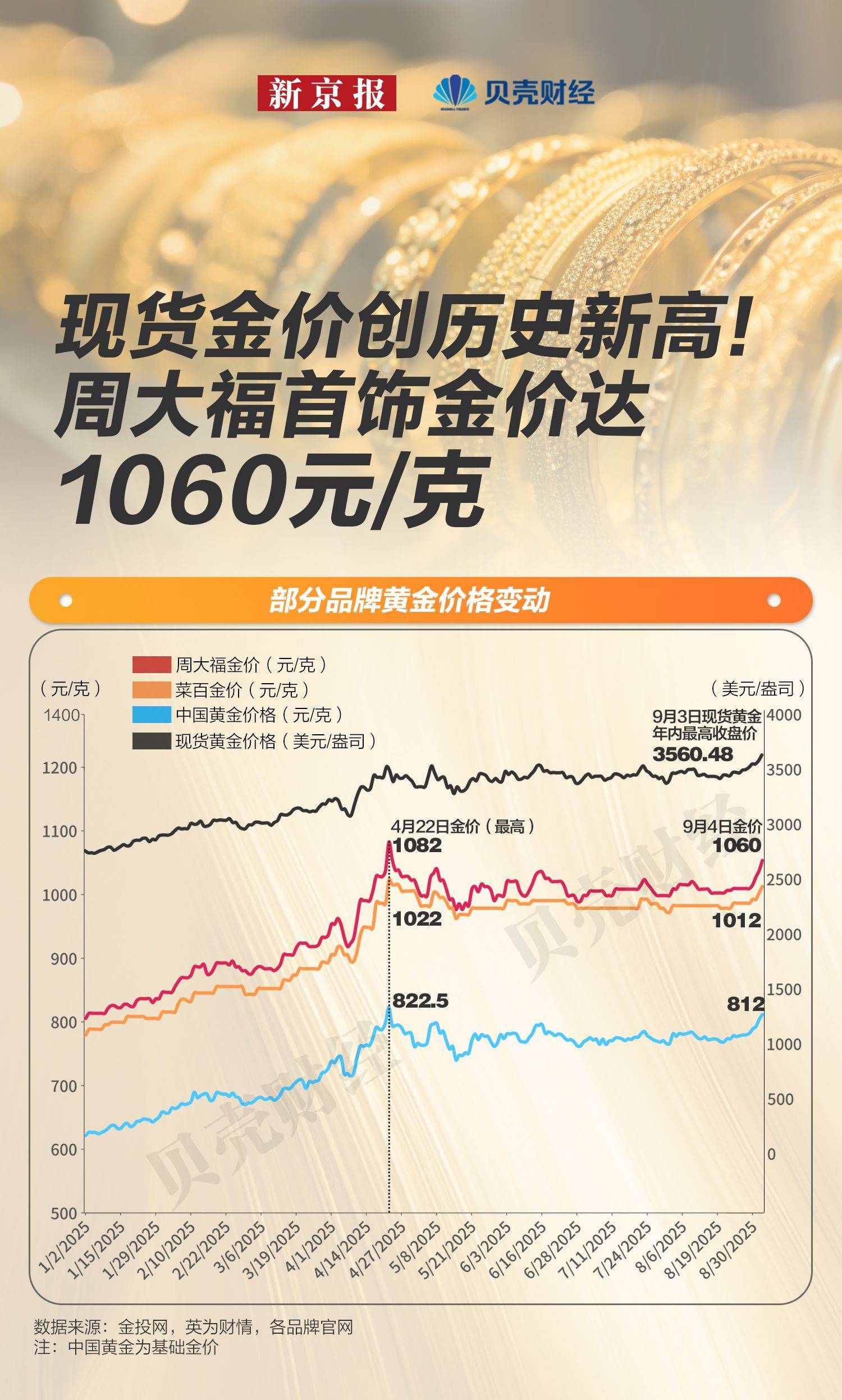
Core Viewpoint - International gold prices continue to rise, with spot gold prices surpassing $3,500 per ounce on September 2 and closing at $3,560.48 per ounce on September 3. Despite the rising gold prices, the performance of gold jewelry companies shows significant divergence [1]. Company Performance - Lao Pu Gold reported substantial growth in the first half of the year, with revenue and net profit increasing by 251.0% and 285.8%, respectively, although its gross margin slightly decreased to 38.1% [1]. - In contrast, several brands such as Lao Feng Xiang, Zhou Da Sheng, and Zhou Sheng Sheng experienced revenue declines. Zhou Da Sheng's revenue fell by 43.9% year-on-year, with a slight net profit decrease of 1.3%. Lao Feng Xiang's revenue and net profit decreased by 16.5% and 13.1%, respectively [1]. - Chao Hong Ji and Zhou Liu Fu, however, saw growth, with Chao Hong Ji's revenue reaching 4.102 billion yuan, a 19.54% increase, and net profit growing by 44.34%. Zhou Liu Fu's revenue was 3.15 billion yuan, up 5.2%, with net profit increasing by 11.9%, and its online sales accounted for 52% of total revenue [1]. Market Trends - The number of franchise stores for several companies has decreased, with Lao Feng Xiang, Zhou Liu Fu, and Zhou Da Sheng reducing their store counts by 279, 274, and 344, respectively. Online sales and overseas expansion are emerging as new growth points [1]. - The consumption structure in the industry is shifting, with national gold jewelry consumption volume declining by 26% year-on-year, while investment demand for gold bars and coins increased by 23.69%. Consumer preferences are moving towards lighter, high-value products, putting pressure on leading brands and prompting the industry to transition towards product innovation and refined self-operated channel management [1].

茶百道(2555.HK):运营效率环比提升 下半年展店有望提速
Ge Long Hui· 2025-09-04 08:24
Core Viewpoint - The company reported a revenue of 2.5 billion CNY in H1 2025, reflecting a 4.3% year-on-year increase, while the net profit attributable to shareholders rose by 37.5% to 326 million CNY, indicating strong financial performance despite a decline in adjusted net profit [1] Group 1: Financial Performance - In H1 2025, the company achieved a revenue of 2.5 billion CNY, up 4.3% year-on-year, and a net profit of 326 million CNY, up 37.5% [1] - Adjusted net profit was 340 million CNY, down 13.8%, with an adjusted net profit margin of 13.6%, a decrease of 2.9 percentage points [1] - The company proposed a mid-term dividend of 266 million CNY, translating to 0.18 CNY per share, with a payout ratio of 80% [1] Group 2: Product Innovation and Sales Growth - The company launched 55 new products and upgraded 9 existing products in H1 2025, with popular items like Lychee Ice Milk driving sales [1] - The sales revenue from products, equipment, franchise fees, and other income were 2.309 billion CNY, 48 million CNY, 101 million CNY, and 41 million CNY respectively, with year-on-year changes of +7.8%, -62.1%, +2.4%, and +52.0% [1] - Estimated single-store product sales revenue was approximately 270,000 CNY, reflecting a 3.7% increase [1] Group 3: Store Expansion and Quality Improvement - The company added 49 new domestic stores in H1 2025, bringing the total to 8,444, focusing on improving operational quality [1] - Store additions in various city tiers included a net decrease of 6 in first-tier cities, an increase of 6 in new first-tier cities, and a net increase of 62 in lower-tier cities [1] - The company also expanded its overseas presence, adding 7 new stores in H1 2025, totaling 21 stores across countries including South Korea, Malaysia, Thailand, Australia, Hong Kong, Macau, and Spain [1] Group 4: Cost Management and Efficiency - The company improved its gross margin to 32.6%, an increase of 0.9 percentage points year-on-year and 1.9 percentage points quarter-on-quarter [1] - Sales expense ratio, management expense ratio, and R&D expense ratio were 6.0%, 10.3%, and 0.6%, with year-on-year changes of +1.6 percentage points, +1.2 percentage points, and flat, respectively [1] - The company achieved a quarter-on-quarter improvement in cost ratios, with sales expenses down by 5.5%, management expenses down by 1.3%, and R&D expenses down by 0.2% [1] Group 5: Investment Outlook - Based on the mid-term performance, the company adjusted its revenue forecasts for 2025-2027 to 5.747 billion CNY, 6.267 billion CNY, and 6.866 billion CNY, respectively [1] - The net profit forecasts for the same period were adjusted to 872 million CNY, 1.002 billion CNY, and 1.132 billion CNY [1] - The latest stock price corresponds to a price-to-earnings ratio of 13, 12, and 10 times for the years 2025, 2026, and 2027, respectively, maintaining a "buy" rating [1]
HubSpot, Inc. (HUBS) Analyst/Investor Day Transcript
Seeking Alpha· 2025-09-04 06:55
Group 1 - HubSpot hosted its Analyst Day at INBOUND in San Francisco, marking a significant event for the company and its stakeholders [1] - The Investor Relations team expressed excitement about the innovations delivered over the past year, highlighting numerous new product announcements [1][2] - The company aims to build on this momentum and is optimistic about the upcoming year [2]


茶百道中期业绩会:收入增长运营提效 业绩迎来向上拐点
Xin Lang Zheng Quan· 2025-09-04 03:57
Core Insights - The company reported significant improvements in store performance, with average daily GMV per store reaching its highest level in nearly a year, up approximately 15% quarter-over-quarter in Q2 [8][10] - The company achieved revenue growth of 4% year-on-year, totaling 2.5 billion yuan, with a gross profit of 815 million yuan and a gross margin of 32.6% [2][5] - The company launched 55 new products in the first half of 2025, with new product sales accounting for 28% of total sales, indicating strong product innovation and supply chain capabilities [2][5] Store Performance - The number of stores increased to 8,444, with 5,833 franchise partners and over 160 million registered members [7] - The average payback period for franchise partners has shortened by 1-2 months, attributed to improved product development strategies focusing on consumer demand [10] - The company is expanding its presence in lower-tier cities, with a 9% year-on-year increase in store numbers in fourth-tier and below cities [7] Product Development - The company emphasizes the effectiveness of new products and lifecycle management of classic products, ensuring quality and cost-effectiveness through a robust supply chain [5][6] - The "True Fresh Ice Milk" series has sold nearly 20 million cups, becoming a market phenomenon and leading the industry's health transformation [2] Supply Chain Efficiency - The company has expanded its national warehousing centers to 26, covering an area of 220,000 square meters, with 93.8% of stores able to achieve next-day delivery [5][6] - The company has implemented 41 high-frequency night delivery routes to enhance delivery efficiency while maintaining product freshness [5] International Expansion - As of June 30, 2025, the company has entered seven overseas markets, including South Korea, Malaysia, Thailand, Australia, Hong Kong, Macau, and Spain, with a total of 21 stores opened [13] - The company plans to deepen its presence in South Korea and Southeast Asia while also expanding into the U.S. and France, with a focus on establishing a representative overseas market presence within three to five years [13]

潍坊青州:积极开拓多元市场 培育外贸新优势
Sou Hu Cai Jing· 2025-09-03 16:43
Core Insights - Qingzhou's foreign trade enterprises are actively exploring international markets, enhancing technological innovation and product development to improve core competitiveness and create new advantages in foreign trade [1][4] Group 1: Company Performance - Shandong Haiyu Heavy Industry Group Co., Ltd. has seen a 60% year-on-year increase in foreign trade orders, attributed to the development of new markets such as Central Asia and ASEAN, as well as support from the Belt and Road Initiative [1][2] - The company has adopted a hybrid strategy of online and offline market development, establishing after-sales centers in countries like Kyrgyzstan, Tanzania, and Uganda to enhance customer trust and communication [1] - The company is focusing on technological innovation, producing high-tech, high-value-added, and green low-carbon products to drive new breakthroughs in overseas business orders [1][2] Group 2: Market Strategy - Qingzhou is guiding foreign trade enterprises to focus on their core businesses, enhance product structure transformation, and strengthen core competitiveness while expanding into emerging markets such as the Middle East, Africa, and Latin America [4] - Shandong Junmadao Machinery Co., Ltd. is shifting its strategic focus to overseas markets, establishing sales and service networks in regions like Central Asia, Israel, and South America [4] - The company is optimizing its production equipment and technology to develop new products, including high-end agricultural machinery and key components, to meet the demands of international markets [4] Group 3: Market Growth - In the first half of the year, Qingzhou's market entities demonstrated strong vitality, achieving a total import and export value of 9.57 billion yuan, reflecting robust resilience and growth in foreign trade [4]
苏泊尔(002032):内销稳健增长,外销、投资收益影响盈利
Changjiang Securities· 2025-09-03 14:42
Investment Rating - The report maintains a "Buy" rating for the company [9]. Core Views - The company reported a revenue of 11.478 billion yuan for the first half of 2025, representing a year-on-year growth of 4.68%. However, the net profit attributable to shareholders was 940 million yuan, a slight decline of 0.07% year-on-year [2][5]. - The company is actively promoting product innovation and optimizing channel layouts, maintaining a leading market share in domestic sales. It is expected to benefit from national subsidies for high-priced products, with strong growth in external orders [7]. - The company has maintained a considerable dividend rate in recent years, with projected net profits attributable to shareholders of 2.258 billion, 2.523 billion, and 2.758 billion yuan for 2025, 2026, and 2027, respectively, corresponding to PE valuations of 18.32, 16.39, and 15.00 times [7]. Summary by Sections Financial Performance - In the second quarter of 2025, the company achieved a revenue of 5.691 billion yuan, a year-on-year increase of 1.87%, while the net profit attributable to shareholders was 443 million yuan, down 5.94% year-on-year [2][5]. - The gross profit margin for the first half of 2025 was 23.61%, with a slight decline compared to the previous year. The company’s net profit margin for the first half was 8.19%, down 0.39 percentage points year-on-year [12]. Sales Breakdown - For the first half of 2025, the company's revenue from domestic sales grew by 3.36%, while external sales increased by 7.55%. The domestic market accounted for 67.62% of total revenue [12]. - The company launched innovative products, such as a handheld garment steamer, which achieved the highest online market share in the first half of 2025 [12]. Future Projections - The company is expected to maintain steady growth in scale while optimizing profitability efficiency. The projected net profits for 2025-2027 indicate a positive outlook for the company's financial performance [7].

古茗(01364):2025H1业绩点评:外卖拉动单量效果明显,门店扩张加速
Changjiang Securities· 2025-09-03 14:42
Investment Rating - The report maintains a "Buy" rating for the company [2][10]. Core Insights - In H1 2025, the company achieved revenue of 5.66 billion, a year-on-year increase of 41.2%, and adjusted profit of 1.09 billion, up 42.4% year-on-year. The growth is significantly driven by the competitive landscape in the takeaway market, which is expected to further enhance performance in Q3 [2][6]. - The company has a clear growth strategy with substantial room for store expansion, focusing on densely populated regions and leveraging a self-controlled supply chain for efficiency. High R&D investment supports rapid product innovation, which is anticipated to contribute to steady revenue growth [2][10]. - The company’s total GMV reached 14.1 billion, reflecting a 34.4% year-on-year increase, with average daily GMV per store at 7.6 thousand, up 21.2% year-on-year. The number of cups sold per store per day increased by 17% to 439 cups, while the average price per cup rose by 3% to 17.3 [10][11]. Summary by Sections Financial Performance - In H1 2025, the company reported a gross profit of 1.79 billion, a 41.0% increase year-on-year, and an adjusted core profit of 1.14 billion, up 49.0% year-on-year [6][10]. - The gross margin for H1 2025 was 31.5%, slightly down by 0.1 percentage points year-on-year, while the adjusted profit margin improved by 0.2 percentage points to 19.2% [10][11]. Store Expansion - The company opened 1,570 new stores in H1 2025, a 105.2% increase year-on-year, bringing the total number of stores to 11,179, which is a 17.5% increase year-on-year. The distribution of stores across different city tiers shows a significant focus on lower-tier cities, with 81% of stores located in second-tier and below [10][11]. Product Development - The company launched 52 new products in H1 2025, demonstrating its strong R&D capabilities. The number of registered members on the company’s mini-program reached 178 million, with 50 million active members, indicating high consumer engagement [10][11]. - The company has equipped over 8,000 stores with coffee machines, achieving a coverage rate of approximately 72%, and introduced 16 new coffee products, which are expected to contribute to sales growth [10][11].
净利润降幅小于营收,克明食品回复称毛利率提升所致
Xi Niu Cai Jing· 2025-09-03 08:53
Core Viewpoint - Kemin Food's 2025 semi-annual report indicates a decline in both revenue and net profit, with revenue down 10.85% year-on-year and net profit down 2.34% year-on-year [2][3]. Financial Performance - Revenue for the reporting period was 2.14 billion yuan, compared to 2.40 billion yuan in the same period last year, reflecting a decrease of 10.85% [3]. - Net profit attributable to shareholders was 100.32 million yuan, down from 102.73 million yuan, a decline of 2.34% [3]. - The net profit after deducting non-recurring gains and losses was 93.04 million yuan, a decrease of 3.92% from the previous year [3]. - The basic earnings per share increased slightly to 0.319 yuan from 0.315 yuan, a rise of 1.27% [3]. - The weighted average return on equity decreased to 3.87% from 4.16%, a drop of 0.29% [3]. Business Segments - Kemin Food operates in two main segments: food and pig farming, with the food segment focusing on the research, production, and sales of noodle and convenience food products [4]. - Despite the overall decline in performance, the decrease in net profit was less than that of revenue, attributed to lower raw material costs and improved cost control in the pig farming segment [4]. - The cost of wheat procurement per ton decreased, leading to a 4.35% increase in gross margin for the food segment [4]. Strategic Initiatives - To mitigate risks from raw material cost fluctuations, Kemin Food is implementing a multi-channel strategy for wheat procurement and maintaining a substantial wheat inventory [5]. - The company plans to continue monitoring wheat price trends and will replenish inventory during price dips to reduce procurement costs [5]. - The decline in revenue from main products like noodles and flour is primarily due to a decrease in sales volume driven by reduced market demand [5]. - Kemin Food aims to enhance product innovation and market competitiveness by focusing on high-end noodle products, expanding the use of buckwheat and whole wheat flour, and improving customer engagement through better product performance [5].


毛利率逆势领跑行业!华帝股份44.1%高毛利背后的\"战略突围\"
Mei Ri Jing Ji Xin Wen· 2025-09-03 01:19
Core Viewpoint - The kitchen and bathroom industry in China has shown overall sales growth in the first half of 2025, but there is significant differentiation in performance across various product categories [1] Group 1: Company Performance - Vatti Co., Ltd. achieved approximately 2.8 billion yuan in revenue and a net profit of 272 million yuan in the first half of 2025, with an overall gross margin improvement [1] - The gross margin for core products such as range hoods, gas stoves, and water heaters increased by 3 percentage points to 44.1% [1][2] - The company's offline channel gross margin reached 45.89%, a significant increase of 6.83 percentage points year-on-year [3] Group 2: Market Trends - The retail volume of kitchen and bathroom appliances grew by 5.1% year-on-year, while retail sales increased by 3.9%, indicating a slower growth in sales compared to volume [2] - High-end and smart kitchen appliances are gaining market share, with sales of range hoods priced above 3,500 yuan increasing by 2.3 percentage points to 7.7% [2] Group 3: Strategic Initiatives - The company focuses on enhancing profitability, capturing market share, and improving operational efficiency, driven by high-end strategies, marketing capabilities, and product innovation [4] - Vatti launched several new products, including the GW6i beauty bath gas water heater and the FA50P steam and baking integrated machine, marking the beginning of the high-end water heater era [4][5] - The company has filed 472 new patents this year, bringing the total to 4,690, emphasizing its commitment to innovation [5]
