
价格战

Search documents
新一轮大降价后,比亚迪销量涨了、股价跌了
华尔街见闻· 2025-06-02 11:33
Core Viewpoint - The article highlights the recent sales performance of BYD amidst a new round of aggressive price competition in the electric vehicle market, indicating both growth in sales and challenges in stock performance due to pricing strategies. Sales Performance - In May, BYD achieved sales of 382,476 vehicles, marking a year-on-year increase of 15.3% and setting a new monthly sales record for the year [2][6] - The sales breakdown includes 88,640 vehicles sold overseas, with the Dynasty and Ocean series contributing 348,393 units, and other models like the Fangchengbao and Tengshi also contributing to the total [3][5] - BYD's pure electric vehicle sales reached 204,369 units, surpassing plug-in hybrid sales of 172,561 units for the second time since early 2024 [4] Pricing Strategy - In late May, BYD initiated a significant price reduction campaign, with some models seeing price cuts of up to 34%, directly impacting traditional fuel vehicle pricing [6][7] - This marks the third major promotional effort by BYD within two months, indicating a strategy focused on aggressive pricing to boost sales [7] Stock Market Reaction - Despite the increase in sales, BYD's stock price has faced downward pressure, with a drop of over 4% on a recent trading day, continuing a trend of more than 15% decline from the previous week [8][9] - Analysts from Citigroup estimate that the price cuts could lead to a 30% to 40% increase in dealer foot traffic, raising questions about the sustainability of this price-driven growth strategy [11] Market Outlook - Analysts express caution regarding BYD's ability to meet its annual sales target of 5.5 million vehicles, noting that an average monthly sales of approximately 534,000 units is required in the remaining months [12] - The upcoming fourth quarter, typically a peak sales season, will be a critical test for BYD to maintain its growth momentum [13] Industry Commentary - The article references a commentary from the People's Daily, which criticizes the ongoing price wars in the automotive industry, emphasizing the need for fair competition and warning against the long-term consequences of such strategies [14]


“价格战”影响多大?理想汽车单车净利两年跌逾六成
Di Yi Cai Jing Zi Xun· 2025-06-02 11:31
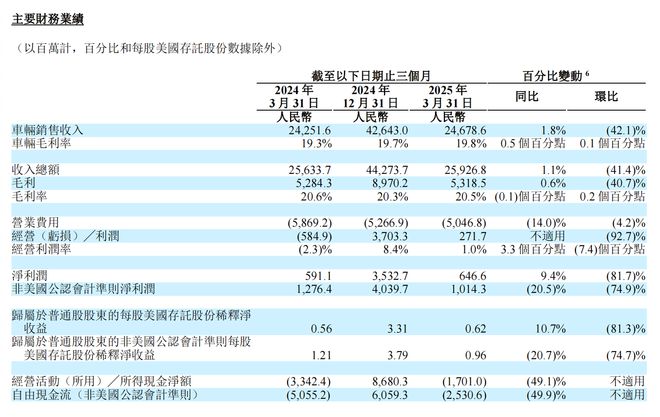
短短两年时间内,不断推迟公布财报披露时间,单车平均净利润不断下滑,理想汽车(02015.HK)给 到投资者"并不理想"的趋势印象。 财务数据显示,2023年第一季度一度实现单车平均净利润1.78万元的理想汽车,两年间的这个数据就一 下子堕落到2025年第一季度的不到0.7万元/辆,单车利润降逾六成。 有业内人士认为,整车"价格战"影响着行业内每一家企业的财务报表,而对理想汽车来说,也包括了L6 等中低价产品销售占比上升的影响,增程技术路线能实现盈利,也有越来越多车企加入,"护城河"并不 深。 迟来的财报 相比2023年5月10日就公布一季报,这一次理想汽车的一季报在5月29日晚间才公布,来得比以往晚了近 20天。 理想汽车公布的2025年第一季度财报显示,公司前三月实现营业收入259.3亿元,同比增长1.1%;净利 润为6.46亿元,同比增长9.4%。一季度,理想汽车交付量为9.3万辆,同比增长16%。 "站在价值投资和产业格局的角度来看,我们认为这不是一个值得重仓押注的方向。未来的胜者或许还 未能看到,我们在其中找不到确定性的机会。"桓睿天泽总经理莫小城向第一财经记者表示,对新能源 车的未来持谨慎看法,认为 ...

零公里二手车:新能源汽车保值困局下的行业畸变
3 6 Ke· 2025-06-02 11:19
Core Viewpoint - The rapid rise of zero-kilometer used cars in the Chinese electric vehicle (EV) market is a significant issue, exacerbated by price wars initiated by leading companies like BYD, leading to a collapse in the residual value of EVs [1][2]. Group 1: Price War Impact - BYD's price war in 2024 resulted in a dramatic price drop for new models, with the Qin PLUS DM-i priced at 12.58 million yuan and zero-kilometer used cars selling for 8.98 million yuan, a decrease of 28.6% [2]. - The residual value of the BYD Seagull dropped from 75.29% in 2024 to 68.7% in 2025 due to the price war, indicating a significant decline in the value of new energy vehicles [2]. - The phenomenon of zero-kilometer used cars has created a "shadow market," with 18% of BYD's inventory being sold through this channel in 2024, leading to confusion in the pricing system between new and used cars [2][3]. Group 2: Technological and Policy Challenges - Rapid technological advancements in EVs have further complicated the residual value issue, with the introduction of BYD's fifth-generation DM system leading to a 12% depreciation in older models [4]. - The introduction of new battery technologies, such as solid-state batteries, has resulted in a 25% decline in the residual value of older models, compressing the depreciation cycle from five years to 2-3 years [6]. - Policy exploitation by used car dealers, such as fraudulent practices to claim government subsidies, has led to a further decline in the residual value of vehicles sold under these schemes [6][7]. Group 3: Regulatory Response and Industry Adaptation - Regulatory bodies are beginning to take action, with the Ministry of Commerce convening meetings with major car manufacturers to enhance oversight and establish a credit evaluation system [7]. - NIO has launched an official used car platform that includes extensive inspections and warranties, aiming to transform the perception of used cars from non-standard to certified products [8]. - The industry is exploring innovative solutions, such as the adoption of solid-state batteries, which could improve the longevity and value retention of EVs in the future [8][10]. Group 4: Future Outlook - The potential for improved residual values exists with the widespread adoption of solid-state batteries and the establishment of a certified used car system [10]. - A collaborative effort among manufacturers, regulators, and consumers is essential to create a sustainable ecosystem for the EV market, ensuring long-term growth and stability [10].

大降价后,比亚迪5月销量创今年最高
Hua Er Jie Jian Wen· 2025-06-02 06:37
Group 1 - BYD's sales in May reached a new high for the year, with 382,476 vehicles sold, representing a year-on-year increase of 15.3% [1] - The sales of pure electric passenger vehicles surpassed plug-in hybrid models for the second time since early 2024, with 204,369 units sold compared to 172,561 units [1] - BYD's overseas sales also hit a record high of approximately 88,900 units, indicating accelerated internationalization and new growth support [1] Group 2 - In late May, BYD initiated a new round of price cuts, with some models seeing reductions of up to 34%, prompting competitors like Leap Motor and Geely to follow suit [2] - The price cuts included significant discounts on 22 models, with the Sea Lion 07DM-i model dropping by 53,000 yuan, a 34% reduction from the original price [2] - This marks the third large-scale promotional effort by BYD in less than two months, indicating an aggressive pricing strategy [2] Group 3 - Despite the increase in sales, BYD's stock price has suffered, with a drop of over 4% in Hong Kong shares, continuing a decline of more than 15% from the previous week [3] - Analysts estimate that the price cuts could lead to a 30% to 40% increase in dealer foot traffic, but there are concerns about the sustainability of this price-driven growth strategy [5] - BYD's cumulative sales for the year have reached 1.76 million units, but there remains a significant gap to the annual target of 5.5 million units, requiring an average monthly sales of approximately 534,000 units for the remainder of the year [5][6] Group 4 - The People's Daily has commented on the recent price wars among car manufacturers, emphasizing the need for fair competition and opposing the current trend [7] - The Ministry of Industry and Information Technology has also supported this initiative, stating that "price wars" have no winners and can lead to detrimental long-term effects on the industry [8]
异动盘点0602|蜜雪冰城创新高,目标价飙至608港元!香港稳定币条例正式生效;PLTR涨超7%
贝塔投资智库· 2025-06-02 03:34
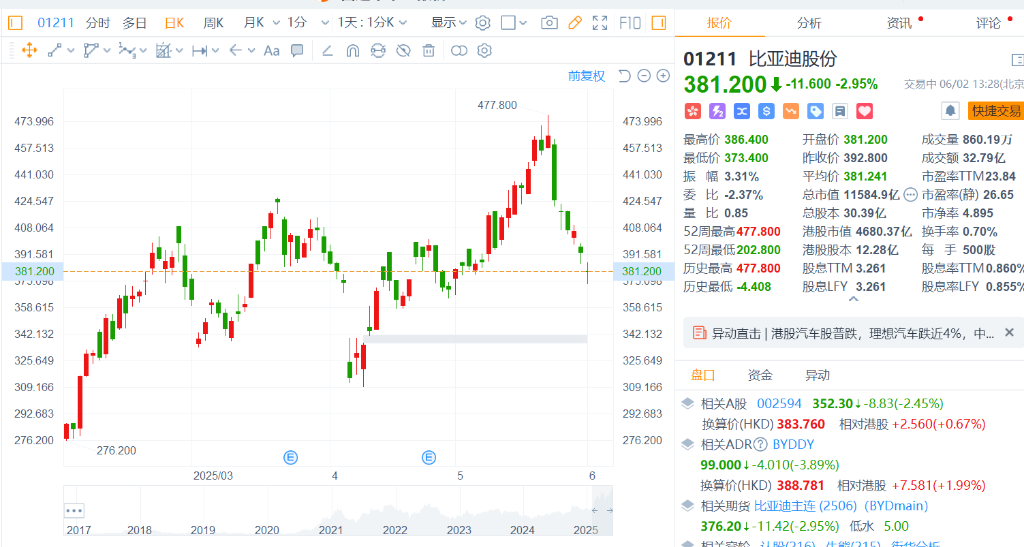
Group 1: Hong Kong Stock Market Highlights - Mixue Group (02097) rose over 7%, reaching a new high, with Daiwa raising its target price to HKD 608, optimistic about same-store sales growth and store opening speed [1] - Lianlian Digital (02598) increased nearly 10% following the official enactment of the "Stablecoin Regulation" in Hong Kong [1] - Automotive stocks collectively declined, with Li Auto-W, Great Wall Motors, and GAC Group all dropping over 2%, as the Ministry of Industry and Information Technology and the China Association of Automobile Manufacturers opposed "involution-style" price wars [1] - CSPC Pharmaceutical Group (02005) fell over 7% after reporting a 36.9% year-on-year decline in revenue and a 59.5% drop in net profit attributable to shareholders for Q1, with expectations of a 45%-60% decline in profit for the first half of the year due to demand drop and intensified competition [1] - Solar energy stocks dropped across the board, with New Special Energy, Xinyi Energy, Fuyao Glass, and Xinyi Solar all declining over 4%, as the anticipated "531" rush in May did not materialize following the April rush [1] - Chinese property stocks fell collectively in early trading, with R&F Properties, Sunac China, New City Development, and Agile Group all dropping over 4%, as data showed a 10.8% year-on-year decline in sales for the top 100 real estate companies from January to May, with a 17.3% drop in May alone [1] Group 2: Other Notable Stocks - Chongqing Rural Commercial Bank (03618) rose nearly 5% after being included in the CSI 300 Index, becoming the first local financial institution from Chongqing to be included, with a 6.25% year-on-year increase in net profit attributable to shareholders for Q1 [2] - Baker Hughes (02149) increased over 8%, reaching a new high after completing a placement of 3 million new H-shares, raising approximately HKD 117 million [2] - Giant Bio (02367) fell over 4% amid ongoing controversies regarding its product components, with the company stating it received an apology from the relevant testing agency and will pursue accountability for the rumors [2] - Chip stocks declined across the board, with Hua Hong Semiconductor, Jingmen Semiconductor, SMIC, and Shanghai Fudan all dropping over 2%, influenced by fluctuating U.S. policies and a decline in the Philadelphia Semiconductor Index [2] - Beike-W (02423) dropped nearly 6% as Huaxi Securities reported a significant slowdown in second-hand housing transaction growth, with a mere 8% year-on-year increase in 15 cities for the first 29 days of May, the lowest since October of the previous year [2] Group 3: U.S. Stock Market Highlights - AstraZeneca (AZN.US) rose over 2% after its cancer drug Imfinzi received EU approval for specific muscle-invasive bladder cancer treatments [3] - Trump Media & Technology Group (DJT.US) increased over 2.4% after announcing the completion of approximately USD 2.44 billion in financing, planning to use about USD 2.32 billion for Bitcoin reserves, potentially becoming one of the largest Bitcoin holders among U.S. public companies [3] - Nvidia (NVDA.US) fell over 2.92% after the CEO announced plans to sell up to 6 million shares by the end of 2025 [3] - Palantir (PLTR.US) rose over 7.73% as reports indicated the Trump administration relies on its technology for inter-agency data sharing, with over USD 113 million in government contracts since Trump took office [3] - Costco (COST.US) increased over 3.12% after reporting Q3 earnings that exceeded expectations, with revenue of USD 63.2 billion, an 8% year-on-year increase, and EPS of USD 4.28, demonstrating its scale advantage and member loyalty [3]


5月汽车销量榜,数字在涨,情绪在变
Jing Ji Guan Cha Bao· 2025-06-01 13:02
(原标题:5月汽车销量榜,数字在涨,情绪在变) 如果只看5月的交付榜单,中国汽车市场似乎仍然在快速增长。 头部车企保持领先,新势力稳定扩张,部分新玩家迅速放量,中腰部品牌抓住产品窗口期成功破圈,所有表面的迹象都在传达同一个信息:车还 在卖,赛道还热,增长没有停。 但真正的转折,不写在榜单里,而写在行业的态度上。 越来越多企业开始对"销量"这件事保持克制的语气。增长依然重要,但它不再是唯一的KPI。在不少车企的对内复盘中,销量的构成、结构、回款 节奏、交付路径,甚至"是否真的流向终端用户"这些指标,开始被反复提起。 这样的转变并非偶然。5月,中国汽车工业协会发布《关于维护公平竞争秩序 促进行业健康发展的倡议》,工信部紧随其后公开表态,明确反对 行业无序"价格战"和"内卷式"竞争。这不仅是一次舆论的定调,更是产业预期的重建。 "价格战没有赢家,更没有未来",这句出自监管层的评论,点中了行业过去一年最大的困境:为了冲量、为了市占率、为了资本市场"讲得通"的 增长逻辑,企业愿意牺牲利润、让渡定价权、甚至挤压售后服务与渠道体系。换来的是数字好看、库存膨胀,以及对用户体验长期透支的焦虑。 而销量结构的异常,也开始显性化。 ...
深度|中国车企为何不能内卷“价格战”?
券商中国· 2025-06-01 12:36
以下文章来源于新财富杂志 ,作者姬婧瑛 新财富杂志 . 《新财富》杂志专注以权威评价、深度研究,揭示资本的选择与逻辑,促进市场信息透明,改善资源配 置效率。 "内卷"和"价格战"无助于中国车企的国际化征途,盈利支撑的研发投入下,品质与服务才是强者的磨刀 石。 昨日,中汽协点名"某车企"意图发动价格战,工信部有关负责人发声,将采取措施,引发车圈巨震。 5月31日,中汽协发布《关于维护公平竞争秩序 促进行业健康发展的倡议》。 倡议指出,5月23日以来,某车企率先发起大幅降价活动,多家企业跟进效仿,引发新一轮"价格战"恐慌。无 序"价格战"加剧恶性竞争,将进一步挤压企业利润空间,进而影响产品质量和售后服务保障,不仅阻碍行业自 身健康发展,也将危害消费者权益,并带来安全隐患。为此,中汽协提出四点倡议,包括优势企业不为垄断市 场,挤压其他主体生存空间等。 (上下滑动,浏览全文) 关于维护公平竞争秩序,促进行业健康发展的倡议 近年来,我国新能源汽车产业快速发展,新能源汽车新车销售占比已经超过40%。当前,行业 整体运行呈现稳中向好态势,市场活力持续释放。我们也看到,一段时间以来,行业盈利水平 下降,以无序"价格战"为主要 ...




24小时内第二座!俄罗斯又一桥梁坍塌
证券时报· 2025-06-01 06:25
Core Points - The article discusses two recent bridge collapses in Russia, highlighting the potential safety risks associated with infrastructure in the region [1][3]. Group 1: Incident Details - On June 1, a bridge in Kursk region collapsed while a freight train was passing, resulting in some train cars falling onto the road below and a fire in the locomotive [1]. - A train driver sustained leg injuries, and all crew members were sent to the hospital for treatment [2]. - This incident marks the second bridge collapse in Russia within 24 hours, with the first occurring on May 31 in Bryansk region, leading to a passenger train derailment and at least 7 fatalities [3]. Group 2: Causes and Context - The Bryansk bridge collapse was reportedly caused by an explosion, with the local governor stating that "illegal interference with transportation activities" led to the incident [3]. - Bryansk region is located in western Russia, bordering Ukraine and Belarus, which may indicate geopolitical factors influencing infrastructure safety [4].

“零公里二手车”多达百万台,各方“配合”造就隐秘链条
经济观察报· 2025-06-01 05:07
Core Viewpoint - The emergence of "zero-kilometer used cars" is seen as a detrimental practice that undermines the foundation of the automotive circulation industry, as highlighted by Wei Jianjun, the chairman of Great Wall Motors [2][17]. Summary by Sections Definition and Market Response - "Zero-kilometer used cars" refer to vehicles that have been registered but not sold to end users, essentially new cars sold at used car prices, leading to concerns about their reliability and potential for misrepresentation [2][5]. - Some used car dealers defend the practice, arguing that lower prices benefit consumers, while others express concerns about after-sales service and the risk of odometer fraud [2][5]. Regulatory Actions - Regulatory bodies, including the Ministry of Commerce, have begun discussions with automotive manufacturers and used car platforms regarding the implications of "zero-kilometer used cars" [3]. Market Dynamics - The supply of "zero-kilometer used cars" comes from various sources, including 4S dealerships and manufacturers, often as a means to clear inventory [6][9]. - The price of these vehicles is significantly lower than that of new cars, which has contributed to their increasing prevalence in the market [6][9]. Industry Insights - The traditional used car market is struggling, prompting dealers to pivot towards "zero-kilometer used cars" as a more profitable alternative [9][11]. - The financial pressures on manufacturers due to unsold inventory have led to collaborations with used car dealers to manage stock effectively [11]. Statistical Data - In 2024, the total transaction volume of used cars in China is projected to reach 19.61 million units, with "zero-kilometer used cars" potentially accounting for 463,400 to 855,000 units [12]. - The proportion of "zero-kilometer used cars" in the traditional fuel vehicle market is estimated to be between 1% to 3%, while in the new energy vehicle market, it ranges from 3% to 5% [7][12]. Consumer Behavior - The typical buyers of "zero-kilometer used cars" include budget-conscious young consumers, business owners, and traditional used car dealers seeking profit margins [14]. Risks and Concerns - The practice of selling "zero-kilometer used cars" raises concerns about misleading sales data and potential financial misrepresentation, which could have serious implications for companies involved [15][16]. - Recommendations have been made for regulatory bodies to establish a vehicle lifecycle tracking system to enhance transparency and accountability in the market [17].

不卷“一口价”后,植发生意该怎么做?|最前线
3 6 Ke· 2025-06-01 03:09
Core Viewpoint - The hair transplant market, once considered a "golden track" in the medical beauty industry, is facing challenges due to price wars, trust crises, and varying service quality, leading to a collective reflection within the industry [1][2]. Industry Overview - The number of hair transplant institutions in China has reached approximately 3,000, including large chain brands, public hospitals, and single stores [1]. - The demand for hair transplant services remains, but the entry of many players has intensified price competition, with some services now offered at prices lower than pre-pandemic levels [2]. Pricing Strategy - The industry has seen a shift from a "one-price" model to a more transparent pricing structure based on the number of hair follicles, allowing consumers to understand the costs associated with their specific needs [2][5]. - The company has moved away from low-price promotions that lead to upselling of high-priced services, emphasizing a return to medical fundamentals and transparent pricing [2][5]. Business Performance - The company's overall business performance remained stable year-on-year, with first and second-tier cities contributing 50%-60% of total revenue, and hair transplant services accounting for 65%-70% of total income [5]. - The company operates 40 hair transplant clinics globally, with a focus on maintaining a manageable number of locations rather than aggressive expansion [5]. Service Diversification - The company is exploring non-surgical aesthetic services in addition to hair transplant procedures, such as hairline transplants for women and beard transplants for men, as part of a broader strategy to enhance service offerings [6].