
AI泡沫

Search documents
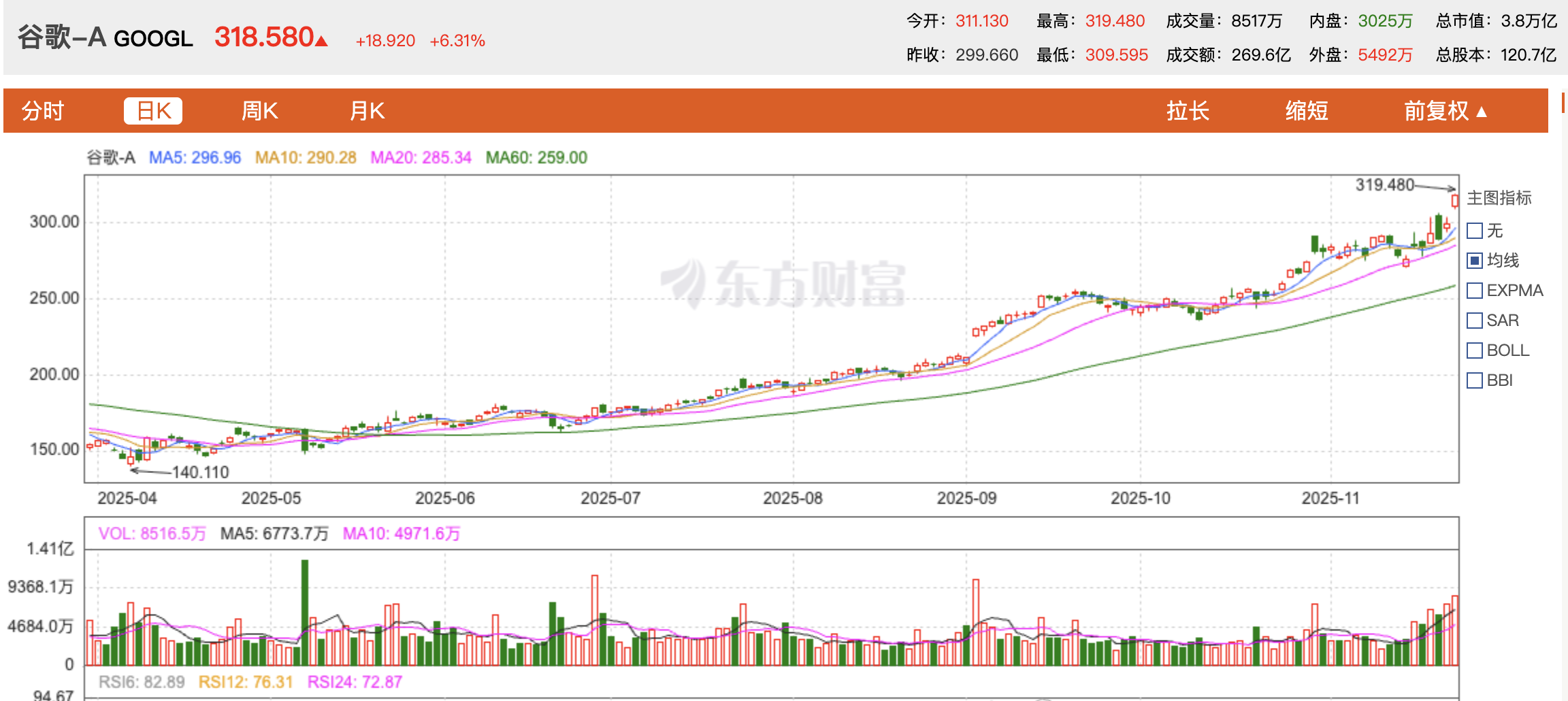
谷歌盘前大涨超4%
第一财经· 2025-11-25 13:28
Core Viewpoint - Google's stock surged over 4% before market opening on November 25, potentially pushing its market capitalization to over $4 trillion, joining the ranks of Nvidia, Apple, and Microsoft [3] Group 1: Stock Performance and Market Position - Google's market capitalization has exceeded $3.8 trillion, surpassing Microsoft's $3.52 trillion, placing it among the top three in U.S. market capitalization [3] - Over the past month, Google's stock has risen more than 20%, with a year-to-date increase of over 67% from around $190 per share at the beginning of the year [5] Group 2: Technological Advancements - The release of new AI models, Gemini 3 Pro and Nano Banana Pro, has generated excitement in the AI community, positioning Google to potentially overtake OpenAI in the AI race [6] - Google's TPU chips, designed for AI tasks, are being marketed to clients, including Meta, which is considering a multi-billion dollar investment to integrate these chips into its data centers [5] Group 3: Competitive Landscape - Google's Gemini series has achieved over 650 million monthly active users, with AI features in search reaching over 2 billion monthly users, narrowing the gap with ChatGPT [6] - In contrast, other AI companies like Nvidia and Microsoft have seen stock declines, with Nvidia down 13% and Microsoft down 14% over the past month [7] Group 4: Strategic Positioning - Google's strategy of integrating its TPU chips into client data centers marks a significant shift, aiming to capture 10% of Nvidia's annual revenue share [5] - The company’s comprehensive approach, covering chips, cloud services, large models, and applications, allows it to control costs and create a unique business cycle [8] - Investors are increasingly favoring Google over other AI startups that are heavily investing and incurring losses, indicating a preference for stability [8]



QDII基金交易热!管理人频繁提示溢价风险,部分产品限购
Bei Jing Shang Bao· 2025-11-25 13:18
Core Viewpoint - Multiple fund managers have issued warnings regarding the premium risk of their QDII funds, indicating that over 20 funds may be affected by secondary market trading price premiums, despite the majority showing strong performance this year [1][3]. Group 1: Premium Risk Warnings - On November 25, several fund management companies, including Huaxia, GF, and Huitianfu, announced premium risk warnings for their QDII funds, affecting more than 20 products [3]. - The funds involved track indices such as the Nasdaq 100, S&P 500, and MSCI US 50, with these indices showing significant gains of 18.38%, 18.07%, and 14% year-to-date, respectively [3]. - The warnings are not new; for instance, Huaxia Nomura Nikkei 225 ETF has issued premium risk alerts up to 30 times since November [3]. Group 2: Market Performance and Fund Management Actions - As of November 21, 92.16% of the 689 QDII funds reported positive returns this year, with some funds, like Huitianfu Hong Kong Advantage Mixed QDII, achieving returns exceeding 122% [6]. - In response to the premium risks, 165 QDII funds have suspended subscriptions or limited large subscriptions, with some funds imposing strict limits on subscription amounts [7][8]. - The tightening of QDII quotas has led to a supply-demand imbalance, contributing to the premium phenomenon as investors rush to buy into these funds [5][8]. Group 3: Market Dynamics and Investor Behavior - The premium risk is exacerbated by a failure in the arbitrage mechanism due to the suspension of the primary market for subscriptions and redemptions, making it difficult to correct the premiums quickly [5]. - High-frequency trading and speculative activities have further amplified price volatility in the QDII funds, particularly those allowing T+0 trading [5]. - Analysts suggest that investors should wait for market adjustments before purchasing QDII funds to avoid chasing high prices, while also being mindful of the overall market conditions and potential risks [8].

国泰海通|海外策略:降息暂缓与AI泡沫担忧下全球普跌
国泰海通证券研究· 2025-11-25 13:04
Market Performance - Global markets experienced a decline, with MSCI Global down by 2.1%, MSCI Developed Markets down by 2.0%, and MSCI Emerging Markets down by 3.0% [1] - The Japanese 10Y government bond yield saw a significant increase, while commodities like corn had notable price fluctuations [1] - The technology sector faced substantial declines amid heightened concerns over AI bubbles, with domestic materials and pharmaceuticals experiencing the largest drops [1] Trading Sentiment - Trading volume increased in European and North American markets, while A-shares and Korean stocks saw a decrease in volume [1] - Investor sentiment in Hong Kong decreased and remained at historically low levels, while sentiment in the US was high but also declined [1] - Volatility increased across Hong Kong, European, Japanese, and US markets, with overall valuations in developed and emerging markets declining compared to the previous week [1] Earnings Expectations - Hong Kong's materials sector saw an upward revision in earnings expectations, while US technology earnings expectations were maintained [2] - The Hang Seng Index's 2025 EPS earnings expectation was revised from 2077 to 2085, while the S&P 500's expectation remained at 272 [2] - European earnings expectations for the STOXX50 index remained unchanged at 333 [2] Economic Expectations - Economic sentiment in China and the US showed signs of recovery, with the Citigroup US Economic Surprise Index rising due to factors like fluctuating Fed rate cut expectations and Nvidia's strong quarterly results [2] - Conversely, the European Economic Surprise Index fell significantly, influenced by geopolitical risks and political instability [2] - The Citigroup China Economic Surprise Index showed marginal improvement, supported by positive expectations from upcoming important meetings [2] Capital Flows - The debate over Fed rate cuts intensified, with most Fed officials maintaining a hawkish stance despite some dovish comments [3] - As of November 21, the futures market implied an expectation of 0.63 rate cuts by the Fed within the year [3] - Global liquidity tightened, with significant capital inflows into the US, China, India, Japan, and South Korea, while Hong Kong saw substantial inflows through the Stock Connect program [3]

“圣诞信仰”撞上AI泡沫阴霾 美股12月上涨神话面临大考
Zhi Tong Cai Jing· 2025-11-25 12:46
Core Viewpoint - The anticipated strong year-end rally in the U.S. stock market, often referred to as the "Christmas rally," is facing uncertainty due to fluctuating expectations regarding Federal Reserve interest rate cuts and ongoing concerns about an "AI bubble" impacting investor sentiment [1][2]. Group 1: Market Performance and Trends - Historically, the S&P 500 index has averaged a 1.5% increase in December since 1945, making it the second-best month after November [1]. - Despite a significant rebound earlier in the week, the S&P 500 index is still projected to decline by 2% this month, marking its first monthly drop since April [2]. - The VIX index, a measure of market volatility, is currently above 20, indicating increased selling pressure in the market [2]. Group 2: Investor Sentiment and Strategies - Investors are showing caution, with demand for options to hedge against declines in major tech stocks like Nvidia and Microsoft reaching its highest level since August 2024 [2]. - Analysts suggest that while seasonal trends typically favor market gains, they are not guaranteed, and current market conditions are being weighed against historical performance [2][3]. - The sentiment among investors is mixed, with some strategists urging caution due to uncertainties surrounding AI investments and potential upward risks in yields [3]. Group 3: Economic Indicators and Predictions - The Federal Reserve's potential interest rate cuts are being closely monitored, with a 70% probability of a cut in the upcoming December meeting [4]. - Concerns about a potential bubble in AI-related investments are growing, particularly following Nvidia's strong earnings report, which led to significant market volatility rather than alleviating fears [4]. - Long-term bullish sentiment remains, with predictions for the S&P 500 index to reach 7400 points by the end of 2026, driven by strong performances from major tech stocks [5]. Group 4: Future Outlook - Morgan Stanley's optimistic forecast suggests the S&P 500 index could rise to 7800 points within the next year, indicating an 18% upside from current levels [6]. - Deutsche Bank is even more bullish, predicting the index could surpass 8000 points by the end of 2026, supported by expected acceleration in U.S. economic growth and broader earnings expansion beyond large-cap tech stocks [6].

谷歌市值冲击四万亿美元,超过微软进入美股总市值前三
Di Yi Cai Jing· 2025-11-25 12:24
Core Insights - Google's stock has surged over 20% in the past month, with a significant increase of over 4% before market opening on November 25, potentially pushing its market capitalization to over $4 trillion for the first time [1][4] - The release of new AI models, Gemini 3 Pro and Nano Banana Pro, has generated excitement in the AI community, allowing Google to surpass OpenAI and achieve record market valuations [1][4] - Google's TPU chips are being marketed to clients, including Meta, which is considering a multi-billion dollar investment to integrate Google's TPU into its data centers, marking a strategic shift for Google [4][6] Financial Performance - Google's stock price has risen from approximately $190 per share at the beginning of the year to $318.58, reflecting a year-to-date increase of over 67% [4][5] - As of November 25, Google's market capitalization exceeded $3.8 trillion, surpassing Microsoft's $3.52 trillion, placing it among the top three companies in the U.S. stock market [1][4] AI Strategy and Market Position - The Gemini 3 series is seen as a pivotal milestone in Google's AI strategy, potentially allowing it to reclaim a leading position in the AI race against OpenAI [5][6] - Monthly active users for Gemini have surpassed 650 million, with over 2 billion users engaging with AI features in search, indicating a growing user base [5] - Google’s comprehensive approach, covering chips, cloud services, large models, and applications, positions it uniquely in the AI landscape, contrasting with competitors that rely on rented computing power [7] Market Trends and Investor Sentiment - The stock prices of competitors like Nvidia and Microsoft have seen declines, while Google's stock and its partner Broadcom have experienced significant gains, indicating a shift in investor confidence [5][6] - Loop Capital upgraded Google's parent company rating from "hold" to "buy," raising the target price from $260 to $320, reflecting positive market sentiment [6] - Berkshire Hathaway has increased its stake in Google, becoming the company's tenth-largest shareholder, further highlighting investor interest [6]
“大空头”战英伟达 “AI泡沫”论再起
Zhong Guo Jin Rong Xin Xi Wang· 2025-11-25 11:57
Group 1 - The resurgence of the "AI bubble" narrative is causing significant corrections in AI-related growth stocks across US, A-share, and Hong Kong markets, indicating a potential disconnect between price and value [1] - Analysts suggest that the assessment of whether an "AI bubble" exists depends on the extent of price deviation from value and whether investments exceed demand and capacity [1] - Leading AI companies are beginning to generate substantial revenue, and the current investment intensity in AI remains reasonable [1] Group 2 - Michael Burry, a well-known investor, argues that the current AI hype mirrors the late 1990s internet bubble, with Nvidia at the center of this "bubble" due to its significant market capitalization of approximately $4.44 trillion as of November 24 [2] - Burry highlights that the current AI boom is driven by high-profit tech giants, similar to the role played by Microsoft, Intel, Dell, and Cisco during the internet bubble, with these companies planning to invest nearly $3 trillion in AI infrastructure over the next three years [2][3] - The unsustainable high capital expenditures by tech giants for data centers and chip purchases are not matched by actual revenue from downstream applications, raising concerns about the viability of these investments [3] Group 3 - The total global spending on AI data centers and chips is projected to reach $2.9 trillion by 2028, with tech giants expected to contribute $1.4 trillion, while the remaining gap may be filled through debt financing [3] - The potential emergence of financial derivatives in future fundraising efforts raises concerns reminiscent of the risks seen during the subprime mortgage crisis [3] - Nvidia has responded to bubble concerns by stating that its strategic investments represent a small portion of its revenue and that the capital raised in global markets is minimal compared to the total [4] Group 4 - Nvidia's CFO emphasized the long lifespan of its chips, asserting that older models like the A100 are still operating at full capacity, countering claims about the sustainability of its products [5] - Analysts argue that not all long-term investments are bubbles, and the true measure of a bubble lies in whether investments exceed demand and capacity [5] - The discussion around AI's potential is centered on two main aspects: internal demand for cost reduction and productivity enhancement, and external demand from new application scenarios, with the latter still lacking breakthrough developments [6]
美国知名“大空头”再次炮轰英伟达
Xin Lang Cai Jing· 2025-11-25 11:35
图 在他看来,如今历史正在美国AI热潮中重演:"再次有一家'思科'处于这一切的中心,它不仅拥有所需 的工具和资源,还具备与之相匹配的远大愿景,而它的名字是英伟达。" 迈克尔·伯里因精准预测2008年次贷危机而闻名,也是电影《大空头》的原型。根据11月3日披露的持仓 报告,迈克尔·伯里旗下基金Scion Asset Management曾在一季度建立了价值超9700万美元的90万股英伟 达空头头寸。但在8月公布的第二季度报告中,这些头寸已被全部清算。 之后,该基金在三季度再度建仓做空英伟达。其持仓报告显示,Scion Asset Management持有价值约1.87 亿美元的100万股英伟达看跌期权,占其资产总值的约80%。 片来源:英伟达官网 美国知名空头迈克尔·伯里再次向英伟达发难。 据新华社消息,当地时间11月23日,迈克尔·伯里在付费订阅平台"订阅堆栈"发文,重申他对美国英伟 达公司的看空立场。 他在一篇题为《泡沫的关键标志:供给侧的贪婪》的文章中,将当前美国人工智能热潮描述为"一场壮 丽的荒唐之举",并点名英伟达是他预期美国AI行业泡沫破裂的前兆。 "荒唐也能赚钱。创造性的破坏和疯狂的荒唐正是美国成 ...
黄金美股罕见同步下跌:万亿美元凭空蒸发,到底谁在抽干华尔街?
Sou Hu Cai Jing· 2025-11-25 10:17
Core Viewpoint - The current market situation on Wall Street is concerning despite the signing of a trade agreement between the US and China, which was expected to boost market sentiment [1][2]. Group 1: Market Performance - The Nasdaq and S&P 500 indices, which had been performing well, have recently experienced a downturn, breaking their upward trend and entering a phase of volatility [5]. - Nvidia's market value has dropped significantly, losing 10% in just two weeks, indicating a broader concern about the sustainability of tech stock valuations [4][7]. Group 2: AI Sector Concerns - The AI sector is facing scrutiny, with warnings about a potential bubble, particularly highlighted by Michael Burry's recent comments and his fund's short positions on Nvidia and Palantir [6][7]. - Despite strong earnings reports from companies like Nvidia and Palantir, their stock prices have plummeted, suggesting a loss of investor confidence in the AI narrative [7]. Group 3: Economic Indicators - The slowdown in revenue growth for major players like TSMC raises alarms about the overall health of the AI industry, as it reflects a significant drop from previous performance levels [9]. - The interconnectedness of AI companies, where investments are often recycled back into purchasing each other's products, mirrors the financing practices seen during the dot-com bubble [11][13]. Group 4: Liquidity Crisis - The current market downturn is attributed more to a liquidity crisis rather than a simple correction in tech stocks, with both gold and tech stocks experiencing declines simultaneously [20][25]. - The US Treasury's inability to spend due to a government shutdown has led to a significant accumulation of funds in its accounts, effectively draining liquidity from the market [22][26]. Group 5: Future Outlook - The market's current volatility is not solely due to the fading AI narrative but rather a tightening of liquidity that forces a reevaluation of asset values [27]. - While AI may not necessarily lead to a repeat of the internet bubble, the withdrawal of liquidity will expose vulnerabilities in overvalued assets [32].
美股观察|降息预期波动叠加AI泡沫担忧,美股回调
Xin Lang Cai Jing· 2025-11-25 09:48
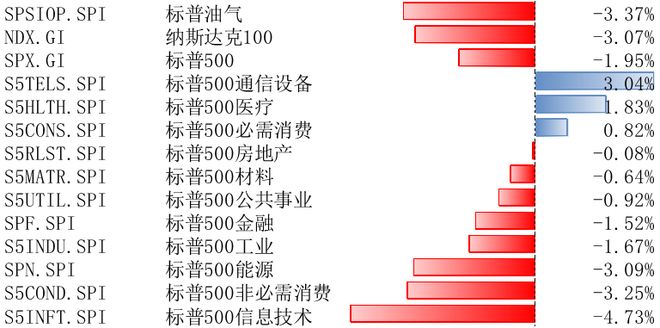
(来源:博时基金) 一、美国宏观经济数据 来源:市场投研资讯 美国9月非农新增就业大超预期,失业率小幅抬升,小时工资环比增速放缓。美国9月非农就业人口新增 11.9万人,高于预期值5.1万人和前值-0.4万人。美国9月失业率为4.4%,高于预期值和前值4.3%。美国9 月平均每小时工资环比增长0.2%,低于预期值0.3%和前值0.4%。美国9月平均每小时工资同比增长 3.8%,高于预期值3.7%,与前值持平。 美国服务业延续扩张,制造业景气度略低于预期。美国11月标普服务业PMI录得55%,高于预期值 54.6%和前值54.8%;美国11月标普制造业PMI录得51.9%,略低于预期值52%和前值52.5%。 美国10月成屋销售超预期上行。美国10月成屋销售总数年化环比增长1.2%,高于预期值0.5%,略低于 前值1.3%;美国10月成屋销售总数年化为410万户,高于预期值408万户和前值405万户。 二、主要指数相关情况 1、 一周指数表现 上周(11月17日-21日),标普油气指数整周下跌3.37%,纳斯达克100指数整周下跌3.07%,标普500指 数整周下跌1.95%,其覆盖的11个行业板块有3个上涨, ...
【黄金期货收评】关注俄乌冲突相关动向 沪金飙升1.48%
Jin Tou Wang· 2025-11-25 09:38
【基本面消息】 数据显示,11月25日上海黄金现货价格报价943.15元/克,相较于期货主力价格(946.50元/克)贴水3.35 元/克。 【黄金期货最新行情】 | 11月25日 | 收盘价(元/克) | 当日涨跌幅 | 成交量(手) | 持仓量(手) | | --- | --- | --- | --- | --- | | 沪金主力 | 946.50 | 1.48% | 299689 | 181169 | 打开APP,查看更多高清行情>> 首先,美联储年内降息预期仍存。"宽松预期+弱美元"修复通道持续。其次,避险情绪升温。美国债务 膨胀、去美元化、地缘冲突再加剧以及中美贸易摩擦、经济格局重塑等弹性避险需求增强了黄金的战略 配置价值。 同时,央行购金是人民币国际化的必经之路。从长期交易策略来看,伴随着美元信用体系受损、全球货 币体系重构以及全球资产重估,非美资产相对占优,黄金仍将是长期的资产配置品种。 短期来看,美联储近期发表鹰派言论,市场对12月的降息预期下降至四成,且市场炒作AI泡沫,短期 流动性收紧,金价短线回调。 【机构观点】 广州期货:CME美联储观察模型显示,由外盘联邦基金利率期货价格反推的12月 ...