
AI芯片

Search documents
恒生科技指数高开高走,半导体板块涨幅居前,中芯国际午后涨超5%
Mei Ri Jing Ji Xin Wen· 2025-11-06 05:40
Group 1 - The Hong Kong stock market indices opened high and continued to rise, with the Hang Seng Tech Index up nearly 2% in the afternoon, driven by gains in tech stocks, metals, and semiconductor sectors [1] - Semiconductor stocks led the gains, with SMIC rising over 5% in the afternoon, attributed to the surge in demand for generative AI training and inference, which is accelerating investments in servers and network facilities [1] - The global GPU market is projected to grow from $77.39 billion in 2024 to $472.45 billion by 2030, indicating rapid growth in the AI chip market in China since the launch of DeepSeek [1] Group 2 - As of November 5, the Hang Seng Tech Index ETF (513180) had a latest valuation (PETTM) of 22.52 times, which is in the low valuation range historically, being below 73% of the time since the index was launched [2] - The outlook for the Hong Kong tech sector is positive, benefiting from the current AI-driven industrial trends, potential foreign capital inflow due to expected Fed rate cuts, and continuous accumulation of southbound funds, suggesting a promising fourth quarter for the Hang Seng Tech Index [2] - Investors without a Hong Kong Stock Connect account can consider the Hang Seng Tech Index ETF (513180) for exposure to core Chinese AI assets [2]

半导体大爆发,长光华芯20cm涨停,中芯国际涨超5%,沪指重回4000点
21世纪经济报道· 2025-11-06 04:08
Market Overview - The A-share semiconductor industry chain experienced a significant surge, with the Shanghai Composite Index rising nearly 1% and returning above 4000 points, while the STAR 50 Index increased by nearly 3% [1][2] - The total trading volume in the Shanghai and Shenzhen markets reached 1.34 trillion yuan, an increase of 188 billion yuan compared to the previous trading day [1][2] Semiconductor Sector Performance - The semiconductor sector saw explosive growth, with stocks like Changguang Huaxin and Demingli hitting the daily limit, and Haiguang Information rising over 10% during trading [2] - Notable gains were observed in computing hardware, with Cambrian-U rising over 7%, briefly surpassing Kweichow Moutai to become the highest-priced stock in A-shares before being overtaken again [3][4] Storage Chip Market Dynamics - The storage chip concept gained strength, with stocks like Jiangbolong rising over 4%. Reports indicate that some DRAM and Flash products have stopped quoting prices or are experiencing daily price fluctuations [4] - Xiaomi's founder publicly commented on the significant price increases in memory chips, highlighting the market's volatility [4] Aluminum and Chemical Sectors - The electrolytic aluminum sector saw a sudden surge, with China Aluminum nearing a daily limit and reaching a 15-year high. Other companies like Minfa Aluminum and Nanshan Aluminum also hit the daily limit [4] - The chemical sector experienced a similar explosion, with multiple stocks like Batian and Chengxing hitting the daily limit [4] Electric Equipment and Gas Turbine Stocks - Electric equipment stocks showed strong performance, with companies like Moen Electric and Baobian Electric achieving consecutive daily limits. UBS raised its forecast for China's electricity demand growth from 2028 to 2030 [5] - The gas turbine sector also saw gains, with companies like Triangle Defense and Quan Chai Power hitting the daily limit [5] Technology Sector Outlook - According to Frost & Sullivan, China's AI chip market is projected to grow from 142.54 billion yuan in 2024 to 1,336.79 billion yuan by 2029, with a compound annual growth rate of 53.7% from 2025 to 2029 [7] - Dongguan Securities noted that while short-term returns in the tech sector may be uncertain due to capital expenditure expansion, the long-term growth trend remains intact [7]






何小鹏:全倾转固定翼飞行汽车汇天A868已进入试飞阶段;LG电子向苹果在印度的iPhone生产线提供制造设备丨智能制造日报
创业邦· 2025-11-06 03:44
Group 1 - Volkswagen announced the self-developed SoC chip, expected to be mass-produced and delivered within 3 to 5 years, with a computing power of 500 to 700 TOPS and a strategic investment of approximately $200 million [2] - Elon Musk clarified that Tesla's AI5 chip will only be mass-produced in 2027, with samples available in 2026, while the AI6 chip is expected to be produced in mid-2028, offering about double the performance [2] - Xiaopeng Motors' chairman He Xiaopeng revealed that the hybrid long-range flying car, Huitian A868, has entered the test flight stage, designed for a range greater than 500 km and a maximum speed exceeding 360 km/h, accommodating up to 6 passengers [2] Group 2 - LG Electronics reportedly provided manufacturing equipment to Apple's iPhone production line in India, facilitating the automated manufacturing process for the latest iPhone 17 [2]



突然!马斯克,重大宣布!
券商中国· 2025-11-05 15:02
Core Viewpoint - Tesla's AI5 chip is expected to be sampled in 2026 and mass-produced in 2027, with significant performance improvements over existing models [2][4][5]. Chip Development - The AI5 chip will be manufactured by TSMC and Samsung, with different versions produced to ensure consistent performance across platforms [4]. - The AI5 chip is designed to achieve 2000 to 2500 TOPS, which is five times the performance of the current HW4 chip, supporting more complex FSD algorithms [4]. - The AI6 chip is planned to double the performance of the AI5 and is expected to be mass-produced by mid-2028 [5]. Market Reaction - Tesla's stock price fell over 5% on November 4, reducing its market capitalization to approximately $1.48 trillion (about 10.5 trillion RMB) [6]. - The decline in stock price was influenced by concerns over Elon Musk's compensation plan, which is facing opposition from major shareholders like the Norwegian sovereign wealth fund [6]. Strategic Implications - The AI5 and subsequent chips are intended to support Tesla's autonomous driving and robotics projects, including the FSD system and Dojo supercomputing platform [5]. - The potential rejection of Musk's compensation plan could lead to a significant drop in Tesla's stock price and raise concerns about the company's strategic direction and talent retention [6].

何小鹏:小鹏第二代VLA大模型将开源 图灵AI芯片获大众定点
Di Yi Cai Jing· 2025-11-05 08:03
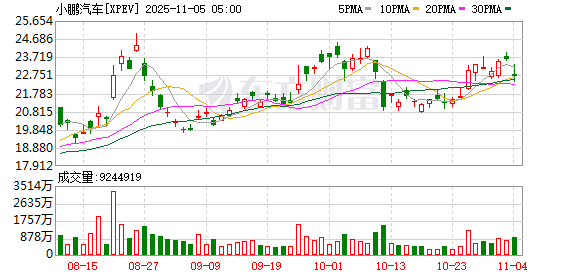
Core Insights - Xiaopeng Motors announced the open-sourcing of its second-generation VLA large model for global commercial partners, with Volkswagen becoming the first strategic partner for this initiative [2] - The Xiaopeng Turing AI chip has been specifically designated for Volkswagen [2]
大众成为小鹏第二代VLA首发客户
Feng Huang Wang· 2025-11-05 07:53
Core Insights - Xiaopeng Motors unveiled its second-generation VLA model at the 2025 Xiaopeng Technology Day, with Volkswagen as the launch customer for this model [1] - The Xiaopeng Turing AI chip has been designated for Volkswagen, indicating a strategic partnership between the two companies [1] Company Developments - The introduction of the second-generation VLA model signifies Xiaopeng Motors' commitment to innovation and expansion in the electric vehicle market [1] - Partnering with Volkswagen as the first customer highlights the growing collaboration between traditional automotive manufacturers and electric vehicle startups [1] Industry Trends - The announcement reflects a broader trend in the automotive industry where established companies are increasingly collaborating with tech-driven firms to enhance their product offerings [1] - The integration of advanced AI technology, such as the Xiaopeng Turing AI chip, showcases the industry's shift towards smarter, more connected vehicles [1]
AI算力大战打到太空!英伟达前脚H100入轨,谷歌TPU后脚上天,中国玩家笑而不语
量子位· 2025-11-05 02:08
Core Viewpoint - The article discusses the competition between Nvidia and Google in deploying AI computing capabilities in space, highlighting the advancements made by a Chinese company, Starcloud, which has already launched its satellite for this purpose [1][5][31]. Group 1: Company Initiatives - Nvidia has successfully launched the Starcloud-1 satellite equipped with the H100 chip, which weighs 60 kg and is comparable in size to a small refrigerator [7][8]. - Starcloud aims to establish a 5-gigawatt space data center, with plans to start commercial services next year and to send additional satellites into orbit [11][12]. - Google plans to launch its TPU satellites under the "Project Suncatcher," with the first two prototype satellites expected to be launched in early 2027 [14][15]. Group 2: Advantages of Space Deployment - Starcloud claims that the energy cost in space is only one-tenth of that on Earth, even when accounting for launch expenses [21]. - Google estimates that if the cost of launching to Low Earth Orbit (LEO) drops to $200 per kilogram, the annual cost of power per kilowatt could be reduced to $810, comparable to current U.S. data center costs [22]. - Solar energy in space can be harnessed more efficiently, with solar panels potentially generating eight times more energy than on Earth, thus reducing reliance on batteries [24]. Group 3: Technical Challenges and Solutions - Starcloud has developed a vacuum cooling architecture to manage heat from the H100 chip, utilizing high thermal conductivity materials [25]. - Google has successfully tested high-speed optical communication links for satellite clusters, achieving 800 Gbps unidirectional and 1.6 Tbps bidirectional communication [27]. - Both companies acknowledge significant engineering challenges remain, such as thermal management and high-bandwidth ground communication [30]. Group 4: Competitive Landscape - Starcloud's "Three-body Computing Constellation" has already been operational for six months, featuring 12 satellites capable of space computing and interconnectivity, achieving a total in-orbit computing power of 5 Peta Operations Per Second (POPS) [32][34]. - The entry of Nvidia and Google into the space AI race is expected to intensify competition in this emerging sector [35].


1800亿江西首富执掌公司,遭前高管索赔43亿
Sou Hu Cai Jing· 2025-11-04 14:04
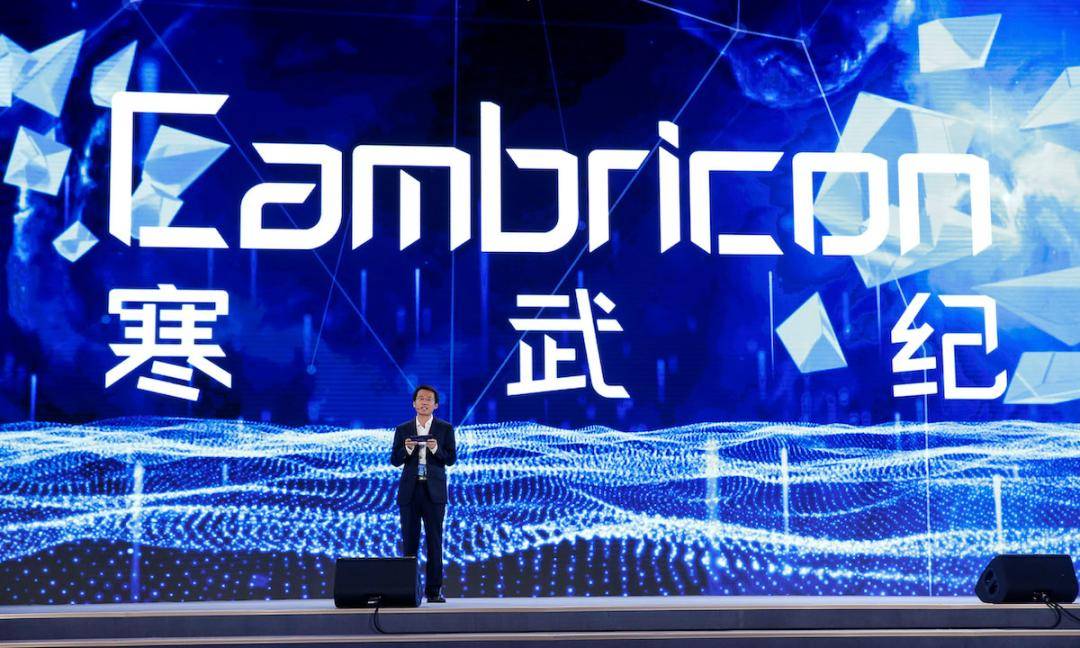
Core Viewpoint - The company Cambricon is currently embroiled in a high-stakes lawsuit initiated by its former CTO Liang Jun, who is claiming damages of 4.287 billion yuan, which is 2.67 times the company's net profit for the first three quarters of the year, setting a record for compensation claims in China's tech sector [2][4][6]. Financial Performance - In the first three quarters, Cambricon achieved revenue of 4.607 billion yuan, a year-on-year increase of 2386.38%, and a net profit of 1.605 billion yuan, marking a turnaround from a loss of 724 million yuan in the same period last year [2][16]. - The third quarter alone saw revenue of 1.727 billion yuan, up 1332.52% year-on-year, with a net profit of 567 million yuan, reflecting a 391.47% increase [16]. Legal Dispute Details - Liang Jun's lawsuit includes three main requests: confirmation of his employment relationship with Cambricon, compensation for stock incentive losses amounting to 4.287 billion yuan, and coverage of legal fees by the company [4][5]. - The compensation claim is based on Liang's indirect holding of 11.5232 million shares, calculated at a maximum stock price of 372 yuan per share [5][6]. Company Background - Cambricon, founded in 2017, is a leading domestic AI chip company and was the first to be listed on the Sci-Tech Innovation Board in China [7]. - Liang Jun, who has a strong background in technology and management, played a crucial role in the development of key chip products before leaving the company in 2022 due to disagreements [6][12]. Market Position and Challenges - Despite impressive financial results, Cambricon faces several challenges, including a decline in third-quarter performance compared to the previous quarter, a concentrated business structure, and high valuation ratios compared to industry averages [3][18]. - The AI chip market is becoming increasingly competitive, with major players like NVIDIA and AMD posing significant threats, alongside domestic competitors such as Huawei and Biren Technology [19][20]. Implications of the Lawsuit - The lawsuit could potentially impact Cambricon's brand image and its ability to attract talent, as it highlights the intense competition for core technical personnel in the AI sector [21]. - Legal experts suggest that Liang's claims may lack a solid contractual basis, which could mitigate the potential financial impact on the company [14][15].
北京利尔跌2.08%,成交额8448.85万元,主力资金净流出1306.22万元
Xin Lang Cai Jing· 2025-11-04 06:06
Core Viewpoint - Beijing Lier's stock price has shown significant volatility, with a year-to-date increase of 70.86%, but a recent decline of 17.42% over the past 20 days, indicating potential market fluctuations and investor sentiment changes [1][2]. Company Overview - Beijing Lier High-Temperature Materials Co., Ltd. was established on November 8, 2000, and went public on April 23, 2010. The company specializes in the production and sales of refractory materials for various industries, including steel, non-ferrous metals, petrochemicals, and construction materials [2]. - The company's main business revenue composition includes: 61.89% from overall contracting of refractory materials, 27.40% from direct sales, and 10.71% from refractory material direct sales [2]. - As of September 30, the number of shareholders increased to 43,200, with an average of 26,461 circulating shares per person, reflecting a slight decrease of 2.35% [2]. Financial Performance - For the period from January to September 2025, Beijing Lier achieved an operating income of 5.446 billion yuan, representing a year-on-year growth of 9.16%. The net profit attributable to shareholders was 348 million yuan, with a year-on-year increase of 12.28% [2]. - The company has distributed a total of 444.5 million yuan in dividends since its A-share listing, with 154 million yuan distributed over the past three years [3].

国金证券期货宏观日报-20251103
SINOLINK SECURITIES· 2025-11-03 15:37
Investment Rating - The report provides a positive investment rating for the communication sector, indicating potential growth opportunities in the industry [33]. Core Insights - The communication sector has shown resilience and growth, with significant increases in revenue and market demand projected for the coming years [10][12]. - Key players in the sector, such as China Mobile and ZTE, are expected to maintain strong performance due to their strategic investments in technology and infrastructure [66]. - The report highlights the increasing importance of cloud services and AI technologies, which are anticipated to drive future growth in the communication industry [36][56]. Summary by Sections Market Performance - The communication sector has experienced a cumulative increase in stock prices, outperforming the broader market indices [3][4]. - The sector's performance is supported by robust demand for telecommunications services and advancements in technology [10]. Financial Metrics - Revenue growth for major companies in the sector is projected to continue, with significant year-on-year increases expected [41][48]. - Profit margins are also anticipated to improve, reflecting operational efficiencies and cost management strategies [49][50]. Company Analysis - China Mobile is highlighted as a leading player with a strong market position and consistent revenue growth, projected to reach significant earnings per share in the coming years [66]. - Other notable companies such as ZTE and Xin Yi Sheng are also expected to show strong financial performance, driven by their innovative product offerings and market expansion strategies [9][66].





