
生产性服务业

Search documents
干货满满!扩范围、清障碍 促进民间投资13条来了
2 1 Shi Ji Jing Ji Bao Dao· 2025-11-10 13:24
11月10日,国务院办公厅对外发布《关于进一步促进民间投资发展的若干措施》(下文简称《若干措施》)。 《若干措施》行文简洁明快,共计出台13条支持措施。"促进民间投资13条"重点围绕扩大市场准入、促进公平竞争、强化资源 支持、优化投融资服务等民企核心关切展开,干货满满。 "促进民间投资13条"进一步拓宽了民间投资空间,支持民间资本加大新质生产力、新兴服务业、新型基础设施等领域投资;要 求严格落实招标投标领域相关制度规定,保障中小企业政府采购预留份额,加大中央预算内投资等对民间投资项目的支持力度 等;还致力于营造公平竞争市场环境,破除限制民间投资的各种隐性壁垒,加强创新支撑和融资支持,完善服务体系,让民营 企业敢投资、有回报。 支持民企入股铁路、核电等 《若干措施》有多条举措涉及扩大市场准入,旨在进一步拓宽民间资本的投资范围,包括支持民企入股铁路、核电等重大项 目,参与城市基础设施领域新建项目,参与低空经济、商业航天、卫星通信等领域,支持民企投向生产性服务业等。 《若干措施》指出,对需报国家审批(核准)的具有一定收益的铁路、核电、水电、跨省跨区直流输电通道、油气管道、进口 液化天然气接收和储运设施、供水等领域项 ...

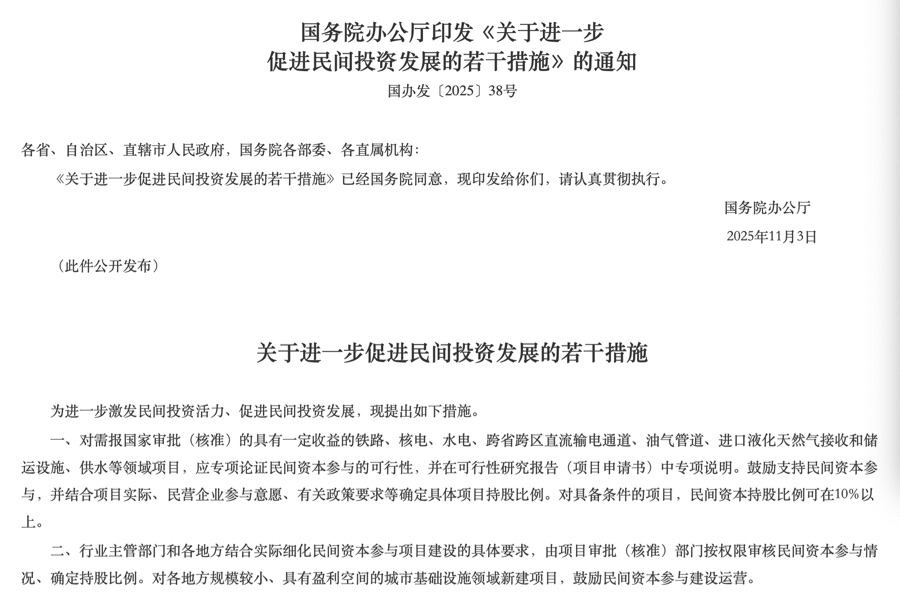
促进民间投资,国办最新发声!
券商中国· 2025-11-10 10:48
Core Viewpoint - The article discusses the recent measures introduced by the State Council to stimulate private investment and promote its development, outlining 13 specific policy initiatives aimed at enhancing the participation of private capital in various sectors [1][3]. Group 1: Policy Measures - The government will conduct special feasibility studies for private capital participation in projects requiring national approval, allowing private capital to hold more than 10% in certain projects [3]. - Local authorities are encouraged to detail specific requirements for private capital involvement in project construction, particularly in smaller urban infrastructure projects [3]. - Private capital will be guided to participate in low-altitude economy infrastructure construction, with equal treatment in commercial space projects [3]. Group 2: Service Sector and Government Cooperation - The article emphasizes the removal of unreasonable entry barriers in the service industry, particularly in sectors like environmental protection and quality certification, to encourage private investment [4]. - It outlines the need for a new mechanism for public-private partnerships, ensuring fair conditions for private capital participation in concession projects [4]. - The government will increase procurement support for small and medium-sized enterprises (SMEs), mandating that at least 40% of budgets for projects over 4 million yuan be reserved for SMEs [4][5]. Group 3: Infrastructure and Digital Transformation - There will be enhanced regulation of network infrastructure operations to protect the rights of private enterprises in energy and transportation sectors [5]. - The government will support the establishment of major pilot platforms by private enterprises in key industries, facilitating market-oriented trial services from state-owned enterprises and research institutions [6]. - Initiatives will be taken to promote digital transformation among SMEs, including the development of comprehensive digital empowerment platforms [6]. Group 4: Financial Support and Investment - The central government will increase budgetary investments in eligible private investment projects, utilizing new policy financial tools to support key sectors [6][7]. - Financial institutions are encouraged to set annual service targets for private enterprises, ensuring access to credit and promoting innovative financing mechanisms [7]. - The article highlights the importance of supporting technology-driven enterprises in accessing public markets and investment trusts [7]. Group 5: Monitoring and Compliance - There is a call for improved services and guidance for private investment, including the establishment of a monitoring system for private investment statistics [7]. - The article stresses the need for private enterprises to operate legally and responsibly, emphasizing the importance of risk prevention and high-quality development in private investment [7].
21专访|黄群慧:发展新质生产力是“十五五”产业政策主线
2 1 Shi Ji Jing Ji Bao Dao· 2025-11-05 11:49
Core Viewpoint - The article discusses China's strategic plan for industrial development during the 15th Five-Year Plan period, emphasizing the construction of a modern industrial system and the strengthening of the real economy as primary tasks [1][2]. Group 1: Traditional Industry Optimization - The 15th Five-Year Plan aims to consolidate and enhance the global competitiveness of traditional industries such as mining, metallurgy, and machinery, which are crucial for economic resilience [3][4]. - The transformation and upgrading of these traditional industries through intelligent, green, and high-end development are expected to generate significant economic value, potentially reaching trillions in added value [4]. Group 2: Emerging Industries - The plan highlights the importance of emerging industries like new energy, new materials, and aerospace, which are anticipated to become major drivers of economic growth and have strong interconnections with various sectors [5][6]. - The development of strategic emerging industries should be tailored to local conditions, leveraging regional resources and capabilities to foster suitable industry clusters [5]. Group 3: Future Industries - The proposal includes promoting future industries such as quantum technology and hydrogen energy, which are seen as critical for gaining competitive advantages in global markets [6][7]. - These future industries are characterized by high dependence on original innovation and long investment cycles, necessitating careful planning and support for their development [6]. Group 4: Modern Industrial System - The modern industrial system is identified as the material and technical foundation for China's modernization, with a focus on maintaining a robust manufacturing sector [7][8]. - The integration of advanced manufacturing with new technologies is essential for driving high-quality development and achieving the goals of the 15th Five-Year Plan [8]. Group 5: New Infrastructure and Service Industry - The plan emphasizes the need for new infrastructure, particularly in computing power, to support technological advancements and industrial upgrades [9][10]. - The expansion and enhancement of the productive service industry are crucial for facilitating the transformation of manufacturing and achieving higher value chains [11].
为“硬制造”匹配“软服务”——天津现代服务业高质量发展观察
Xin Hua Wang· 2025-11-05 02:40
Core Insights - The article highlights the rapid development of the modern service industry in Tianjin, emphasizing its role in driving economic transformation and innovation [2][3] - The establishment of high-quality pilot testing platforms is crucial for the industrialization of scientific research outcomes, particularly in the petrochemical sector [3][4] - Financial innovations, such as the "laboratory all-risk" insurance, are being introduced to support research and development activities [9][10] Group 1: Economic Growth and Service Industry - Tianjin's third industry added value grew by 5.2% in the first three quarters, with modern service sectors like information technology and business services showing double-digit growth rates of 21.8% and 14.4%, respectively [2] - The city is nurturing new business models and pathways in the modern service industry, contributing to sustained economic momentum [2] Group 2: Pilot Testing and Innovation - The POE (polyolefin elastomer) material is a key focus, with breakthroughs in domestic technology leading to significant advancements in catalyst activity, achieving 1.5 million times the activity of existing catalysts [3] - The establishment of the North Chemical Institute's Tianjin Scientific Experiment Base is a significant step in enhancing pilot testing capabilities, with 33 scientific tasks underway and projected research income of 290 million yuan by 2025 [4] Group 3: Financial Support for Innovation - The introduction of the "laboratory all-risk" insurance aims to provide a safety net for research activities, covering personnel and third-party liabilities during experiments [9][10] - Tianjin's financial services are increasingly integrated into the modern industrial system, with a focus on addressing funding challenges for innovative enterprises [10][11] - The city plans to increase its technology loan balance from over 900 billion yuan to 1.1 trillion yuan by 2027, indicating a strong commitment to supporting technological innovation [11]

李正军:把握产业转型升级的原则重点
Jing Ji Ri Bao· 2025-11-04 00:04
Core Viewpoint - The 20th Central Committee's Fourth Plenary Session emphasizes the importance of focusing economic development on the real economy, advocating for intelligent, green, and integrated development as a guiding principle for industrial transformation and upgrading [1][2]. Group 1: Industrial Transformation and Upgrading - Industrial transformation and upgrading are essential for adapting to macroeconomic environments, technological trends, and market changes, involving both internal upgrades and structural optimization between industries [3]. - The key to industrial transformation is achieving qualitative leaps in development, shifting from factor-driven to innovation-driven growth, and enhancing total factor productivity through technological innovation and management optimization [3][4]. Group 2: Challenges and Strategic Directions - The current industrial landscape faces pressures from global trends such as unilateralism and protectionism, necessitating a focus on high-quality development and the establishment of a modern industrial system centered on advanced manufacturing [2][4]. - To enhance industrial chain resilience and security, it is crucial to prioritize quality improvement, implement foundational re-engineering, and develop strategic emerging industries like intelligent manufacturing and new materials [4][5]. Group 3: Principles for Industrial Upgrading - Four key principles for industrial upgrading include: 1. Adapting to local conditions by identifying unique regional industries to enhance competitiveness [5]. 2. Promoting deep integration of technological and industrial innovation to foster new industries and business models [5]. 3. Coordinating the optimization of traditional industries while nurturing emerging sectors to solidify the foundation of the real economy [5]. 4. Focusing on the modernization of the industrial chain and supply chain, supported by high-end service industries that enhance overall efficiency [5][6].
会长话封关:“建设更完善的现代化产业体系”
Sou Hu Cai Jing· 2025-11-02 12:30
Core Viewpoint - The construction of a more complete modern industrial system in Hainan is essential, leveraging the advantages of the free trade port and policy levers to enhance market guidance [1] Group 1: Exhibition Economy - Hainan should utilize tax policy incentives post-free trade port closure to stimulate the exhibition economy, aiming to make it one of the pillar industries [2] - The exhibition economy has five key characteristics: high driving effect, frontier nature, quality, window effect, and social effect [2] - Hainan's tax, geographical, and climate advantages provide an excellent foundation for developing the exhibition economy, with a focus on incorporating local or ethnic characteristics [2] Group 2: Tourism Industry Development - The tourism industry in Hainan has not reached its ideal level, primarily due to a high proportion of sightseeing products and significant seasonal fluctuations [3] - A multi-dimensional development approach is needed, integrating tourism with deep-sea economy and low-altitude economy [3] - Examples include developing deep-sea aquaculture and low-altitude sightseeing products to attract a diverse range of tourists [3] Group 3: Silver Economy and Health Care Economy - Hainan can address challenges in the real estate sector by developing a community-based silver economy, utilizing idle assets for community elder care [4] - The establishment of high-end health care communities can help alleviate real estate inventory issues, providing standardized facilities and services [4] Group 4: Modern Service Industry Chains - Hainan's service industry has been dominated by life services, with production services being relatively weak; establishing four major service industry chains is recommended [5] - The proposed chains include modern logistics, international shipping, financial services, and cross-border digital services, which are crucial for the development of the free trade port [5] - Effective market construction and government support are essential to convert policy advantages into economic benefits and high-end industry advantages [5]
黄奇帆:民企不要在制造业“内卷”,生产性服务业还可盘活商业地产
Sou Hu Cai Jing· 2025-10-30 23:05
Core Insights - By 2025, China's GDP is expected to reach approximately 140 trillion yuan, with a projected increase of over 35 trillion yuan during the 14th Five-Year Plan, equivalent to the total GDP of Guangdong, Jiangsu, and Shandong provinces combined, surpassing the economic output of the world's third-largest economy [1] - Manufacturing is identified as the core pillar supporting this substantial economic base, with China maintaining the world's largest manufacturing scale for 15 consecutive years and leading in the production of over 200 major industrial products [1] - The development of the productive service industry, which is closely related to manufacturing, has lagged behind, presenting new growth opportunities for China's economy during the 15th Five-Year Plan [3][4] Productive Service Industry - The productive service industry is defined as sectors that provide services to manufacturing, including research and development, design, logistics, and financial services, rather than producing tangible products [5] - This sector has seen its GDP share increase from 10% in 1980 to approximately 28% by 2024, making it the fastest-growing segment of China's GDP, with an average annual growth rate of about 12.1% from 2020 to 2024, significantly outpacing the overall GDP growth rate of 5% [7][8] - In comparison, the productive service industry accounts for about 50% of GDP in the United States, indicating substantial room for growth in China [7] Role of Private Enterprises - Private enterprises are encouraged to expand their focus beyond traditional manufacturing and seize opportunities in the productive service industry, which is seen as a promising area for growth [3][11] - The report highlights that private enterprises contribute over 50% of China's tax revenue, 60% of GDP, 70% of technological innovations, 80% of urban employment, and 90% of new urban jobs, underscoring their critical role in the economy [11] - The rise of unicorn companies, particularly in the productive service sector, is viewed as a key driver for industry growth, with 372 unicorns in China valued at over $1.2 trillion, indicating a need for nurturing and expanding these enterprises [9][11] Employment and Economic Development - The growth of the productive service industry is expected to create millions of jobs in office settings, helping to alleviate the current supply-demand imbalance in the commercial real estate market [11] - With over 10 million university graduates entering the job market annually, the productive service industry offers new avenues for employment and entrepreneurship, particularly for high-skilled talent [11]
主流经济学产业结构 论调局限在哪
Sou Hu Cai Jing· 2025-10-30 22:21
Core Argument - The mainstream economic view that prioritizes the development of productive services as the leading industry is outdated; instead, a strong manufacturing sector, particularly high-end manufacturing, is essential for a country's economic strength and competitiveness [1][2][3]. Group 1: Historical Context and Economic Theories - Historically, no country has become a global power solely through services; all strong nations have relied on manufacturing [3]. - The "Pietro-Clark Theorem" suggests that as income rises, labor shifts from primary to secondary and then to tertiary industries, but this view has misled global industrial structure adjustments [1][3]. - The U.S. began to refocus on manufacturing as a strategic economic initiative during the Obama administration, indicating a shift back to prioritizing manufacturing [2]. Group 2: Importance of Manufacturing - The rise of the Netherlands in the 17th century was closely tied to its manufacturing strength, particularly in textiles, which was later undermined by an overemphasis on commerce and finance [3]. - The experience of Hong Kong illustrates that a lack of strong manufacturing can limit economic development, despite having competitive service sectors [4]. - A robust manufacturing base is crucial for national security; countries without strong manufacturing capabilities risk vulnerability [4]. Group 3: Current Global Trends - The global competition for economic dominance is increasingly centered on high-end and advanced manufacturing sectors, with major developed countries vying for resources in these areas [2][5]. - The U.S. maintains a competitive edge in high-end manufacturing, particularly in defense and aerospace, as evidenced by the production of advanced military aircraft [4]. - The urgency for China to develop a manufacturing-centric industrial system is emphasized, highlighting a consensus on the importance of this strategy for long-term economic stability [5].
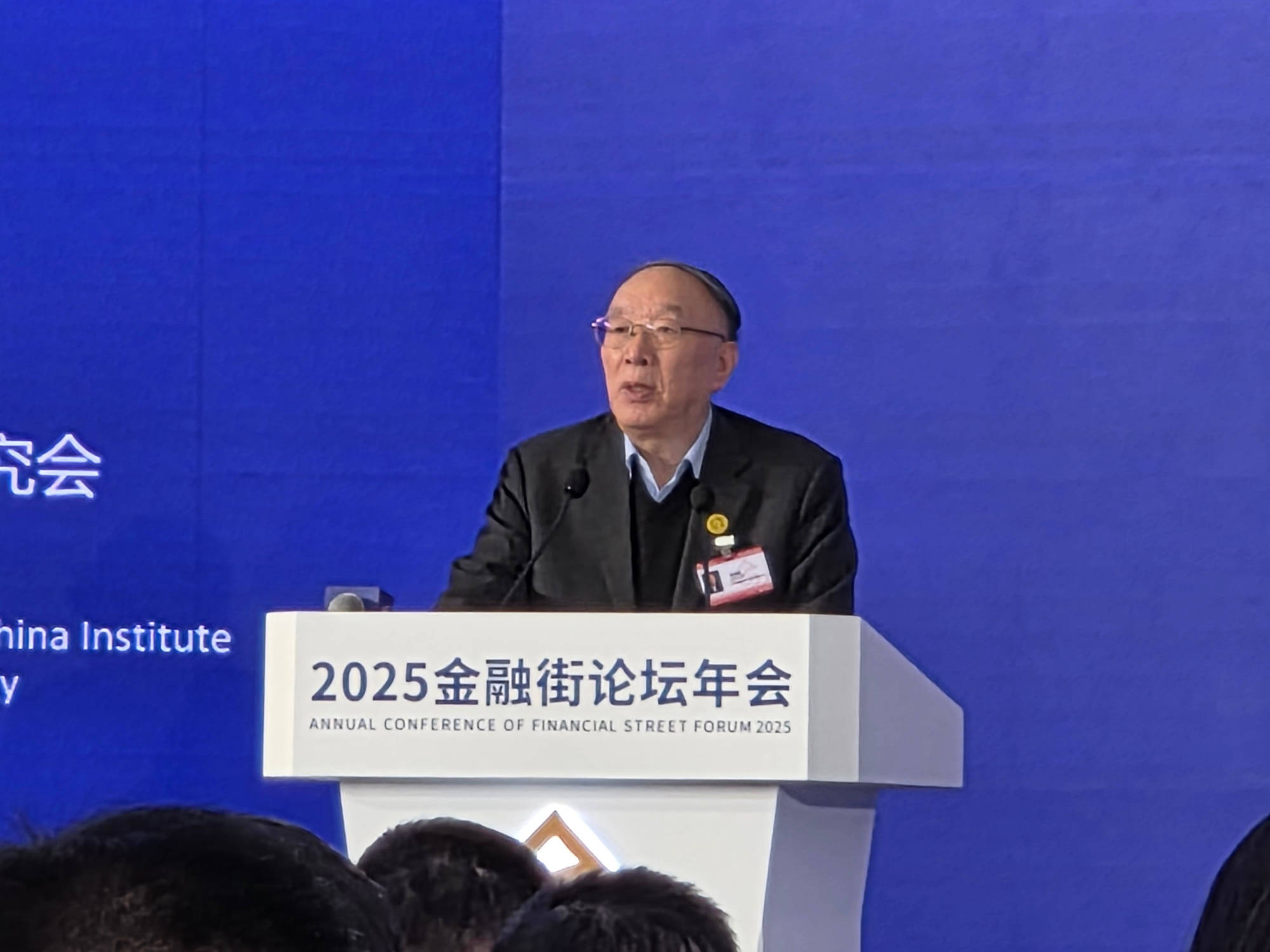
2025金融街论坛|黄奇帆:生产性服务业是民营企业发展新赛道
Bei Jing Shang Bao· 2025-10-29 15:41
Core Insights - China's manufacturing industry has achieved "five leading and five parallel" sectors, with automotive, shipbuilding, power equipment, high-speed rail equipment, and new energy equipment leading globally, while new materials, biomedicine, high-end equipment, aerospace, and artificial intelligence are on par with developed countries [1] Group 1: Manufacturing Sector - The global share of China's manufacturing industry has reached 32% [1] - The leading sectors are automotive, shipbuilding, power equipment, high-speed rail equipment, and new energy equipment [1] - The parallel sectors include new materials, biomedicine, high-end equipment, aerospace, and artificial intelligence [1] Group 2: Service Industry - The productive service industry encompasses ten categories: R&D, logistics, inspection and testing, finance, green low-carbon, digitalization, trade, intellectual property, professional consulting, and human resources [1] - This sector is identified as a growth driver for GDP, unicorn cultivation, service trade enhancement, and total factor productivity [1] - There is a call for private enterprises to expand into the productive service industry to alleviate manufacturing competition, create job opportunities for graduates, and revitalize office resources [1]

营业执照10分钟搞定!广东惠州注册效率助力生产性服务业发展再添新动能
Zhong Guo Zhi Liang Xin Wen Wang· 2025-10-24 08:30
Group 1 - The establishment of China Energy Conservation and Environmental Protection Group's subsidiary in Huizhou marks a significant step in promoting high-quality development of the productive service industry in the region [1] - Huizhou is striving to become a new growth pole for high-quality development in Guangdong, with the optimization of the business environment being a key focus [1] - The efficient registration process, taking only 10 minutes, reflects Huizhou's commitment to enhancing administrative service efficiency and attracting quality enterprises [1] Group 2 - Huizhou's market regulatory department has implemented full electronic registration and a unified review system to improve the efficiency of business registrations [2] - In 2023, the average processing time for business establishment in Huizhou has been reduced to 0.20 hours, with a 71.01% improvement in registration efficiency compared to June [2] - The regulatory department's efforts in streamlining registration processes have led to increased enterprise satisfaction and market activity [2]
