
美联储政策预期

Search documents
白银演绎“过山车”行情:单日巨震逾10%,马斯克直呼价格如此暴涨“不是好事”
Sou Hu Cai Jing· 2025-12-29 02:56
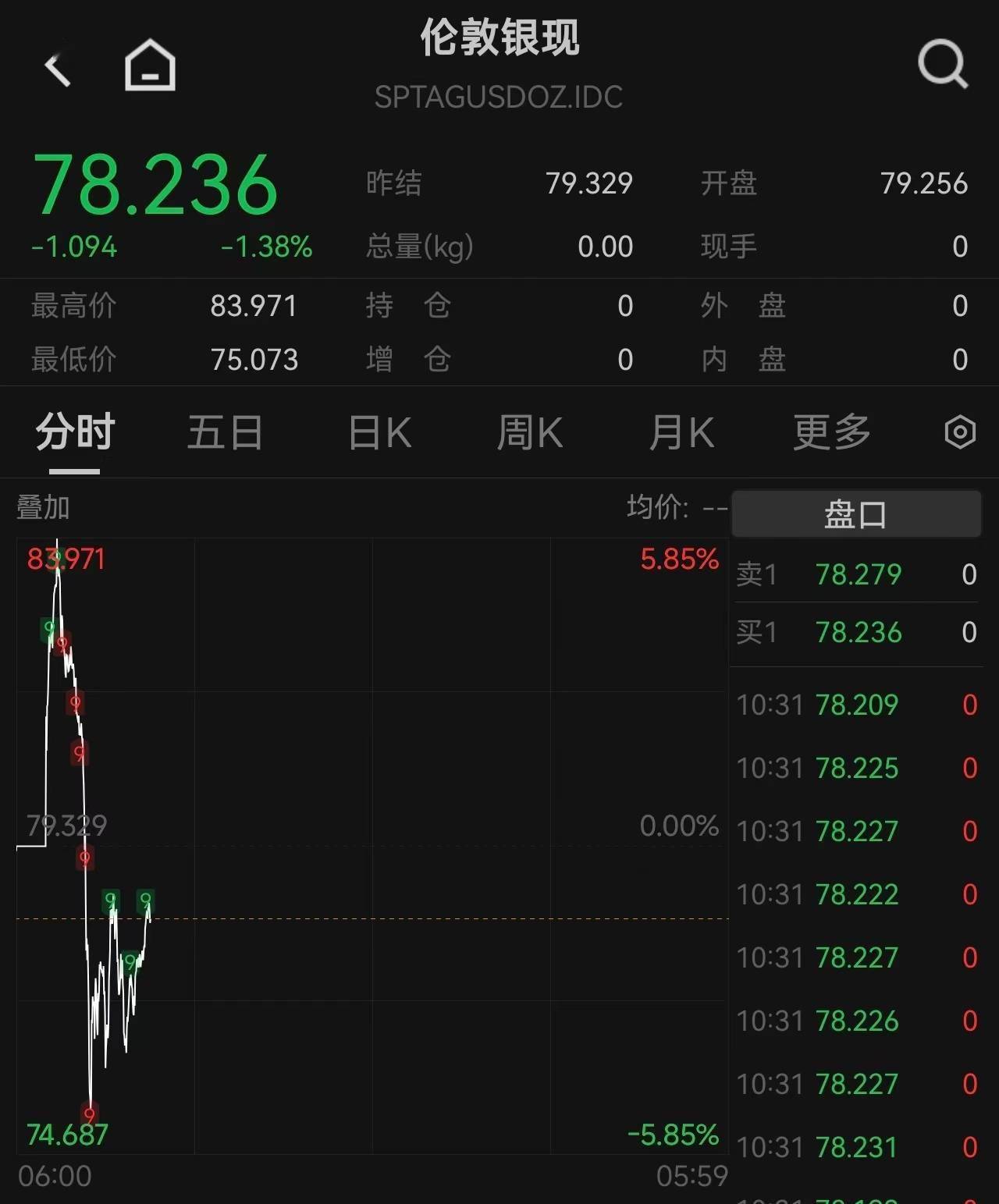
Core Viewpoint - The silver market has entered a "high volatility mode," driven by supply shortages supporting prices while speculative sentiment amplifies risks [1]. Group 1: Price Movements - On Monday, spot silver surged nearly 6% during Asian trading, approaching $84 per ounce, but later experienced a sharp decline, with intraday losses exceeding 5%, resulting in a total fluctuation of over 10% [1]. - As of the report, the spot silver price retreated to around $78 [1]. - The highest price recorded was $83.971, while the lowest was $75.073 [2]. Group 2: Yearly Performance - Silver has shown remarkable performance this year, starting at $29 per ounce and achieving a maximum cumulative increase of approximately 180%, significantly outpacing gold [3]. - Last week alone, spot silver saw a weekly increase close to 18% [3]. Group 3: Market Reactions - The domestic futures market mirrored international trends, with the main Shanghai silver contract rising over 7% at one point, reaching a new high [3]. - The A-share market reacted positively, with the non-ferrous metal sector becoming active, including significant gains for silver-related companies [3]. Group 4: Supply and Demand Dynamics - The surge in silver prices is attributed to a severe imbalance in supply and demand, with global silver demand projected to reach 1.24 billion ounces by 2025, while supply is only expected to be 1.01 billion ounces, creating a shortfall of 100 to 250 million ounces [6]. - The market has been in a "structural deficit" for five consecutive years, driven by increasing consumption in industries such as photovoltaics, electric vehicles, and data centers, alongside declining physical inventories [6]. Group 5: Expert Opinions - Economists like Peter Schiff suggest that a silver price of $100 by 2026 is a "very realistic target," while more aggressive forecasts predict prices could reach $200 [6]. - Contrarily, some analysts express skepticism, with pessimistic views suggesting that prices have risen to levels difficult to justify based on fundamentals, predicting a potential drop to around $42 by next year [7]. - UBS warns that the current price surge is largely based on insufficient market liquidity, indicating a risk of rapid declines [7]. Group 6: Historical Context and Future Uncertainty - The recent price of silver has surpassed that of a barrel of U.S. crude oil, a situation not seen since April 2020 during the pandemic [7]. - The volatility in silver prices is closely linked to expectations regarding Federal Reserve policy, with upcoming announcements expected to reveal internal divisions within the Fed [7].

【UNforex财经事件】避险需求未退 黄金高位回调后维持强势区间
Sou Hu Cai Jing· 2025-12-26 09:47
Group 1 - The core viewpoint of the articles highlights the strong performance of precious metals, particularly gold and silver, driven by geopolitical tensions and a weakening dollar, with gold reaching approximately $4531 per ounce before retreating slightly [1][2][3] - Geopolitical factors, such as increased pressure on Venezuelan oil exports and military actions in Nigeria, are significant drivers of precious metal prices, as they heighten investor concerns about political and security risks [2] - The recent decline in U.S. dollar strength, influenced by market expectations of potential Federal Reserve rate cuts, has made precious metals more attractive as the opportunity cost of holding non-yielding assets decreases [2][3] Group 2 - The low liquidity environment following the Christmas holiday has amplified price volatility in the precious metals market, leading to increased sensitivity to changes in risk appetite [1][2] - Silver has not only reached historical highs but has also exhibited greater volatility than gold, supported by its industrial applications in electronics, clean energy, and photovoltaics [1] - Overall, the current dynamics in the precious metals market reflect a re-evaluation of risk assets, with ongoing adjustments expected based on shifts in risk sentiment and macroeconomic expectations [3]
【UNforex财经事件】黄金冲击历史高点后回吐仍维持高位震荡 格局由避险与政策主导
Sou Hu Cai Jing· 2025-12-24 10:08
Core Viewpoint - The pricing of risk assets has become significantly sensitive to geopolitical events and policy expectations as global market liquidity decreases during the holiday season, with gold prices breaking the $4500 mark for the first time, reflecting strong demand for safe-haven assets [1][4]. Group 1: Market Dynamics - The U.S. market will close early on Christmas Eve and remain closed on Christmas Day, leading to reduced trading activity in Europe and Asia, which contributes to lower overall transaction depth [1]. - Gold prices reached a high of $4525 during Asian trading but later consolidated around $4500, with a weekly increase of nearly 3.5%, outperforming other major asset classes [1][2]. Group 2: Geopolitical Influences - The recent surge in gold prices is primarily driven by heightened geopolitical risks, particularly the escalating tensions between the U.S. and Venezuela over oil transport issues, which have raised concerns about regional stability and potential energy supply disruptions [2]. - The market's reaction to geopolitical events is amplified due to lower participation ahead of the holidays, leading to a swift shift towards safer assets like gold [2]. Group 3: Economic Indicators - U.S. economic data, including a third-quarter GDP growth rate of 4.3%, has not diminished the mid-term appeal of gold, as the market remains cautious about the dollar's strength despite the positive economic indicators [2][3]. - The market continues to expect the Federal Reserve to initiate a rate cut cycle in 2026, maintaining low policy rate expectations that reduce the opportunity cost of holding gold [2][4]. Group 4: Trading Strategies - As gold prices reach historical highs, some short-term investors are taking profits, leading to slight price corrections, but the overall downward space for gold remains constrained by ongoing geopolitical uncertainties and discussions around the Fed's policy independence [3]. - The current trading environment for gold is characterized by high volatility and potential for amplified price movements due to low liquidity, suggesting a cautious approach to position sizing and trend-following strategies [3][4].
双重支撑 铂、钯期价涨停!警惕短线回调
Qi Huo Ri Bao· 2025-12-23 00:37
Core Viewpoint - The prices of platinum and palladium futures have surged, driven by macroeconomic liquidity and tightening supply in the physical market, with platinum futures reaching 568.45 CNY per gram and palladium futures at 508.45 CNY per gram, marking increases of 6.99% and 7% respectively [1] Group 1: Macroeconomic Factors - The Federal Reserve's policy expectations and geopolitical uncertainties are key supports for the price increases of platinum and palladium [1] - The U.S. labor market shows signs of downward risk, with the unemployment rate rising to 4.6%, the highest since 2021, which may further support the Fed's easing measures [2] - Inflation is gradually receding, with the core CPI falling to 2.6%, the lowest since March 2021, indicating a potential slowdown in consumer spending [2] Group 2: Supply and Demand Dynamics - Platinum supply is expected to remain tight, with a projected supply gap of 46.4 tons by 2025, providing upward momentum for prices [3] - The palladium market has shifted to a state of oversupply, with expectations of a further increase in surplus to approximately 16.9 tons by 2026, which may exert downward pressure on prices [3] - The demand for platinum is supported by its applications in hydrogen energy and stable industrial uses, despite structural impacts from electric vehicle developments [3] Group 3: Market Sentiment and Future Outlook - The current price increases of platinum and palladium reflect strong macroeconomic expectations, but there is a risk of rapid corrections if market sentiment shifts [3][4] - The ongoing adjustments in the EU regarding the ban on fuel vehicles may improve future demand expectations for platinum and palladium [2] - In the absence of clear negative factors, precious metals are expected to maintain strength in the short term, although their volatility remains relatively low [3]
实施交易限额、调整交易手续费!上期所,对白银期货出手!
券商中国· 2025-12-22 13:25
Core Viewpoint - The Shanghai Futures Exchange (SHFE) has implemented multiple risk prevention measures for silver futures contracts to cool down the market and guide rational trading, emphasizing the need for investors to control risks [1][3]. Group 1: SHFE Measures - Starting from December 24, the SHFE has set a daily opening position limit of 10,000 lots for non-futures company members and special overseas non-broker participants in the silver futures AG2602 contract [1]. - The trading fees for closing positions in the AG2602 contract will be adjusted to 0.25% of the transaction amount, while the AG2604 contract will have a fee of 0.05% [1]. Group 2: Market Context - The recent surge in silver futures and other precious metals has led to historical highs, with the main silver contract rising by 6.06% to 16,210 yuan per kilogram [3]. - The price increases are attributed to strong market sentiment supported by factors such as Federal Reserve policy expectations and geopolitical uncertainties, particularly in the Middle East and Europe [5]. Group 3: Analyst Insights - Analysts suggest that the SHFE's measures are a response to the rapid price increases and heightened trading activity, aimed at preventing excessive speculation and maintaining market stability [3]. - The precious metals sector is expected to maintain a strong performance in the short term, but there are warnings about increased volatility following significant price rises [5].
伦敦金偏强临方向抉择 美重磅数据或定破局
Jin Tou Wang· 2025-12-19 01:56
Core Insights - The gold market is currently experiencing slight adjustments while maintaining high levels, with international gold prices showing a minor retreat and domestic prices fluctuating within a narrow range, indicating increased divergence between bulls and bears [1][1] - The fundamental support for gold prices is bolstered by the dual benefits of the Federal Reserve's "rate cuts + balance sheet expansion," establishing a solid foundation for long-term price strength despite short-term technical overbought conditions and profit-taking pressures [1][1] - The European Union has imposed sanctions on 41 vessels of Russia's "shadow fleet," while the UK has added 24 more entities to its sanctions list, intensifying economic pressure on Russia [1] - The U.S. core CPI for November recorded a year-on-year rate of 2.6%, the lowest since March 2021, indicating a further easing of inflationary pressures, with Federal Reserve officials expressing cautious optimism regarding the data but maintaining a conservative stance on "preemptive rate cuts" [1][1] Market Dynamics - Investors are advised to focus on the upcoming U.S. GDP and PCE data to gauge potential impacts on market expectations regarding Federal Reserve policies, which may provide new driving factors for short-term gold price fluctuations [2] - The current London gold market remains in a high-level consolidation phase, with an overall strong pattern suggesting a preference for a bullish approach; however, increased uncertainty necessitates caution [3] - Following several days of high-level consolidation, gold may be approaching a new directional choice, with potential for a breakout from the existing oscillation pattern, although there are short-term downward risks following a recent peak [3]
杨振金:黄金区间反复白银再创新高 今日走势分析及操作建议
Xin Lang Cai Jing· 2025-12-17 05:26
12月17日,周二(12月16日),现货黄金价格在高位震荡,盘中一度跌至4272美元附近,却又迅速反弹 至4335美元,最终收报4302美元,基本持平。这种波动并非偶然,而是受到了美国就业数据、地缘政治 紧张局势以及美联储政策预期的多重影响。数据显示,美国11月就业岗位增长反弹,但失业率意外升至 4.6%的四年高位,这不仅强化了市场对美联储进一步降息的预期,还推动美元指数触及两个月低点, 令黄金对海外买家更具吸引力。同时,俄乌冲突的最新进展为黄金提供了潜在的避险支撑。投资者们正 密切关注即将公布的CPI和PCE数据,以及美联储官员的讲话,这些因素将共同塑造黄金的短期走势。 黄金技术分析: 黄金维持看涨不变的前提下,继续看这个周期的调整力度和上涨空间,目前的高点是4350,4350破位就 看4385,但周期的调整空间也不得不看,周一强调4350之下不要过分看涨,随时可能出现调整空间,实 际最低跌至4270,而在周二非农出局后上涨至4335附近后,午夜也回落到4290,结合这两波行情可以看 到,黄金在多头趋势中既要看上涨的趋势力度,也要看有效的调整空间,周三维持这个原则做有效的交 易。 从技术面来看,日线周期表现 ...
李鑫恒:黄金非农分化乱市场 今天看如何消化
Xin Lang Cai Jing· 2025-12-17 05:20
Core Viewpoint - The fluctuations in gold and silver prices are influenced by multiple factors, including U.S. non-farm employment data, geopolitical tensions, and Federal Reserve policy expectations [1][7]. Economic Data Summary - The U.S. non-farm employment data for November showed an increase of 64,000 jobs, surpassing the market expectation of around 50,000, indicating a potential short-term recovery in the job market [2][8]. - In contrast, the October non-farm employment data was significantly revised downwards from an initial increase to a decrease of 105,000 jobs, reflecting pressures on the job market due to government shutdowns and economic fluctuations [2][8]. - The unemployment rate rose to 4.6% in November, higher than the expected 4.4%, marking the highest level since September 2021, suggesting a deepening of labor market slack despite the job growth [2][8]. - Retail sales data exhibited a mixed pattern, with overall sales being flat while core sales showed strength, highlighting structural characteristics of U.S. consumer spending [2][8]. Market Sentiment and Federal Reserve Policy - The recent economic data has not provided a clear signal regarding the U.S. economy or Federal Reserve policy, leading to increased market expectation divergence [3][9]. - The strong non-farm job growth and robust core retail sales suggest some resilience in the U.S. economy, potentially limiting aggressive easing measures by the Federal Reserve [3][9]. - Conversely, the downward revision of October's non-farm data, the rising unemployment rate, and underwhelming overall retail sales indicate ongoing short-term economic pressures, leaving room for future policy adjustments by the Federal Reserve [3][9]. Geopolitical Developments - President Trump is reportedly interviewing another candidate for the Federal Reserve chair position, Christopher Waller, who has been a proponent of interest rate cuts [3][9]. - Ukrainian President Zelensky visited the Netherlands and announced that a Ukrainian negotiation team would visit the U.S. to discuss plans to end the Russia-Ukraine conflict [3][9]. Technical Analysis of Gold - The gold market has shown signs of correction after two days of high volatility, with a high position candlestick pattern indicating some caution among bulls [4][10]. - Key resistance levels for gold are identified at approximately $4,355, while support is noted around the $4,300 level [4][10]. - The hourly chart indicates potential consolidation within a high triangle range, with critical levels to watch being around $4,330 for resistance and $4,285-$4,280 for support [4][10]. Trading Strategy - The trading strategy suggests focusing on a short-term range between $4,330 and $4,280, with a broader range extending to $4,350-$4,250 [5][11]. - Market participants are advised to monitor how the market reacts to the conflicting economic data to determine future trading directions [5][11].
今日期货市场重要快讯汇总|2025年12月17日
Sou Hu Cai Jing· 2025-12-17 00:06
Group 1: Precious Metals Futures - Spot gold prices showed active performance, breaking through $4310 per ounce on the morning of December 17, with a daily increase of 0.16% [1] - On December 16, spot gold reached above $4320 per ounce (daily increase of 0.35%) and $4330 per ounce (daily increase of 0.59%) [2][3] - New York futures gold also strengthened, breaking through $4350 per ounce on the evening of December 16 (daily increase of 0.34%) and further rising to $4360 per ounce, with a daily increase of 0.57% [4][5] Group 2: Energy and Shipping Futures - In the oil market, U.S. API inventory data showed a significant decrease of 9.322 million barrels in U.S. crude oil inventory for the week ending December 12, far exceeding the expected decrease of 2.197 million barrels, with a previous value of a decrease of 4.779 million barrels [6] - Despite the larger-than-expected inventory drop, oil prices remained under pressure, with WTI crude oil dropping over 3% on December 16, falling below $55 per barrel, with a minimum of $54.97 per barrel [7][8] - Brent crude oil also fell below $59 per barrel, with a daily decline of 2.58% [9] - Additionally, on December 17, Trump ordered a comprehensive blockade on all sanctioned oil tankers entering and leaving Venezuela, which may further impact the crude oil supply chain [10] Group 3: Macroeconomic and Market Impact - Federal Reserve policy expectations remain a focal point for the market [3] - Reports indicate that Trump plans to interview Federal Reserve Governor Waller on December 18, considering nominating him as the Federal Reserve Chairman [11][12] - Previous doubts were expressed by Trump administration officials regarding the current Federal Reserve Chairman nominee, Hassett, while Hassett stated that Trump disagrees with the notion that "the Federal Reserve Chairman cannot be a close friend" and believes interest rates can be lower [13][14] - Waller, a key advocate for interest rate cuts within the Federal Reserve, voted against maintaining interest rates this year, and his potential nomination may strengthen market expectations for easing policies [15]
美乌和平谈判推进沪金强势上攻
Jin Tou Wang· 2025-12-15 03:03
Group 1 - Gold futures are currently trading around 979.30 yuan per gram, with a rise of 1.52%, reaching a high of 985.78 yuan and a low of 963.50 yuan, indicating a short-term bullish trend [1] - The main contract for Shanghai gold continues to show strength, maintaining a key support level at 950 yuan per gram, with short-term moving averages in a bullish arrangement and MACD indicators showing a golden cross, suggesting an upward channel [4] - Market sentiment is leaning towards bullish, with moderate volume increase, but caution is advised regarding potential fluctuations in Federal Reserve policy expectations and short-term profit-taking risks [4] Group 2 - The ongoing discussions between Ukraine and the U.S. representatives in Berlin regarding a "peace plan" to end the Russia-Ukraine conflict lasted over five hours and are set to continue [3] - Key participants in the talks include U.S. Special Envoy Wittekov and Jared Kushner, along with Ukrainian President Zelensky and other high-ranking officials [3]