
PPI

Search documents
博时市场点评2月11日:两市涨跌不一,创业板跌超1%
Xin Lang Cai Jing· 2026-02-11 08:02
【博时市场点评2月11日】两市涨跌不一,创业板跌超1% 每日观点 今日沪深三大指数涨跌不一,创业板指跌超1%,两市成交较昨日继续缩量至略过2万亿。央行发布2025 年第四季度货币政策报告,重申继续实施适度宽松的货币政策,灵活运用多种工具保持流动性充裕,为 A股奠定了较为稳定的宏观流动性基础。同时提出将常态化开展国债买卖操作,关注长期收益率的变 化。政策核心是完善流动性管理框架、加强政策协同,而非直接进行大规模量化宽松。同时,报告表述 的细微变化显示政策更注重"精准滴灌",短期降息概率或有所降低。1月物价数据公布,核心CPI温和上 涨的态势没有改变,PPI环比继续上涨,同比降幅延续收窄。数据释放了工业生产与居民消费两端动能 边际改善的积极信号,有助于提振企业盈利预期和整体市场信心。从当前市场行为看,资金或逐步从宏 观预期转向微观验证,市场整体有望在业绩验证中延续结构性行情。 2月10日,工业和信息化部等五部门联合发布《关于加强信息通信业能力建设 支撑低空基础设施发展的 实施意见》。文件设定了明确的发展目标:到2027年,全国低空公共航路地面移动通信网络覆盖率不低 于90%。为此,文件部署了推进低空通信网络覆盖、 ...

国家统计局:2026年1月份CPI同比上涨,PPI同比降幅收窄
Jin Rong Jie· 2026-02-11 07:43
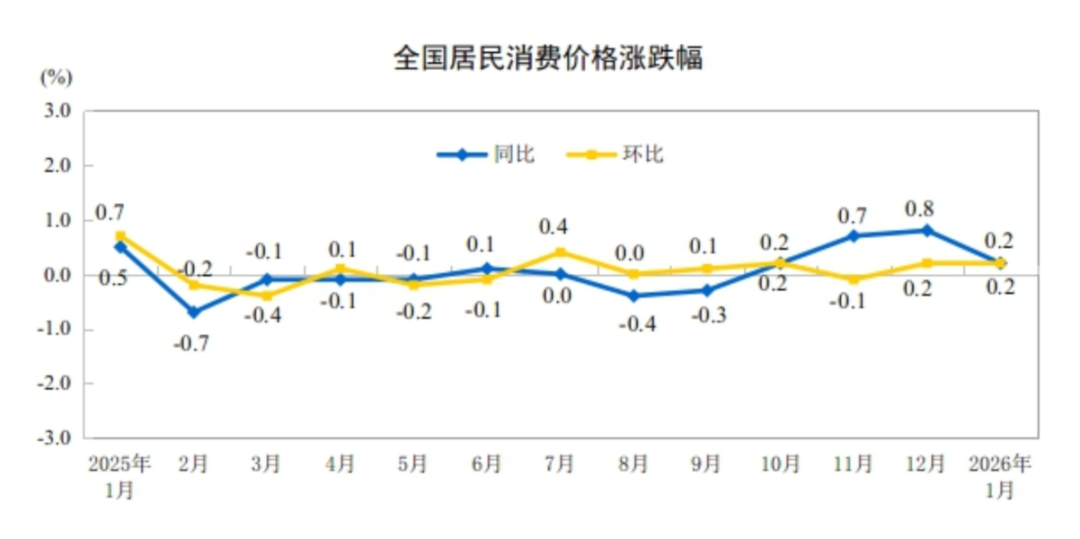
1月份,居民消费需求持续恢复,居民消费价格指数(CPI)环比上涨0.2%,同比上涨0.2%,扣除食品 和能源价格的核心CPI同比上涨0.8%。受全国统一大市场建设持续推进、部分行业需求增加及国际大宗 商品价格传导等因素影响,工业生产者出厂价格指数(PPI)环比上涨0.4%,同比下降1.4%。 股票频道更多独家策划、专家专栏,免费查阅>> 一、CPI同比涨幅回落主要受春节错月影响,核心CPI保持温和上涨 责任编辑:山上 二、PPI环比继续上涨,同比降幅收窄 PPI环比上涨0.4%,连续4个月上涨,涨幅比上月扩大0.2个百分点。本月PPI环比运行的主要特点:一是 全国统一大市场建设持续推进带动部分行业价格上涨。水泥制造、锂离子电池制造价格环比均上涨 0.1%,均连续4个月上涨;光伏设备及元器件制造价格由上月下降0.2%转为上涨1.9%,基础化学原料制 造价格由下降0.1%转为上涨0.7%,黑色金属冶炼和压延加工业价格由下降0.1%转为上涨0.2%。二是需 求增加带动相关行业价格上涨。人工智能等数字化技术加快发展、算力需求增长带动计算机通信和其他 电子设备制造业价格环比上涨0.5%,其中电子半导体材料、外存储设备及 ...
2026年1月通胀数据点评:开年通胀:回升的绿芽
Guolian Minsheng Securities· 2026-02-11 07:09
Inflation Data Overview - In January 2026, the Consumer Price Index (CPI) increased by 0.2% month-on-month and year-on-year, while the core CPI (excluding food and energy) rose by 0.8% year-on-year[4] - The Producer Price Index (PPI) saw a month-on-month increase of 0.4% but a year-on-year decrease of 1.4%[4] Seasonal Effects and Consumer Demand - The January CPI year-on-year drop to 0.2% was influenced by the late timing of the Spring Festival, which typically weakens food price increases[4] - Historical data suggests that seasonal disturbances like this are often corrected in February, indicating potential recovery in CPI[5] Core CPI and Consumer Recovery - The core CPI's month-on-month increase of 0.3% marks a six-month high, reflecting improving consumer demand supported by effective consumption policies[4] - Price increases in household goods and services, such as travel and entertainment, indicate a robust recovery in service consumption[4] PPI Trends and Influences - The PPI's year-on-year decline narrowed to -1.4%, with a month-on-month increase of 0.4%, both reaching their highest values since October 2023[4] - Factors contributing to PPI recovery include the "anti-involution" policy and international commodity price increases[4] Risks and Future Outlook - Potential risks include policy measures falling short of expectations, unexpected changes in the domestic economy, and fluctuations in exports[4]
【广发宏观郭磊】通胀上行加快
郭磊宏观茶座· 2026-02-11 06:58
Core Viewpoint - Inflation is accelerating, with January CPI showing a month-on-month increase of 0.2%, marking the second consecutive month of positive growth. Core CPI, excluding food and energy, rose by 0.3%, the highest in six months, surpassing similar periods in 2015 and 2018. January PPI increased by 0.4%, reaching the highest point since May 2022 [5][6][7]. Group 1: Inflation Data Analysis - January CPI increased by 0.2% month-on-month, consistent with the previous value. Core CPI rose by 0.3%, higher than the previous value of 0.2% and equal to January 2023's 0.4%, marking the highest since August 2025 [6]. - January PPI increased by 0.4%, matching the previous month and reaching the highest level since May 2022. The base period adjustment and weight changes had a minor impact on the data, with an estimated effect of 0.06-0.08 percentage points on month-on-month growth rates [7][8]. Group 2: Price Increases in CPI - Notable month-on-month price increases in CPI include seasonal rises in tourism and service prices, with tourism prices up by 1.8% and service prices up by 0.2%. Specific increases include airfare (5.7%) and travel agency fees (2.0%) [2][8]. - The "CPI within PPI" category for household appliances continued to rise by 0.7%, with year-on-year growth increasing from 5.9% to 6.6%. Communication tools also saw a month-on-month increase of 0.9%, with year-on-year growth at 1.3% [2][8]. - Pork prices experienced their first month-on-month increase in six months, rising by 1.2% in January [2]. Group 3: Price Decreases in CPI - Certain categories, such as alcoholic beverages and rental housing, continued to show month-on-month declines. These categories are significant for the capital market, reflecting shifts in consumer behavior and economic cycles [2][9][10]. Group 4: PPI Price Increases - In January, prices for globally priced non-ferrous metals rose significantly, with non-ferrous metal mining and smelting increasing by 5.7% and 5.2%, respectively. Other sectors, including cement manufacturing and lithium-ion battery production, also saw increases [3][14][15]. - The automotive manufacturing sector reported zero growth, marking the first month without a decline in seven months. Prices in the AI industry chain, particularly for computer communication electronics, rose by 0.5% [3][16]. Group 5: Simulated Deflation Index - The simulated deflation index showed a year-on-year decline from -0.28% to -0.44% due to the timing of the Spring Festival, despite a month-on-month CPI increase. The index is expected to improve in February, potentially returning to around -0.28% [3][16].


最新公布!核心CPI温和上涨
Zhong Guo Zheng Quan Bao· 2026-02-11 05:40
服务价格上涨0.1%,影响CPI同比上涨约0.05个百分点,对CPI同比的上拉影响比上月减少约0.2个百分点。服务中,飞机票、旅行社收费和家政服务价格 分别下降14.3%、7.7%和3.5%,三项合计影响CPI同比下降约0.16个百分点,而上月其对CPI同比影响为上拉约0.04个百分点。 国家统计局2月11日发布的数据显示,1月份,居民消费需求持续恢复,居民消费价格指数(CPI)环比上涨0.2%,同比上涨0.2%,扣除食品和能源价格的 核心CPI同比上涨0.8%;工业生产者出厂价格指数(PPI)环比上涨0.4%,同比下降1.4%。 核心CPI保持温和上涨 1月CPI同比上涨0.2%,涨幅有所回落。对此,国家统计局城市司首席统计师董莉娟认为,主要受春节错月影响。上年1月份为春节月份,食品和部分服务 价格上涨较多,导致上年同期对比基数较高,带动1月同比涨幅回落较多。 图片来源:国家统计局 分类别看,食品价格下降0.7%,影响CPI同比下降约0.11个百分点,而上月对CPI的影响为上拉约0.21个百分点。食品中,鲜菜价格上涨6.9%,涨幅比上月 回落11.3个百分点,对CPI同比的上拉影响比上月回落约0.27个百分 ...
解读:2026年1月份CPI同比上涨 PPI同比降幅收窄
Guo Jia Tong Ji Ju· 2026-02-11 03:28
Group 1 - The core viewpoint of the articles indicates a continuous recovery in consumer demand, with the Consumer Price Index (CPI) showing a slight increase while the Producer Price Index (PPI) has also risen, reflecting various economic factors [1][4][5] Group 2 - In January, the CPI increased by 0.2% month-on-month and year-on-year, while the core CPI, excluding food and energy, rose by 0.8% year-on-year [1] - The decline in food prices, particularly a 0.7% drop, contributed to a decrease in the CPI's year-on-year growth rate, with fresh vegetable prices rising by 6.9% but showing a reduced growth rate compared to the previous month [2][3] - Energy prices fell by 5.0% in January, impacting the CPI negatively by approximately 0.34 percentage points, with gasoline prices down 11.4% year-on-year [2][3] Group 3 - The PPI increased by 0.4% month-on-month, marking the fourth consecutive month of growth, driven by the ongoing development of a unified national market and increased demand in certain sectors [4][5] - Specific industries such as cement manufacturing and lithium-ion battery production saw price increases, while the prices of photovoltaic equipment turned from a decline to an increase of 1.9% [4] - Year-on-year, the PPI decreased by 1.4%, but the decline was less severe than in the previous month, with notable increases in the prices of non-ferrous metal mining and manufacturing sectors [5]
1月CPI、PPI数据出炉
21世纪经济报道· 2026-02-11 02:51
2月11日,国家统计局公布今年1月份最新CPI、PPI数据。 2026年1月份居民消费价格同比上涨0.2% 2026年1月份,全国居民消费价格同比上涨0.2%。其中,城市上涨0.2%,农村上涨0.1%;食 品价格下降0.7%,非食品价格上涨0.4%;消费品价格上涨0.3%,服务价格上涨0.1%。 1月份,全国居民消费价格环比上涨0.2%。其中,城市上涨0.2%,农村上涨0.2%;食品价格持 平,非食品价格上涨0.2%;消费品价格上涨0.2%,服务价格上涨0.2%。 2026年1月份,全国工业生产者出厂价格同比下降1.4%,降幅比上月收窄0.5个百分点;环比 上涨0.4%,涨幅比上月扩大0.2个百分点。工业生产者购进价格同比下降1.4%,降幅比上月收 窄0.7个百分点;环比上涨0.5%,涨幅比上月扩大0.1个百分点。 什么是基期轮换? 按照官方的定义,CPI的"基期轮换"是指对居民消费价格指数(CPI)的统计基期、商品和服 务篮子以及权重等进行定期调整的工作。通俗一点说,基期轮换,就是把统计的 "对比起点" 更新一下,以前拿2020年的"一篮子"价格当对比基准,现在换成 2025 年的"一篮子"价格当基 准,这 ...

CPI同比涨幅回落主要受春节错月影响,核心CPI保持温和上涨
Sou Hu Cai Jing· 2026-02-11 02:12
一、CPI同比涨幅回落主要受春节错月影响,核心CPI保持温和上涨 CPI同比涨幅有所回落,主要有以下两方面原因:一是春节错月影响。上年1月份为春节月份,食品和 部分服务价格上涨较多,导致上年同期对比基数较高,带动本月同比涨幅回落较多。分类别看,食品价 格下降0.7%,影响CPI同比下降约0.11个百分点,而上月对CPI的影响为上拉约0.21个百分点。食品中, 鲜菜价格上涨6.9%,涨幅比上月回落11.3个百分点,对CPI同比的上拉影响比上月回落约0.27个百分 点;鲜果价格上涨3.2%,涨幅比上月回落1.2个百分点;猪肉和鸡蛋价格分别下降13.7%和10.6%。服务 价格上涨0.1%,影响CPI同比上涨约0.05个百分点,对CPI同比的上拉影响比上月减少约0.20个百分点。 服务中,飞机票、旅行社收费和家政服务价格分别下降14.3%、7.7%和3.5%,三项合计影响CPI同比下 降约0.16个百分点,而上月其对CPI同比影响为上拉约0.04个百分点。二是国际油价变动导致能源价格 降幅扩大。1月份能源价格下降5.0%,影响CPI同比下降约0.34个百分点,对CPI同比的下拉影响比上月 增加约0.06个百分点,其 ...
春节错月叠加能源价格下行 1月CPI同比涨幅回落
Xin Hua Cai Jing· 2026-02-11 02:08
Core Viewpoint - The Consumer Price Index (CPI) has shown a year-on-year decline in January 2026, primarily due to the impact of the Spring Festival timing and changes in international oil prices [1] Group 1: CPI Analysis - The year-on-year increase in CPI has decreased due to two main reasons: the high base effect from last year's Spring Festival and changes in food and service prices [1] - Food prices decreased by 0.7%, contributing approximately 0.11 percentage points to the decline in CPI year-on-year, while last month, food prices had a positive impact of about 0.21 percentage points [1] - Fresh vegetable prices increased by 6.9%, but the growth rate fell by 11.3 percentage points compared to the previous month, reducing its positive impact on CPI by approximately 0.27 percentage points [1] - Fresh fruit prices rose by 3.2%, with a decrease in growth rate of 1.2 percentage points from the previous month [1] - Pork and egg prices fell by 13.7% and 10.6%, respectively [1] - Service prices increased by 0.1%, contributing about 0.05 percentage points to the CPI year-on-year increase, but this was a reduction of approximately 0.20 percentage points compared to the previous month [1] - The prices of airline tickets, travel agency fees, and housekeeping services decreased by 14.3%, 7.7%, and 3.5%, respectively, collectively impacting CPI by approximately -0.16 percentage points [1] Group 2: Energy Price Impact - Energy prices fell by 5.0% in January, contributing approximately 0.34 percentage points to the decline in CPI year-on-year, with this downward impact increasing by about 0.06 percentage points compared to the previous month [1] - Gasoline prices decreased by 11.4%, with the decline rate expanding by 3.0 percentage points from the previous month [1]
国家统计局:1月份CPI同比上涨 PPI同比降幅收窄
Guo Jia Tong Ji Ju· 2026-02-11 02:01
Group 1: CPI Analysis - The Consumer Price Index (CPI) increased by 0.2% month-on-month and year-on-year, with the core CPI (excluding food and energy) rising by 0.8% year-on-year [1] - The year-on-year CPI growth rate declined mainly due to the high base effect from the previous year's Spring Festival, with food prices decreasing by 0.7%, impacting the CPI by approximately 0.11 percentage points [1] - Energy prices fell by 5.0% in January, contributing to a year-on-year CPI decrease of about 0.34 percentage points, with gasoline prices down 11.4% [1] Group 2: Core CPI Trends - The core CPI (excluding food and energy) rose by 0.3% month-on-month, marking the highest increase in six months [2] - Prices for air tickets and travel agency services increased by 5.7% and 2.0% respectively, while prices for household appliances and personal care products saw increases between 0.7% and 1.4% [2] - The year-on-year increase in industrial consumer goods prices (excluding energy) expanded to 2.6%, with gold jewelry prices surging by 77.4% [2] Group 3: PPI Analysis - The Producer Price Index (PPI) rose by 0.4% month-on-month, marking the fourth consecutive month of increases, with the growth rate expanding by 0.2 percentage points from the previous month [3] - The increase in PPI was driven by the ongoing construction of a unified national market, leading to price rises in sectors such as cement manufacturing and lithium-ion battery production [3] - The year-on-year PPI decline narrowed to 1.4%, with significant price increases in the non-ferrous metal mining sector (up 22.7%) and cultural and educational products manufacturing (up 21.2%) [4]