美元指数

Search documents
12月1日白银晚评:聚焦今晚ISM制造业数据 银价试图收于57美元上方
Jin Tou Wang· 2025-12-01 09:23
Core Viewpoint - The recent decline in the US dollar is supporting silver prices, with expectations of a potential interest rate cut by the Federal Reserve influencing market sentiment [3]. Group 1: Silver Price Movement - As of December 1, 2025, the spot silver price is at $57.24 per ounce, with a daily range between $56.15 and $57.86 [1][2]. - The silver price opened at $56.32 per ounce [1]. Group 2: Economic Indicators and Federal Reserve Expectations - The upcoming ISM manufacturing PMI report is anticipated to impact market expectations regarding the Federal Reserve's interest rate decisions [3]. - There is an increased betting on a 25 basis point rate cut by the Federal Reserve in December, with a probability of 87.4% for this outcome [3]. - The market is also pricing in a 67.5% chance of a cumulative 25 basis point cut by January 2026 [3]. Group 3: Technical Analysis of Silver - The silver price remains significantly above the 100-day EMA of $45.60, indicating a strong bullish trend [4]. - The RSI is at 73.47, suggesting an overbought condition, which may lead to a potential consolidation phase [4]. - Initial support for a price pullback is identified at the Bollinger Band midline near $51.29, with further support at $51.04 if the first level fails [4].
金荣中国:黄金目前仍有反弹动力
Sou Hu Cai Jing· 2025-12-01 07:40
反之,如数据符合或者是低于预期,则可能点燃市场对明年降息的强烈预期,给美元带来下行压力。并 提振金价大幅走强。 日图;金价自筑底布林带中轨支撑盘整后,多头反弹拉升走强,目前30日等众多均线已转为支撑,布林 带也开口向上延伸,多头前景加大,附图指标也维持看涨信号发展,短期方向将仍以看涨反弹为主,下 方关注5日均线支撑附近仍以看涨为主,继续等待上探4260美元或4380美元目标。 本周全球主要经济体将密集发布一系列关键经济指标,重点关注周三的美国11月ADP就业人数(万人)以 及美国9月核心PCE物价指数年率,目前市场预期ADP减少,PCE通胀减弱,将会进一步增强降息预 期,而会支持金价。故此,即便是最终公布好于预期,预计也是震荡波动为主。 本周周一,黄金开盘先行快速的震荡走盘,并之后维持,虽有一定的短线回落预期,但整体前景仍偏向 看涨上行,另外,美元指数开盘仍偏弱运行,则对其金价产生一定支撑。因而,日内操作仍以低多看涨 为主。 ...


白银发挥“工业助力” 沪银整体趋势上扬
Jin Tou Wang· 2025-12-01 07:19
今日周一(12月1日)亚盘时段,白银期货目前交投于13031一线上方,今日开盘于12720元/千克,截至发 稿,白银期货暂报13280元/千克,上涨5.88%,最高触及13520元/千克,最低下探12675元/千克,目前来 看,白银期货盘内短线偏向震荡走势。 中国太阳能装置的大幅增加也提振了银价。国家能源局数据显示,10月份新增太阳能装机容量为12.6吉 瓦,比上个月高出30%。按照这一速度,2025年的太阳能装置预计将与2024年创纪录的277千兆瓦的年 增长相匹配。 【最新白银期货行情解析】 沪银在上涨趋势下刷新高点至13400,这也是历史性的时刻,上个周期的看涨目标在12450,现在有超过 了1000个点,这波白银刷新高点,不猜顶,按照市场目前的走法,还有很大的上涨空间,下方支撑在 13150,13000,看在本周调整是否有做多的机会。沪银主力合约参考运行区间12650-13400。 打开APP,查看更多高清行情>> 【要闻速递】 上周美元指数下跌0.69%,创下7月21日以来最大单周跌幅。这种势头直接源于市场对美联储降息的押 注,因为降息通常会削弱美元的吸引力。由于白银以美元计价,美元走弱支撑了银价。 ...
金融期货早评-20251201
Nan Hua Qi Huo· 2025-12-01 02:49
Report Industry Investment Ratings No information provided in the given content. Core Views of the Report - Domestic industrial enterprise profit growth is currently dragged down by the "weak volume and price" situation, with significant marginal decline. In the short - term, it will face pressure and maintain a weak oscillation. In the long - term, it is expected to enter a repair channel in 2025 [2]. - The upward space of the US dollar index is limited, and it will maintain a high - level oscillation in the short - term. The release of November non - farm payroll data and the determination of the Fed chair candidate will test its resilience [2]. - The RMB exchange rate will likely show a complex pattern of depreciation trend (appreciation of the RMB against the US dollar) and volatility risks coexisting within the year. In the short - term, it will be robust and strong, but the appreciation speed may slow down, and the two - way fluctuation will be more obvious [4][5]. - The stock index trading atmosphere is sluggish and is expected to continue to oscillate in the short - term. In the long - term, the logic of valuation repair driven by liquidity easing remains unchanged [6][7]. - The mid - term outlook for treasury bonds is not pessimistic. Although the market is weak due to rumors, the economic fundamentals suggest that interest rates will remain low for some time, waiting for monetary policy signals [8]. - The container shipping European line futures are expected to maintain a weak oscillation in the short - term, with geopolitical trends as the key variable [11][12]. - Precious metals prices are expected to continue rising in the long - term, driven by central bank gold purchases and investment demand. In the short - term, low inventory and potential demand release will increase the upward elasticity of prices [14][16]. - Copper prices are expected to continue to break through at the end of the year. The impact of PMI data and US ADP employment changes on market sentiment should be noted [17][20]. - Aluminum is expected to oscillate strongly in the short - term, mainly affected by macro - sentiment and the rise of copper and silver. Alumina will run weakly, and cast aluminum alloy will oscillate strongly [20][21]. - Zinc prices are expected to continue to build a bottom, with short - term strong oscillation due to supply contraction and demand decline [23]. - Nickel and stainless steel will maintain a wide - range oscillation, with a downward trend due to weak fundamentals. Tin prices will maintain a high - level oscillation, and it is recommended to enter the market on dips [23][25]. - Carbonate lithium prices will be in a game range, waiting for a driving force. It is recommended to avoid chasing high prices near 100,000 yuan/ton and seize opportunities to build positions on dips [26][27]. - Industrial silicon will be in a weak supply - demand situation, with short - term oscillation and long - term value for position building on dips. Polysilicon trading is shifting to the game between warehouse receipts and positions, and position risks should be noted [28][31]. - Lead prices are expected to oscillate between 16,900 - 17,300 yuan, with strong support at 16,700 yuan [32]. - Steel prices are expected to oscillate strongly, with the operating range of rebar at 3,000 - 3,300 yuan and hot - rolled coil at 3,200 - 3,500 yuan. Attention should be paid to the destocking speed and downstream consumption [33][35]. - Iron ore prices are expected to maintain a high - level oscillation, with short - term valuation repair. It is recommended to take profits on long positions at high prices [36][37]. - Coking coal and coke prices are under pressure. For coking coal, short - term short positions can be held, and long positions can be considered for the far - month contract after a stable signal. For coke, it is not recommended to blindly participate in the downward market [38][39]. - Ferrosilicon and ferromanganese are expected to oscillate weakly due to high inventory and weak demand [40][41]. - Crude oil prices will continue to oscillate, with a long - term downward trend due to supply - surplus pressure. Attention should be paid to OPEC+ policy implementation and the progress of Russia - Ukraine peace talks [43][45]. - LPG prices are supported by supply - demand conditions and the external market, although the domestic LPG valuation is relatively high [47][48]. - PX - PTA prices may fall back after the departure of speculation funds. It is recommended to consider building long positions on dips, with attention to maintenance plans and blending oil dynamics [49][53]. - MEG prices have a weakened downward drive, and it is recommended to sell call options. The long - term supply - surplus situation remains unchanged [55][57]. - Urea prices are expected to continue to oscillate, with the downside space supported and the upside pressured [58][59]. - PP prices are supported by the cost side. Attention should be paid to the PDH device operation status and basis changes [60][63]. - PE prices are expected to continue to oscillate after a rebound. Attention should be paid to the spot situation and basis changes [64][65]. - Pure benzene and styrene prices are affected by device maintenance. Pure benzene shows a near - weak and far - strong pattern, while styrene shows a near - strong and far - weak pattern [66][68]. - High - sulfur fuel oil cracking is expected to decline, and low - sulfur fuel oil cracking may rebound after the stabilization of Dar Blend discount [69][70]. - Asphalt prices will maintain a weak oscillation in the short - term, with attention to winter storage policies [71][72]. - Rubber and 20 - number rubber prices are expected to oscillate strongly [73]. Summary by Relevant Catalogs Financial Futures - **Macro**: China's November official manufacturing PMI rebounded to 49.2, and the high - tech manufacturing PMI remained above 50 for 10 consecutive months. The US "Black Friday" sales increased by 4.1% year - on - year, and the AI traffic soared by 600%. The US - Ukraine negotiation was considered "productive" [1]. - **RMB Exchange Rate**: The on - shore RMB against the US dollar closed at 7.0794 on the previous trading day, up 12 points. The RMB against the US dollar central parity rate was 7.0789, down 10 points. The RMB exchange rate is expected to show a complex pattern of appreciation and volatility risks [3][4]. - **Stock Index**: The trading atmosphere is sluggish, and it is expected to oscillate in the short - term. In the long - term, the logic of valuation repair driven by liquidity easing remains unchanged [6][7]. - **Treasury Bonds**: The mid - term outlook is not pessimistic. Although the market is weak due to rumors, the economic fundamentals suggest that interest rates will remain low for some time, waiting for monetary policy signals [7][8]. - **Container Shipping European Line**: The futures are expected to maintain a weak oscillation in the short - term, with geopolitical trends as the key variable [11][12]. Commodities Non - ferrous Metals - **Gold & Silver**: Precious metals prices are expected to continue rising in the long - term, driven by central bank gold purchases and investment demand. In the short - term, low inventory and potential demand release will increase the upward elasticity of prices [14][16]. - **Copper**: Copper prices are expected to continue to break through at the end of the year. The impact of PMI data and US ADP employment changes on market sentiment should be noted [17][20]. - **Aluminum Industry Chain**: Aluminum is expected to oscillate strongly in the short - term, mainly affected by macro - sentiment and the rise of copper and silver. Alumina will run weakly, and cast aluminum alloy will oscillate strongly [20][21]. - **Zinc**: Zinc prices are expected to continue to build a bottom, with short - term strong oscillation due to supply contraction and demand decline [23]. - **Nickel, Stainless Steel**: Nickel and stainless steel will maintain a wide - range oscillation, with a downward trend due to weak fundamentals [23][24]. - **Tin**: Tin prices will maintain a high - level oscillation, and it is recommended to enter the market on dips [25]. - **Carbonate Lithium**: Carbonate lithium prices will be in a game range, waiting for a driving force. It is recommended to avoid chasing high prices near 100,000 yuan/ton and seize opportunities to build positions on dips [26][27]. - **Industrial Silicon & Polysilicon**: Industrial silicon will be in a weak supply - demand situation, with short - term oscillation and long - term value for position building on dips. Polysilicon trading is shifting to the game between warehouse receipts and positions, and position risks should be noted [28][31]. - **Lead**: Lead prices are expected to oscillate between 16,900 - 17,300 yuan, with strong support at 16,700 yuan [32]. Black Metals - **Rebar & Hot - Rolled Coil**: Steel prices are expected to oscillate strongly, with the operating range of rebar at 3,000 - 3,300 yuan and hot - rolled coil at 3,200 - 3,500 yuan. Attention should be paid to the destocking speed and downstream consumption [33][35]. - **Iron Ore**: Iron ore prices are expected to maintain a high - level oscillation, with short - term valuation repair. It is recommended to take profits on long positions at high prices [36][37]. - **Coking Coal & Coke**: Coking coal and coke prices are under pressure. For coking coal, short - term short positions can be held, and long positions can be considered for the far - month contract after a stable signal. For coke, it is not recommended to blindly participate in the downward market [38][39]. - **Ferrosilicon & Ferromanganese**: Ferrosilicon and ferromanganese are expected to oscillate weakly due to high inventory and weak demand [40][41]. Energy and Chemicals - **Crude Oil**: Crude oil prices will continue to oscillate, with a long - term downward trend due to supply - surplus pressure. Attention should be paid to OPEC+ policy implementation and the progress of Russia - Ukraine peace talks [43][45]. - **LPG**: LPG prices are supported by supply - demand conditions and the external market, although the domestic LPG valuation is relatively high [47][48]. - **PTA - PX**: PX - PTA prices may fall back after the departure of speculation funds. It is recommended to consider building long positions on dips, with attention to maintenance plans and blending oil dynamics [49][53]. - **MEG - Bottle Chip**: MEG prices have a weakened downward drive, and it is recommended to sell call options. The long - term supply - surplus situation remains unchanged [55][57]. - **Urea**: Urea prices are expected to continue to oscillate, with the downside space supported and the upside pressured [58][59]. - **PP**: PP prices are supported by the cost side. Attention should be paid to the PDH device operation status and basis changes [60][63]. - **PE**: PE prices are expected to continue to oscillate after a rebound. Attention should be paid to the spot situation and basis changes [64][65]. - **Pure Benzene & Styrene**: Pure benzene and styrene prices are affected by device maintenance. Pure benzene shows a near - weak and far - strong pattern, while styrene shows a near - strong and far - weak pattern [66][68]. - **Fuel Oil**: High - sulfur fuel oil cracking is expected to decline, and low - sulfur fuel oil cracking may rebound after the stabilization of Dar Blend discount [69][70]. - **Asphalt**: Asphalt prices will maintain a weak oscillation in the short - term, with attention to winter storage policies [71][72]. - **Rubber & 20 - number Rubber**: Rubber and 20 - number rubber prices are expected to oscillate strongly [73].
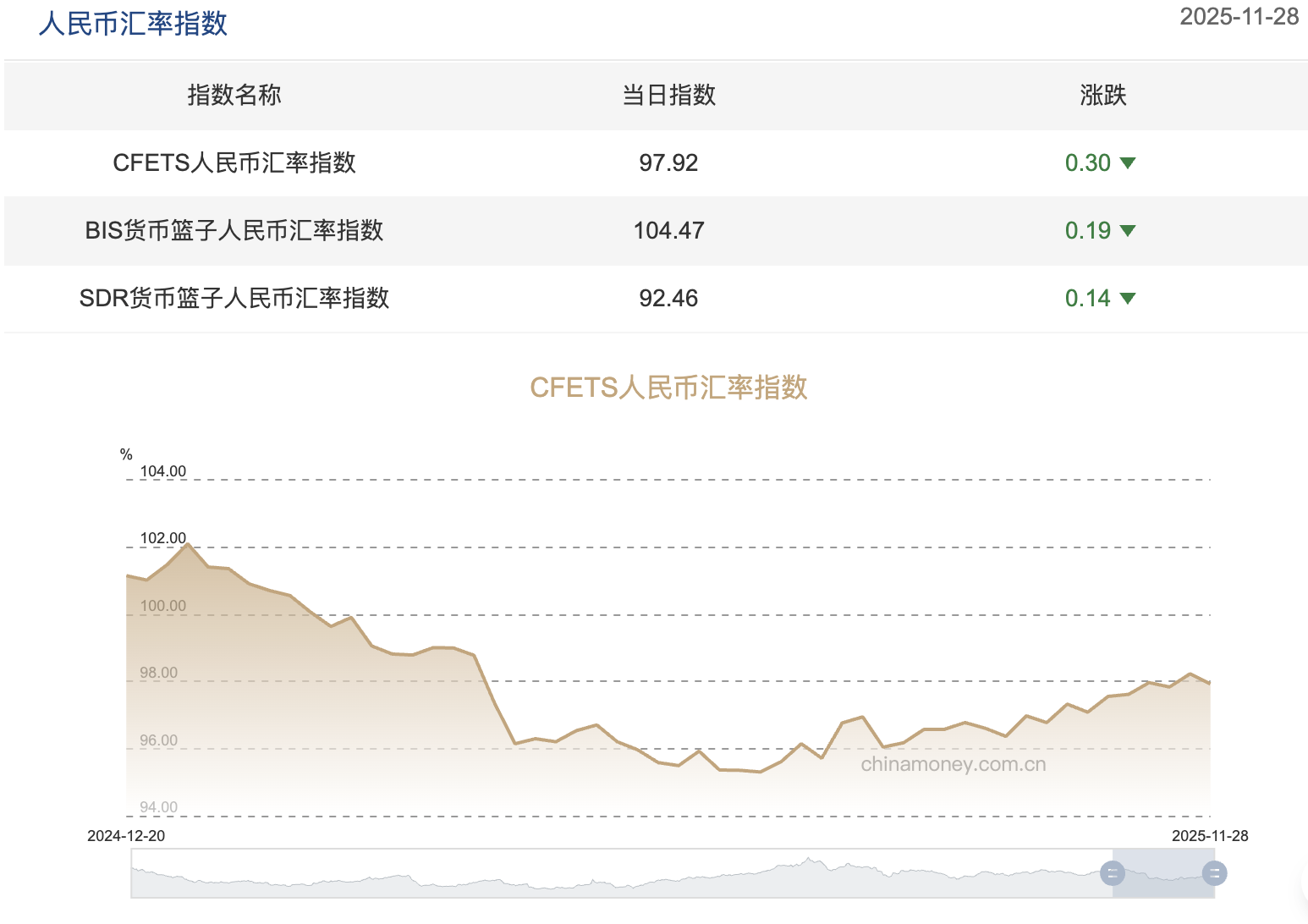
三大人民币汇率指数小幅下挫,人民币汇率中长期或稳中有升
Zhong Guo Jin Rong Xin Xi Wang· 2025-12-01 02:45
Core Viewpoint - The Chinese yuan's exchange rate indices have declined, reflecting a broader trend influenced by expectations of a Federal Reserve interest rate cut and changes in market sentiment towards the dollar [1][5]. Group 1: Exchange Rate Indices - The CFETS yuan exchange rate index reported at 97.92, down 0.3% week-on-week [1][2]. - The BIS currency basket yuan exchange rate index stood at 104.47, decreasing by 0.19% [1][2]. - The SDR currency basket yuan exchange rate index was at 92.46, with a weekly decline of 0.14% [1][2]. Group 2: Market Influences - The dollar index experienced a decline of 0.71% over the week, falling below the 100 mark, influenced by weak U.S. retail data and heightened expectations for a Fed rate cut [5]. - The yuan strengthened against the dollar, with the onshore yuan closing at 7.0740, up 310 basis points (0.51%) for the week, and the offshore yuan at 7.0713, up 341 basis points (0.48%) [5]. - The yuan's central parity rate against the dollar was adjusted to 7.0789, an increase of 86 basis points for the week [5]. Group 3: Analyst Insights - Analysts attribute the yuan's strength to the Fed's anticipated rate cut, with the probability of a December cut rising from 35.4% to 85.4% within a week [5]. - The chief macro analyst at Guotai Junan noted a trend reversal in foreign trade enterprises' currency settlement preferences, contributing to the yuan's appreciation [6]. - The chief economist at Zhongyin Securities highlighted that the yuan's resilience amidst global economic uncertainties reflects a combination of factors, including a recovering Chinese economy and a weakening dollar [6]. Group 4: Future Outlook - Analysts predict that the yuan's exchange rate will be influenced by the dollar's performance and U.S.-China trade relations, with expectations of continued moderate appreciation [7]. - The chief economist at Qianhai Kaiyuan Fund anticipates a long-term upward trend for the yuan against the dollar, suggesting a potential break below 7 and a return to the 6 range by next year [8].
黑色与建材原木周度报告-20251130
Guo Tai Jun An Qi Huo· 2025-11-30 11:24
Report Industry Investment Rating - Not provided in the content Core Viewpoints - The market for logs is currently in a state of weak supply and demand. The prices of mainstream log varieties have remained stable, and the inventory in major ports has generally increased. Shipping schedules indicate a certain volume of log arrivals in the near future, and factors such as freight rates and exchange rates are also showing corresponding changes [4][6][20] Summary by Section Overview - For the mainstream deliverable 3.9 - meter 30 + radiata pine, the quotes in Shandong and Jiangsu markets remained unchanged from last week at 755 yuan/cubic meter, with a regional price difference of 0. The prices of other specifications of radiata pine in Shandong also remained stable. European spruce and fir in the Jiangsu market are still in short supply [4] Supply - As of November 23, there were 29 ships departing from New Zealand in November, with 23 bound for the Chinese mainland and 6 for Taiwan, China, and South Korea (with reduced loads). Among them, about 12 ships are expected to arrive in November, and 17 in December. The expected arrival volume in November is 1.41 million cubic meters [5][8] Demand and Inventory - As of the week of November 21, the daily average shipment volume of Lanshan Port was 23,200 cubic meters (a week - on - week increase of 2,400 cubic meters), and that of Taicang Port was 13,000 cubic meters (a week - on - week increase of 2,300 cubic meters). In terms of port inventory, Lanshan Port had about 1.3628 million cubic meters (a week - on - week increase of 70,000 cubic meters), Taicang Port had about 401,600 cubic meters (a week - on - week increase of 30,400 cubic meters), Xinminzhou had about 238,700 cubic meters (a week - on - week decrease of 25,800 cubic meters), and Jiangdu Port had about 173,800 cubic meters (a week - on - week decrease of 7,700 cubic meters). The total inventory of the four major ports was 2.1769 million cubic meters, an increase of 66,900 cubic meters from the previous week [6][13] Market Trends - As of November 27, the closing price of the main contract LG2601 was 765 yuan/cubic meter, a decrease of 1.7% from last week. The market continued to fluctuate weakly this week, and the fundamentals maintained a pattern of weak supply and demand. The monthly spread changes this week were relatively small, with the 01 - 03 monthly spread at - 11.5 yuan/cubic meter, the 01 - 05 monthly spread at - 25 yuan/cubic meter, and the 03 - 05 monthly spread at - 13.5 yuan/cubic meter [20] Price and Spread - **Spot Price**: The prices of various specifications of radiata pine and spruce in Shandong and Jiangsu markets remained unchanged from last week, but there were different degrees of decline compared to four weeks ago [24] - **Regional Spread**: The report presents the price differences of different tree species and specifications between Shandong and Jiangsu regions, including 3.9 - meter 30 + radiata pine, 3.9 - meter 40 + radiata pine, etc. [24][27] - **Species and Specification Spread**: It shows the price differences between different tree species and specifications, such as the price difference between 3.9 - meter 30 + radiata pine and 3.9 - meter 40 + radiata pine [38][39] Other - As of the week of November 30, the Baltic Dry Index (BDI) was 2480.00 points, an increase of 205 points (+9.0%) from last week. Its related sub - index, the Handysize Shipping Index (BHSI), was 825 points, an increase of 0.6% from last week. The Shanghai Containerized Freight Index (SCFI) was 1403.13 points, an increase of 0.7% from last week. In terms of exchange rates, the US dollar index weakened, the US dollar to RMB exchange rate was 7.079, a week - on - week decrease of 0.44%, and the US dollar to New Zealand dollar exchange rate decreased by 2.4% to 1.748 [6][53]
美元指数28日小幅下跌
Zheng Quan Shi Bao Wang· 2025-11-28 23:56
人民财讯11月29日电,美元指数11月28日下跌。衡量美元对六种主要货币的美元指数当天下跌0.12%, 在汇市尾市收于99.444。 (原标题:美元指数28日小幅下跌) ...
美元指数延续跌势
Jin Rong Jie· 2025-11-28 20:27
Group 1 - The ICE Dollar Index decreased by 0.10% to 99.44 points at the end of trading on Friday, November 28, with a cumulative decline of 0.33% for November, trading within a range of 100.39 to 98.99 points, showing an M-shaped trend [1] - The Bloomberg Dollar Index fell by 0.13% to 1217.84 points, with a cumulative decline of 0.29% for November, trading between 1228.98 and 1213.92 points [1]
美国国债收益率和美元上涨,市场继续受到芝商所故障的干扰
Xin Lang Cai Jing· 2025-11-28 11:58
美国国债收益率和美元上涨,尽管因芝加哥商业交易所的技术故障导致交易依然零散。法国兴业银行策 略师在一份报告中称,芝商所故障干扰了期货交易,与此同时美元兑其他G10货币走强。DXY美元指数 上涨0.2%,至99.772。各期限美国国债收益率上涨多达3个基点,但买卖价差仍然很阔,表明因芝商所 故障以及周四美国感恩节假期刚过,交投清淡。据Tradeweb的数据,10年期美国国债收益率上涨0.8个 基点,报4.006%。 ...
百利好晚盘分析:数据清淡 金价震荡
Sou Hu Cai Jing· 2025-11-28 09:15
黄金方面: 恰逢美国重要假期,近期黄金市场基本面较为清淡。此前公布美国经济数据显示,截至11月22日当周,美国初请失业金人数录 得21.6万人,低于市场预期的22.5万人,创下了今年4月份以来的最低水平。 美联储经济褐皮书提到,美国政府停摆对消费者决策产生了负面的影响,低收入者受到了直接冲击,在美国经济面临压力的背 景下,美联储延续宽松的货币政策将是大概率事件。 地缘政治方面,俄罗斯总统普京表示,和平协议目前尚无最终版本,暗示俄乌冲突想要结束停火仍然存在不确定性。 百利好特约智昇研究资深分析师辰宇认为,市场对美联储宽松的预期押注以及地缘仍然存在不确定性,短期将为金价提供支 撑。 技术面:日线上,近期黄金价格震荡上行为主,表现较为强势。指标上看,20日均线拐头向上,暗示金价有机会再度上行。日 内关注上方4231美元一线压力,下方关注4155美元一线支撑。 本周在美国经济数据并不亮眼的背景下,美联储官员们公开讲话中再度倾向降息,美元指数从高位回落。 短期来看,美国经济数据好坏参半,美联储内部对于降息仍然存在分歧,美元指数维持高位震荡调整的概率比较大。 从中长期来看,美国的债务水平巨大,需要美联储降息以缓解压力;特 ...