逆全球化

Search documents
西南期货早间评论-20250617
Xi Nan Qi Huo· 2025-06-17 01:16
Report Industry Investment Ratings No relevant content provided. Core Views of the Report - The macro - economic recovery momentum needs to be strengthened, and the monetary policy is expected to remain loose. Different investment strategies are recommended for various commodities based on their market conditions [6][9][11] - For most commodities, the report analyzes supply - demand relationships, price trends, and provides corresponding investment suggestions such as long - position, short - position, or waiting for opportunities Summary by Related Catalogs Bonds - **Treasury Bonds**: Futures prices mostly rose in the previous trading day. The central bank conducted reverse repurchase operations with a net investment of 68.2 billion yuan. The macro - economy shows a stable recovery, but the recovery momentum needs to be strengthened. It is expected that there will be no trend - based market, and caution is advised [5][6][7] Equities - **Stock Index Futures**: Futures prices showed mixed trends in the previous trading day. The employment situation is stable, but the macro - economic recovery momentum is weak, and market confidence in corporate profits is lacking. However, domestic asset valuations are low, and China's economy has sufficient resilience. It is optimistic about the long - term performance of Chinese equity assets, and considering going long on stock index futures [8][9][10] Precious Metals - **Precious Metals**: Gold and silver futures had different price changes in the previous trading day. The global trade and financial environment is complex, and the "de - globalization" and "de - dollarization" trends are beneficial to the allocation and hedging value of gold. The long - term bull market trend of precious metals is expected to continue, and considering going long on gold futures [11][12] Base Metals - **Copper**: The price of Shanghai copper fluctuated within a range. The spot market atmosphere was average, and the downstream consumption was mediocre. The Sino - US London negotiation reached a framework agreement, which is beneficial to market sentiment. The US refined copper inventory increased, and the copper tariff has not been determined. The basis for copper price increase still exists, and a long - position operation is considered [48][49][51] - **Tin**: The price of Shanghai tin fluctuated. The supply of tin ore is tight, and the downstream production data is good. The inventory is decreasing. The current contradiction lies in the game between the tight supply in reality and the loose expectation. It is expected that the tin price will fluctuate [52] - **Nickel**: The price of Shanghai nickel declined. The cost support weakened, the downstream consumption was pessimistic, and the demand entered the off - season. The primary nickel is in an oversupply situation, and it is expected that the nickel price will fluctuate [53] Ferrous Metals - **Rebar and Hot - Rolled Coil**: Futures prices rebounded slightly. The real - estate industry's downward trend has not reversed, and the demand for rebar is decreasing with over - capacity. The market has entered the off - season, and the price is at a low level with limited downward space. It is recommended to pay attention to short - position opportunities on rebounds [13][14] - **Iron Ore**: Futures prices fluctuated weakly. The iron - water production decreased, and the supply increased. The price valuation is relatively high. It is recommended to pay attention to long - position opportunities at low levels [16] - **Coking Coal and Coke**: Futures prices rebounded significantly. The market is in an oversupply situation. The short - term price may stop falling, but the medium - term weakness has not reversed. It is recommended to pay attention to short - position opportunities on rebounds [18][19] - **Ferroalloys**: Manganese - silicon and silicon - iron futures prices rose. The demand for ferroalloys is weak, and the supply is high. The inventory is at a high level, and the price is under pressure. Long - position investors need to be cautious. If the spot loss increases significantly, consider low - value call options [21][22] Energy - **Crude Oil**: INE crude oil rose significantly due to geopolitical risks. Fund managers increased their net long positions, and the number of oil and gas rigs decreased. The Sino - US negotiation is beneficial to market sentiment, but the situation in Iran is uncertain. It is recommended to wait and see [23][24][26] - **Fuel Oil**: Fuel oil prices rose following crude oil. The inventory in Fujairah increased, which is negative for fuel oil. The global trade demand is recovering, but geopolitical risks are high. It is recommended to wait and see [27][28][30] Chemicals - **Synthetic Rubber**: Futures prices rose. The supply pressure eased slightly, the demand improvement was limited, and the cost is expected to rebound. It is recommended to wait for the price to stabilize and then participate in the rebound [31][32] - **Natural Rubber**: Futures prices rose. The demand is worried about the future, and the inventory is accumulating. The supply is affected by rain. It is recommended to wait for the price to stabilize and then consider long - position opportunities [33][34] - **PVC**: Futures prices rose slightly. The supply - demand drive is weak, and it is in the traditional off - season. The price is expected to fluctuate at a low level [34] - **Urea**: Futures prices rose. It is supported by agricultural demand release and overseas supply tightening, and a long - position is recommended [35][36] - **PX**: Futures prices declined. The supply - demand expectation may weaken, and the price is mainly driven by the cost of crude oil. Interval operation with caution is recommended [36] - **PTA**: Futures prices declined. The supply - demand structure weakened, and the inventory decreased. Interval operation and paying attention to reducing processing fees are recommended [37] - **Ethylene Glycol**: Futures prices rose. The supply - demand situation weakened, and the inventory increased slightly. It is recommended to wait and see [38] - **Short - Fiber**: Futures prices rose. The downstream demand weakened, but the cost provides support. Consider long - position opportunities at low levels and pay attention to increasing processing fees [39] - **Bottle Chips**: Futures prices rose. The raw material price fluctuates strongly, and the device maintenance increases. It is recommended to consider long - position opportunities at low levels and pay attention to increasing processing fees [40] - **Soda Ash**: Futures prices rose. The supply is stable, and the demand is average. The short - term market is expected to be weakly stable, and excessive long - position chasing is not recommended [41] - **Glass**: Futures prices rose slightly. The actual supply - demand contradiction is not prominent, and the market sentiment is weak. Excessive long - position chasing is not recommended [42] - **Caustic Soda**: Futures prices declined. The supply is relatively loose, and the regional difference is obvious. Long - position investors need to control positions [43][44] - **Pulp**: Futures prices rose slightly. The inventory is high, and the market is in the off - season. The real turnaround may occur in August [45][46] - **Lithium Carbonate**: Futures prices declined. The supply is high, and the demand has slowed down. The oversupply situation has not changed significantly, and the price is difficult to reverse [47] Agricultural Products - **Soybean Oil and Soybean Meal**: Soybean meal prices declined, and soybean oil prices rose. The supply of soybeans is expected to be loose, and it is recommended to wait and see for soybean meal. For soybean oil, consider low - value call options at the bottom support level [54][55] - **Palm Oil**: Malaysian palm oil prices rose. The export volume increased, and the domestic inventory is at a medium level. Consider expanding the spread between rapeseed oil and palm oil [56][58] - **Rapeseed Meal and Rapeseed Oil**: Rapeseed prices jumped. The import volume of rapeseed oil increased, and the inventory of rapeseed meal and rapeseed oil is at a high level. Consider long - position opportunities for the oil - meal ratio [59] - **Cotton**: Domestic cotton prices fluctuated, and overseas prices rose. The global supply - demand is expected to be loose, and the oil price rise provides some support. It is recommended to wait and see [60][62][63] - **Sugar**: Domestic sugar prices rebounded after a sharp decline, and overseas prices rose. The domestic inventory is low, and the import volume will increase. It is recommended to go long in batches [64][65][66] - **Apples**: Futures prices fluctuated. The new - year's apple production is uncertain. It is recommended to wait and see [67] - **Hogs**: The spot price rose slightly. The supply is increasing, and the demand is weak after the Dragon - Boat Festival. Consider long - position opportunities for peak - season contracts [68][69] - **Eggs**: The spot price rose slightly. The supply is expected to increase in June, and it is in the off - season. It is recommended to wait and see [70][71] - **Corn and Starch**: Corn and corn - starch futures prices declined. The domestic corn supply - demand is approaching balance, and the bottom support is strong. It is recommended to wait and see for corn starch [72][73][74] - **Logs**: Futures prices rose. The supply and demand have no obvious drive, and the market transaction is light. Be vigilant against bullish sentiment disturbances [75]
宝城期货:金融属性与工业属性共振,白银有望继续补涨
Qi Huo Ri Bao· 2025-06-17 00:57
Group 1 - Silver futures experienced a significant surge, with New York silver prices breaking through $35 per ounce and quickly rising to $36 per ounce, marking a nearly one-year high [1] - The increase in silver holdings was notable, with positions rising from 870,000 contracts to 1,040,000 contracts within just five trading days after the Dragon Boat Festival [1] - The market's attention on silver has intensified as it broke through the upper boundary of a year-long trading range, driven by increased trading volume [1] Group 2 - The gold-silver ratio has reached historical highs, reflecting heightened market risk aversion, but has begun to decline as silver prices rise, indicating a potential shift in market sentiment [2] - The recent recovery in industrial demand and overall commodity market improvement are key factors driving silver's upward movement [2] - Silver's price increase is seen as a response to both its precious metal attributes and its industrial metal characteristics, particularly in the context of post-crisis recovery phases [3] Group 3 - The long-term outlook for silver remains positive, supported by a weak dollar index and geopolitical tensions, which bolster gold's upward trend and, consequently, silver's financial attributes [4] - The commodity market shows signs of recovery, with expectations for continued trading around economic recovery themes in the third quarter [4] - Investors are advised to capitalize on the current bullish sentiment in silver while maintaining effective risk management strategies [4]
彻底取消计划生育,什么信号?
凤凰网财经· 2025-06-16 15:09
Group 1 - The core viewpoint of the article is that Vietnam has officially abolished its long-standing family planning policy, allowing couples to decide on their own fertility choices, which reflects a global trend towards encouraging higher birth rates [1][2][3] - Vietnam's population has surpassed 100 million as of 2023, making it one of the few countries with such a large population, which is significant on a global scale [4][7] - The total fertility rate in Vietnam has drastically declined from 4-5 in the 1980s to 1.91, falling below the replacement level of 2.1, indicating a severe demographic challenge [11][14][18] Group 2 - The decline in birth rates is attributed to modernization, urbanization, and changing cultural values, which have diminished traditional views on childbearing [19][20] - The rising costs of living, particularly housing, have made it increasingly difficult for young people to prioritize marriage and childbirth, with property prices in major cities like Hanoi and Ho Chi Minh City soaring [23][27] - The article emphasizes that simply lifting the family planning policy will not resolve the underlying issues contributing to the demographic crisis [29] Group 3 - Vietnam is at risk of missing its demographic dividend, as the window for benefiting from a young labor force is closing rapidly, with projections indicating a population decline by 2054 [17][30] - The article draws parallels with other countries that have experienced demographic challenges, highlighting that having a large population does not guarantee economic benefits [32][33] - The emergence of new technological challenges, particularly in the context of artificial intelligence, poses additional risks to Vietnam's economic prospects and labor market [37][38]


战火引燃“期限溢价”,10年期美债或迎更猛烈抛售潮
智通财经网· 2025-06-16 09:59
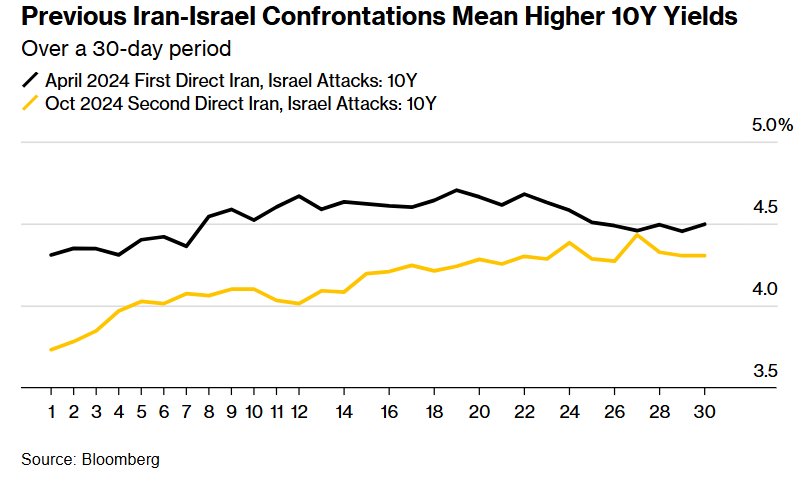
Group 1 - The latest military confrontation between Israel and Iran is expected to exert continued selling pressure on 10-year U.S. Treasury bonds, contrary to some investors' expectations of a flight to safety driving yields down [1][5] - Since the escalation of tensions into direct military conflict, the 10-year U.S. Treasury yield has risen by over 10 basis points, driven by soaring international oil prices and concerns over inflation [1][5] - Historical data indicates that previous confrontations between Israel and Iran have led to a rapid increase in 10-year U.S. Treasury yields, which remained elevated for 30 days following such events [4][1] Group 2 - The current geopolitical situation is increasing the long-term risks faced by U.S. Treasury bond investors, who are already contending with rising inflation concerns and expanding U.S. debt issues [1][5] - The yield curve for U.S. Treasuries is steepening, with the 2-year yield rising by 8 basis points since last Thursday, while shorter-term yields are on a downward trajectory [5][6] - The concept of "term premium," which compensates investors for holding long-term bonds, is expected to rise, potentially pushing 10-year U.S. Treasury yields to levels even higher than the over 5% seen in 2023 [6][5]
年内大涨超25%,白银涨幅直追黄金!又一个投资风口?
券商中国· 2025-06-16 08:32
机构人士分析,逆全球化、去美元化的浪潮下,美元美债维持弱势,黄金上行的长线趋势不变,这为白银的贵 金属属性提供了强有力的支撑。4月下旬开始美国关税政策趋于缓和后,三季度全球市场可能会走经济回升的 逻辑。白银得益于其工业属性,在经济回升且金银比值高位的背景下或持续补涨。 白银基本面支撑上涨 白银的基本面确实处于比较好的状态中。白银的工业属性是下游需求的重要来源。白银具有优良的导电导热 性、延展性、较高的感光性,因此成为重要的工业金属。2020年之后,全球光伏新能源技术的发展推动了白银 需求的快速上行。2021至2023年,白银总需求上升约9540万盎司,其中工业需求上升9310万盎司,贡献增量的 约97.6%。 世界白银协会发布的《2025全球白银调查》数据显示,2024年全球白银总供应量为10.15亿盎司,其中一次矿 山生产供应量占比为81%;2024年全球白银总需求量为11.64亿盎司,其中工业需求为6.81亿盎司,占比达 58.5%,主要集中在电子电气(光伏)、钎焊合金和焊料等领域。 平安证券指出,全球白银2016—2024年供应总量CAGR达-0.5%。2024年全球矿产银总供给中伴生矿产量占比 约72 ...
西南期货早间评论-20250616
Xi Nan Qi Huo· 2025-06-16 02:26
Report Industry Investment Ratings No relevant information provided. Core Views of the Report - For Treasury bonds, it is expected that there will be no trend - based market, and caution is advised [6][7]. - For stock indices, the long - term performance of Chinese equity assets is optimistic, and considering going long on stock index futures is recommended [10][11]. - For precious metals, the long - term bull market trend of precious metals is expected to continue, and considering going long on gold futures is advised [12][13]. - For steel products such as rebar and hot - rolled coils, investors can focus on shorting opportunities on rebounds, and light - position participation is recommended [15][16]. - For iron ore, investors can focus on buying opportunities at low levels, and light - position participation is recommended [17][18]. - For coking coal and coke, investors can focus on shorting opportunities on rebounds, and light - position participation is recommended [20][21]. - For ferroalloys, the overall price is under pressure, and long - position holders need to be cautious. Low - value call option opportunities can be considered [23]. - For crude oil, the price is expected to rise, and a long - position operation on the main contract is considered [25][26]. - For fuel oil, the price is expected to be strong, and a long - position operation on the main contract is considered [28]. - For synthetic rubber, wait for the market to stabilize and then participate in the rebound [30]. - For natural rubber, focus on long - position opportunities after the market stabilizes [33]. - For PVC, it is in a bottom - oscillating state [34]. - For urea, consider deploying long positions opportunistically [35][36]. - For PX, be cautious about chasing high prices, and pay attention to changes in crude oil costs and macro - policies [37]. - For PTA, consider range - bound operations and opportunities to narrow the processing margin [39]. - For ethylene glycol, it is expected to oscillate and adjust, and pay attention to port inventory and macro - policy changes [40]. - For staple fiber, participate cautiously and pay attention to opportunities to expand the processing margin [42]. - For bottle chips, participate cautiously and pay attention to changes in crude oil costs [43]. - For soda ash, the short - term market trend is weakly stable, and do not over - pursue long positions on short - term rebounds [44][45]. - For glass, the short - term may have bullish sentiment fermentation, but do not over - pursue long positions on short - term rebounds [46]. - For caustic soda, the overall supply and demand is relatively loose, and long - position holders need to control positions [47][49]. - For pulp, the market is in a stalemate in June, and a turnaround may occur in August [50][51]. - For lithium carbonate, the price is difficult to reverse before large - scale clearance of mine - end capacity [52]. - For copper, consider a long - position operation on the main contract of Shanghai copper [54][55]. - For tin, the price is expected to oscillate [56]. - For nickel, the price is expected to oscillate [57]. - For soybean meal and soybean oil, be on the sidelines for soybean meal, and pay attention to low - value call option opportunities for soybean oil [59]. - For cotton, take a wait - and - see approach [64]. - For sugar, consider batch - wise long - position operations [67][68]. - For apples, take a wait - and - see approach and pay attention to future production data [71][72]. - For live pigs, consider long - position arbitrage opportunities in peak - season contracts [74]. - For eggs, consider gradually closing out short positions in near - month contracts [78]. - For corn and corn starch, the bottom of corn has strong support, and temporarily observe corn starch [80][81]. - For logs, be wary of bullish sentiment disturbances as the 07 contract approaches the delivery month [82]. Summaries by Related Catalogs Treasury Bonds - Last trading day, Treasury bond futures closed up across the board. The central bank conducted reverse repurchase operations, and there was a net investment of 67.5 billion yuan on a single day. The social financing scale and money supply data in the first five months of 2025 were released [5]. - The current macro - economic recovery momentum needs to be strengthened, and the Treasury bond yield is at a relatively low level. It is recommended to remain cautious [6][7]. Stock Indices - Last trading day, stock index futures showed mixed performance. The Guangzhou government proposed measures to boost consumption, and the real - estate policy was optimized [8][9][10]. - Although the domestic economic recovery momentum is not strong, the long - term performance of Chinese equity assets is optimistic, and going long on stock index futures can be considered [10][11]. Precious Metals - Last trading day, the gold main contract closed up, and the silver main contract closed down. US consumer confidence and inflation expectation data were released [12]. - Due to the complex global trade and financial environment and the trends of "de - globalization" and "de - dollarization", the long - term bull market trend of precious metals is expected to continue, and going long on gold futures can be considered [12][13]. Steel Products (Rebar, Hot - Rolled Coils) - Last trading day, rebar and hot - rolled coil futures showed weak oscillations. The spot prices were reported, and the industry supply - demand situation was analyzed [14][15]. - The downward trend of the real - estate industry suppresses the prices of rebar and hot - rolled coils. The current price valuation is low, and investors can focus on shorting opportunities on rebounds [15][16]. Iron Ore - Last trading day, iron ore futures showed weak oscillations. The spot prices and industry supply - demand situation were reported [17]. - The supply - demand pattern of the iron ore market has weakened marginally. The price valuation is high, and investors can focus on buying opportunities at low levels [17][18]. Coking Coal and Coke - Last trading day, coking coal and coke futures rebounded slightly. The industry supply - demand situation is that there is an oversupply, and the market sentiment is bearish [19][20]. - The short - term may stop falling, but the medium - term weakness has not reversed. Investors can focus on shorting opportunities on rebounds [20][21]. Ferroalloys - Last trading day, the manganese - silicon and silicon - iron main contracts closed up. The supply - demand situation and inventory data were reported [22]. - The short - term demand may peak, and the supply is excessive. The overall price is under pressure, and long - position holders need to be cautious [22][23]. Crude Oil - Last trading day, INE crude oil rose significantly. Multiple market data and news were reported, including CFTC data, Baker Hughes data, and the trading volume of call options [24]. - The negotiation between China and the US is over, and the conflict between Israel and Iran intensifies. The price of crude oil is expected to rise, and a long - position operation on the main contract can be considered [25][26]. Fuel Oil - Last trading day, fuel oil rose significantly following crude oil. The market supply - demand situation and price changes were reported [27][28]. - The decrease in Singapore's fuel oil inventory and the recovery of global trade demand are favorable for fuel oil. A long - position operation on the main contract can be considered [28]. Synthetic Rubber - Last trading day, the synthetic rubber main contract closed up. The supply - demand situation and cost factors were analyzed [29]. - Wait for the market to stabilize and then participate in the rebound [30]. Natural Rubber - Last trading day, the natural rubber main contract showed mixed performance. The supply - demand situation, inventory data, and import data were reported [31][32]. - Focus on long - position opportunities after the market stabilizes [33]. PVC - Last trading day, the PVC main contract closed up. The supply - demand situation, cost - profit situation, and inventory data were reported [34]. - It is in a bottom - oscillating state [34]. Urea - Last trading day, the urea main contract closed up. The supply - demand situation and inventory data were reported [35]. - Consider deploying long positions opportunistically [35][36]. PX - Last trading day, the PX2509 main contract rose. The supply - demand situation, cost factors, and price spreads were reported [37]. - Be cautious about chasing high prices, and pay attention to changes in crude oil costs and macro - policies [37]. PTA - Last trading day, the PTA2509 main contract rose. The supply - demand situation, cost factors, and inventory data were reported [38][39]. - Consider range - bound operations and opportunities to narrow the processing margin [39]. Ethylene Glycol - Last trading day, the ethylene glycol main contract rose. The supply - demand situation, inventory data, and downstream demand were reported [40]. - It is expected to oscillate and adjust, and pay attention to port inventory and macro - policy changes [40]. Staple Fiber - Last trading day, the staple fiber 2507 main contract rose. The supply - demand situation, cost - benefit situation, and downstream demand were reported [41][42]. - Participate cautiously and pay attention to opportunities to expand the processing margin [42]. Bottle Chips - Last trading day, the bottle chips 2509 main contract rose. The supply - demand situation, cost - benefit situation, and downstream demand were reported [43]. - Participate cautiously and pay attention to changes in crude oil costs [43]. Soda Ash - Last trading day, the main 2509 contract closed down. The supply - demand situation, production, and inventory data were reported [44]. - The short - term market trend is weakly stable, and do not over - pursue long positions on short - term rebounds [44][45]. Glass - Last trading day, the main 2509 contract closed down. The supply - demand situation, price changes in different regions, and market sentiment were reported [46]. - The short - term may have bullish sentiment fermentation, but do not over - pursue long positions on short - term rebounds [46]. Caustic Soda - Last trading day, the main 2509 contract closed down. The production, inventory data, and supply - demand situation were reported [47][48][49]. - The overall supply and demand is relatively loose, and long - position holders need to control positions [47][49]. Pulp - Last trading day, the main 2507 contract closed down. The inventory data, market situation, and price changes of different pulp types were reported [50][51]. - The market is in a stalemate in June, and a turnaround may occur in August [50][51]. Lithium Carbonate - Last trading day, the lithium carbonate main contract closed down. The supply - demand situation, market sentiment, and price factors were reported [52]. - The price is difficult to reverse before large - scale clearance of mine - end capacity [52]. Copper - Last trading day, Shanghai copper fell significantly. The spot price, market situation, and price changes were reported [53]. - The Sino - US negotiation is favorable for the market sentiment, and a long - position operation on the main contract of Shanghai copper can be considered [54][55]. Tin - Last trading day, Shanghai tin oscillated. The supply - demand situation, mine - end situation, and price trend were reported [56]. - The price is expected to oscillate [56]. Nickel - Last trading day, Shanghai nickel fell slightly. The supply - demand situation, cost factors, and price trend were reported [57]. - The price is expected to oscillate [57]. Soybean Meal and Soybean Oil - Last trading day, soybean meal closed down slightly, and soybean oil closed up. The spot price, supply - demand situation, inventory data, and consumption situation were reported [58][59]. - Be on the sidelines for soybean meal, and pay attention to low - value call option opportunities for soybean oil [59]. Cotton - Last trading day, domestic Zhengzhou cotton oscillated. The global and domestic supply - demand situation, and the US cotton data were reported [62][63]. - Take a wait - and - see approach [64]. Sugar - Last trading day, domestic Zhengzhou sugar showed a significant bottom - recovering trend. The domestic and foreign supply - demand situation, production data, and price factors were reported [65][67]. - Consider batch - wise long - position operations [67][68]. Apples - Last trading day, domestic apple futures showed a trend of rising and then falling. The production situation, inventory data, and price information were reported [69]. - Take a wait - and - see approach and pay attention to future production data [71][72]. Live Pigs - The national average price of live pigs rose slightly. The supply - demand situation, production data, and price trend were reported [73][74]. - Consider long - position arbitrage opportunities in peak - season contracts [74]. Eggs - The average price of eggs in the main production and sales areas fell. The supply - demand situation, production data, and price trend were reported [75][78]. - Consider gradually closing out short positions in near - month contracts [78]. Corn and Corn Starch - Last trading day, the corn main contract closed up, and the corn starch main contract closed down. The supply - demand situation, inventory data, and consumption situation were reported [79][80]. - The bottom of corn has strong support, and temporarily observe corn starch [80][81]. Logs - Last trading day, the main 2507 contract closed up. The arrival and inventory data of New Zealand logs were reported [82]. - Be wary of bullish sentiment disturbances as the 07 contract approaches the delivery month [82].
【广发资产研究】全球杠铃策略如何应对美国衰退风险?—债务周期下的资产配置新策略系列(七)
戴康的策略世界· 2025-06-15 02:42
Core Viewpoint - The article emphasizes the need for long-term investors to deeply interpret the reshaping of the global order and assess the cost-effectiveness of various assets, particularly in light of the increasing risks associated with U.S. recession and the implications of new investment paradigms [3][4][9]. Group 1: Introduction and Key Variables - The beginning of the year has seen two critical variables (Deepseek and reciprocal tariffs) that reinforce the underlying logic of a new investment paradigm characterized by increasing de-globalization, trends in AI industries, and debt cycles [3][12]. - The global risk premium has risen, potentially amplifying asymmetric pricing risks, particularly regarding the underpricing of recession risks in major asset classes [3][4]. Group 2: U.S. Recession Trading - Historical data shows that U.S. recession trading often begins 1-6 months before the National Bureau of Economic Research (NBER) officially declares a recession [4][42]. - Typical characteristics during U.S. recession trading include declines in U.S. stocks and industrial metals, falling 10-year Treasury yields, widening credit spreads, and defensive stocks outperforming cyclical stocks [4][47]. Group 3: Volatility During Recession Trading - During past U.S. recession trading phases, asset volatility has increased, with risk assets experiencing greater volatility than safe-haven assets [4][63]. - The volatility amplification factors for various assets have been ranked, with Nasdaq showing the highest, followed by the Indian SENSEX30 and Hang Seng Technology [5][70]. Group 4: All-Weather Strategy Model - The article discusses how to adjust the all-weather strategy model to correct the underestimation of U.S. recession risks in asset pricing [4][70]. - The model suggests increasing the allocation to Chinese convertible bonds and A-share dividends while reducing exposure to Nasdaq, Indian SENSEX30, and Hang Seng Technology based on their respective volatility amplification factors [5][70]. Group 5: Asymmetric Pricing Risks - The current global investment landscape shows a significant underestimation of U.S. recession risks, which presents an opportunity for asymmetric trading strategies that favor high potential gains with limited losses [4][24]. - The article highlights the importance of adjusting asset allocations to account for these asymmetric risks, particularly in light of the evolving global economic landscape [4][70].

【广发资产研究】全球杠铃策略如何应对美国衰退风险?—债务周期下的资产配置新策略系列(七)
戴康的策略世界· 2025-06-15 02:42
Core Viewpoint - The article emphasizes the need for long-term investors to deeply interpret the reshaping of the global order and assess the cost-effectiveness of various assets, particularly in light of the increasing risks associated with U.S. recession and the implications of new investment paradigms [3][10]. Group 1: Introduction - The article discusses two key variables at the beginning of the year: Deepseek and equivalent tariffs, which reinforce the underlying logic of a new investment paradigm characterized by increasing de-globalization, trends in AI industries, and debt cycles [3][10]. - It suggests that the global risk premium has risen, potentially amplifying asymmetric pricing risks, particularly regarding the underpricing of recession risks in major asset classes [3][10]. Group 2: U.S. Recession Trading - Historical data indicates that U.S. recession trading often begins 1-6 months before the National Bureau of Economic Research (NBER) officially declares a recession [4][47]. - Typical characteristics during U.S. recession trading include declines in U.S. stocks and industrial metals, falling 10-year Treasury yields, widening credit spreads, and defensive stocks outperforming cyclical stocks [4][47]. Group 3: Volatility During Recession Trading - The article notes that during past U.S. recession trading phases, asset volatility has generally increased, with risk assets experiencing greater volatility than safe-haven assets [5][65]. - Specific examples include the Nasdaq and Hang Seng Index showing higher volatility compared to gold and U.S. Treasuries during recession periods [5][65]. Group 4: All-Weather Strategy Model - The article proposes an all-weather strategy model to adjust for the underestimation of U.S. recession risks, focusing on the asymmetric pricing risks present in current asset allocations [6][73]. - It ranks various assets based on their volatility amplification factors during past recession trading periods, with Nasdaq, Indian SENSEX30, and Hang Seng Technology leading the list [6][73]. - The model suggests adjusting asset weights based on these factors, increasing allocations to underweighted assets like Chinese convertible bonds and A-share dividends while reducing exposure to overvalued assets like Nasdaq and Indian SENSEX30 [6][73].


广发证券:全球杠铃策略如何应对美国衰退风险?—债务周期下的资产配置新策略系列
智通财经网· 2025-06-14 12:52
Core Viewpoint - Long-term investors need to deeply interpret the direction of the reshaping world order and weigh the cost-effectiveness of various assets, as two key variables (Deepseek and reciprocal tariffs) have further strengthened the underlying logic of a new investment paradigm [1] Group 1: U.S. Recession Trading - The initiation of recession trading often leads the actual declaration of recession by the NBER by an average of 1-6 months [1] - Typical characteristics of U.S. recession trading include declines in U.S. stocks and industrial metals, a decrease in 10Y U.S. Treasury yields, widening U.S. credit spreads, and defensive stocks outperforming cyclical stocks [1] Group 2: Asset Volatility During Recession Trading - Historical data shows that asset volatility increases during U.S. recession trading phases, with risk assets experiencing a greater increase in volatility compared to safe-haven assets [2] - Specifically, the volatility amplification factor for risk assets (e.g., Nasdaq, Hang Seng Index) is greater than that for safe-haven assets (e.g., gold, U.S. Treasuries, Chinese bonds, A-share dividends) [2] Group 3: All-Weather Strategy Model - Investors need to focus on the asymmetric pricing risks in their portfolios, particularly the underestimation of U.S. recession risks [3] - The ranking of volatility amplification factors for various assets during past U.S. recession trading periods is as follows: Nasdaq > India SENSEX30 > Hang Seng Tech > U.S. Treasuries > Gold > Chinese bonds > Bitcoin > A-share dividends [3] - Adjustments to asset allocation based on corrected volatility factors indicate an increase in weight for Chinese convertible bonds and A-share dividends, while reducing weight for Nasdaq, India SENSEX30, and Hang Seng Tech [3]
【广发资产研究】全球杠铃策略如何应对美国衰退风险?—债务周期下的资产配置新策略系列(七)
戴康的策略世界· 2025-06-14 06:54
Core Viewpoint - The article emphasizes the need for long-term investors to deeply interpret the reshaping of the global order and assess the cost-effectiveness of various assets, particularly in light of the underestimation of U.S. recession risks in global asset pricing [3][20][46]. Group 1: Introduction - The beginning of the year has seen two key variables (Deepseek and equivalent tariffs) that reinforce the underlying logic of a new investment paradigm, characterized by increasing de-globalization, trends in AI industries, and debt cycles [3][10]. - The global risk premium has risen, potentially amplifying asymmetric pricing risks, with current global risk assets having largely recovered to levels prior to the imposition of equivalent tariffs [3][20]. Group 2: U.S. Recession Trading - Historical data shows that U.S. recession trading often begins 1-6 months before the National Bureau of Economic Research (NBER) officially declares a recession [4][47]. - Typical characteristics during U.S. recession trading include declines in U.S. stocks and industrial metals, falling 10-year Treasury yields, widening U.S. credit spreads, and defensive stocks outperforming cyclical stocks [4][47]. Group 3: Volatility During Recession Trading - During past U.S. recession trading phases, asset volatility has increased, with risk assets experiencing greater volatility than safe-haven assets [5][65]. - The volatility amplification factors for risk assets (e.g., Nasdaq, Hang Seng Index) are higher than those for safe-haven assets (e.g., gold, U.S. Treasuries) [5][65]. Group 4: All-Weather Strategy Model - The article discusses how to adjust the all-weather strategy model to correct the underestimation of U.S. recession risks in asset pricing [6][73]. - The model suggests that the risk parity principle should be applied based on the adjusted volatility of various assets, leading to changes in asset allocation [6][73]. - The revised model indicates an increase in allocation for Chinese convertible bonds and A-share dividends, while reducing allocations for Nasdaq and Indian SENSEX30 [6][73]. Group 5: Asymmetric Pricing Risks - The current global investment landscape shows a significant underpricing of U.S. recession risks, which presents an opportunity for asymmetric trading strategies [20][46]. - The article highlights the importance of adjusting asset allocations to account for the potential impact of U.S. recession risks on various asset classes [20][46].