产品创新

Search documents
蜜雪集团上半年营收148.7亿元,全球门店数超5.3万家
Sou Hu Cai Jing· 2025-08-27 09:52
Core Insights - The core viewpoint of the articles highlights the significant growth and expansion of Mixue Group, driven by enhanced supply chain capabilities, brand IP development, and optimized store operations [1][2][3] Financial Performance - In the first half of 2025, Mixue Group achieved a revenue of 14.87 billion yuan, representing a year-on-year increase of 39.3% [1] - Gross profit reached 4.71 billion yuan, up 38.3% year-on-year [1] - Net profit was 2.72 billion yuan, reflecting a 44.1% increase compared to the previous year [1] Store Expansion - As of June 30, 2025, Mixue Group's total number of global stores reached 53,014, with an addition of 9,796 stores compared to the same period last year [1] - The number of stores in third-tier cities and below reached 27,804, accounting for 57.6% of the total stores in mainland China, with an increase of 5,707 stores year-on-year [1] International Expansion - Mixue Group opened its first store in Kazakhstan in April 2025, marking its entry into the Central Asian market [1] - The brand's coffee segment, Lucky Coffee, opened its first overseas store in Malaysia in August 2025, initiating its global expansion [1] Operational Efficiency - The company is enhancing store efficiency through technology, with over 5,600 stores testing and promoting smart dispensing machines since October 2024 [2] - Mixue Group has established a comprehensive end-to-end supply chain system, covering procurement, production, logistics, research and development, and quality control [2] - The company has signed a procurement agreement worth 4 billion yuan with Brazil to expand its global sourcing of quality raw materials [2] Brand Development and Product Innovation - Mixue Group's flagship store in Zhengzhou attracted over 240,000 visitors during the May Day holiday, showcasing its brand and product experience [3] - The "蜜雪冰城" topic on Douyin has accumulated over 54.2 billion views, indicating strong brand engagement [3] - New product launches, including "青提肉多多," achieved sales of over 7 million cups within three days of release [3] - Lucky Coffee's "真果咖" series generated over 100 million yuan in sales in its first month after launch [3]


东海证券:直面竞争持续创新 扫地机行业放眼全球潜力可期
Zhi Tong Cai Jing· 2025-08-27 04:01
Group 1 - The core viewpoint of the report highlights that leading companies in the robotic vacuum cleaner industry are continuously upgrading basic functions while integrating advanced technologies to enhance user experience and reduce market homogenization [1] - Domestic sales data shows positive growth, with retail sales of robotic vacuum cleaners in China increasing by 41.1% year-on-year in the first half of 2025, and sales volume rising by 40.7% [1] - The application of innovative technologies such as bionic robotic arms, self-cleaning features, and AI interaction has significantly improved the adaptability and user-friendliness of robotic vacuum cleaners [1] Group 2 - The average online retail price of robotic vacuum cleaners has shown fluctuations, with a year-on-year decrease of 4.9% in May and 5.0% in June, followed by a 4.3% increase in July [2] - The high-end market's retail sales accounted for 13.7%, 16.1%, and 16.6% in May, June, and July respectively, indicating a growing segment [2] - The price segment of 3500-4000 yuan accounted for the highest market share at 21.8% in July, with brands like Ecovacs and DJI focusing on the high-end market [2] Group 3 - The global market for robotic vacuum cleaners is projected to see significant growth, with an expected shipment of 20.6 million units in 2024, representing a year-on-year increase of 11.2% [3] - The total sales revenue for the global robotic vacuum cleaner market is anticipated to reach 9.31 billion USD in 2024, reflecting a year-on-year growth of 19.7% [3] - The average price of robotic vacuum cleaners is expected to rise by 7.6% to 452 USD in 2024 due to technological advancements [3] Group 4 - Chinese brands are expected to dominate the global market, with the top four robotic vacuum cleaner shipments in Q1 2025 being Chinese brands, led by Stone Technology [4] - Stone Technology achieved the highest market share in various Amazon channels across Europe, the US, and Australia during the 2025 Prime Day [4] - The development of cross-border e-commerce has provided Chinese brands with opportunities to penetrate high-end overseas markets, with significant growth in sales in North America and Northern Europe [4]
医药零售冲击波下的龙头突围战:葵花药业解码药企韧性成长密码
Xin Lang Cai Jing· 2025-08-27 00:27
Core Insights - The pharmaceutical retail market has undergone significant structural adjustments since 2024, driven by external forces such as the "same drug price comparison" policy, leading to increased price transparency and rationality in the market [1][3] - Leading companies in the industry, particularly in the OTC sector, are initiating proactive marketing transformations and optimizing channel inventories to adapt to these changes [1][5] Industry Overview - The Chinese traditional medicine and OTC industry has faced challenges over the past year, with policies driving retail drug prices back to a more transparent and rational range, directly impacting production companies' profits [3][4] - Many A-share traditional Chinese medicine companies have reported losses or significant performance reductions, indicating that the industry is at a cyclical low point [3][4] Company Strategies - Leading companies like Kewflower Pharmaceutical are viewing the current adjustments as strategic opportunities, implementing comprehensive changes in channel management, product innovation, and digital empowerment [5][6] - Kewflower Pharmaceutical has adopted a proactive strategy to control short-term shipment volumes and optimize channel inventories, aiming for a healthier sales system [6] Product Innovations - Kewflower Pharmaceutical plans to launch two key new products in the first half of 2025, targeting unmet needs in adult constipation and children's medication markets [7] - The company has developed a new adult constipation medication and a children's ibuprofen suspension, enhancing product safety and efficacy to capture market share [7] Market Positioning - Kewflower Pharmaceutical has established a strong brand presence with its "Kewflower" and "Little Kewflower" brands, achieving significant brand value growth [11] - The company is leveraging its extensive product line and strong brand recognition to benefit from increasing demand for pediatric medications due to supportive national policies [10][11] Digital Transformation - Kewflower Pharmaceutical is embracing digitalization with its "532" vision, aiming to establish a comprehensive cloud platform for better management of downstream distributors and retail pharmacies [12] - The introduction of the "Kewflower Smart Travel" app is set to enhance sales efficiency through data-driven decision-making [12] Conclusion - The OTC industry is at a critical juncture, with leading companies like Kewflower Pharmaceutical poised to navigate through the cyclical downturn by leveraging product innovation, channel adjustments, and digital capabilities [13]


古茗上半年营收同比增长41.2%,净利增42.4%,下沉市场扩张策略见效 | 财报见闻
Hua Er Jie Jian Wen· 2025-08-26 10:23
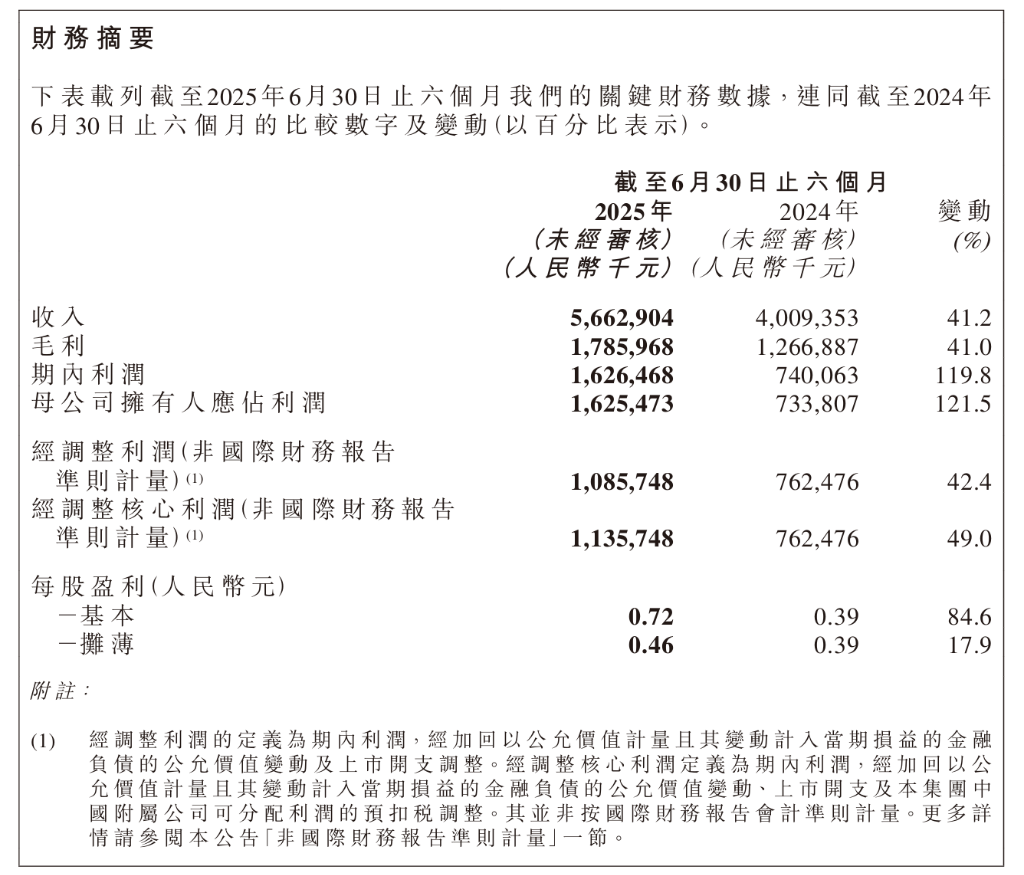
Core Insights - The company, Gu Ming, achieved strong growth in core profitability due to rapid expansion in lower-tier markets and improved store operational efficiency [1][2][4] Financial Performance - Revenue for the six months ending June 30, 2025, reached RMB 5.66 billion, a year-on-year increase of 41.2% [4] - Gross profit was RMB 1.79 billion, up 41.0% compared to the previous year [4] - Net profit was RMB 1.63 billion, a significant increase of 119.8%, primarily due to a one-time gain of RMB 557 million from the fair value change of financial liabilities [2][4] - Adjusted profit, excluding one-time gains and listing expenses, was RMB 1.09 billion, reflecting a 42.4% year-on-year growth [2][4] - Adjusted profit margin slightly increased from 19.0% to 19.2% [2] Store Expansion and Efficiency - The total number of stores reached 11,179, a 17.5% increase from 9,516 stores in the same period last year [3][4] - The company opened 1,570 new stores in the first half of the year, more than double the 765 stores opened in the same period last year [3] - The strategy of "regional densification" has been effective, with stores in second-tier and lower cities increasing from 79% to 81% of total stores [3] - Total GMV for the first half of the year was RMB 14.09 billion, with average daily GMV per store rising from RMB 6,200 to RMB 7,600 [3] Supply Chain and Product Innovation - The company operates 22 warehouses with a total area of approximately 230,000 square meters and has a self-owned fleet of 362 vehicles [6] - Cold chain logistics infrastructure allows for two-day delivery to about 98% of stores, with delivery costs accounting for less than 1% of total GMV [6] - The company launched 52 new products in the first half of the year and expanded its coffee offerings, equipping over 8,000 stores with coffee machines [6] - As of June 30, 2025, the number of registered members on the company's mini-program reached approximately 178 million, with about 50 million active members quarterly [6]
西王食品:2025年上半年营收21.18亿元,运动营养板块将扩大创新平台,拓展新型产品形态
Cai Jing Wang· 2025-08-26 10:23
Core Viewpoint - In the first half of 2025, Xiwang Food reported a significant decline in revenue and a net loss, primarily due to strategic shifts in product sales and increased raw material costs [1] Financial Performance - The company achieved a revenue of 2.118 billion yuan, representing a year-on-year decrease of 15.82% [1] - The net loss for the period was 18.57 million yuan, marking a transition from profit to loss compared to the previous year [1] Operational Insights - The decline in revenue was attributed to a focus on profit-oriented strategies that led to reduced sales of low-margin products and changes in the competitive landscape of the weight management category [1] - The gross margin decreased due to rising costs of key raw materials [1] Strategic Initiatives - In the plant oil business, the company launched a new product strategy, completed brand renewal, and upgraded product offerings [1] - Preliminary statistics indicated that the shipment volume to end customers exceeded the company's own shipment volume during the reporting period [1] - The sports nutrition segment plans to continue expanding its innovation platform, developing new product forms, and creating science-based nutritional solutions focused on performance, metabolism, and long-term health [1]

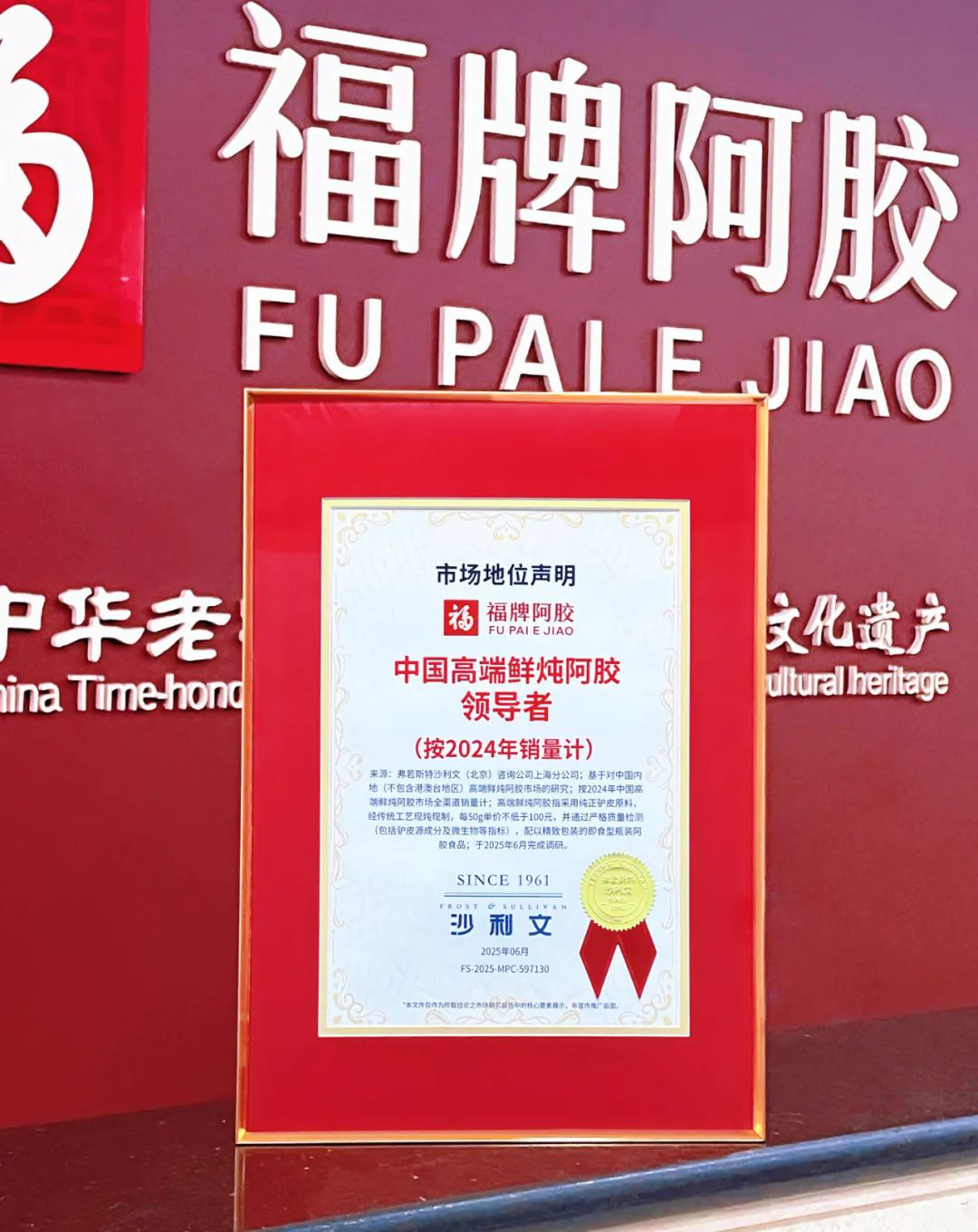
全球权威认证!福牌阿胶荣膺“中国高端鲜炖阿胶领导者”称号
Qi Lu Wan Bao· 2025-08-26 07:23
Core Insights - The traditional Chinese health supplement industry has received significant recognition as Fupai Ejiao has been awarded the title of "Leader in High-End Freshly Stewed Ejiao" by Frost & Sullivan, affirming its market leadership and strong capabilities in the high-end segment [1][10] Group 1: Company Recognition - Fupai Ejiao has been recognized by Frost & Sullivan, a reputable market research institution, based on comprehensive research and analysis of the Chinese health supplement market [3] - The award reflects Fupai Ejiao's innovative integration of traditional and modern stewing techniques, evolving its products from solid forms to "ready-to-eat" formats [4] Group 2: Market Performance - Fupai Ejiao's freshly stewed Ejiao products achieved sales of 1.19 million bottles and revenue exceeding 30 million within just six months of launch, leading the high-end freshly stewed Ejiao market in 2024 [4] - The company focuses on functional scenarios such as women's health, postpartum recovery, and support for individuals with low vitality, enhancing its product offerings [4] Group 3: Brand Heritage and Innovation - Fupai Ejiao originates from Dong'e Town in Jinan, recognized as the only "Hometown of Ejiao" in China, with a brand heritage spanning over 300 years [6] - The company has continuously innovated while preserving traditional techniques, creating a new ecosystem of health products that includes various consumption methods [6] Group 4: Technological Advancements - Fupai Ejiao has invested heavily in intelligent production lines, implementing digital monitoring across all production processes to ensure product quality stability [8] - The company operates multiple research centers, including a national postdoctoral research station and a provincial enterprise technology center, providing robust support for product innovation and quality enhancement [8] Group 5: Future Commitment - The recognition from Frost & Sullivan is seen as both an honor and a responsibility, with Fupai Ejiao committed to maintaining high-quality standards and driving the industry towards higher quality and standards [10]
雅迪控股发布中期业绩,股东应占利润16.49亿元 同比增加59.5%
Zhi Tong Cai Jing· 2025-08-26 05:54
Core Insights - Yadea Holdings (01585) reported a revenue of RMB 19.186 billion for the first half of 2025, representing a year-on-year increase of 33.11% [1] - The profit attributable to shareholders was RMB 1.649 billion, a year-on-year increase of 59.5%, with earnings per share at 54.3 cents [1] - The revenue growth was primarily driven by an overall recovery in market demand, an expanded product mix, and increased investment in marketing and brand building [1] Group 1 - The management has implemented a series of strategic and operational measures to strengthen core business, consolidate market position, and promote sustainable growth in response to the anticipated recovery in the electric two-wheeler industry by the end of 2024 [1] - Key measures include prioritizing new product development, optimizing domestic and international distribution networks, enhancing cost control in production, and improving efficiency [1] - The company continues to focus on long-term growth by investing in R&D, particularly in new product innovation and advanced technology for core components, while also increasing efforts to promote the "Yadea" brand globally [1] Group 2 - Looking ahead to the second half of 2025, management remains confident in its strategic direction and is committed to maintaining the growth momentum from the first half [2] - Yadea will continue to focus on strengthening its core competitiveness, driving product innovation, expanding its global business footprint, and deepening brand engagement, especially among younger consumers [2] - The company plans to further invest in R&D to enhance product performance, user experience, and sustainability capabilities, while advancing smart manufacturing capabilities [2]

雅迪控股上半年股东应占利润增长59.5%
Zheng Quan Shi Bao Wang· 2025-08-26 05:17
Core Insights - Yadea Holdings reported a 33.1% increase in revenue to RMB 19.1859 billion for the first half of 2025, with gross profit rising by 45.1% to RMB 3.7632 billion and net profit attributable to shareholders increasing by 59.5% to RMB 1.6490 billion [1][1][1] - The revenue growth is attributed to increased sales driven by recovering market demand, optimized product mix, and increased marketing investments [1][1][1] - Yadea expresses confidence in maintaining growth momentum in the second half of 2025, focusing on enhancing core competitiveness, product innovation, global business expansion, and deepening brand engagement, particularly targeting younger consumers [1][1][1] - The company plans to increase R&D investments to improve product performance, user experience, and sustainability, while advancing smart manufacturing [1][1][1] - Yadea aims to solidify its leadership position in the electric two-wheeler market and create long-term value for shareholders [1][1][1]
2025ClientDay亮点|以消费者洞察之力,谋品牌增长之道
凯度消费者指数· 2025-08-26 04:15
Core Insights - The article emphasizes the importance of consumer insights in driving brand growth, focusing on how brands can penetrate consumer perceptions and purchasing behaviors to identify sources of growth in a fragmented market [1][7][12]. Group 1: Market Trends - The fast-moving consumer goods (FMCG) market in China is entering a phase of slow adjustment, with consumers increasingly fragmented in their media, channel, and brand choices, presenting hidden opportunities [7]. - Consumer behavior is characterized by both rationality and upgrading, with a significant trend towards on-demand purchasing and extreme segmentation of consumption scenarios [7][15]. - Brands need to leverage cultural symbols and sustainable values to resonate emotionally with consumers, employing strategies that combine scenario-driven insights, cross-generational understanding, and emotional storytelling to seize growth opportunities [7][12]. Group 2: Brand Growth Strategies - The core engine for achieving certain growth in a complex market is increasing penetration rates, which brands can enhance through differentiated pathways based on their development stages [12]. - The "Five News" framework—new demands, new scenarios, new regions, new channels, and new demographics—serves as a guideline for brands to identify penetration breakthrough paths [12]. - Brands must respond precisely to the differentiated needs of various age groups and clearly define channel roles to open up diverse growth paths [15]. Group 3: Product Innovation - In the past year, 380,000 new products entered the Chinese FMCG market, indicating a growing desire among brands to achieve growth through innovation [18]. - Successful product innovation is not solely dependent on the quantity of new products but rather on the speed of identifying and validating new concepts, selecting appropriate channels for launch, and ensuring that new products contribute to brand growth without cannibalizing existing offerings [18]. - The article highlights the role of AI technology and consumer purchase data tracking in enhancing product innovation efficiency and precision [18]. Group 4: Consumer Insights and Brand Performance - The "2025 Brand Footprint Report" was released, showcasing the top ten consumer preferred brands and the fastest-growing brands in the Chinese market, indicating stable competition among leading brands [22]. - The report underscores the need for brands to adapt to the evolving consumer landscape and to utilize insights effectively to drive brand performance and growth [22].

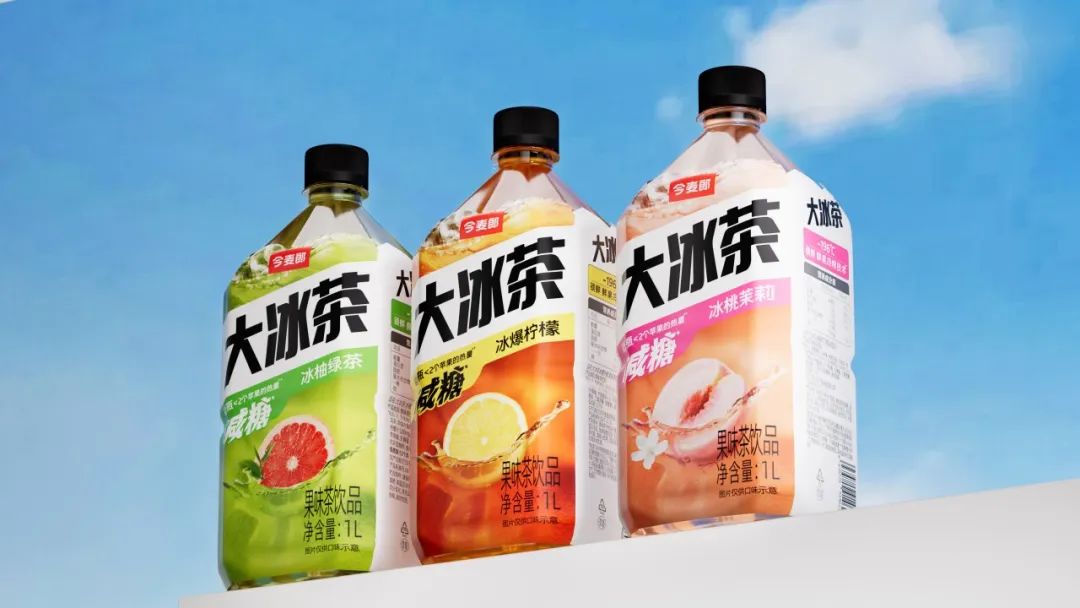
1L装只要3.3元?今麦郎杀进冰红茶“红海战场”
3 6 Ke· 2025-08-26 03:32
Core Insights - The beverage market is experiencing a price war, with companies like Jinmailang and Bai Xiang launching competitively priced products to attract consumers [5][41] - Jinmailang's new product, "Big Ice Tea," is priced at 3.3 yuan per 1L bottle, undercutting competitors like Master Kong and Unification [6][11] - The market for bottled iced tea has reached a significant scale, with Master Kong leading with a 68.6% market share [16][18] Group 1: Product Launches and Pricing Strategies - Jinmailang has introduced a new 1L iced tea product priced at 3.3 yuan, significantly lower than Master Kong's suggested retail price of 5 yuan [5][8] - Bai Xiang has also launched a new product, "Qinxiang Red Tea," priced at 3.18 yuan for a 500mL bottle [2][5] - Master Kong has announced price increases for its tea and juice products, with 1L iced tea now suggested to be priced at no less than 5 yuan [5][6] Group 2: Market Dynamics and Competition - The iced tea market is becoming increasingly competitive, with new entrants like Jinmailang and Yuanqi Forest challenging established brands [18][41] - The market for iced tea has evolved, with a shift towards larger packaging and reduced sugar content becoming key selling points [20][26] - Consumer preferences are changing, with a growing demand for low-sugar and natural ingredient products [26][28] Group 3: Market Share and Growth - The iced tea market in China has reached a size of 53.3 billion USD, indicating significant growth potential [11][16] - Despite rapid growth, Yuanqi Forest's iced tea still holds only a 2.7% market share, highlighting the competitive landscape [14][16] - The top ten brands in the iced tea market account for 99.2% of the total market share, indicating a concentrated competitive environment [16][18]