新消费

Search documents
什么信号?热门赛道ETF建仓放缓,头部基金组团入局新消费
证券时报· 2025-09-22 07:37
Core Viewpoint - Despite the strong performance of technology and pharmaceutical funds, public funds are gradually adopting a defensive mindset [1] Group 1: ETF Construction Strategies - The construction speed of popular industry ETFs has slowed down as stock prices heat up [4] - As of September 19, 2023, the strongest technology fund has achieved a performance of 196%, while the strongest pharmaceutical fund has exceeded 170% [5] - The construction speed of ETFs is influenced by the performance of the underlying sectors, with slower construction in sectors that have seen rapid price increases [5][6] Group 2: Shift to New Consumption - Head funds are increasingly participating in new consumption IPOs, indicating a strategic shift towards defensive assets [7] - Notable new consumption companies, such as IFBH, have attracted significant public fund interest, reflecting a growing focus on consumer stocks [8] - The new consumption sector is seen as a core defensive asset due to its relatively stable stock performance and emerging growth drivers [9] Group 3: Market Outlook and Investment Logic - The third quarter of 2023 is expected to be a period of market differentiation, with a focus on selecting quality companies [10] - Analysts suggest that the new consumption sector is gaining traction due to its emphasis on consumer experience and the emergence of leading brands in the capital market [10] - The consumption sector is anticipated to benefit from clearer demand-side policies in the second half of the year, leading to improved profitability [11]


什么信号?热门赛道ETF建仓放缓,头部基金组团入局新消费
券商中国· 2025-09-22 05:57
Core Viewpoint - Despite the strong performance of technology and pharmaceutical funds, public funds are gradually adopting a defensive mindset [1] Group 1: ETF Construction Strategies - The construction speed of popular industry ETFs has slowed down, with significant positions only around 10-17% before their respective listings [3][4] - As of September 19, 2023, the strongest technology funds have achieved returns of up to 196%, while pharmaceutical funds have exceeded 170% [3][4] - The rapid construction of ETFs is often linked to the performance of the underlying sectors, with slower construction occurring when sector gains are excessive [4] Group 2: Shift Towards Consumer Stocks - Leading funds are increasingly focusing on consumer stocks, with several pharmaceutical-themed funds beginning to include new consumer stocks in their portfolios [5][6] - The IPO of IFBH, a coconut water company, attracted significant interest from multiple public and private funds, indicating a shift in investment strategy [5] - The entry of public funds into consumer stocks is seen as a response to the strong performance of the innovative drug sector [6] Group 3: Outlook on Consumer Sector - The consumer sector is viewed as a core defensive asset for public funds, driven by the emergence of quality companies and new performance drivers [7][8] - Analysts suggest that the competitive landscape in the consumer industry may improve due to a weak economic environment, leading to better product innovation and operational efficiency [8] - The consumer sector is characterized by a vast domestic market and increasing international expansion, presenting new investment opportunities [8]

策略升级构建韧性组合
Zhong Guo Zheng Quan Bao· 2025-09-21 20:17
Core Viewpoint - The recent performance of dividend funds has come under pressure due to a shift in market focus towards technology growth stocks, leading to investor concerns about the effectiveness and value of dividend strategies [1][2]. Summary by Sections Dividend Funds Under Pressure - From September 18 to 19, the stock price of Industrial and Commercial Bank of China experienced two consecutive declines, with other bank stocks also performing poorly, resulting in a 4.21% drop in the banking index, the largest decline among 31 Shenwan first-level industry indices [1]. - Approximately 90% of equity dividend funds reported negative returns last week, and around 70% of these funds have negative returns over the past month [1]. Market Sentiment and Concerns - Investors expressed confusion and dissatisfaction regarding the performance of dividend funds on social media, with some humorously suggesting they were "hiding from the market" within these funds [2]. - Concerns were raised about the potential of holding dividend funds at high prices due to the recent downturn in bank stocks [2]. Effectiveness of Dividend Strategies - According to Huaxia Fund, the dividend strategy has not lost its effectiveness; rather, there has been a short-term shift in market style. High dividend assets provide long-term stable returns and low volatility, serving as a ballast in investment portfolios [2]. - The relationship between technology growth and dividend assets is seen as complementary, with dividend strategies likely remaining effective in the long term, especially in the context of global economic uncertainties [2]. Defensive Capabilities of Dividend Strategies - Haitong Securities noted that the appeal of dividend strategies has grown due to their defensive capabilities during volatile market conditions. For instance, from 2021 to 2024, dividend indices outperformed the broader market during periods of decline [3]. - Dividend assets are not only favored during market downturns but also represent a long-term choice for conservative investors, particularly in a low-interest-rate environment [3]. Recommendations for Dividend Strategy Enhancement - Institutions suggest that investors consider a "barbell strategy," which involves combining dividend assets with high-growth assets to capture structural opportunities while maintaining a resilient investment portfolio [4]. - Specific recommendations include investing in Hong Kong dividend funds, which are characterized by deep value and stable performance, particularly in mature sectors like energy and finance [4]. - Investors are also encouraged to explore various dividend index products, such as free cash flow series and dividend quality index products [4].

A股短期或延续震荡立足景气逻辑挖掘主线机会
Shang Hai Zheng Quan Bao· 2025-09-21 18:07
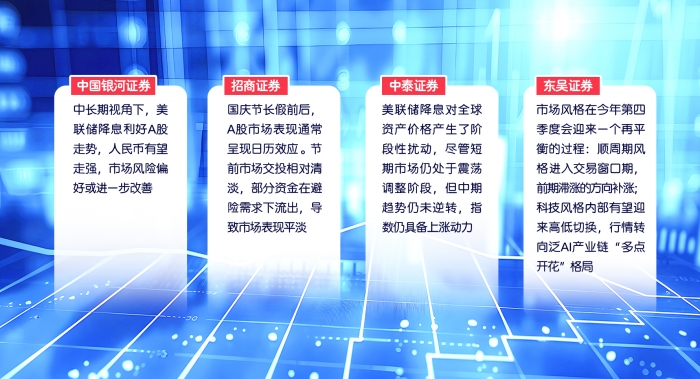
Market Overview - A-shares experienced a mixed performance last week, with the Shanghai Composite Index declining by 1.30% to close at 3820.09 points, while the Shenzhen Component Index rose by 1.14% and the ChiNext Index increased by 2.34% [2] - The market showed overall volatility in the first half of the week, but retreated towards the end as investors reacted to the Federal Reserve's interest rate cut [2][3] Federal Reserve Impact - The Federal Reserve's decision to cut interest rates by 25 basis points was in line with market expectations, leading to a temporary cooling of investor sentiment and risk appetite [3][4] - Despite short-term fluctuations, the long-term outlook remains positive for A-shares, with expectations of a stronger RMB and improved market risk appetite [3][4] Calendar Effects - Historical data indicates that A-shares typically exhibit a calendar effect around the National Day holiday, with a tendency for the market to perform poorly before the holiday and rebound afterward [5][6] - Over the past decade, indices such as the Shanghai Composite and CSI 300 have shown over 60% probability of rising in the week following the National Day holiday [5] Sector Performance - Certain sectors, particularly technology-related industries such as computers, communications, and electronics, have a higher probability of rising in the five trading days following the holiday [6] - Financial sectors, including banks and non-bank financials, are also expected to perform well in the weeks following the holiday [6] Investment Strategy - The fourth quarter is anticipated to see a shift in investment styles, with a potential rotation from previously high-performing sectors to more defensive ones [7] - Investors are encouraged to focus on sectors driven by economic recovery and industry trends, such as AI, innovative pharmaceuticals, new energy, and consumer sectors [7]
热门赛道ETF建仓放缓 部分基金开启防守思维
Zheng Quan Shi Bao· 2025-09-21 17:05
Group 1 - The core viewpoint indicates that despite strong performance in technology and pharmaceutical funds, some public funds are shifting towards a defensive strategy, with new consumption stocks potentially offering better investment safety [1][4] - The construction speed of popular thematic ETFs has slowed down significantly as stock prices rise, with specific ETFs showing low stock positions just before their listing [2][3] - The slowdown in ETF construction speed is attributed to the substantial gains in related sector funds, with technology funds achieving up to 196% and pharmaceutical funds over 170% year-to-date [3] Group 2 - Some funds are beginning to replace their holdings in pharmaceuticals and technology with defensive consumer stocks, indicating a strategic shift among fund managers [4][6] - Public funds have started to participate in the IPOs of consumer stocks, which was rare earlier in the year, suggesting a growing interest in the consumer sector [4][5] - The consumer sector is viewed as a key defensive asset for public funds, driven by reasonable valuations and the emergence of quality companies with new performance drivers [6][8] Group 3 - Fund managers believe that the third quarter will see a differentiation in market performance, emphasizing the importance of selecting quality companies as the market becomes more rational [7] - New consumption trends are characterized by a focus on consumer experience and the emergence of leading brands in the capital market, which could lead to sustained interest in these sectors [7][8] - The consumer industry is expected to benefit from clearer demand-side policies in the second half of the year, potentially leading to improved profitability and competitive dynamics [8]
一周新消费NO.327|水獭吨吨推出轻乳茶新品;元气森林登陆英国Tesco
新消费智库· 2025-09-21 13:04
Core Viewpoint - The article highlights the latest trends and developments in the new consumption sector, focusing on product launches, market expansions, and investment activities across various companies and industries [2]. New Product Launches - Guanghe Planet launched HMO maternal formula full-nutrition baby noodles, incorporating 19 nutrients including HMO and DHA:ARA in a 1:2 ratio, using organic fertilizers from Australian wheat [6]. - Dayao introduced a new plant protein series with six types of nut milk and jasmine milk tea, which are not yet available on major e-commerce platforms [4]. - Otter Tonton released new light milk tea products, emphasizing low-calorie options that meet health-conscious consumer demands [6]. - Haihe Dairy launched a limited edition Tianjin mooncake-flavored yogurt, with 50,000 cups available for a Mid-Autumn Festival promotion [9]. - UHA introduced a lemon-flavored refreshing salt candy, enriched with vitamin C [9]. - LaBi launched the Reef2 all-terrain stroller, certified by Chinese and EU safety standards [9]. - Jollybaby released an interactive food cart toy for children, promoting early education through play [6]. Industry Events - Meituan's international delivery brand Keeta officially launched in Kuwait, marking its third entry into the Middle East market [12]. - Fabrique opened its first offline boutique in Beijing, showcasing a collection from over 350 global designers [13]. - The British Retail Consortium warned that approximately 400 large retail stores could close if the government implements higher business tax rates [13]. - ALDI opened its first store in Changzhou, indicating its expansion in the Yangtze River Delta region [13]. - Meituan's Xiaoxiang Supermarket plans to open its first offline store in Beijing, covering nearly 6,000 square meters [16]. - Bosideng's high-end line VERTEX opened its first global store in Shenyang, representing a shift towards high-end outdoor fashion [16]. - Yuanqi Forest products launched in Tesco UK, expanding its international presence to over 40 countries [18]. Investment and Financing Activities - Galaxy Magnetics plans to acquire 100% of Kyoto Longtai and raise supporting funds [20]. - VF Corporation announced the sale of its Dickies brand for $600 million as part of its strategic transformation [20]. - Finnish startup Perfat Technologies secured €2.5 million in funding to advance its healthy fat replacement technology [20]. - Zhaimi Technology completed over 200 million RMB in Series A financing to support new drug clinical trials and international expansion [20]. - Zhaimi Automotive announced the completion of its first round of financing, with plans for a factory near Tesla's German facility [21]. - Stareep completed nearly 100 million RMB in financing to enhance its AI sleep technology [25]. Food Industry Developments - HPP launched a new beverage combining HPP prebiotics with plum and oil fruit juice, featuring over 56% juice content [26]. - Mengniu Group formed a strategic partnership with Huati Group to integrate sports and dairy industries [26]. - Heytea introduced a new bottled super plant tea product featuring kale and cucumber, which quickly became popular [26]. - M Stand announced the opening of its first concept store in Shanghai, focusing on burgers and snacks [27]. - Quaker launched a new probiotic fermented oatmeal product, suitable for various meal occasions [29]. Beauty and Fashion Trends - Korean designer brand ORR opened its first store in China, located in Shanghai [31]. - LEGO launched a new Star Wars set, enhancing its product offerings [33]. - Chinese beauty brand Huaxizi debuted its skincare line, introducing innovative beauty technologies [33]. - Gap officially entered the beauty market, launching beauty sections in 150 Old Navy stores [34]. - On opened Asia's largest flagship store in Tokyo, enhancing its retail presence [34].

板块分化加剧双创指数强于大盘指数
Zhe Shang Qi Huo· 2025-09-21 07:31
Report Investment Rating - No investment rating information is provided in the given content Core Viewpoints - Technology remains the main driving force, with the recent volatility of high - flying technology blue - chips increasing significantly, and sectors such as solid - state batteries and energy storage taking over to gain strength. There is still room for the revaluation of Chinese assets, but its sustainability requires the support of macro - policies. It is recommended to enter the futures index market on pullbacks [3] - It is advisable to focus on allocating to technology - growth sectors with earnings certainty, such as semiconductors and AI computing power, and also pay attention to the rotation allocation value of low - valuation defensive sectors like finance, securities, and consumption [6] Summary by Directory Market Performance - This week, domestic stock indices were mainly volatile, with the ChiNext and STAR Market indices remaining strong. The Shanghai Composite Index fell by 1.30%, the Shenzhen Component Index rose by 1.14%, the ChiNext Index rose by 2.34%, and the STAR 50 Index rose by 1.84%. In terms of global indices, the Nasdaq rose by 2.22%, the S&P 500 rose by 1.22%, and the Hang Seng Tech Index rose by 5.09% [15][19] - Among the Shenwan first - tier industries, sectors such as coal, power equipment, and electronics rose significantly, while sectors such as banks, non - ferrous metals, and non - bank finance led the decline [19] Liquidity - In August, the growth rate of social financing declined, and the "scissors gap" between M1 and M2 narrowed. The difference in August was 2.8 percentage points, indicating an increase in the activation of funds. The policies to stabilize the market effectively boosted market confidence, which is beneficial for the short - term economic activity [17][18] - As of September 19, 2025, the capital interest rate (DR007) remained at a low level, and the net MLF investment in July was 40 billion yuan. The yield of the 10 - year Treasury bond was around 1.7%. The total social financing in August increased less year - on - year, with the new social financing in August at 2.57 trillion yuan, a year - on - year decrease of 483 billion yuan. The year - on - year growth rate of the social financing stock dropped to 8.8%, 0.2 percentage points lower than at the end of last month [20] Trading Data and Sentiment - The number of new accounts opened in January was 1.57 million, in February was 2.88 million, in March was 3.06 million, in April dropped to 1.92 million, in May continued to drop to 1.555 million, in June slightly rose to 1.6464 million, in July was 1.9636 million, and in August was 2.6503 million [28] - The average daily trading volume of the two markets (MA5) rebounded above 2.5 trillion yuan, and the liquidity supported the index. The single - day trading volume within the week exceeded 3 trillion yuan, and the divergence intensified [28] Index Valuation - As of September 19, 2025, the latest PE of the Shanghai Composite Index was 16.36, with a percentile of 81.41; the latest PE of the SSE 50 was 22.10, with a percentile of 84.90. Among the major stock indices, the valuation percentiles of the CSI 1000, CSI 500, and SSE 204.5 were close to 50% [37] Index Industry Weights (as of 2025/6/30) - For the SSE 50, the weights of the banking, non - bank finance, and food and beverage sectors were relatively high, at 21.34%, 15.48%, and 13.88% respectively. The electronics industry became the fourth - largest weighted industry [46][47] - For the CSI 300, the weights were relatively dispersed. The top three weighted industries were banking, non - bank finance, and electronics [46][47] - For the CSI 500, the top three weighted industries were electronics, pharmaceutical biology, and non - bank finance [47][51] - For the CSI 1000, the top three weighted industries were electronics, pharmaceutical biology, and computer [47][51] Other Overseas and Domestic Policy Tracking - The United States is about to enter another interest - rate cut cycle, with a 25 - basis - point cut in September. According to CME data, as of September 18, the probability of another interest - rate cut by the Fed in October is nearly 80%, and there are still two expected cuts within the year [52] - In 2025, the government work report and the Two Sessions in March set the economic growth target at 5%, the CPI increase at around 2%. A moderately loose monetary policy was implemented, with timely reserve - requirement ratio cuts and interest - rate cuts to ensure sufficient bond liquidity. A more proactive fiscal policy was implemented, with a planned deficit ratio of around 4% and the issuance of ultra - long - term special treasury bonds worth 1.3 trillion yuan [53] - At the State Council Information Office press conference on May 7, 2025, the reserve - requirement ratio was cut by 0.5 percentage points, the policy interest rate was lowered by 0.1 percentage points from 1.56% to 1.4%, and the provident - fund interest rate was lowered by 0.25 percentage points. A 500 - billion - yuan re - loan for service consumption and elderly care was established, and support was provided for Central Huijin to play the role of a "stabilization fund" [53]
食品饮料行业周报:批价走弱,关注终端动销-20250921
Shenwan Hongyuan Securities· 2025-09-21 04:45
Investment Rating - The report maintains a cautious outlook on the food and beverage industry, particularly in the liquor segment, suggesting a bottoming process for the industry and structural opportunities for food companies as they navigate the September peak season [2][6]. Core Insights - The report emphasizes the need for patience regarding the industry's fundamentals, particularly in the liquor sector, which is expected to experience a bottoming phase. It highlights the recovery of consumption scenarios in September and the importance of monitoring demand recovery during the peak season [2][6]. - Key recommendations include focusing on leading companies with long-term investment value, such as high-end liquor brands and major dairy and beer companies, which are expected to benefit from market rotation and gradually improving valuations [2][6]. - The report identifies structural growth opportunities in the food and beverage sector, driven by new retail formats and consumer trends towards health and convenience [2][6]. Summary by Sections 1. Weekly Overview of Food and Beverage - The food and beverage sector saw a decline of 2.53% last week, with liquor down 2.95%, underperforming the Shanghai Composite Index by 1.23 percentage points [5][33]. - The report ranks the food and beverage sector 25th among 31 sub-industries in terms of performance [5]. 2. Market Performance of Food and Beverage Segments - The liquor segment is under pressure, with key brands like Moutai and Wuliangye experiencing price declines, while the overall industry is entering a destocking phase [7][14]. - The report notes that the performance of the liquor segment is expected to improve in September, but year-on-year comparisons still show significant pressure [7][14]. 3. Recommendations for Key Companies - Recommended companies include Guizhou Moutai, Shanxi Fenjiu, and Luzhou Laojiao in the liquor sector, and Yili, New Dairy, and Tsingtao Brewery in the consumer goods sector [2][6]. - The report also highlights the potential for growth in snack foods, low-alcohol beverages, and drinks driven by new consumer trends [2][6]. 4. Price Trends and Cost Changes - Moutai's bottle price is reported at 1755 yuan, down 25 yuan week-on-week, while Wuliangye remains stable at around 840 yuan [7][14]. - The average price of fresh milk is 3.03 yuan per kilogram, showing a year-on-year decline of 3.50% [30]. 5. Structural Opportunities and Challenges - The report indicates that the dairy sector is expected to benefit from cost reductions and improved supply-demand dynamics, while the beer industry remains stable [8][30]. - It warns of increasing competition in certain segments due to slow demand recovery, particularly in ambient milk and snacks [8][30].




重磅信号!下周A股,猛攻3900点!
Sou Hu Cai Jing· 2025-09-21 04:23
Market Overview - A-shares experienced a pullback after reaching a 10-year high, with the Shanghai Composite Index down 1.3% for the week, while the Shenzhen Component and ChiNext Index rose by 1.14% and 2.34% respectively [1] - The total trading volume for the week increased to 12.59 trillion yuan, with a daily trading volume exceeding 2 trillion yuan for 28 consecutive trading days [1] - The market's adjustment is seen as a normal rotation of profit-taking, with analysts suggesting limited downside potential and a likely continuation of an upward trend [1][4] Sector Performance - The electronics sector saw a net inflow of 41.6 billion yuan for the week, leading all industries, with a total net inflow of 104.5 billion yuan over the past 20 trading days [2] - Other sectors such as machinery, automotive, and telecommunications also received significant net inflows, while the non-ferrous metals and pharmaceutical sectors experienced notable outflows [2] - The tourism sector showed strength ahead of the Mid-Autumn and National Day holidays, with the tourism index reaching a 4.5-year high [5][6] Investment Trends - Margin trading balances in the A-share market have risen to over 2.4 trillion yuan, marking a historical high, with significant net purchases in the manufacturing sector [2] - Analysts from various firms suggest that the current bull market remains intact, with a focus on sectors such as AI, solid-state batteries, and semiconductors as key investment themes [3][4] - The upcoming "14th Five-Year Plan" is expected to increase investor attention on long-term reform directions, with a focus on economic development and innovation [3] Upcoming Events - The People's Bank of China will issue central bank bills in Hong Kong, and the Ministry of Finance plans to reissue 157 billion yuan of 3-year government bonds [7][8] - The upcoming LPR (Loan Prime Rate) announcement is anticipated, with the previous rates set at 3.0% for 1-year and 3.5% for 5-year loans [9] - A series of significant events, including the National Cultural and Tourism Consumption Month and various economic forums, are scheduled, which may impact market sentiment [10][13]
A股这一板块火了!多只股票创新高,更有个股三连涨停……
Sou Hu Cai Jing· 2025-09-20 15:01
Market Overview - A-shares experienced a pullback after reaching a 10-year high, with the Shanghai Composite Index adjusting quickly, while the Shenzhen Component, Sci-Tech 50, and ChiNext also consolidated after hitting multi-year highs. Weekly trading volume increased to 12.59 trillion yuan [1] - Margin trading saw a significant net buy of 50.8 billion yuan this week, marking the 13th consecutive week of net purchases exceeding 10 billion yuan, with the margin balance reaching a historical high of 2.39 trillion yuan [1] Sector Performance - The electronics sector attracted nearly 15 billion yuan in net financing for the week, leading all sectors, while non-bank financials saw over 6.5 billion yuan in net purchases. Other sectors like machinery, automotive, and power equipment each received over 4 billion yuan in net inflows [1] - The electronic industry recorded a net inflow of 41.6 billion yuan for the week, maintaining the top position, with net inflows of 104.5 billion yuan over the last 20 trading days and 380.7 billion yuan over the last 60 trading days [1] - The metals sector experienced a net outflow of over 13.1 billion yuan, while pharmaceuticals saw a net outflow of over 9 billion yuan, and banks and food & beverage sectors also faced significant net outflows [1] Future Outlook - According to招商证券, the A-share market is expected to continue along low penetration rate tracks, focusing on eight key areas: AI, humanoid robots, solid-state batteries, controllable nuclear fusion, military trade, commercial aerospace, semiconductor self-sufficiency, and innovative pharmaceuticals [2] - 中金公司 suggests that the A-share market is in a short-term adjustment phase with limited downside risk, as rapid increases in trading volume typically do not alter the medium-term trend [2] - The upcoming 20th Central Committee's Fourth Plenary Session is anticipated to discuss the "14th Five-Year Plan" recommendations, which may increase investor focus on long-term reform directions [2] Sector Highlights - The technology sector continues to strengthen, particularly in the chip sector, with the photolithography machine segment performing exceptionally well, achieving historical highs during market adjustments [2] - The tourism sector is experiencing a surge, with indices reaching a four-and-a-half-year high, driven by strong performance from companies like Yunnan Tourism and Qujiang Cultural Tourism [4] - Data from 同程旅行 indicates a significant increase in travel demand, with popular outbound travel routes selling out quickly and a projected record number of tourists and tourism revenue during the National Day holiday [6]