
供应链优势

Search documents
外卖商战烽烟起,餐饮行业迎新机,南王科技供应链优势凸显
Quan Jing Wang· 2025-07-16 11:02
Group 1: Market Overview - The online food delivery market in China is projected to reach 1.64 trillion yuan in 2024 and 1.7469 trillion yuan in 2025, indicating strong growth momentum and unprecedented development opportunities for the restaurant industry [1][2] - Major food delivery platforms like Meituan, Taobao Flash Sale, and JD have intensified competition, with Taobao Flash Sale reporting daily order volumes exceeding 80 million and Meituan surpassing 150 million [1] Group 2: Industry Dynamics - The ongoing competition in the food delivery sector has led to significant income growth for delivery riders, with average monthly earnings reported at over 12,500 yuan for active riders on Taobao Flash Sale and 9,793 yuan for Meituan's riders [1] - The integration of digital products in restaurant operations is increasing, with 94.2% of restaurants using ordering/cash register systems and 89.3% utilizing external traffic platforms [2] Group 3: Company Spotlight - Nanwang Technology - Nanwang Technology, established in 2010, specializes in environmentally friendly packaging and has rapidly responded to the booming food delivery market by expanding its product offerings [3][4] - The company has invested in a new smart industrial park in Fujian, capable of producing over 2.247 billion paper packaging products annually, to meet the surging demand for food delivery packaging [4][5] Group 4: Supply Chain and Innovation - Nanwang Technology has established long-term partnerships with major paper manufacturers to ensure stable supply and quality of raw materials, enhancing its supply chain management capabilities [5][6] - The company employs over 400 advanced production machines for flexible printing and automated bag-making, achieving a high level of production efficiency and quality control [6][7] Group 5: Environmental Initiatives - Nanwang Technology has developed fluorine-free oil-resistant paper to address environmental concerns associated with traditional fluorinated agents, contributing to the industry's green transformation [7] - The company is actively involved in setting industry standards for food contact materials, promoting sustainable practices within the packaging sector [6][7]
“中国造”引爆全球购物潮:从免签政策到退税红利,外国游客为何疯狂“扫货中国”?
Sou Hu Cai Jing· 2025-07-12 01:00
Group 1 - The core viewpoint of the article highlights a significant increase in foreign tourist shopping in China, driven by policy benefits, cultural confidence, and consumption upgrades, leading to a global shopping revolution [1][9][10] - In the first half of 2025, inbound foreign tourists reached 26.94 million, a year-on-year increase of 96%, with Chengdu's airport seeing over 790,000 foreign arrivals, up 58.5% from the previous year [1][4] - The expansion of China's visa-free policy to 47 countries and the implementation of a 240-hour transit visa have significantly lowered entry barriers for foreign tourists [4][8] Group 2 - The upgrade of the departure tax refund policy has reduced shopping costs by 11%, with a notable increase in the number of tax refund applications and sales of tax refund goods [5][11] - In the first quarter of 2025, tax refund store applications in Beijing increased by 128%, while Shanghai's tax refund goods sales reached 760 million yuan, up 85% [5][11] - The cultural revival of traditional products, such as Shu embroidery and bamboo weaving, has become a key attraction for foreign tourists, who are now willing to pay for cultural value [5][6] Group 3 - Chinese technology products, including drones and smart home devices, have become popular among foreign tourists, showcasing China's manufacturing capabilities [6][7] - Traditional markets like Chengdu's Hehua Pond and Guangzhou's Shisan Hang have emerged as new shopping hotspots, offering unique cultural experiences and competitive pricing [6][7] - China's supply chain advantages allow for flexible production, making it a global shopping hub, with significant cost savings compared to local production in other countries [7][8] Group 4 - The increase in U.S. tariffs on Chinese goods has inadvertently led to a surge in American tourists shopping in China, with a reported 300% increase in tax refunds for U.S. tourists in the first quarter of 2025 [8][9] - The shopping wave among foreign tourists not only boosts China's consumer market but also serves as a channel for cultural export, enhancing global awareness of Chinese culture [9][10] - The overall shopping experience in China is characterized by a more open, confident, and inclusive approach, fostering shared development opportunities with the world [10]


​单店日销破1000杯!挪瓦果蔬咖啡引爆Z世代消费潮
Sou Hu Wang· 2025-06-24 09:19
Core Insights - The Chinese fresh coffee market is experiencing significant growth, with Nowwa Coffee achieving a daily sales peak of over 1,000 cups per store by 2025, marking a remarkable performance [1] - Partnering convenience stores have also seen explosive growth, with revenue increasing tenfold, foot traffic up by 20%, and new store franchise conversion rates soaring by 50%, making coffee a core revenue driver for these stores [1] Group 1: Product Innovation and Marketing - Nowwa Coffee is breaking through traditional flavors with its "fruit and vegetable coffee" and leveraging high-frequency co-branding marketing to effectively reach Generation Z [3] - Collaborations with popular games, such as the limited edition product with "War of the Dual Worlds," resulted in a 460% sales increase on the first day in Guangzhou and a 220% increase in Shanghai [3] - The combination of "game IP + coffee + merchandise" has made Nowwa a hot topic on social media, with over ten million views on platforms like Xiaohongshu and Douyin, directly driving foot traffic to partner convenience stores [3] Group 2: Sales Performance and Impact - Data shows that a certain chain convenience store in Guangdong saw its average daily coffee sales increase from fewer than 10 cups to 470 cups after partnering with Nowwa [5] - In Shandong, a convenience store that introduced the Nowwa co-branded store project experienced an average revenue increase of 25% [5] - A store in Fujian reported that coffee sales contributed to nearly a 50% increase in daily revenue, with Nowwa accounting for 20%-25% of gross profit, second only to tobacco products [5] Group 3: Digital Empowerment and Efficiency - Nowwa Coffee has integrated online and offline traffic, helping convenience stores achieve significant sales on delivery platforms, with average daily coffee sales reaching 700-1,000 cups [6] - The top-performing stores have seen weekly revenue growth exceeding 50% [6] - Nowwa's digital management system provides real-time sales analysis, inventory alerts, and consumer profiling, enhancing competitive differentiation [7] Group 4: Supply Chain and Long-term Strategy - Facing potential fluctuations in global coffee bean prices by 2025, Nowwa maintains a "no price increase" strategy, ensuring high-quality raw materials for partners through its supply chain advantages [9] - The "direct sourcing + regional warehousing" system is a key support for convenience stores, alleviating their concerns [9] - Nowwa Coffee is redefining the value boundaries of convenience stores, positioning them not just as sales channels but as gathering places for young consumers, with a focus on product innovation, digitalization, and supply chain as its three pillars for future growth [9]
“丑怪”变“怪萌”,全球年轻人为何都追LABUBU?
Bei Jing Ri Bao Ke Hu Duan· 2025-06-24 03:35
Core Insights - The popularity of LABUBU, a toy character launched by Beijing-based Pop Mart, has rapidly gained traction among global youth, showcasing the effective grasp of trends, cultural confidence, and advantages in China's industrial and supply chains [1][2][3] Product Evolution - LABUBU was first created by Hong Kong artist Long Jia Sheng in 2015 but gained significant attention after Pop Mart signed the IP in 2018 and launched it as a collectible figure [3][8] - The character underwent several iterations, with a major design shift occurring in 2020 when the MiniSeries3 series transitioned the design from "ugly monster" to "cute monster," enhancing its appeal [10][12] - The introduction of the "Heart Macaron" series in October 2023 marked a breakthrough in materials, combining PVC and plush to create a more tactile and visually appealing product [10][12] Market Expansion - LABUBU's international recognition surged after a social media post by BLACKPINK member Lisa in April 2024, leading to a significant increase in sales and the establishment of a LABUBU-themed store in Bangkok, which achieved over 10 million in single-day sales [17][19] - The character's association with high-profile celebrities has further propelled its popularity, with notable figures showcasing LABUBU in various contexts, leading to viral trends on social media platforms [17][19] Consumer Behavior - The primary consumer base, mainly Gen Z, is shifting from mere collection to self-expression, viewing LABUBU as a symbol of individuality and a social currency among peers [19][20] - The emotional connection with the product is emphasized, as consumers engage in customizing their LABUBU figures, enhancing the personal significance of the toys [19][20] Supply Chain and Production - The production of LABUBU involves over a hundred processes, reflecting the complexity and craftsmanship required to meet the high standards of adult collectors [21][22] - Pop Mart has established deep collaborations with factories in Guangdong, focusing on improving manufacturing processes and ensuring quality control, which highlights the advantages of China's supply chain [21][22]


茶百道(2555.HK):供应链优势领航 关注经营底部反转
Ge Long Hui· 2025-06-21 07:41
Core Viewpoint - The current state of the ready-to-drink tea industry is improving, with a price war easing and a trend towards brand concentration, benefiting from external delivery subsidies that stimulate demand [1][2] Group 1: Industry Dynamics - Since H2 2024, the ready-to-drink tea industry has seen a slowdown in price wars, with market consolidation continuing after previous store closures [1] - In April 2025, JD.com entered the food delivery market with a substantial subsidy plan, prompting competitors like Meituan and Ele.me to follow suit, which has positively impacted the tea industry due to its stable delivery and high consumption frequency [1] - Although delivery subsidies have normalized since June, brands have benefited from increased exposure and effective consumer engagement, leading to significant long-tail effects [1] Group 2: Supply Chain and Franchise Relations - The company has achieved nationwide supply chain coverage across 31 provinces, supported by 25 warehouses and over 300 temperature-controlled delivery vehicles, enabling same-day delivery [1] - The strategic national layout is characterized by initial challenges followed by easier expansion, with lower marginal costs for new store openings as the network is established [1] - As of the end of 2024, the company has 8,382 franchise stores and aims to enhance efficiency and cost optimization while maintaining a reasonable pace of new openings to stabilize gross profit and improve store profitability [1] Group 3: Product Strategy and International Expansion - The company's product matrix includes classic, seasonal, and regional products, allowing for continuous innovation and frequent new product launches, with a recent lychee series achieving over 2 million cups sold within five days [1] - In 2023, the company began expanding into international markets with a model of "international supply chain + local procurement," entering eight countries including Australia, South Korea, and Singapore, with South Korea already achieving franchise qualifications [2] - Overseas stores are reportedly profitable, with a faster return on investment compared to domestic operations, and the company plans to accelerate international store openings over the next three years [2] Group 4: Financial Outlook - In 2024, the company is expected to increase marketing expenditures to repair brand image, which, along with store compensation and listing costs, may pressure operational performance [2] - As the impact of public sentiment diminishes, the market maintains positive expectations regarding the company's supply chain advantages, with a forecast for steady recovery in store numbers and performance by 2025 [2] - Projected EPS for 2025-2027 are 0.68, 0.86, and 1.12 yuan, with corresponding PE ratios of 13, 10, and 8 times, leading to an initial "buy" investment rating [2]
茶百道(02555):公司动态研究报告:供应链优势领航,关注经营底部反转
Huaxin Securities· 2025-06-20 11:17
Investment Rating - The report assigns a "Buy" rating for the company, marking its first coverage [1]. Core Insights - The company is expected to benefit from a recovering industry ecosystem and increased demand driven by delivery subsidies [5]. - The company has established a comprehensive supply chain across all 31 provinces in China, enhancing its operational efficiency and cost management [6]. - The product matrix is diverse, with a focus on innovation and international expansion, having entered eight countries and regions [7]. - Earnings forecasts indicate a recovery in performance, with projected EPS of 0.68, 0.86, and 1.12 yuan for 2025, 2026, and 2027 respectively, alongside a corresponding PE ratio decline [8]. Summary by Sections Industry Overview - The ready-to-drink tea industry is experiencing a stabilization in pricing wars, leading to a concentration of market share among leading brands [5]. - The introduction of substantial delivery subsidies by major platforms is expected to significantly boost demand in the tea beverage sector [5]. Supply Chain and Operational Efficiency - The company has achieved nationwide supply chain coverage with 25 warehouses and over 300 temperature-controlled delivery vehicles, allowing for same-day delivery [6]. - The strategy of coexisting with franchisees aims to enhance efficiency and optimize costs, thereby stabilizing the company's gross profit structure [6]. Product Development and Market Expansion - The product lineup includes classic, seasonal, and regional offerings, with a strong emphasis on innovation, resulting in rapid sales growth for new products [7]. - The company has initiated overseas market expansion, with a focus on establishing an "international supply chain + local procurement" model, achieving profitability in international locations [7]. Financial Projections - Revenue is projected to recover from 4,918 million yuan in 2024 to 6,097 million yuan in 2025, reflecting a year-on-year growth of 23.97% [11]. - Net profit is expected to rebound significantly from 472.18 million yuan in 2024 to 1,006.04 million yuan in 2025, indicating a growth rate of 113.06% [11]. - The company's PE ratio is forecasted to decrease from 26.69 in 2024 to 12.53 in 2025, suggesting improved valuation metrics as earnings recover [11].
京东618实现全面增长:数码家电占据近七成份额,户外服饰221%超高增速领跑行业
Sou Hu Cai Jing· 2025-06-18 02:50
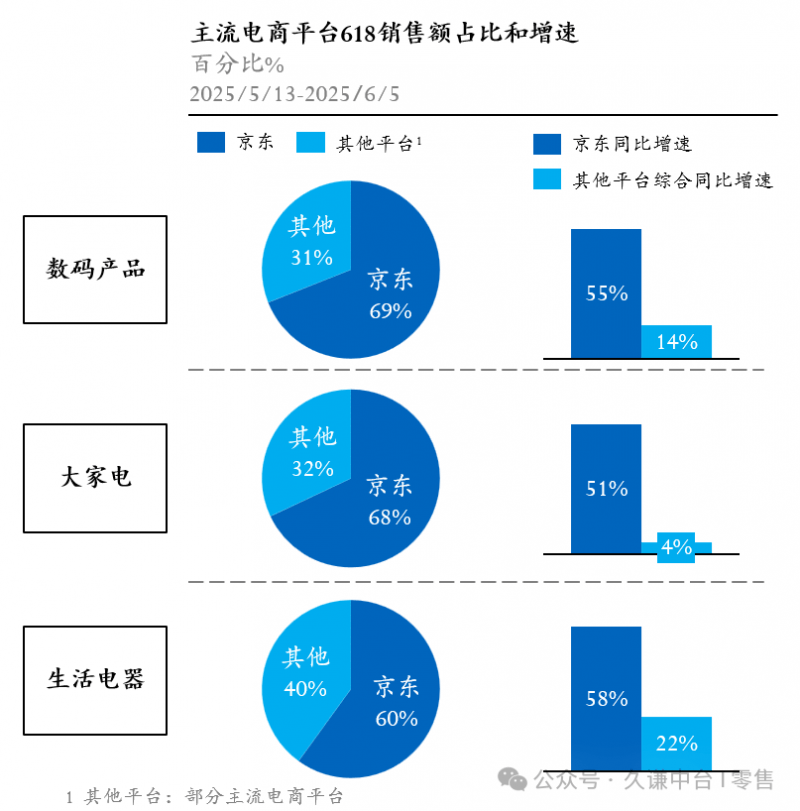
Core Viewpoint - JD.com demonstrates strong market leadership during the 618 shopping festival, leveraging its supply chain, logistics, and marketing strategies to achieve significant sales growth across various categories, particularly in consumer electronics and home appliances [1][6][15]. Group 1: Sales Performance - JD.com captures 69% of the digital product sales, 68% of the major appliance sales, and 60% of the small appliance sales among mainstream e-commerce platforms, with all categories showing over 50% year-on-year growth [1][6]. - The outdoor apparel category experiences a remarkable 221% year-on-year growth, while the sportswear category sees a 127% increase, both significantly outpacing the overall industry growth [1][9]. - In personal care and cleaning products, JD.com achieves over 30% year-on-year sales growth, again surpassing the industry average [1][12]. Group 2: Marketing Strategies - JD.com effectively utilizes a 38-day promotional period, launching a series of themed shopping days to engage various consumer segments, enhancing brand visibility and consumer interaction [3][4]. - The company implements targeted marketing strategies, such as the "Fan Day" event, focusing on tech enthusiasts and utilizing auction-style promotions to boost sales in the 3C digital product category [7][8]. Group 3: Policy and Pricing Strategies - National subsidy policies and JD.com's own promotional strategies work in tandem to enhance market competitiveness, particularly in the digital and home appliance sectors [6][8]. - The company offers substantial subsidies on energy-efficient appliances, with discounts reaching up to 20% and additional promotional offers, effectively driving consumer interest and sales [8][9]. Group 4: Expansion into New Categories - JD.com successfully expands into new growth areas, such as outdoor sports and beauty products, demonstrating its ability to adapt and capture emerging market trends [9][12][15]. - The company’s dual strategy of simplifying pricing and incentivizing merchants leads to significant growth in the beauty and personal care categories, with sales growth exceeding 30% [12][15].

【古茗(1364.HK)】全品类货架型品牌,“结硬寨”践行长期主义——投资价值分析报告(陈彦彤/汪航宇/聂博雅)
光大证券研究· 2025-06-05 13:36
点击注册小程序 查看完整报告 特别申明: 古茗深耕现制茶饮十余年,从浙江走向全国。截至24年底,公司在全国17个省份覆盖超过200个城市,共 有9914家门店,主要分布于二线、三线及更低线城市。古茗是中国最大的大众现制茶饮店品牌,亦是全价 格带下中国第二大现制茶饮店品牌。2023年古茗平均季度复购率高达53%,门店经营利润率约20%,均领 先行业。 行业下沉市场空间大,供应链打造核心竞争力 根据灼识咨询数据,按GMV统计,2024年中国现制饮品行业拥有超过6000亿元的市场规模,其中现制茶 饮行业规模最大(超过3000亿元),现制咖啡行业增速较快(24-28年CAGR预计为18.5%)。按城市线级 划分来看,低线市场具有更大的增长潜力,预计三线及以下城市24-28年CAGR均超过20%。按价格带划分 来看,大众价格带产品增长势头最好,预计24-28年CAGR为20.8%。从企业各项能力看,供应链为最核心 的竞争力。 供应链优势和独特渠道策略,公司快速成长为行业第二大品牌 茶饮市场竞争激烈,古茗避开一二线城市的激烈竞争,将目光投向三线及以下城市、乡镇城郊和县域市 场。其强大的加盟体系成为下沉的关键动力,加盟商较 ...
全品类货架型品牌,“结硬寨”践行长期主义——古茗(1364.HK)投资价值分析报告
EBSCN· 2025-06-05 00:30
Investment Rating - The report gives a "Buy" rating for the company, marking its first coverage [3][13][5]. Core Insights - Guming is a leading affordable fresh tea beverage brand with significant advantages, having expanded from Zhejiang to over 200 cities across 17 provinces in China, with 9,914 stores by the end of 2024 [1][25]. - The company has a strong supply chain and unique channel strategies that have propelled it to become the second-largest brand in the industry, focusing on lower-tier cities to avoid intense competition [2][11]. - The tea beverage market is expected to grow significantly, with a projected market size exceeding 600 billion CNY by 2024, and Guming is well-positioned to capitalize on this growth [1][52]. Summary by Sections Company Overview - Guming has been in the fresh tea beverage industry for over a decade, establishing a robust presence with a high average quarterly repurchase rate of 53% and a store operating profit margin of approximately 20% [1][25]. - The company operates primarily through a franchise model, which has facilitated rapid expansion and a strong brand presence in lower-tier cities [2][11]. Market Potential - The fresh beverage market in China is projected to reach over 1 trillion CNY by 2028, with the fresh tea segment being the largest [52][55]. - The market for fresh tea beverages is expected to grow at a CAGR of 19.2% from 2024 to 2028, particularly in lower-tier cities where Guming has focused its expansion efforts [55][60]. Supply Chain and Competitive Advantage - Guming's supply chain is a core competitive advantage, allowing for efficient operations and the ability to quickly respond to market demands [2][11]. - The company has implemented a regional density strategy, enhancing its market penetration and brand recognition in areas with multiple store locations [2][11]. Financial Projections - The company is projected to achieve net profits of 1.96 billion CNY, 2.36 billion CNY, and 2.76 billion CNY for the years 2025, 2026, and 2027, respectively, with corresponding EPS of 0.82, 0.99, and 1.16 CNY [3][4][13]. - Guming's revenue is expected to grow significantly, with a forecasted revenue of 11.16 billion CNY in 2025, reflecting a 27% growth rate [4][8]. Strategic Initiatives - Guming plans to increase its store count by 2,000 in 2025, focusing on provinces such as Anhui, Hubei, Hunan, Guangdong, and Guangxi [2][11]. - The introduction of coffee products is anticipated to contribute positively to store revenue, with an estimated 10% increase in sales per store [2][11].
名创优品(09896.HK):同店渐现改善趋势 业绩压力有望逐季缓解
Ge Long Hui· 2025-05-28 17:59
Group 1: Financial Performance - In Q1 2025, the company reported revenue of 4.43 billion yuan, a year-on-year increase of 18.9%, with a gross margin of 44.2%, up 0.8 percentage points year-on-year, and an adjusted net profit of 590 million yuan, down 4.8% year-on-year [1] - The domestic same-store sales showed improvement, with a significant recovery in sales performance since the beginning of the year, and a notable recovery during the May Day holiday [1] - The company achieved a total of 4,275 stores in China by the end of March 2025, with a net closure of 111 stores, focusing on high-quality development and refined store network strategy [1] Group 2: International Operations - In Q1 2025, the company's overseas revenue reached 1.59 billion yuan, a year-on-year increase of 30.3%, despite high base pressure from the previous year [2] - The company added 95 new stores overseas, focusing on markets in Asia and North America, with a stable performance in overseas same-store sales when viewed from a two-year compound growth perspective [2] - Since April, there has been a month-on-month improvement in same-store performance in key overseas markets such as Mexico and the United States, supported by the execution of the IP strategy and store quality enhancement [2] Group 3: Strategic Outlook - The company is committed to a five-year strategic plan aimed at stable profit growth, with projected revenues of 20.54 billion yuan, 24.60 billion yuan, and 29.55 billion yuan for 2025-2027, corresponding to growth rates of 20.9%, 19.7%, and 20.2% respectively [2] - Adjusted net profits are expected to be 2.86 billion yuan, 3.68 billion yuan, and 4.56 billion yuan for the same period, with growth rates of 4.97%, 28.74%, and 24.04% respectively [2] - The company maintains an "overweight" rating due to its supply chain advantages and strengthened IP conversion capabilities, alongside ongoing global strategic initiatives [2]