
全球经济复苏

Search documents
【高端制造】6月对美出口继续降温,工程机械品类出口保持高景气度——机械行业海关总署出口月报(十三)(黄帅斌/陈佳宁/李佳琦)
光大证券研究· 2025-07-23 08:58
Group 1: Consumer Goods - The core viewpoint indicates a significant rebound in U.S. retail sales, with June 2025 showing a month-on-month growth of +0.6%, surpassing market expectations of +0.1% and recovering from a previous decline of -0.9% [2] - Core retail sales (excluding automobiles and gasoline) also increased by +0.5% in June, higher than the expected +0.3% and revised from a previous -0.2% [2] - The increase in retail sales is attributed to consumers' preemptive purchasing ahead of tariff expirations, although actual growth, when adjusted for price factors, was only +0.3% [2] Group 2: Export Data - In the first half of 2025, the export growth rates for electric tools, hand tools, and lawn mowers were 5%, -6%, and 47% respectively, with June showing monthly declines for electric tools and hand tools [3] - Cumulative export amounts to North America for electric tools, hand tools, and lawn mowers showed declines of -7%, -6%, and -4% year-on-year, indicating a cooling effect on exports due to tariffs [3] Group 3: Capital Goods - Industrial sewing machines are primarily exported to Asia, accounting for 68% of export value in 2024, with key markets including Turkey, Vietnam, and Singapore [4] - Forklifts and machine tools also have significant export markets in Asia and Europe, with respective export shares of 30% and 34% in 2024 [4] - The cumulative export value of construction machinery increased by 11% in the first half of 2025, with Africa showing the fastest growth at 65% [5][6] Group 4: Engineering Machinery - In June 2025, the export growth rates for major engineering machinery categories were 14%, 25%, 8%, and 20% respectively, with cumulative growth rates for the first half of 2025 reaching 11% [7] - The export of forklifts, machine tools, and industrial sewing machines showed varying growth rates, with machine tools experiencing a cumulative increase of 12% [6][7]


帮主郑重聊隔夜市场:标普新高里,藏着中长线要盯的信号
Sou Hu Cai Jing· 2025-07-23 03:11
Group 1 - The S&P 500 index reached a new high, while the Nasdaq experienced a decline, primarily due to the underperformance of the semiconductor sector [3] - Upcoming earnings reports from major tech companies will be crucial in determining whether their performance can support current valuations and impact the sustainability of the S&P 500's new high [3] - Trade agreements announced by Trump with the Philippines and Indonesia may have long-term implications for industries such as agriculture and manufacturing, warranting careful observation [3] Group 2 - The commodity market shows mixed signals, with oil prices declining for three consecutive days, while gold prices rose above $3,440, and copper prices increased by over 2%, indicating complex market expectations regarding global economic recovery [4] - European stock indices mostly declined, suggesting that global market sentiment is not uniformly optimistic [5] - The overall market dynamics highlight the importance of a long-term perspective in investment, as short-term fluctuations may present opportunities if the underlying fundamentals remain strong [5]

波罗的海干散货指数领涨大类资产,中国港口韧性凸显
Xin Hua Cai Jing· 2025-07-11 07:19
Core Insights - The Baltic Dry Index (BDI) has rebounded significantly in the first half of 2025, with a cumulative increase of 49.35%, indicating a strong performance among global asset classes [1] - The BDI serves as a barometer for global economic conditions, reflecting trade market health and demand fluctuations, particularly in relation to China's import and export activities [1][2] - China's ports are undergoing a transformation towards digitalization, intelligence, and sustainability, enhancing the resilience and vitality of the shipping industry [1][5] Economic Trends - The BDI is closely correlated with global economic development, particularly in the demand for raw materials essential for manufacturing, such as iron ore, coal, and grains [2] - Historical data shows that the BDI trends align with global GDP growth and manufacturing PMI, indicating its role as a leading indicator for macroeconomic conditions [2][3] - The first quarter of 2025 saw a recovery in dry bulk shipping demand, although fluctuations occurred due to U.S. tariff policies impacting global trade sentiment [3] China's Port Performance - In the first five months of 2025, China's major ports handled 7.34 billion tons of cargo, a year-on-year increase of 3.8%, with foreign trade throughput growing by 1.8% [4] - Container throughput reached 14 million TEUs, reflecting a 7.4% year-on-year increase, showcasing the resilience of China's foreign trade [4] - The rise in the BDI corresponds with the increase in container throughput at Chinese ports, indicating stable growth in foreign trade and the recovery of the industrial chain [4] Shipping Industry Developments - The 2025 Xinhua-Baltic International Shipping Center Development Index indicates that Shanghai ranks third globally among shipping centers, with other Chinese ports also improving their standings [4] - The adaptability and resilience of Chinese ports and foreign trade enterprises are highlighted as key factors in maintaining stable international trade amidst a complex global economic environment [5] - The evolution of international shipping centers is driven by the need to manage increasing trade volumes while addressing challenges and opportunities in a changing world [5]
每日机构分析:7月9日
Xin Hua Cai Jing· 2025-07-09 11:51
Group 1 - Mizuho Securities warns that U.S. tariffs may have a significant impact on the global industrial ecosystem, affecting not only the taxed products but also related supply chains and industry networks, leading to a chain reaction [1] - Goldman Sachs strategists highlight the high volatility in the current financial landscape driven by macroeconomic uncertainties, with potential fiscal issues in the U.S. or U.K. being a source of volatility [1] - Apollo Global Management economists caution that stagflation risks will complicate Fed Chair Powell's decision-making regarding interest rate cuts, with only one rate cut expected this year despite increased forecasts for unemployment and inflation [2] Group 2 - Morgan Stanley strategists note that the U.S. dollar index has dropped nearly 11% in the first half of the year, which is a significant benefit for U.S. companies, especially large-cap stocks, due to their high overseas revenue exposure [3] - The trend towards a more fragmented global order is expected to lead to sustained inflation and rising interest rates, as central banks may adopt tightening monetary policies in response to inflationary pressures [2] - Temasek's Chief Investment Officer anticipates an economic recovery by the end of the year as uncertainties around tariffs diminish, alongside the implementation of Fed rate cuts and deregulation policies [3]
中方还没走,欧盟就收到美国罚单,马克龙连提四个请求,事情不简单
Sou Hu Cai Jing· 2025-07-08 10:59
Group 1 - The article highlights the escalation of trade tensions between the US and the EU, with the US threatening a 17% tariff on EU agricultural exports, which could severely impact major agricultural exporting countries like France and the Netherlands [1][3] - The ongoing trade disputes have seen the US impose various tariffs on the EU, including a 20% "reciprocal tariff," 25% "automobile tax," and 25% "steel and aluminum tax," leading to significant disruptions in EU industries and affecting profits and market shares [3] - French President Macron has expressed the need for stronger coordination with China on international economic and financial policies, especially in light of global challenges such as economic recovery, climate crisis, and public health issues [3][4] Group 2 - Despite progress in Sino-French economic cooperation, there remain imbalances in certain sectors, prompting Macron to seek increased Chinese investment in France to foster a more balanced economic relationship [4] - The EU faces challenges in forming a unified response to US trade threats due to the diverse interests of its member states and complex decision-making processes [5] - There are existing tensions in EU-China relations, including disputes over electric vehicle tariffs and China's policies on rare earth exports, alongside recent anti-dumping measures imposed by China on EU products [5][8] Group 3 - The article emphasizes the potential for cooperation between China and the EU in areas such as green energy, digital economy, and technological innovation, which could enhance global technological development [5] - China maintains a principle of peaceful coexistence and mutual benefit in its relations with the EU, advocating for the removal of unreasonable sanctions to foster a conducive environment for cooperation [8]

白银走势阴晴不定 特朗普加税举措令全球经济蒙阴
Jin Tou Wang· 2025-07-08 09:34
Group 1 - The core viewpoint of the news is that President Trump announced new tariffs on imports from 14 countries, which may negatively impact the fragile global economic recovery and increase market risk aversion [2][3] - The new tariffs range from 25% to 40%, affecting countries such as Japan, South Korea, and Malaysia, with specific rates assigned to each country [2] - The announcement has led to increased demand for safe-haven assets like gold, although the immediate market reaction showed volatility rather than a clear upward trend in gold prices [2][3] Group 2 - The silver market experienced a slight rebound on July 8, trading around $36.75 per ounce, but still shows a downward trend overall [1][4] - If silver prices fall below $36.50, they may approach recent support levels between $35.65 and $35.85 [4]
突然大爆发!发生了什么?
Sou Hu Cai Jing· 2025-07-05 10:50
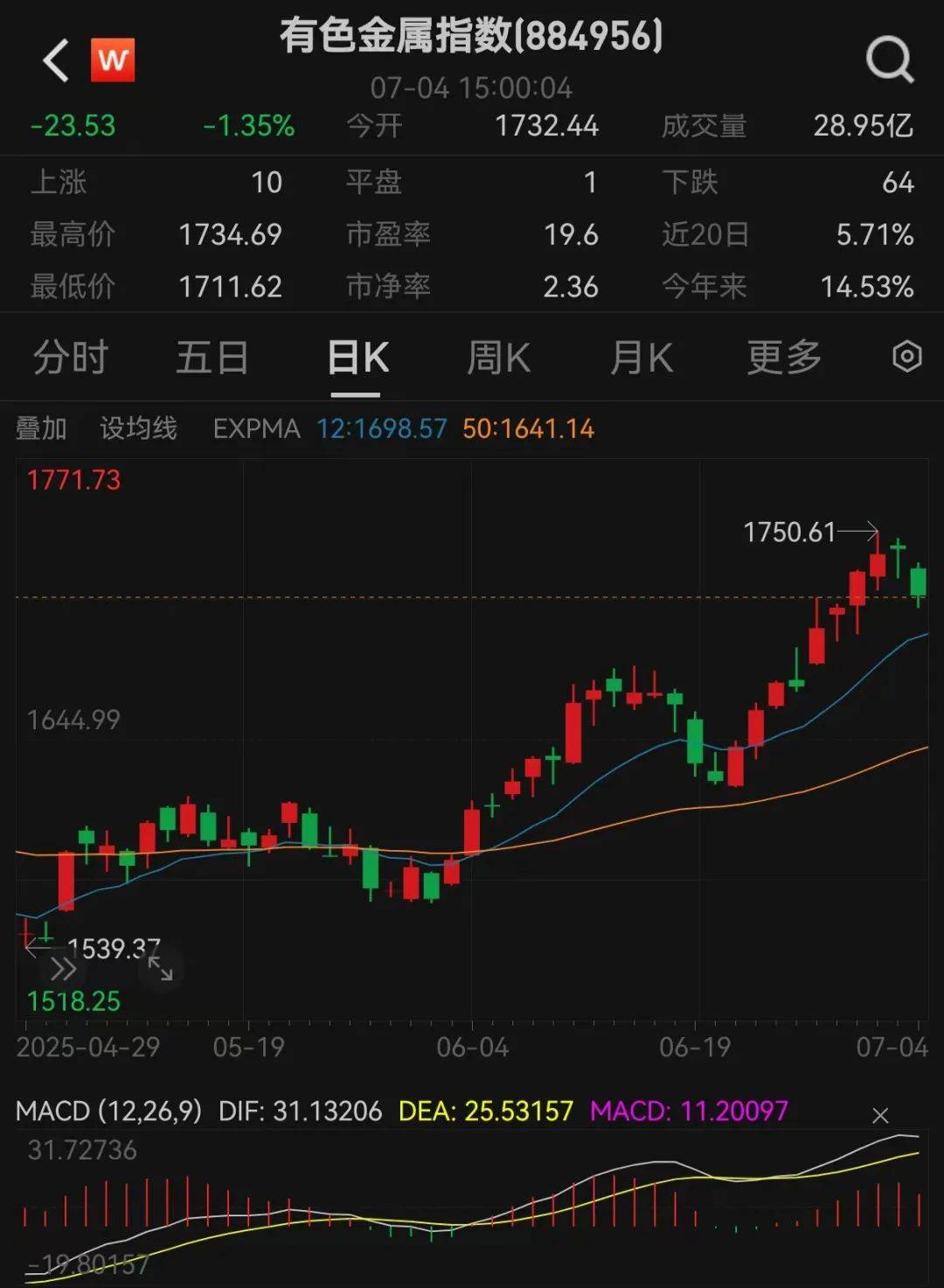
Core Viewpoint - The non-ferrous metal sector has recently outperformed the market, with various metals experiencing significant price increases, particularly copper, which has reached a three-month high [1][3]. Price Movements - International copper prices have surged, with LME copper futures breaking the $10,000 per ton mark, marking a three-month high [1][4]. - The non-ferrous metal index has risen by 8.74% over the past month, ranking second among 31 Shenwan industry indices [4]. Market Drivers - The rise in copper prices is attributed to traders stockpiling copper in the U.S. ahead of potential tariff increases by the Trump administration [3][5]. - Factors supporting copper prices include a weak dollar, supply constraints, and strong consumption [5]. Supply and Demand Dynamics - LME copper inventories have dropped to 90,000 tons, the lowest level since August 2023, contributing to the price surge [4]. - The supply side is constrained due to previous energy shortages and recent tariff-induced inventory tightness [5]. Future Outlook - Analysts predict a potential bottom reversal for the non-ferrous metal sector, driven by a shift in macroeconomic policies emphasizing growth and increased capital expenditure due to a new round of Fed rate cuts [7]. - The sector is expected to benefit from a mismatch in supply and demand, profit recovery, and liquidity easing [7]. Investment Opportunities - Investment opportunities are identified in gold, copper, aluminum, and new materials, with a focus on the Fed's interest rate decisions and U.S. tariff uncertainties [10][11]. - The gold sector is particularly favored due to its safe-haven value amid global economic uncertainties and geopolitical conflicts [12]. Emerging Materials - High-growth new materials such as rare metals and advanced materials like graphene and carbon fiber are gaining attention for their strategic value and broad application prospects in high-end industries [12].
专访世界经济论坛执行董事萨迪娅·扎希迪:中国转型经验为世界“打样” 今年继续发挥稳定器作用
证券时报· 2025-06-25 00:53
Core Insights - The article emphasizes the importance of cooperation and emerging technologies for global economic recovery, highlighting China's role as a stabilizer in the global economy [2][3][6]. Group 1: Global Economic Recovery Drivers - One key driver for global economic recovery is the rebuilding of trade relationships, which may create opportunities for emerging markets and developing economies [3]. - The proliferation of AI is identified as a significant opportunity, with about 40% of economists expecting AI to boost global economic growth by 5% over the next 5 to 10 years [3][5]. Group 2: China's Economic Transition - China is transitioning from a high-speed growth phase to a high-quality development phase, with an emphasis on expanding domestic demand through proactive fiscal and moderate monetary policies [5][6]. - China's contribution to global economic growth is projected to remain around 30% this year, indicating its substantial influence on the global economy [6]. Group 3: AI Development and Employment - The application of AI in sectors like healthcare and education is seen as beneficial, with potential for significant value creation [7]. - While AI may initially lead to job losses, particularly in white-collar sectors, it is expected to generate substantial employment growth in industries that are not threatened by AI in the long term [7].

近期股市为何起伏不定?深度解析市场波动原因与投资策略
Sou Hu Cai Jing· 2025-06-24 20:23
Group 1: Recent Market Volatility - Global stock markets have shown alternating rises and falls, with accelerated sector rotation since June 2025 [2] - A-shares are fluctuating between 3200-3500 points, with growth stocks like new energy and semiconductors experiencing increased volatility, while defensive sectors like banks and consumer goods remain stable [2] - The Nasdaq index has seen daily fluctuations exceeding 2% due to tech stock earnings reports, with Federal Reserve policy expectations being a focal point [2][3] Group 2: Core Reasons for Market Fluctuations - Uncertainty in global economic recovery is evident, with the U.S. experiencing easing inflation pressures but volatile employment data, leading to debates on the timing of Federal Reserve rate cuts [4][5] - European economies face recession risks due to fluctuating energy prices and weak manufacturing [5] - China's economic recovery is mixed, with consumer and investment rebounds but ongoing adjustments in the real estate sector affecting market confidence [6][7] Group 3: Policy Adjustments and Regulatory Changes - The Federal Reserve's June 2025 FOMC meeting signaled a hawkish stance, cooling rate cut expectations and pushing up U.S. Treasury yields, which suppresses risk assets [8] - In China, the A-share market is influenced by the "New National Nine Articles," which strengthen dividend requirements for listed companies, putting pressure on some high-valuation growth stocks [9][10] Group 4: Geopolitical Factors and Market Sentiment - Ongoing disruptions in energy and food supply chains due to the Russia-Ukraine conflict are exacerbating global inflation expectations [11][12] - The U.S.-China relationship impacts foreign investment risk appetite in A-shares, with rising investor caution reflected in the VIX index [12] Group 5: Fund Flows and Institutional Adjustments - Foreign capital inflows into A-shares have slowed, with significant net outflows on certain trading days [13] - Institutional investors are reducing holdings in high-valuation sectors, shifting towards low-valuation, high-dividend assets [13] Group 6: Divergence in Corporate Earnings Expectations - Some AI and semiconductor companies are reporting earnings below expectations, putting pressure on the Nasdaq index [14] - Domestic consumption recovery is weak, with sectors like liquor and home appliances experiencing slowed growth [14] Group 7: Investment Strategies in Volatile Markets - Diversification is recommended to mitigate risks associated with single assets, including a balanced allocation between stocks and bonds [16] - Focus on high-dividend, low-valuation assets such as banks and utilities is advised for conservative investors [16] - Implementing a systematic investment approach, such as dollar-cost averaging in index funds, can help smooth market volatility [17][18] - Maintaining a cash reserve of 30%-50% during high uncertainty allows for flexibility in investment opportunities [19] - A long-term perspective is crucial to avoid emotional trading and capitalize on the inherent value of quality assets [20] Group 8: Outlook for the Second Half of 2025 - The stock market in the second half of 2025 will be influenced by monetary policy decisions, including potential rate cuts by the Federal Reserve and further easing in China [20]
关于要不要对伊朗动手,特朗普在纠结什么?
Hua Er Jie Jian Wen· 2025-06-19 07:52
Group 1 - The core issue revolves around whether the Massive Ordnance Penetrator (MOP) can effectively destroy Iran's fortified nuclear facilities, particularly the Fordow site, which is heavily defended and buried deep within a mountain [1][2][3] - President Trump has expressed hesitation about military action against Iran, seeking assurance from military advisors regarding the effectiveness of the MOP in achieving the goal of dismantling Iran's nuclear program [1][3] - The U.S. possesses the necessary capabilities, including the MOP and B-2 bombers, to carry out such an attack, unlike Israel, which lacks these resources [2][3] Group 2 - As tensions escalate, the global market is bracing for potential volatility, particularly in the oil sector, with analysts predicting that military action could push oil prices above $100 per barrel, potentially reaching $120 per barrel [6] - The uncertainty surrounding Trump's decision-making process is causing fluctuations in the market, with investors reacting to the possibility of military engagement and its implications for oil supply, especially through the Strait of Hormuz [6] - Diplomatic efforts are ongoing, with U.S. special envoy Steve Witkoff attempting to communicate with Iranian officials, although the response has been inconsistent, indicating a complex negotiation landscape [4][5]