
全面绿色转型

Search documents
二十届四中全会公报解读:“十五五”的20个关键词
Yong Xing Zheng Quan· 2025-10-27 06:53
Overall Insights - The 20th Central Committee's Fourth Plenary Session approved the "Suggestions" for the 15th Five-Year Plan, highlighting the need for strategic investment opportunities during this period[1] - Key focus areas include maintaining economic stability, enhancing domestic demand, and promoting high-quality development[3] Key Themes - The "Four Advantages" emphasize China's strong economic foundation, large market, complete industrial system, and rich talent resources, which are crucial for technological and industrial advancements[11] - The "Seven Major Goals" for the 15th Five-Year Plan include significant improvements in high-quality development, technological self-reliance, and social welfare[16] - By 2035, the goal is to achieve a per capita GDP of $22,443 or $21,295, depending on annual growth rates of 5.0% or 4.5% respectively, reflecting a 26.7% increase from 2019[17] Investment and Risk Considerations - Investment strategies should focus on the implications of the 20 keywords from the plan, which are expected to create strategic investment opportunities[42] - Risks include potential technological disruptions, challenges in industrial upgrades, geopolitical conflicts, and intensified international strategic competition[43][44]
展望“十五五”:如何增加“含绿量”,提升经济“含金量”?
Nan Fang Du Shi Bao· 2025-10-24 14:09
Core Viewpoint - The Fourth Plenary Session of the 20th Central Committee of the Communist Party of China emphasized a systematic deployment for comprehensive green transformation, aiming to build a beautiful China through carbon peak and carbon neutrality initiatives [1][4]. Group 1: Green Transformation Measures - The session proposed accelerating the comprehensive green transformation of economic and social development, focusing on the concept that "lucid waters and lush mountains are invaluable assets" [1]. - Key measures include establishing a dual control system for carbon emissions and intensity, transitioning to a green low-carbon energy system, and promoting green low-carbon industrial structure and lifestyle transformations [4][5]. Group 2: Energy System Development - The development of a new energy system is prioritized, with a goal that by the end of the 14th Five-Year Plan, most new electricity demand will be met by new clean energy generation [4][5]. - Specific actions include enhancing non-fossil energy development, promoting clean and efficient use of fossil energy, and constructing a new power system to ensure the effective integration of green electricity [5][11]. Group 3: Industrial Structure Transformation - The green low-carbon industrial structure transformation aims to increase the "green content" of industries, with the current scale of green low-carbon industries estimated at approximately 11 trillion yuan, expected to double in the next five years [5][10]. - The plan includes creating around 100 national-level zero-carbon parks during the 14th Five-Year Plan period, which will significantly expand the green low-carbon industry [5]. Group 4: Lifestyle Changes - The transformation of production and lifestyle towards green low-carbon practices is essential, involving clean production, circular economy development, and promoting green living habits among the public [6][10]. - Goals include achieving a solid waste utilization rate of about 4.5 billion tons by 2030 and increasing the proportion of railway and waterway transport for bulk goods [6]. Group 5: Innovation and Market Dynamics - The period of the 14th Five-Year Plan is seen as crucial for green technology innovation, with a focus on breaking down barriers between industry, academia, and research to enhance green innovation [8][9]. - The market's role in the development of low-carbon green industries is highlighted, with mechanisms established to guide market expectations and attract investment [10].

二十届四中全会公报点评:窥探未来五年的投资方向
Shanghai Securities· 2025-10-24 10:30
Economic Planning and Investment Opportunities - The "15th Five-Year Plan" (2026-2030) is crucial for achieving socialist modernization by 2035, presenting significant investment opportunities[3] - The emphasis on "technological self-reliance" and "domestic substitution" is expected to drive long-term investment logic, particularly in critical sectors[4] Key Investment Sectors - Focus on semiconductors, software and IT services, high-end equipment manufacturing, and AI chips as areas with strong growth potential[4] - The construction of a unified national market is vital for enhancing domestic demand and reducing reliance on external markets[5] Industry Outlook - Cyclical industries like coal, steel, chemicals, and cement may experience a turnaround, presenting investment value as low-end supply exits the market[6] - The push for a comprehensive green transition will accelerate opportunities in renewable energy sectors such as photovoltaics, energy storage, and electric vehicles[7] Risks and Considerations - Potential risks include underwhelming growth policies, escalating US-China trade conflicts, and geopolitical uncertainties[8]
数据显示“十四五”时期我国经济总量跃升、质量提升—— 继续跑好“十五五”基础坚实底气足
Jing Ji Ri Bao· 2025-10-21 03:40
Economic Growth and International Influence - During the "14th Five-Year Plan" period, China's GDP increased from 103.5 trillion yuan in 2020 to 134.9 trillion yuan in 2024, with an average annual growth rate of 5.5%, significantly higher than the global average of 3.9% [1] - China's contribution to global economic growth remained around 30% annually, highlighting the resilience and vitality of the economy [1] - Per capita GDP rose from 10,632 USD in 2020 to 13,445 USD in 2024, maintaining a position among upper-middle-income countries [1] Technological Innovation - R&D investment reached a record high, with an intensity of 2.69% in 2024, surpassing the EU average [2] - The total number of R&D personnel exceeded 7 million, ranking first globally [2] - By 2025, China's innovation index is expected to rank among the top ten globally, improving by four positions since 2020 [2] Modern Industrial System - The focus on the real economy led to significant advancements in traditional and emerging industries, with the agricultural technology contribution rate reaching 63.2% by the end of 2024, up 2.5 percentage points from 2020 [3] - The added value of equipment manufacturing and high-tech manufacturing industries grew at average annual rates of 8.2% and 9.2% respectively from 2021 to 2024 [3] - The service sector's added value grew at an average annual rate of 5.9%, contributing 60.6% to economic growth during the same period [3] Urban-Rural Coordination - The urbanization rate reached 67.00% by the end of 2024, an increase of 3.11 percentage points since 2020 [3] - The ratio of per capita disposable income between urban and rural residents decreased from 2.56 in 2020 to 2.34 in 2024 [3] Reform and Opening Up - The number of negative list items for market access decreased from 123 in 2020 to 106 by 2025 [4] - Domestic demand contributed an average of 86.8% to economic growth from 2021 to 2024, with final consumption expenditure contributing 59.9%, an increase of 11.1 percentage points compared to the "13th Five-Year Plan" period [4] - The scale of goods trade increased from 32.2 trillion yuan in 2020 to 43.8 trillion yuan in 2024, with an average annual growth rate of 8.0% [4] Green Transformation - The share of non-fossil energy consumption in total energy consumption rose from 16.0% in 2020 to 19.8% in 2024 [5] - The average number of days with good air quality in cities reached 87.2% in 2024, an increase of 2.4 percentage points since 2020 [5] Social Development - The urban unemployment rate remained stable between 5.1% and 5.5% from 2021 to 2024 [6] - The cultural industry saw a revenue increase of 37.7% by 2024 compared to 2020 [6] - The average life expectancy reached 79 years by 2024 [6] Security and Stability - Grain production stabilized above 1.3 trillion jin, exceeding 1.4 trillion jin in 2024 [6] - The manufacturing value added grew at an average annual rate of 5.4% from 2021 to 2024, accounting for nearly 30% of global manufacturing [6]
继续跑好“十五五”基础坚实底气足
Jing Ji Ri Bao· 2025-10-21 00:38
Core Viewpoint - During the "14th Five-Year Plan" period, China's economic and social development has achieved significant progress, characterized by eight "new" aspects, showcasing resilience and vitality in a complex environment [1][7]. Economic Strength and International Influence - China's GDP has grown from 103.5 trillion yuan in 2020 to 134.9 trillion yuan in 2024, with an average annual growth rate of 5.5%, surpassing the global average of 3.9% [1] - The average contribution rate of China's economy to global growth remains around 30%, highlighting its role as a key driver of world economic development [1]. High-Level Technological Self-Reliance - R&D investment intensity is projected to reach 2.69% in 2024, exceeding the EU average [2] - The total number of R&D personnel is over 7 million, maintaining the top position globally [2]. Modern Industrial System - The contribution rate of agricultural technology progress is expected to reach 63.2% by the end of 2024, up 2.5 percentage points from 2020 [3] - The average annual growth rates for value-added in equipment manufacturing and high-tech manufacturing are 8.2% and 9.2%, respectively, from 2021 to 2024 [3]. Coordinated Urban-Rural Development - The urbanization rate is projected to reach 67.00% by the end of 2024, an increase of 3.11 percentage points since 2020 [3]. Comprehensive Deepening of Reform and Opening Up - The number of market access negative list items has decreased from 123 in 2020 to 106 by 2025 [4] - The scale of goods trade is expected to grow from 32.2 trillion yuan in 2020 to 43.8 trillion yuan in 2024, with an average annual growth rate of 8.0% [4]. Green Transformation - The share of non-fossil energy consumption in total energy consumption is projected to rise from 16.0% in 2020 to 19.8% in 2024 [5]. - The average air quality in cities is expected to improve, with the proportion of days with good air quality reaching 87.2% by 2024 [5]. Social Welfare Development - The urban unemployment rate is expected to remain stable between 5.1% and 5.5% from 2021 to 2024 [6]. - The cultural industry is projected to see a revenue increase of 37.7% by 2024 compared to 2020 [6]. Safety Development Foundation - Grain production is expected to stabilize above 1.3 trillion jin, with a new milestone of 1.4 trillion jin by 2024 [6]. - The manufacturing value-added is projected to grow at an average annual rate of 5.4% from 2021 to 2024, maintaining a global share close to 30% [6].
国家统计局:“十四五”时期我国经济社会发展实现八个“新”
Xin Jing Bao· 2025-10-20 05:09
Core Insights - The 20th Central Committee's Fourth Plenary Session will review the recommendations for the 15th Five-Year Plan, outlining China's development blueprint for the next five years [1] - China's GDP has consistently surpassed significant milestones during the 14th Five-Year Plan, growing from 103.5 trillion yuan in 2020 to an expected 134.9 trillion yuan in 2024, with an average annual growth rate of 5.5%, significantly higher than the global average of 3.9% [1][2] - The contribution rate of China's economy to global growth has remained around 30% during the 14th Five-Year Plan, establishing it as a key driver of world economic development [1] Economic Performance - China's R&D investment has reached new heights, with an intensity of 2.69% in 2024, surpassing the EU average; the total number of R&D personnel exceeds 7 million [2] - The "new economy" sector's contribution to GDP is projected to reach 18.01% in 2024, an increase of 1.5 percentage points since 2020 [2] - The service sector's average contribution to economic growth from 2021 to 2024 is 60.6%, with an annual growth rate of 5.9% [2][3] Urbanization and Income Distribution - By the end of 2024, the urbanization rate is expected to reach 67%, an increase of 3.11 percentage points from 2020; the ratio of disposable income between urban and rural residents has decreased from 2.56 in 2020 to 2.34 in 2024 [3] - The average contribution rate of domestic demand to economic growth from 2021 to 2024 is 86.8%, with final consumption expenditure contributing 59.9%, an increase of 11.1 percentage points compared to the 13th Five-Year Plan [3] Energy and Environment - China has established the world's largest and fastest-growing renewable energy system, with non-fossil energy consumption rising from 16.0% in 2020 to 19.8% in 2024 [4] - The production of new energy vehicles is expected to increase more than eightfold from 2020 levels by 2024, maintaining the world's leading position for ten consecutive years [4] - The average air quality in cities is projected to improve, with 87.2% of days classified as good by 2024, an increase of 2.4 percentage points since 2020 [4] Agricultural and Industrial Growth - Grain production is expected to exceed 1.4 trillion jin in 2024, ensuring food security for the population [5] - The manufacturing sector's value added is projected to grow at an average rate of 5.4% from 2021 to 2024, maintaining a global share close to 30% [5] - The scale of China's social security network has expanded, with urban unemployment rates stabilizing between 5.1% and 5.5% from 2021 to 2024 [4]
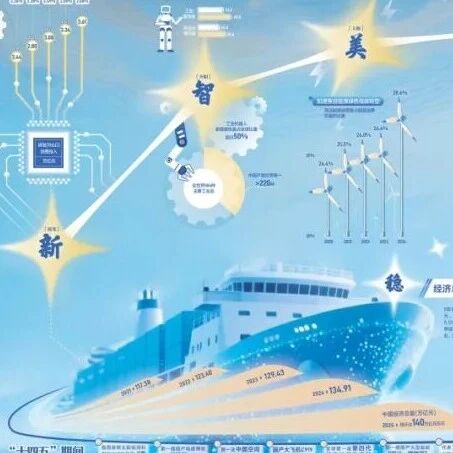
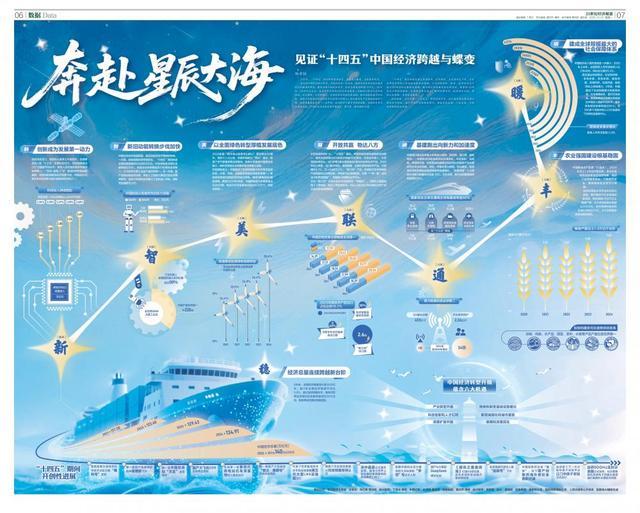
奔赴星辰大海,见证“十四五”中国经济跨越与蝶变
21世纪经济报道· 2025-10-18 13:08
Core Viewpoint - The article highlights the achievements and progress made during China's "14th Five-Year Plan" period, emphasizing economic resilience, innovation, and sustainable development as key drivers for future growth [1][2]. Economic Growth - China's economic increment over the past five years is expected to exceed 35 trillion yuan, with an average growth rate of 5.5%, surpassing the global average and contributing approximately 30% to global economic growth [5]. Innovation - Innovation has become the primary driving force for development, with national R&D investment increasing by nearly 50% compared to the end of the "13th Five-Year Plan." R&D intensity is approaching the OECD average, and China ranks 10th in the global innovation index [7]. Industrial Transformation - The transition from old to new economic drivers is progressing smoothly, with manufacturing value added expected to increase by 8 trillion yuan during the "14th Five-Year Plan," contributing over 30% to global manufacturing growth [9]. Green Development - China has established the world's largest renewable energy system, with installed capacities for hydropower, wind, and solar energy leading globally. By mid-2025, the number of electric vehicles reached 36.89 million, with charging infrastructure also ranking first worldwide [11]. Trade and Global Cooperation - During the "14th Five-Year Plan," China's goods trade volume remained the largest globally, with service trade expected to surpass 1 trillion USD for the first time in 2024. High-tech products accounted for nearly 20% of exports [13][14]. Infrastructure Development - China has built the largest highway, high-speed rail, and port networks globally, with significant growth in new infrastructure sectors such as computing networks and smart cities, achieving a 30% annual growth rate in computing capacity over the past five years [16]. Agricultural Strength - China's grain production has achieved 21 consecutive years of growth, reaching a new milestone of 1.4 trillion jin in 2024, ensuring food security and advancing agricultural technology [18]. Social Welfare - The income gap between urban and rural areas has narrowed, with per capita disposable income reaching 21,840 yuan in the first half of 2025, reflecting ongoing improvements in social welfare systems [20].
奔赴星辰大海 见证“十四五”中国经济跨越与蝶变
2 1 Shi Ji Jing Ji Bao Dao· 2025-10-17 22:48
Core Insights - The article highlights the significant achievements of China's economy during the "14th Five-Year Plan" period, emphasizing its resilience and contributions to global economic growth [1][3]. Economic Growth - Over the past five years, China's economic increment is expected to exceed 35 trillion yuan, with an average annual growth rate of 5.5%, surpassing the global average [3]. - China's contribution to global economic growth has remained around 30% annually, establishing it as a stable anchor for the world economy [3]. Innovation - National R&D investment has increased by nearly 50% compared to the end of the "13th Five-Year Plan," with R&D intensity approaching the OECD average [4]. - China ranks 10th in the global innovation index and has maintained the largest number of R&D personnel in the world for several years [4]. Industrial Transformation - The manufacturing sector is projected to contribute an additional 8 trillion yuan during the "14th Five-Year Plan," maintaining over 30% of global manufacturing growth [5]. - China continues to lead in the production of over 220 major industrial products, with significant advancements in AI and innovative pharmaceuticals [5]. Green Development - China has made substantial progress in environmental quality, with the fastest improvement in air quality and the largest increase in forest resources globally [6]. - By mid-2025, the installed capacity of renewable energy has surpassed that of coal, with 368.9 million new energy vehicles and nearly 16.7 million charging facilities, both ranking first in the world [6]. Trade and Global Cooperation - During the "14th Five-Year Plan," China's goods trade volume has remained the largest globally, with service trade expected to exceed 1 trillion USD for the first time in 2024 [8]. - High-tech products account for nearly 20% of exports, with significant growth in electronic information and high-end equipment sectors [8]. Infrastructure Development - China has established the world's largest networks of highways, high-speed rail, and ports, while also rapidly expanding new infrastructure in computing and smart cities [9]. - The computing power scale has grown at an annual rate of 30% over the past five years, with major nodes accounting for about 70% of the national total [9]. Agricultural Strength - China has achieved 21 consecutive years of grain production growth, with a target of 1.4 trillion jin by 2024, ensuring food security [10]. - The country has built over 1 billion mu of high-standard farmland, with a mechanization rate exceeding 74% for major crops [10]. Social Welfare - By mid-2025, the per capita disposable income reached 21,840 yuan, reflecting a nominal growth of 5.3% [11]. - China has developed the largest education, social security, and healthcare systems globally, with a basic pension insurance coverage exceeding 95% [11].
推进全面绿色转型 加快形成绿色生产力
Zhong Guo Huan Jing Bao· 2025-10-16 01:43
Core Viewpoint - The article emphasizes the importance of promoting green and low-carbon development as a key aspect of high-quality development and a fundamental strategy for addressing ecological issues in China [1] Group 1: Economic and Social Development - The 20th National Congress of the Communist Party of China has included accelerating the comprehensive green transformation of economic and social development as a goal for deepening reforms [1] - The government work report for 2025 highlights the need to synergistically promote carbon reduction, pollution reduction, and green growth [1] Group 2: Technological Transformation - Technological transformation is identified as the core driving force for comprehensive green transformation, characterized by substitution, efficiency enhancement, and creation effects [2] - By 2024, the share of clean energy consumption in China is expected to reach 28.6%, with non-fossil energy consumption accounting for 19.8% [2] - China's photovoltaic component production has ranked first globally for 16 consecutive years, supplying 70% of the world's photovoltaic components and 60% of wind power equipment [2] Group 3: Institutional Innovation - A systematic institutional framework has been established through property rights, pricing mechanisms, and judicial collaboration [3] - The carbon emissions trading market in China achieved a cumulative transaction volume of 189 million tons and a transaction value of 18.114 billion yuan in 2024 [3] - The introduction of a coal power capacity pricing mechanism is expected to significantly increase the exit rate of high-energy-consuming industries [3] Group 4: Market System - The market system serves as an effective carrier for comprehensive green transformation, focusing on factor flow, product iteration, and capital circulation [4] - By August 2024, the carbon emissions trading market had a cumulative transaction volume of nearly 700 million tons and a transaction value of approximately 48 billion yuan [5] - In 2024, the issuance of green bonds in China reached 681.433 billion yuan, with a custody scale of 2.09 trillion yuan, reflecting a 5.57% year-on-year growth [5] Group 5: Challenges and Future Directions - Despite significant progress in green transformation, challenges remain in key technology autonomy, regional development imbalances, and international green trade rules [6] - Continuous open innovation and the establishment of a fair and inclusive international cooperation mechanism for green transformation are essential for China to fulfill its role in global ecological civilization construction [6]
推进全面绿色转型,加快形成绿色生产力
Zhong Guo Huan Jing Bao· 2025-10-14 03:26
Core Viewpoint - The transition to a green and low-carbon economy is a crucial aspect of China's high-quality development and a fundamental strategy for addressing ecological issues, as emphasized in the 20th National Congress and subsequent government reports [1] Group 1: Technological Transformation - Technological transformation serves as the core driving force for the comprehensive green transition, characterized by substitution, efficiency enhancement, and creation effects [2] - Renewable energy technologies are expected to increase the share of clean energy consumption to 28.6% by 2024, with non-fossil energy consumption projected to reach around 25% by 2030 and over 30% by 2035 [2] - China's photovoltaic component production has led the world for 16 consecutive years, supplying 70% of global photovoltaic components and 60% of wind power equipment [2] Group 2: Institutional Innovation - A systematic institutional framework has been established through property rights, pricing mechanisms, and judicial collaboration [3] - The carbon emissions trading market is set to see a cumulative transaction volume of 18.9 million tons and a transaction value of 18.114 billion yuan in 2024, creating an effective mechanism for guiding high-carbon industries towards transformation [3] - The introduction of a coal power capacity pricing mechanism aims to enhance the efficiency of the electricity pricing system, significantly increasing the exit rate of high-energy-consuming industries [3] Group 3: Market System - The market system is a vital vehicle for achieving the comprehensive green transition, focusing on factor circulation, product iteration, and capital circulation [4] - As of August 2024, the national carbon emissions trading market has recorded a cumulative transaction volume of nearly 70 million tons and a transaction value of approximately 48 billion yuan [5] - The issuance of green bonds reached 681.433 billion yuan in 2024, with a custody scale of 2.09 trillion yuan, reflecting a 5.57% year-on-year growth, guiding social capital towards pollution prevention and low-carbon technology development [5] Group 4: Challenges and Future Directions - Despite significant progress in the green transition, challenges remain, including the need for independent control of key technologies and imbalances in regional development [6] - Continuous open innovation and the establishment of a fair and inclusive international cooperation mechanism for green transition are essential for China to fulfill its role as a contributor and leader in global ecological civilization [6]