
高技术制造业

Search documents
上半年东莞GDP同比增4.8%,外贸进出口同比增16.5%
2 1 Shi Ji Jing Ji Bao Dao· 2025-07-23 13:50
Economic Performance - Dongguan's GDP for the first half of the year reached 606.784 billion yuan, with a year-on-year growth of 4.8% [1] - The primary industry added value was 1.487 billion yuan, growing by 2.8% year-on-year; the secondary industry added value was 339.943 billion yuan, growing by 5.3%; and the tertiary industry added value was 265.355 billion yuan, growing by 4.1% [1] Manufacturing Sector - The city's industrial added value for large-scale enterprises increased by 5.1% year-on-year [1] - Key industries showed strong growth: electronic information manufacturing increased by 9.2%, electrical machinery and equipment manufacturing by 8.8%, and chemical manufacturing by 12.4% [1] - New momentum industries performed well, with advanced manufacturing and high-tech manufacturing added value growing by 7.5% and 9.1% respectively, surpassing the city average [1] - High-tech product output saw significant growth, with servers up by 408.8%, integrated circuits by 89.9%, sensors by 67.3%, and complete electronic computers by 44.3% [1] Foreign Trade - Dongguan's total foreign trade import and export volume reached 749.28 billion yuan, a year-on-year increase of 16.5% [1] - Imports totaled 293.13 billion yuan, growing by 27.0%, while exports were 456.14 billion yuan, increasing by 10.6% [1] Consumer Market - The total retail sales of social consumer goods amounted to 219.555 billion yuan, with a year-on-year growth of 3.4%, improving by 0.5 percentage points from the first quarter [2] - Restaurant income grew by 2.4%, while commodity retail increased by 3.6% [2] Investment Trends - Total fixed asset investment in Dongguan decreased by 10.9% year-on-year, but the decline was narrowed by 3.1 percentage points compared to the first quarter [2] - Excluding real estate development investment, fixed asset investment grew by 6.9% [2] - New momentum investments in advanced manufacturing and high-tech manufacturing increased significantly, by 30.6% and 31.8% respectively [2] Other Economic Indicators - Total electricity consumption reached 52.254 billion kWh, with a year-on-year growth of 5.0%; industrial electricity consumption was 35.599 billion kWh, growing by 3.5% [2] - As of the end of June, the number of registered businesses in the city was 1.891 million, a year-on-year increase of 5.5%, with emerging industry registrations at 769,200, growing by 16.2% [2]
2025年1-6月份河南固定资产投资增长5.1%
Sou Hu Cai Jing· 2025-07-18 03:03
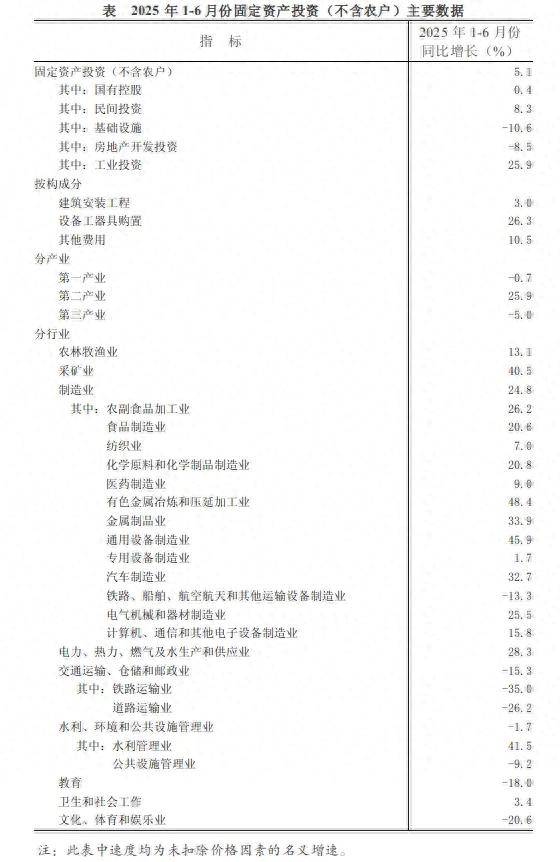
Core Viewpoint - The fixed asset investment in Henan Province for the first half of 2025 shows a year-on-year growth of 5.1%, driven by a significant increase in private investment and industrial investment, despite declines in infrastructure and real estate development investments [1][3]. Investment Overview - Fixed asset investment (excluding rural households) increased by 5.1% year-on-year [2] - Private investment grew by 8.3% [2][8] - Industrial investment rose by 25.9% [2] - Infrastructure investment (excluding power, heat, gas, and water supply) decreased by 10.6% [2] - Real estate development investment fell by 8.5% [2] Sector Analysis - First industry investment decreased by 0.7% [2] - Second industry investment increased by 25.9% [2] - Third industry investment declined by 5.8% [2] Industrial Investment Breakdown - Mining industry investment surged by 40.5% [2] - Manufacturing investment rose by 24.8% [2] - Investment in electricity, heat, gas, and water production and supply increased by 28.3% [2] Infrastructure Investment Details - Water conservancy, environment, and public facilities management investment decreased by 1.7% [2] - Transportation and postal services investment fell by 22.2% [2] - Information transmission investment declined by 18.2% [2] Project Investment Insights - Central project investment grew by 4.0% [2] - Local project investment increased by 5.1% [2] Policy and Economic Context - The investment growth is supported by macroeconomic policies aimed at stabilizing growth and enhancing the business environment [3] - Manufacturing investment accelerated with a year-on-year increase of 24.8%, reflecting a 3.3 percentage point rise from the first quarter [4] - Key industrial chains saw a 25.2% increase in investment, indicating a focus on high-quality development [5] - High-tech manufacturing investment grew by 12.1%, with significant contributions from the pharmaceutical sector [6] - Equipment procurement investment surged by 26.3%, driven by industrial needs [7] - The policies promoting private sector investment have led to an 8.3% increase in private investment, with a notable rise in non-real estate projects [8] - Major projects with planned investments of over 100 million yuan saw a 9.3% increase, contributing significantly to overall investment growth [9]

高技术制造业宏观周报:国信周频高技术制造业扩散指数有所走弱-20250717
Guoxin Securities· 2025-07-17 11:43
Group 1: High-tech Manufacturing Index - The Guosen weekly high-tech manufacturing diffusion index A recorded -0.4, indicating a weakening trend[1] - The diffusion index B stood at 50.6, showing a decline from the previous period[1] - The semiconductor sector's prosperity increased, while aerospace, new energy, and pharmaceutical industries saw a downturn[1] Group 2: Price Trends - The price of 6-amino penicillanic acid decreased to 220 RMB/kg, down by 10 RMB/kg from last week[2] - The price of acrylonitrile fell to 8,150 RMB/ton, a decrease of 50 RMB/ton[2] - The price of dynamic random-access memory (DRAM) rose to $1.5080, an increase of $0.059[2] - The price of lithium hexafluorophosphate dropped to 49,800 RMB/ton, down by 80 RMB/ton[2] Group 3: Policy and Industry Developments - Shanghai issued a plan to build a world-class modern shipbuilding base by 2027, targeting an industry scale exceeding 120 billion RMB[2] - NVIDIA's CEO Jensen Huang visited China for the third time this year, announcing the re-approval of the H20 chip for sale[2] Group 4: Economic Indicators - Fixed asset investment cumulative year-on-year growth is at 2.80%[5] - Retail sales year-on-year growth for the month is at 4.80%[5] - Monthly export year-on-year growth is at 5.80%[5] - M2 money supply growth stands at 8.30%[5] Group 5: Risk Factors - Development and structural adjustments in high-tech manufacturing may lead to indicator failures[3] - Economic policies and industrial policy interventions pose risks[3] - Economic growth slowdown is a potential concern[3]
高技术制造业宏观周报:国信周频高技术制造业扩散指数小幅修复-20250704
Guoxin Securities· 2025-07-04 11:15
Group 1: High-Tech Manufacturing Index - The Guosen weekly high-tech manufacturing diffusion index A recorded 0.2, while index B was 50.8, showing slight recovery compared to the previous period[1] - The semiconductor and aerospace industries showed improved sentiment, while the pharmaceutical sector experienced a decline in sentiment[1] - Prices for dynamic random access memory (DRAM) and acrylonitrile increased, while the price of 6-amino penicillanic acid decreased[2] Group 2: Price Tracking and Policy Developments - The price of 6-amino penicillanic acid was 180 RMB/kg, down 40 RMB/kg from last week; acrylonitrile was 8200 RMB/ton, up 50 RMB/ton[2] - DRAM prices rose to 1.4180 USD, an increase of 0.027 USD, while wafer prices fell to 2.68 USD, down 0.01 USD[2] - On June 30, the National Healthcare Security Administration and the National Health Commission issued measures to support the high-quality development of innovative drugs, proposing 16 measures across five areas[2] Group 3: Risks and Economic Indicators - Risks include potential indicator failures due to structural adjustments in high-tech manufacturing and economic policy interventions[3] - Fixed asset investment cumulative year-on-year growth was 3.70%, while retail sales and exports showed year-on-year growth of 6.40% and 4.80%, respectively[4]
2025年6月PMI数据点评:稳增长政策效应显现叠加贸易局势缓和,6月宏观经济景气度延续回升
Dong Fang Jin Cheng· 2025-06-30 09:09
Economic Indicators - In June 2025, China's manufacturing PMI was 49.7%, up 0.2 percentage points from May[1] - The non-manufacturing business activity index in June was 50.5%, also up 0.2 percentage points from May[1] - The comprehensive PMI output index rose to 50.7%, an increase of 0.3 percentage points from May[1] Policy Impact - The rebound in manufacturing PMI is attributed to the ongoing effects of growth-stabilizing policies, including a series of financial measures announced on May 7, which led to a sustained increase in social financing[2] - The new orders index increased by 0.4 percentage points, returning to the expansion zone, indicating strong market demand[2] Trade Environment - The easing of trade tensions, particularly following the May 12 de-escalation of the "tariff war," contributed to a slight recovery in the new export orders index, which rose to 47.7%, up 0.2 percentage points from the previous month[2] Sector Performance - The construction PMI in June was 52.8%, up 1.8 percentage points, indicating robust activity despite a slight decline in civil engineering indices[6] - The high-tech manufacturing PMI remained stable at 50.9%, reflecting strong demand and policy support[4] Challenges Ahead - Despite the positive indicators, the overall export slowdown may continue due to high tariffs exceeding 40% on Chinese goods[3] - The real estate market shows signs of intensified adjustment, which may limit the PMI's rebound potential[3] Future Outlook - GDP growth for the first half of the year is projected at around 5.2%, with no major new policy measures expected in the short term[7] - The manufacturing PMI is anticipated to remain around 49.7% in July, but with significant downward risks due to external pressures[8]
高技术制造业宏观周报:国信周频高技术制造业扩散指数小幅走弱-20250629
Guoxin Securities· 2025-06-29 03:29
Economic Indicators - The Guosen Weekly High-Tech Manufacturing Diffusion Index A recorded -0.2, while Index B was at 50.6, indicating a slight weakening compared to the previous period[1] - Fixed asset investment cumulative year-on-year growth is at 3.70%[4] - Retail sales year-on-year growth for the month is at 6.40%[4] - Monthly export year-on-year growth stands at 4.80%[4] - M2 money supply growth is at 7.90%[4] Price Trends - The price of 6-Aminopenicillanic Acid remains stable at 260 RMB/kg[2] - The price of Acrylonitrile decreased by 50 RMB/ton to 8150 RMB/ton[2] - Dynamic Random Access Memory (DRAM) price increased by 0.061 USD to 1.3910 USD[2] - Wafer price remains unchanged at 2.73 USD per piece[2] - Lithium Hexafluorophosphate price decreased by 0.05 RMB/ton to 51,700 RMB/ton[2] Industry Insights - The semiconductor industry shows improved sentiment, while the new energy and aerospace sectors are experiencing a downturn[1] - QuantumScape announced a significant advancement in solid-state battery technology, improving production speed by approximately 25 times[2] - A national standard for non-invasive brain-machine interface medical devices is open for public consultation, focusing on performance indicators and testing methods[2] Risk Factors - Potential for indicator failure due to structural adjustments in high-tech manufacturing[3] - Economic policy and industrial policy interventions may impact the sector[3] - Economic growth slowdown poses risks to the industry[3]
前5月东莞规上工业增加值同比增长5.5%,固投持续承压
2 1 Shi Ji Jing Ji Bao Dao· 2025-06-28 13:46
Economic Overview - Dongguan's economy showed stable performance in the first five months of 2025, with industrial production and foreign trade maintaining rapid growth [1][2] Industrial Performance - The industrial added value of Dongguan increased by 5.5% year-on-year from January to May 2025, with significant growth in key sectors: electronic information manufacturing up by 9.2%, electrical machinery and equipment manufacturing up by 9.5%, and chemical manufacturing up by 12.2% [1] - New momentum industries continued to grow rapidly, with advanced manufacturing and high-tech manufacturing added value increasing by 7.8% and 9.2% respectively [1] - High-tech product output saw substantial increases, with servers up by 380.9%, integrated circuits by 85.9%, sensors by 80.8%, and complete electronic computers by 42.6% [1] Foreign Trade - Dongguan's total foreign trade import and export volume reached 615.85 billion yuan from January to May 2025, a year-on-year increase of 17.4%. Imports were 244.11 billion yuan (up 28.5%) and exports were 371.74 billion yuan (up 11.2%) [1] - In May 2025, foreign trade total volume grew by 10.7% year-on-year, with imports increasing by 14.2% and exports by 8.6% [1] Investment Trends - Fixed asset investment in Dongguan decreased by 16.7% year-on-year from January to May 2025, with a 4.6% decline when excluding real estate development investments. Infrastructure investment grew by 7.0%, while industrial investment fell by 4.1% and real estate development investment dropped by 43.3% [2] - The proportion of industrial investment in total fixed asset investment rose to 54.4%, an increase of 7.1 percentage points year-on-year [2] Consumer Market - The retail sales of consumer goods in Dongguan reached 186.281 billion yuan from January to May 2025, reflecting a year-on-year growth of 4.4%, with an acceleration of 0.4 percentage points compared to the first four months [2]
高技术制造业宏观周报:国信周频高技术制造业扩散指数保持不变-20250620
Guoxin Securities· 2025-06-20 11:13
Group 1: High-tech Manufacturing Index - The Guosen weekly high-tech manufacturing diffusion index A recorded 0, while index B remained at 50.8, unchanged from the previous period[1] - The price of dynamic random access memory (DRAM) increased to $1.3300, up by $0.112 from last week[2] - The price of acrylonitrile decreased to ¥8200 per ton, down by ¥100 from last week, impacting the aerospace industry's performance[2] Group 2: Price Trends and Industry Insights - The price of 6-amino penicillanic acid remained stable at ¥260 per kilogram[2] - The price of lithium hexafluorophosphate remained unchanged at ¥52,200 per ton[2] - The price index for electronic products in Zhongguancun, specifically liquid crystal displays, reported a stable value of 91.04[2] Group 3: Policy and Market Developments - The 2025 New Energy Vehicle initiative launched on June 15, featuring 124 models, significantly increasing the variety available to consumers[2] - AI unicorn MiniMax is considering an IPO in Hong Kong, currently in preliminary preparation stages[2] Group 4: Economic Indicators - Fixed asset investment cumulative year-on-year growth stands at 3.70%[4] - Retail sales growth for the month is at 6.40% year-on-year[4] - Monthly export growth is recorded at 4.80% year-on-year[4] - M2 money supply growth is at 7.90%[4]
我市高质量发展成果丰硕
Zheng Zhou Ri Bao· 2025-06-13 00:45
Core Insights - The fifth national economic census in Zhengzhou has been successfully completed, revealing significant growth in the secondary and tertiary industries over the past five years, with improvements in asset scale, revenue, and technological innovation capabilities [1] Group 1: Growth in Legal Entities - The number of legal entities in the secondary and tertiary industries reached 566,000 by the end of 2023, an increase of 181,000 or 46.9% compared to the end of 2018 [2] - The number of industrial activity units was 599,000, up by 186,000 or 45.1% [2] - The number of individual businesses rose to 783,000, an increase of 284,000 or 57.0% [2] Group 2: Employment Trends - By the end of 2023, the secondary and tertiary industries employed 6.125 million people, an increase of 1.138 million or 22.8% since 2018, with 2.279 million being female workers [3] - Employment in the tertiary industry increased by 1.2 million or 39%, while employment in the secondary industry decreased by 62,000 or 3.2% [3] - The top three sectors for employment in the secondary and tertiary industries were wholesale and retail (1.042 million), construction (889,000), and manufacturing (786,000) [3] Group 3: Digital Economy Development - By the end of 2023, there were 60,000 legal entities in the core digital economy sector, employing 587,000 people and generating revenue of 868.06 billion [4] - The digital product manufacturing sector had 857 entities, employing 140,000 people and generating revenue of 605.01 billion [4] - The high-tech manufacturing sector had 259 entities, achieving revenue of 629.28 billion, while the high-tech service sector had 1,027 entities with revenue of 131.14 billion [4]
中银晨会聚焦-20250606
Bank of China Securities· 2025-06-06 01:40
Core Insights - The report highlights a diversified investment strategy with a focus on specific stocks, including SF Holding, Anji Technology, and others, indicating a positive outlook for these companies in the near term [1] - The macroeconomic analysis points to a mixed performance in domestic and foreign demand, with improvements in the external trade environment positively impacting manufacturing sentiment [2][5] - The tourism sector shows a strong recovery during the Dragon Boat Festival, with significant increases in domestic travel and spending, driven by short-distance leisure travel and cultural events [8][10] Macroeconomic Analysis - In May, the manufacturing PMI rose to 49.5%, indicating a slight recovery but still within a contraction zone, with new orders and production indices showing improvements [5][6] - The high-tech manufacturing sector continues to expand, with a PMI of 50.9%, reflecting robust demand and export orders [7] - The report notes a positive shift in manufacturing expectations, with a production activity expectation index of 52.5% [6] Tourism Sector Insights - The Dragon Boat Festival saw 119 million domestic trips, a 5.7% increase year-on-year, with total spending reaching 42.73 billion yuan, up 5.9% [8][10] - The integration of cultural and sports events has significantly boosted tourism, with family-oriented travel becoming a prominent trend [9] - Cross-border travel remains strong, with a notable increase in inbound tourism, particularly from countries with visa-free policies [10] Pharmaceutical Sector Analysis - The report on Ma Yinglong indicates a solid revenue growth of 18.85% year-on-year for 2024, with a total revenue of 3.728 billion yuan [12] - The company’s focus on the healthcare sector, particularly in the treatment of hemorrhoids, is expected to drive future growth, supported by a strong brand presence [13][15] - The pharmaceutical industry overall is experiencing steady growth, with a significant increase in sales of hemorrhoid treatment products [13]
