
M1

Search documents
2025年9月金融数据点评:居民存款搬家暂缓,社融受基数效应回落
Shanghai Aijian Securities· 2025-10-17 06:42
Report Industry Investment Rating No relevant content provided. Core Viewpoints - In September 2025, financial data was neutral, continuing the trend of "weak credit and rising M1 year-on-year". Affected by the base effect, the year-on-year growth rate of social financing is expected to decline. The "deposit relocation" process needs further verification, and the bond market is expected to be mainly volatile [6][30]. Summary by Directory 1. Financial Data Review - **Social Financing**: In September 2025, the year-on-year growth rate of social financing declined slightly to 8.68%. The government bond's driving effect on social financing weakened due to the misaligned issuance rhythm and high base from the previous year. Excluding government bonds, the year-on-year growth rate of social financing was 5.94% [4][10]. - **Money Supply**: M1 continued its high - growth trend, with a year-on-year growth rate of 7.2% in September, up 1.2 percentage points from the previous month. The year-on-year gap between M1 and M2 widened to -1.2%. The growth was driven by a low base last year and increased fiscal spending [5][17]. - **Credit**: The total credit was slightly weak and structurally differentiated. In September, new RMB loans were 129 billion yuan, slightly lower than expected. Corporate short - term loans expanded, while resident credit was weak. Resident short - term loans increased less year - on - year, and the personal consumption loan discount policy's effect was not fully shown. Resident long - term loans increased year - on - year due to housing policy optimization and the sales season. Overall, the credit data showed that policy guidance was effective in some areas, but enterprise long - term investment willingness and resident consumption credit recovery were still constraints [20][21]. - **Deposit**: In September, RMB deposit data showed structural differentiation. Resident deposits increased significantly, while non - banking financial institution deposits decreased. This was affected by seasonal factors and the high base from the previous year, and the "deposit relocation" trend needs further verification [27]. 2. Financial Data and Bond Market Outlook - The financial data in September was neutral, and the bond market is expected to improve slightly in the fourth quarter but remain a weak asset, mainly volatile. Investors should focus on four short - term disturbance factors: tariff trends, fund sales fee rate adjustments, inflation trends, and equity market performance [30].
国信证券晨会纪要-20251017
Guoxin Securities· 2025-10-17 01:13
Group 1: Macro and Strategy - In September, China's new social financing reached 3.53 trillion yuan, exceeding expectations of 3.27 trillion yuan, while new RMB loans amounted to 1.29 trillion yuan, slightly below the expected 1.39 trillion yuan. M2 growth year-on-year was 8.4%, close to the expected 8.5% [7][8] - The financial data indicates a trend of "total pressure, structural optimization," with social financing growth slowing to 8.7%, reflecting weak overall financing demand. However, there are signs of improvement in corporate credit structure and a slight increase in household medium to long-term loans [7][8] - The increase in deposits in September was 2.21 trillion yuan, with M2 growth rate declining to 8.4%. The structure shows an increase in household and corporate deposits, while fiscal and non-bank deposits decreased significantly [9] Group 2: Industry and Company - The e-commerce industry is currently focusing on two main themes: reducing competition pressure and enhancing efficiency for small and medium-sized merchants. Platforms are adjusting their monetization strategies, with Pinduoduo showing the most significant decline in monetization rate [12][13] - The upcoming Double 11 shopping festival is expected to see a reduction in investment from platforms, leading to a divergence in GMV performance. Taobao's market share is projected to decline slightly, while JD, Pinduoduo, and Kuaishou are expected to gain [12][13] - The media sector showed a 4.96% increase in September, outperforming the CSI 300 index by 1.76 percentage points. Key stocks like Giant Network and Mango Super Media performed well, while others like Youzu Network saw declines [14][15] - The gaming market's revenue in August saw a slight month-on-month increase of 0.6%, with 145 domestic games and 11 imported games approved in September. The market is expected to benefit from new product cycles and AI applications [14][15] - The film and television sector experienced a decline in box office revenue during the National Day holiday, primarily due to a lack of compelling new releases. However, the overall ticket sales in September increased by 82.8% year-on-year [15][16] - Investment recommendations include focusing on companies with strong AI capabilities and those benefiting from new product cycles in the gaming sector, such as Kae Ying Network and 37 Interactive Entertainment [17]
“存款搬家”进程暂缓?
第一财经· 2025-10-16 11:38
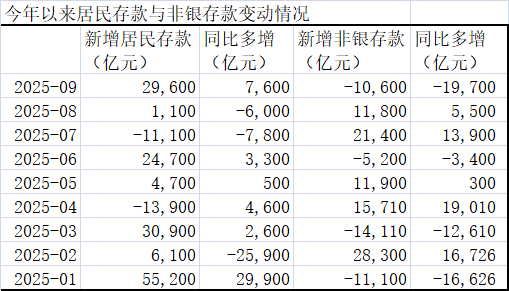
Core Viewpoint - The article discusses the recent changes in China's deposit structure, highlighting a significant divergence between household deposits and non-bank financial institution deposits, indicating a slowdown in the "deposit migration" process as capital markets fluctuate [3][5]. Group 1: Deposit Structure Changes - In September, household deposits increased by 2.96 trillion yuan, a year-on-year increase of 760 billion yuan, marking the first time in the second half of the year that monthly household deposits exceeded 2 trillion yuan [5][6]. - Conversely, non-bank deposits decreased by 1.06 trillion yuan, a year-on-year decrease of 1.97 trillion yuan, representing the first negative growth in monthly non-bank deposits since the beginning of the second half of the year [5][6]. - This structural change is attributed to a combination of fiscal policy actions, market fluctuations, and adjustments in household asset allocation preferences [6][7]. Group 2: Economic Analysis - Chief economist Li Chao from Zheshang Securities noted that in September, the increase in RMB deposits was 2.21 trillion yuan, with household deposits contributing significantly to this growth [7]. - The decline in non-bank deposits is influenced by last year's high base effect, market volatility, and adjustments in asset management products [8][9]. - Analysts suggest that the recent "deposit migration" phenomenon reflects a reallocation of household assets in response to changing asset return rates, rather than a direct cause of market changes [10]. Group 3: M1 and M2 Trends - The changes in household and non-bank deposits have led to a contrasting trend in M1 and M2, with M1's year-on-year growth rate rising to 7.2% in September, while M2's growth rate fell to 8.4% [12][13]. - The narrowing of the M1-M2 gap indicates increased market liquidity, suggesting that households and enterprises are more inclined to convert time deposits into demand deposits for immediate spending [13]. - Analysts emphasize that the recent increase in M1 does not necessarily indicate a significant recovery in the real estate market or a substantial boost in consumption and investment activity [13].


存款搬家停下来了!这是什么信号?
大胡子说房· 2025-10-16 11:23
Group 1 - The core viewpoint of the article emphasizes the current economic situation, particularly focusing on CPI and PPI data, indicating a lack of inflation and a need for continued monetary and fiscal policy support [5][6][10] - In September, the CPI decreased by 0.3% year-on-year and increased by 0.1% month-on-month, while the PPI fell by 2.3% year-on-year, suggesting weak consumer demand and manufacturing prices [1][3] - The article highlights the importance of M1 and M2 monetary supply data, with M2 growing by 8.4% year-on-year and M1 by 7.2%, indicating a narrowing gap between the two, which reflects a shift in liquidity dynamics [6][8][9] Group 2 - The increase in M1 is attributed to a decline in government bond prices, leading individuals to withdraw funds from fixed-term investments and place them into demand deposits [9][10] - In September, household deposits rose by 2.96 trillion yuan, while non-bank financial institution deposits fell by 1.06 trillion yuan, indicating a trend of funds returning to banks rather than remaining in investment accounts [10][11] - The article suggests that the current market volatility and lack of clear upward trends in the stock market have led to a decrease in the attractiveness of non-bank investments, resulting in a return of funds to traditional banking [12][13] Group 3 - The article anticipates that the government will continue to stimulate the capital market to encourage investment and support economic recovery, as the current economic conditions necessitate such actions [15][18] - It discusses the potential for a bull market in the A-share market, suggesting that as long as there is a need to escape deflation, the market will continue to seek upward momentum [19][20] - Upcoming key events, including trade negotiations and monetary policy decisions, are expected to influence market behavior, with a recommendation for strategic asset allocation in anticipation of these developments [21][22]

非银存款下半年首现负增长,“存款搬家”进程暂缓?
Di Yi Cai Jing· 2025-10-16 10:13
Core Viewpoint - The process of "deposit migration" has shown signs of slowing down, with significant divergence in the deposit structure between household deposits and non-bank financial institution deposits in September [1][2]. Group 1: Deposit Changes - In September, household deposits increased by 2.96 trillion yuan, a year-on-year increase of 760 billion yuan, marking the first time in the second half of the year that monthly household deposits exceeded 2 trillion yuan [2][4]. - Conversely, non-bank deposits decreased by 1.06 trillion yuan, a year-on-year decrease of 1.97 trillion yuan, representing the first negative growth in monthly non-bank deposits in the second half of the year [2][4]. Group 2: M1 and M2 Growth - The structural changes in deposits have led to a rise in M1 (narrow money) and a decline in M2 (broad money), with M1's year-on-year growth rate at 7.2%, up from 6% in August, while M2's growth rate fell to 8.4% from 8.8% [8][9]. - The M1-M2 spread narrowed to -1.2%, indicating increased market liquidity as households and enterprises are more inclined to convert time deposits into demand deposits for immediate spending [8][9]. Group 3: Market Dynamics - The decline in non-bank deposits is attributed to multiple factors, including last year's high base effect, fluctuations in the equity market, and adjustments in asset management products [5][6]. - The recent high volatility in the equity market has led to a temporary halt in the "migration" of household deposits into the stock market, suggesting a reallocation of assets rather than a permanent shift [6][7].
9月金融数据点评:期待政策的确定性稳定市场预期
Bank of China Securities· 2025-10-16 09:45
Group 1: Financial Data Overview - In September, new social financing (社融) amounted to 3.53 trillion yuan, a decrease of 229.7 billion yuan compared to the same month last year, but an increase of 967 billion yuan from August, exceeding the consensus expectation of 3.27 trillion yuan[2] - The year-on-year growth rate of social financing stock was 8.7%, slightly down by 0.13 percentage points from August, and above the expected 8.63%[2] - New RMB loans in September were 1.61 trillion yuan, down by 366.2 billion yuan year-on-year, but up by 982.7 billion yuan from August[2] Group 2: Financing Structure and Trends - Government bond financing in September was 1.19 trillion yuan, down by 347.1 billion yuan year-on-year, while direct financing increased, with corporate bond and stock financing up by 203.1 billion yuan and 37.2 billion yuan respectively[2] - The proportion of government bonds in the financing structure increased by 0.11 percentage points from August, while RMB loans decreased by 0.11 percentage points[2] - M2 growth was 8.4% year-on-year, down by 0.4 percentage points from August, while M1 grew by 7.2%, up by 1.2 percentage points[2] Group 3: Deposit and Loan Trends - New deposits in September totaled 2.21 trillion yuan, with new household deposits at 2.96 trillion yuan and new corporate deposits at 919.4 billion yuan, but fiscal and non-bank deposits saw significant declines[2] - The trend of "deposit migration" appears to be slowing, as household deposits increased year-on-year while non-bank deposits decreased[2] - New loans from financial institutions were 1.29 trillion yuan, down by 300 billion yuan year-on-year, with corporate loans at 1.22 trillion yuan, also down by 270 billion yuan[2]
宏观点评:信贷不弱,M1不强-20251016
CAITONG SECURITIES· 2025-10-16 09:11
Credit and Financing Analysis - In September, the growth rate of RMB loans decreased from 6.8% to 6.6%, with new loans totaling 1.6 trillion yuan, a year-on-year decrease of 3.66 billion yuan[7] - Short-term loans increased by 122.1 billion yuan year-on-year, while medium and long-term loans decreased by 30 billion yuan[10] - Corporate bill financing saw a net repayment of 402.6 billion yuan, a year-on-year decrease of 471.2 billion yuan[10] - The total social financing (社融) in September was 3.53 trillion yuan, a year-on-year decrease of 229.7 billion yuan, with a stock growth rate of 8.7%[6] Monetary Supply Insights - M1 growth in September was 7.2%, an increase of 1.2 percentage points, but showed a significant decline from 2.3% in March to -3.3% in September due to manual interest compensation[27] - M2 growth was 8.4%, a decrease of 0.4 percentage points from the previous value[6] - The decline in non-bank deposits was 1.06 trillion yuan in September, a year-on-year decrease of 1.97 trillion yuan, indicating significant volatility[23] Policy and Economic Implications - Policy financial tools began to be deployed at the end of September, which may support social financing in the fourth quarter[18] - Fiscal deposits decreased by 840 billion yuan in September, a year-on-year reduction of 604.2 billion yuan, suggesting accelerated fiscal spending to stabilize economic growth[26] - Risks include potential underperformance of domestic policy measures, uncertainties in investment behavior, and unexpected changes in overseas policies and geopolitical situations[31]
A股,突迎变局
Zheng Quan Shi Bao· 2025-10-16 06:23
Core Insights - The A-share market is experiencing a contraction in the breadth of its upward movement, with less than 1500 stocks rising in early trading on October 16, indicating a concentration of funds towards core assets [1] - The market's driving forces have shifted, with M1 and M2 growth rates showing significant changes, reflecting a more resilient credit environment despite a slight decline in new social financing and RMB loans [1][2] Financial Data Analysis - M1 and M2 growth rates are reported at 7.2% and 8.4% respectively, with M2 slightly down from previous values due to reduced government bond issuance and a cooling of RMB appreciation expectations [2] - The increase in M1 is attributed to a low base effect and improved corporate liquidity, with a notable increase in household deposits by 760 billion yuan year-on-year [2] E-commerce and Logistics Sector - The China E-commerce Logistics Index reached a new high of 112.7 points in September, indicating a robust growth in e-commerce logistics, particularly in rural areas [2] - The total business volume index for e-commerce logistics also increased to 132.5 points, reflecting a strengthening internal economic momentum [2] Market Participation and Trends - Recent data shows a net inflow of 66.336 billion yuan into the A-share market, with significant contributions from margin financing and ETF subscriptions, suggesting increased market activity [4] - The trading volume reached 5.21 trillion yuan with a turnover rate of 4.26%, indicating heightened market participation [4] Investor Behavior and Market Volatility - Investor sentiment is influenced by external shocks such as tariffs, leading to irrational trading behaviors and increased volatility in the market [5] - The current market environment may encourage a shift from value investing to short-term emotional trading, increasing risk exposure for investors [5]
A股,突迎变局!
券商中国· 2025-10-16 04:03
Market Overview - The A-share market is experiencing a contraction in the number of rising stocks, with less than 1500 stocks rising in early trading on October 16, indicating a concentration of funds towards core assets [1] - The market's driving forces have changed, with M1 and M2 growth rates at 7.2% and 8.4% respectively, both exceeding market expectations [1][2] Internal Driving Forces - The internal driving forces for the A-share market's rise are shifting, with September 2025 financial data showing a slight decline in new social financing and RMB loans, yet still above market expectations, indicating resilience in the credit sector [2] - M2 growth slightly decreased to 8.4%, while M1 increased to 7.2%, suggesting a correlation between M1 recovery and equity market performance [2] Financial Data Analysis - The decline in M2 is attributed to a slowdown in government bond issuance and a decrease in the willingness of enterprises to convert foreign currency, while M1's increase is influenced by a low base effect and improved corporate liquidity [5] - The e-commerce logistics index in China reached a new high of 112.7 points in September, indicating a strengthening of economic internal dynamics [5] Market Activity - A net inflow of capital into the A-share market was observed, totaling 663.36 billion, with significant contributions from margin financing and ETF subscriptions, reflecting increased market participation [8] - The overall trading volume in the A-share market reached 5.21 trillion, with a turnover rate of 4.26%, indicating heightened trading activity [8] Investor Behavior - Market volatility often leads to irrational investor behavior, such as "chasing highs and selling lows," which can diminish investment returns and increase risk exposure [9] - It is recommended that investors establish a system to smooth out volatility and capture long-term returns amidst uncertainty [9]

铝:震荡整理,氧化铝:利润压缩,铸造铝合金:跟随电解铝
Guo Tai Jun An Qi Huo· 2025-10-16 02:21
Report Investment Ratings - Aluminum: Consolidating with oscillations [1] - Alumina: Profit compression [1] - Cast aluminum alloy: Following the trend of electrolytic aluminum [1] Core Views - The report provides updated fundamental data for aluminum, alumina, and cast aluminum alloy, including prices, trading volumes, open interests, spreads, cost - profit situations, and inventory levels in both the futures and spot markets [1]. - It also presents macro - economic data such as China's September CPI, PPI, and new social financing, and analyzes their implications [3]. - The trend intensities for aluminum, alumina, and aluminum alloy are 0, - 1, and 0 respectively [3]. Summary by Related Catalogs Futures Market Electrolytic Aluminum - The closing price of the SHFE aluminum main contract was 20,910, with a night - session closing price of 20,885. The LME aluminum 3M closing price was 2,745 [1]. - Trading volume and open interest of the SHFE aluminum main contract decreased compared to previous periods. The LME aluminum 3M trading volume also showed changes [1]. - The LME canceled warrant ratio was 19.50%, and the LME aluminum cash - 3M spread was 6.66 [1]. - The spread between the near - month and the first - continuous contract was - 55, and the cost of the near - month long and first - continuous short inter - delivery spread arbitrage was 70.58 [1]. Alumina - The closing price of the SHFE alumina main contract was 2,797, with a night - session closing price of 2,780 [1]. - Trading volume and open interest of the SHFE alumina main contract had different trends compared to previous periods [1]. - The spread between the near - month and the first - continuous contract was 7, and the cost of the near - month long and first - continuous short inter - delivery spread arbitrage was 22.15 [1]. Aluminum Alloy - The closing price of the aluminum alloy main contract was 20,410, with a night - session closing price of 20,425 [1]. - Trading volume and open interest of the aluminum alloy main contract changed compared to previous periods [1]. - The spread between the near - month and the first - continuous contract was - 45, and the spot premium was 30 [1]. Spot Market Electrolytic Aluminum - The pre - baked anode market price, aluminum rod processing fees, and aluminum ingot scrap - refined spread showed different changes [1]. - Electrolytic aluminum enterprises' profit was 4,748.93, and the import profit and loss of aluminum spot and 3M had different values [1]. - The domestic social inventory of aluminum ingots was 64.20 million tons, and the LME aluminum ingot inventory was 49.90 million tons [1]. Alumina - The domestic average price of alumina was 2,974, and the alumina prices at Lianyungang in different units had different trends [1]. - Alumina enterprises in Shanxi had a loss of - 42, and the prices of imported bauxite from different regions changed slightly [1]. Aluminum Alloy - The theoretical profit of ADC12 was 180, and the price of Baotai ADC12 was 20,600 [1]. - The difference between Baotai ADC12 and A00 was - 320, and the total inventory of three regions was 49,125 [1]. Caustic Soda - The price of Shaanxi ion - exchange membrane liquid caustic soda (32% converted to 100%) was 2,830 [1]. Macroeconomic Data - In September, China's CPI year - on - year decline narrowed to 0.3%, core CPI returned to 1% for the first time in 19 months, and PPI year - on - year decline narrowed to 2.3% [3]. - China's new social financing in September was 3.53 trillion yuan, new RMB loans were 1.29 trillion yuan, and the M2 - M1 gap reached a new low of 1.2 percentage points [3].