宏观政策

Search documents
洪灏:上次民间信贷萎缩发生在2005年,随后迎来一轮大牛市
Sou Hu Cai Jing· 2025-08-18 05:32
Group 1 - The relative performance of small-cap stocks in the A-share market has approached or reached previous highs, facing resistance at these levels [1] - The Chinese stock market may still rise, depending on how macro policies respond [1] - The contraction of private lending is not a positive sign for the Chinese economy, but the central bank's intention to maintain an upward market trend is evident [1] Group 2 - There are no signs of recovery in the real estate sector, but a rising stock market could alleviate some downward pressure from the real estate decline [1] - The last occurrence of private lending contraction was in 2005, which was followed by a significant bull market [1]
7月经济数据不乏亮点,宏观政策将适时加力
Di Yi Cai Jing· 2025-08-17 13:39
Group 1 - The core viewpoint emphasizes the need for macroeconomic policies to continuously exert force and adapt as necessary to stabilize and stimulate economic growth, especially in light of recent economic indicators showing a slowdown [2][8][10] - The National Bureau of Statistics reported a decline in key economic indicators for July, including a 3.7% year-on-year growth in retail sales of consumer goods, which is the lowest for the year [3][4] - Investment in fixed assets (excluding rural households) reached 288.229 billion yuan in the first seven months, showing a year-on-year growth of 1.6%, with infrastructure investment growing by 3.2% [4][6] Group 2 - The government is expected to implement new incremental policies, including timely budget increases, interest rate cuts, and measures to support the real estate sector and foreign trade enterprises [2][8][9] - The manufacturing sector, particularly high-tech industries, has shown resilience, with significant year-on-year growth in sectors such as integrated circuit manufacturing (26.9%) and electronic materials (21.7%) [3][6] - The service sector's retail sales remained stable, with a 5.2% growth from January to July, indicating a sustained expansion in consumption [4][6] Group 3 - The government plans to enhance fiscal policies by accelerating the issuance of special bonds and improving the effectiveness of fiscal measures to stimulate economic activity [10][11] - The People's Bank of China aims to maintain a moderately loose monetary policy while optimizing the structure of financial resource allocation to support innovation and advanced manufacturing [11][12] - The focus on expanding domestic demand and enhancing the adaptability of supply and demand in consumer goods is a priority for the Ministry of Industry and Information Technology [12]
发力国内需求,巩固经济回升向好势头
2 1 Shi Ji Jing Ji Bao Dao· 2025-08-15 22:08
Economic Overview - The national economy shows a steady development trend, requiring continued macro policy support to effectively release domestic demand potential and promote a stable and healthy economic development [1][2] Export and Consumption - In July, exports increased by 7.2% year-on-year, surpassing the previous value of 5.9% [1] - Social retail sales grew by 3.7% year-on-year in July, down from 4.8% in June and 6.4% in May, with retail sales of goods increasing by 4.0%, lower than the previous value of 5.3% [1] - The consumption upgrade policy continues to show effects, with significant growth in retail sales of home appliances (28.7%), furniture (20.6%), communication equipment (14.9%), and cultural office supplies (13.8%) [1] Fixed Asset Investment - From January to July, fixed asset investment increased by 1.6% year-on-year, a decline of 1.2 percentage points compared to the first half of the year [1] - Investment growth in manufacturing, infrastructure, and real estate showed a downward trend, decreasing by 1.3%, 1.4%, and 0.8% respectively [1] Industrial Production - In July, the industrial added value above designated size grew by 5.7% year-on-year, lower than the previous value of 6.8% [2] - The producer price index for industrial producers decreased by 0.2% month-on-month, with a year-on-year decline of 3.6% [2] Policy Measures - Starting in August, the government will implement measures to expand consumption, including childcare subsidies and the exemption of certain fees for public kindergartens [3] - The government aims to accelerate infrastructure investment and improve the efficiency of fund utilization through the issuance of government bonds [3] Short-term Influences - July's economic data was affected by short-term factors such as extreme weather and adjustments in consumption subsidies [3] - The introduction of macroeconomic policies in August is expected to promote effective investment and release domestic demand potential [3]
国家统计局:7月份规模以上工业增加值同比增长5.7%
Zheng Quan Ri Bao· 2025-08-15 16:54
Economic Overview - In July, China's economy demonstrated resilience and vitality despite external complexities and extreme weather conditions, maintaining a steady growth trajectory [1][2] - The industrial sector showed robust growth, with the industrial added value of enterprises above designated size increasing by 5.7% year-on-year in July, supported by strong performance in the equipment manufacturing sector, which grew by 8.4% [2][3] Consumption and Investment - Consumption-related policies have effectively boosted demand, with retail sales of consumer goods increasing by 3.7% year-on-year in July, and retail sales of goods growing by 4% [3] - Fixed asset investment grew by 1.6% year-on-year in the first seven months, with significant growth in equipment and tool purchases, which rose by 15.2% [3] Foreign Trade - China's total goods import and export value increased by 6.7% year-on-year in July, reflecting ongoing resilience in foreign trade [3] Innovation and New Industries - The integration of technology and industry has been actively promoted, leading to steady development of new productive forces, with significant growth in high-tech industries such as integrated circuit manufacturing and electronic materials, which saw increases of 26.9% and 21.7% respectively in July [5][6] Digital Economy - The digital economy is rapidly advancing, with the added value of the digital product manufacturing industry increasing by 8.4% year-on-year in July, and significant growth in smart products such as unmanned aerial vehicles and smart vehicle-mounted devices [6] Green Development - The focus on green development has led to substantial growth in the production of new energy products, with output of new energy vehicles and lithium-ion batteries increasing by 17.1% and 29.4% respectively in July [7]
王青:7月汽车销售额转负拖累消费 四季度初前后或推出增量政策 | 首席读数据
Di Yi Cai Jing· 2025-08-15 11:31
Core Insights - The latest data from the National Bureau of Statistics indicates that in July, the total retail sales of consumer goods reached 38,780 billion yuan, reflecting a year-on-year growth of 3.7% but a month-on-month decline of 0.14% [1] - From January to July, the total fixed asset investment (excluding rural households) amounted to 288,229 billion yuan, showing a year-on-year increase of 1.6%. When excluding real estate development investment, the growth rate of fixed asset investment was 5.3% [1] - Chief Macro Analyst Wang Qing from Dongfang Jincheng suggests that the economic growth momentum in August may continue to reflect the weaker state observed in July, indicating that new significant incremental measures in macro policy may be introduced around the beginning of the fourth quarter to stabilize the macroeconomic operation and employment market [1]
钢矿:供需矛盾不突出,短期震荡走势
Ge Lin Qi Huo· 2025-08-15 10:56
Report Summary 1. Report Industry Investment Rating No relevant content provided. 2. Core Viewpoints - The supply - demand contradiction in the steel and ore industry is not prominent, and the short - term trend is expected to be volatile. The I2601 contract is recommended to focus on the 750 - 800 yuan/ton range, and consider going long lightly around 750 yuan/ton with a stop - loss. For the Spiral Coil 2510 contract, short - term long positions can be taken when it retraces to the key support level, while controlling the position and setting a stop - loss. The RB2510 contract has a resistance level of 3384 and a support level of 3150, and the hot - rolled coil has a support level of 3300 and a resistance level of 3550 [5]. 3. Summary by Related Catalogs Steel and Ore Market Conditions - This week, the steel and ore market first rose and then fell. The iron ore trend was stronger than that of finished products, and its high point was close to the previous high. The iron ore has completed the main contract roll - over [6]. - This week, the supply of steel increased. The supply of five major steel products was 871.63 tons, a week - on - week increase of 2.42 tons or 0.3%. The total inventory was 1415.97 tons, a week - on - week increase of 40.61 tons or 2.95%. The weekly consumption was 831.02 tons, a decrease of 1.7% [15]. Demand Side - In the terminal market, the year - on - year decline rates of real estate investment and new construction have both widened, and the demand for steel in the real estate sector has continued to have a negative feedback. The manufacturing growth rate is 6.2% and the infrastructure investment growth rate is 3.2%, both lower than last month, indicating that the demand side remains weak. Overall, the downstream industries have not recovered [5]. Supply Side - Before the military parade activity's production restrictions, steel mills were highly motivated to start production. The daily hot - metal output this week was 2.4066 million tons, a week - on - week increase of 0.3 million tons. The inventory and daily consumption of imported sintered powder both increased, and there is still a profit in off - peak electricity for short - process steelmaking. Starting from August 16, steel mills will start production restrictions, and it is expected that steel production will decline until early September [5][17]. - The iron ore shipping volume has decreased week - on - week, especially the shipping volume from Australia. The supply of iron ore is expected to shrink. The continuous decline in iron ore shipping volume for two weeks means that the short - term pressure on iron ore arrival at ports is not significant. The port iron ore inventory has slightly increased, but the inventory contradiction is not prominent [5][24]. Important News - On August 13, some steel mills in Hebei and Tianjin regions raised the coke purchase price for the sixth time. The price of tamping wet - quenched coke increased by 50 yuan/ton, and the price of tamping dry - quenched coke increased by 55 yuan/ton. The price of top - charged wet - quenched coke increased by 70 yuan/ton, and the price of top - charged dry - quenched coke increased by 75 yuan/ton, with mainstream steel mills tendering on the 14th [12]. - From August 16 to early September, some steel enterprises in Tangshan will implement production restrictions, but the actual implementation effect remains to be observed [14]. - Nearly 30 cities have introduced 34 property market relaxation policies, including Guangzhou's plan to fully cancel the "four restrictions" and Beijing's cancellation of purchase restrictions outside the Fifth Ring Road [14].
最新经济数据公布,主要指标增长
21世纪经济报道· 2025-08-15 07:31
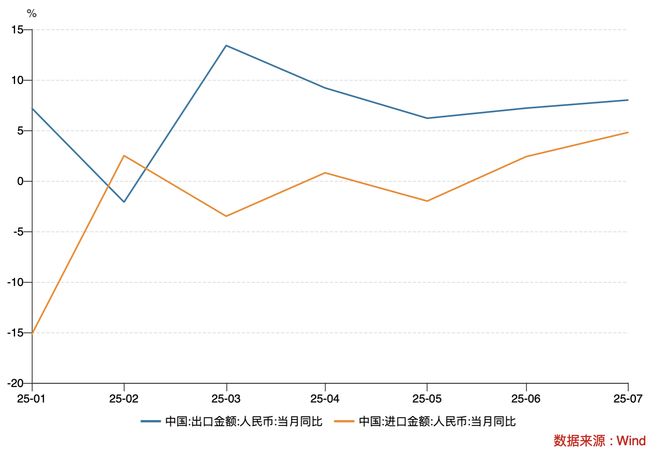
Core Viewpoint - The article discusses the economic data released by the National Bureau of Statistics for July, highlighting a mixed performance in various economic indicators, with a notable rebound in exports while other sectors showed signs of decline. Overall, the cumulative growth rates from January to July remain stable. Group 1: Trade and Exports - In July, the total goods import and export volume reached 3.91 trillion yuan, a year-on-year increase of 6.7%. Exports amounted to 2.31 trillion yuan, growing by 8.0%, while imports were 1.6 trillion yuan, increasing by 4.8% [1][3] - Despite a decrease in exports to the U.S. due to tariffs, China's overall export resilience is evident, with significant growth in non-U.S. markets [3] - The rebound in imports is attributed to the U.S. lifting some export controls on high-tech products, with the largest increase in imports seen in high-tech categories such as aircraft engines and integrated circuits [3][5] Group 2: Consumer Spending - The total retail sales of consumer goods in July reached 3.88 trillion yuan, with a year-on-year growth of 3.7% but a month-on-month decline of 0.14%. Retail sales of goods grew by 4.0%, while catering revenue increased by only 1.1%, indicating cautious consumer spending [3][5] - The "old-for-new" policy significantly boosted the consumption of key goods, with retail sales of home appliances and audio-visual equipment rising by 28.7% year-on-year [5] - Cumulatively, from January to July, retail sales of consumer goods grew by 4.8%, while service retail sales increased by 5.2%, suggesting a steady recovery in consumption [5] Group 3: Investment Trends - From January to July, fixed asset investment (excluding rural households) totaled 28.82 trillion yuan, with a year-on-year growth of 1.6%, a decline of 1.2 percentage points compared to the first half of the year [5][6] - Manufacturing investment grew by 6.2%, while infrastructure investment increased by 3.2%. However, real estate development investment saw a year-on-year decline of 12%, with the drop widening by 0.8 percentage points [5][6] - Factors contributing to the decline in investment growth include extreme weather conditions, complex external environments, and weakened investment momentum in traditional industries like real estate [6][7] Group 4: Policy and Economic Outlook - The National Bureau of Statistics emphasized the need for proactive macroeconomic policies to address the complex international environment and domestic challenges, aiming to stabilize employment, businesses, and market expectations [7][8] - The Central Political Bureau meeting highlighted the importance of maintaining a continuous and flexible macro policy to effectively stimulate domestic demand and promote economic stability [8]


宏观政策发力显效 !一图速览前7月主要经济指标数据→
Zhong Guo Jing Ji Wang· 2025-08-15 06:57
Economic Overview - The macroeconomic policies have shown effectiveness, allowing the national economy to maintain a steady and progressive development despite external complexities and extreme weather conditions [3]. Industrial Performance - From January to July, the industrial added value of large-scale enterprises increased by 6.3% year-on-year [4]. Service Sector - The service production index saw a year-on-year growth of 5.9% during the same period [4]. Consumer Spending - The total retail sales of consumer goods reached 284,238 billion yuan, reflecting a year-on-year increase of 4.8% [5]. Investment Trends - Fixed asset investment (excluding rural households) totaled 288,229 billion yuan, showing a year-on-year decline of 6% [6]. - When excluding real estate development investment, fixed asset investment grew by 5.3% [7]. Trade Performance - The total value of goods import and export amounted to 256,969 billion yuan, with a year-on-year growth of 3.5% [8].

最新数据,国家统计局详解
Shang Hai Zheng Quan Bao· 2025-08-15 06:37
Economic Overview - In July, the international environment was complex and severe, with extreme weather conditions impacting economic operations, yet key economic indicators remained stable overall [1][8] - The industrial production increased by 5.7% year-on-year in July, while the retail sales of consumer goods grew by 3.7% year-on-year [1][3] Industrial Production - The industrial production showed a steady and relatively fast growth, with the added value of large-scale industries increasing by 5.7% year-on-year in July [3] - The equipment manufacturing sector performed well, with an increase of 8.4% in added value, and high-tech manufacturing saw a growth of 9.3%, outpacing the overall industrial growth by 2.7 and 3.6 percentage points respectively [3] - The "two new" policies continued to show positive effects, with significant growth in specific industries such as shipbuilding and electric motor manufacturing, which grew by 29.7% and 15.9% respectively [3] Investment Trends - From January to July, fixed asset investment increased by 1.6% year-on-year, with actual growth estimated between 4% to 5% after adjusting for price factors [3][4] - Manufacturing investment grew by 6.2% year-on-year, significantly higher than the overall investment growth rate, with aerospace and computer equipment manufacturing investments increasing by 33.9% and 16% respectively [4] Consumer Market - In July, the retail sales of consumer goods increased by 3.7% year-on-year, although the growth rate decreased by 1.1 percentage points compared to June [6] - The sales of home appliances and communication devices saw substantial growth, with increases of 28.7% and 14.9% respectively [6] - Service retail maintained stability, with a year-on-year growth of 5.2% from January to July, supported by active markets in sports events, movies, and cultural tourism [6] Future Outlook - The economic foundation remains stable with strong potential for growth, supported by effective macroeconomic policies and increased market demand [8][9] - The government plans to implement policies to lower credit costs for personal consumption and service industry loans, which is expected to stimulate consumption and promote service sector growth [9] - The International Monetary Fund has raised its growth forecast for China's economy by 0.8 percentage points, indicating increased international confidence in China's economic development [9]
7月部分经济指标有所波动,下一步要增强政策灵活性预见性
2 1 Shi Ji Jing Ji Bao Dao· 2025-08-15 06:30
Economic Overview - In July, China's total goods import and export amounted to 3.91 trillion yuan, a year-on-year increase of 6.7%, with exports at 2.31 trillion yuan, growing by 8.0% [1][3] - The export growth rate in July continued to rebound for the second consecutive month, increasing by 0.8 percentage points compared to June [1] - Imports also showed significant improvement, with a growth rate increase of 2.4 percentage points from June [1] Export and Import Dynamics - Despite a decline in exports to the U.S. due to tariffs, China's overall export performance remains resilient, with a notable increase in exports to non-U.S. markets [3] - The major categories driving the increase in imports in July included high-tech products, such as aircraft engines and integrated circuits, following the U.S. lifting some export controls [3] Consumer Spending Trends - The total retail sales of consumer goods in July reached 3.88 trillion yuan, with a year-on-year growth of 3.7%, although it saw a month-on-month decline of 0.14% [3][5] - The consumption of key goods, supported by the policy of replacing old appliances, showed significant growth, with categories like home appliances and communication equipment seeing increases of 28.7% and 14.9% respectively [5] Investment Insights - From January to July, fixed asset investment (excluding rural households) totaled 28.82 trillion yuan, with a year-on-year growth of 1.6%, reflecting a decline of 1.2 percentage points compared to the first half of the year [5][6] - Manufacturing investment grew by 6.2%, while infrastructure investment increased by 3.2%, both showing a decrease in growth rate compared to the previous period [5][6] Economic Challenges and Policy Responses - The economic environment remains complex, with external factors such as trade protectionism and extreme weather conditions impacting economic performance [7] - The government is focusing on maintaining stable macroeconomic policies, enhancing flexibility, and promoting domestic demand to support economic recovery [7]