财政政策

Search documents
今年以来税收收入稳中有升(锐财经)
Ren Min Ri Bao· 2025-09-23 22:52
Core Insights - The overall public budget revenue for the first eight months of the year reached 14.82 trillion yuan, showing a year-on-year growth of 0.3%, with the growth rate improving by 0.2 percentage points compared to the first seven months [1] - Tax revenue amounted to 12.11 trillion yuan, a slight increase of 0.02% year-on-year, marking the first positive cumulative growth [1] Tax Revenue Growth - Major tax categories maintained positive growth, with total tax revenue (excluding export tax rebates) increasing by 2% in the first eight months [2] - Key tax types included domestic value-added tax at 47,389 billion yuan (up 3.2%), domestic consumption tax at 11,523 billion yuan (up 2%), corporate income tax at 31,477 billion yuan (up 0.3%), and personal income tax at 10,547 billion yuan (up 8.9%) [2] - Manufacturing and financial sectors showed rapid tax revenue growth, with manufacturing accounting for over 30% of total tax revenue and experiencing growth rates above 5% [2] Economic Factors Supporting Tax Revenue - The increase in tax revenue in recent months is attributed to the robust performance of major tax types, indicating a positive economic recovery and active capital markets [4] - The capital market's activity significantly contributed to tax revenue, with the Shanghai Composite Index surpassing 3,800 points and A-share total market value exceeding 100 trillion yuan [4] - Enhanced taxpayer compliance and awareness of legal tax obligations have also supported tax revenue growth [5] Fiscal Expenditure and Policy Outlook - Public budget expenditure has been on the rise, with social security and employment spending increasing by 10% and education spending by 5.6% in the first eight months [8] - The overall fiscal situation is improving, with expectations for continued positive trends in revenue and expenditure in the latter half of the year [8] - The tax authorities plan to maintain a fair legal framework and optimize management practices to foster a conducive environment for high-quality economic development [8]
国泰海通证券梁中华:宏观政策将保持积极
Zhong Guo Zheng Quan Bao· 2025-09-23 15:07
Core Viewpoint - The domestic macroeconomic fundamentals have significantly exceeded expectations this year, with particularly strong growth in the first half despite external uncertainties [1] Economic Structure - There is a notable divergence in economic structure: the supply side is performing well, while the demand side requires further policy support, especially in real estate and consumption sectors [1] - The economic total is experiencing high growth, but price indicators remain low, indicating a disparity between total economic growth and pricing [1] Policy Outlook - Future domestic policy direction is expected to remain positive, with increased efforts in both monetary and fiscal policies [1] - There is potential for further reductions in reserve requirement ratios and interest rates, with various policy rates likely to continue decreasing [1] - The central bank is anticipated to maintain a loose monetary policy environment to support the recovery of domestic demand [1] - Narrow fiscal policy (budgetary fiscal) is unlikely to see significant additional deficits in the coming months, while broad fiscal policy will become a focal point for action [1] - Domestic policies will concentrate on stimulating the demand side of the economy through coordinated monetary and fiscal efforts to achieve more balanced and stable growth [1]

李迅雷:全球经济步入债务驱动时代 | 立方大家谈
Sou Hu Cai Jing· 2025-09-23 03:20
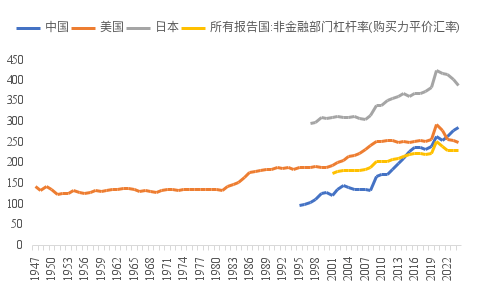
Group 1 - The global macro leverage ratio has been continuously increasing, primarily driven by government leverage, with total global debt exceeding 350% of GDP [2][5][6] - Major economies like the US, Japan, and China have shown a trend of increasing government leverage while corporate and household leverage remains stable or decreases [5][12][41] - The US government debt interest payments are projected to exceed $1 trillion for the first time, highlighting the growing fiscal pressure [41][42] Group 2 - The structure of leverage in major economies indicates that government departments are increasing their debt levels, while businesses and households are more cautious [5][9][12] - Japan's government has maintained a high leverage ratio, yet its economy has struggled with long-term stagnation despite significant fiscal stimulus [9][12][41] - China's government leverage has risen rapidly post-pandemic, contrasting with the declining leverage in many developed countries [12][35][41] Group 3 - The increasing reliance on debt to stimulate economic growth raises concerns about the sustainability of this model, as investment returns decline [45][46] - The need for effective fiscal policy is emphasized, with suggestions for improving the efficiency of government spending and addressing social welfare needs [57][58][59] - The demographic challenges, particularly aging populations, are driving up social security expenditures, necessitating higher government spending [33][35][41]

关于年内利率走势的展望分析
Sou Hu Cai Jing· 2025-09-23 03:09
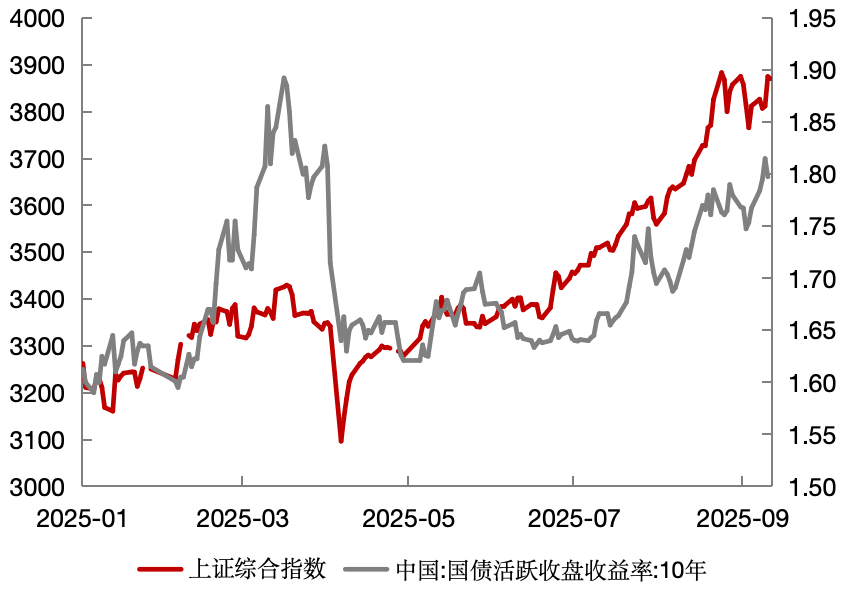
Group 1 - The bond market is currently in a chaotic phase, influenced by weak fundamentals and strong risk appetite, with expectations of two phases in market performance for the remainder of the year [1][2] - The first phase, from mid-September to October, is expected to see a recovery in the bond market, with the 10-year government bond yield potentially peaking around 1.85% [1][25] - The second phase, from November to mid-December, may see an increase in policy expectations, with the yield center likely to rise, potentially reaching a high of around 1.9% [1][26] Group 2 - Bond yields have fluctuated, with the 10-year government bond yield rising from 1.65% at the end of June to above 1.81%, before retreating to 1.79% by September 12 [2] - The "stock-bond seesaw" effect has been observed, where rising stock market performance leads to increased bond yields, as seen with the Shanghai Composite Index rising from 3440 to above 3880 [2][4] - The macroeconomic environment shows limited changes, with GDP growth in the first half of the year at 5.3%, but subsequent months showing weaker consumption and investment data [2][3] Group 3 - Monetary policy remains moderately accommodative, with potential for further interest rate cuts following the Federal Reserve's recent rate reduction [3] - Institutional behavior is impacting the bond market, with banks and insurance companies showing varied levels of bond purchasing activity [13][14][15] - Recent regulatory changes regarding fund sales fees are expected to increase redemption pressures on bond funds, potentially leading to higher bond yields [19][20] Group 4 - Historical analysis indicates that previous "stock-bond seesaw" phases have led to significant movements in both markets, with the current phase expected to be less impactful than past occurrences [7][9] - The bond market's sensitivity to stock market movements is anticipated to weaken, with the bond market's performance becoming less reactive to stock price changes [10][26] - The overall bond market is expected to maintain a stable yield environment, with predictions of slight fluctuations in the coming months [22][25]
迈向中等发达国家:“十四五”经济回顾与“十五五”增长目标测算
Hua Xia Shi Bao· 2025-09-22 09:25
Group 1 - The "14th Five-Year Plan" period (2021-2025) has shown strong resilience in China's macroeconomic performance despite facing complex internal and external challenges, with nominal GDP expected to exceed 140 trillion yuan by the end of this period, an increase of over 35 trillion yuan compared to the end of the "13th Five-Year Plan" [3][4][5] - During the first four years of the "14th Five-Year Plan," China's GDP experienced an average annual real growth rate of 5.5% and a nominal growth rate of 6.9%, with the nominal GDP growth rate projected to be around 4.5% for the entire year of 2025 [3][5][6] - The economic growth achievements during the "14th Five-Year Plan" have laid a solid material foundation for modernizing the economy and have provided strong support for stabilizing employment and improving people's livelihoods [4][5] Group 2 - The "15th Five-Year Plan" period (2026-2030) is crucial for achieving the strategic vision of reaching a per capita GDP level of a moderately developed country by 2035, with a minimum nominal GDP average growth rate requirement of 5% [9][10][14] - The core guiding principle for economic growth in the "15th Five-Year Plan" is to achieve a per capita GDP of 27,000 USD by 2035, reflecting a shift from focusing on total GDP growth to per capita income improvement [10][12][14] - To meet the 2035 target, the nominal GDP growth rate during the "15th Five-Year Plan" should ideally be around 6%, with a minimum requirement of 5%, depending on factors such as actual GDP growth, price levels, and exchange rate fluctuations [14][16][18] Group 3 - The "15th Five-Year Plan" should consider setting clear economic growth targets to address demand insufficiency and promote supply-demand balance, which is essential for achieving full employment and improving living standards [19][20] - A comprehensive target system around nominal GDP growth should be established, including a core target of 5% nominal GDP growth and 4.8% real GDP growth, alongside specific goals for consumption and investment growth [21][22][23] - Policies should focus on expanding domestic demand, particularly through boosting consumption and stabilizing infrastructure investment, to ensure necessary growth rates are met [23][25][26]

周周芝道 - 中国股债的位置
2025-09-22 01:00
Summary of Key Points from the Conference Call Industry or Company Involved - The discussion primarily revolves around the **Chinese economy** and its financial markets, including stock and bond markets, as well as the impact of **U.S. monetary policy** on global markets. Core Points and Arguments 1. **Contradictory Economic Signals in China**: August economic data shows mixed signals with manufacturing PMI slightly improving but still below the threshold, while export growth has declined from 7.1% in July to 4.4% in August. Social financing growth has also decreased from 9% to 8.8%, while M1 growth increased from 5.6% to 6% [3][4][5]. 2. **Current Market Conditions**: The Chinese stock market is performing well, while the bond market is weaker. The overall economic fundamentals remain stable, but fiscal conditions are cooling, leading to weaker consumption [5][10]. 3. **U.S. Federal Reserve's Monetary Policy**: The Fed is expected to implement two more rate cuts this year and continue easing in 2026, indicating a small cyclical recession in the U.S. and a clear path for monetary easing [2][7][23]. 4. **Divergence in Financial and Price Indicators**: There is a notable divergence between financial indicators, such as declining social financing growth and rising M1 growth, alongside improvements in PPI and core CPI. This reflects different levels of economic activity [8][17]. 5. **Fiscal Policy Outlook**: The likelihood of increased fiscal policy measures is low due to better-than-expected export data. The government is expected to focus on long-term planning rather than immediate fiscal stimulus [9][12][15]. 6. **Internal vs. External Demand**: Internal demand in China is still in a testing phase, while external demand is performing better than expected. This indicates that despite some weak economic data, the overall macro trend has not changed significantly [6][20]. 7. **PMI and Export Performance**: The PMI data reflects a mixed performance among different-sized enterprises, with large and medium enterprises showing better conditions compared to small enterprises. This has led to a strong overall export performance despite the weak PMI [11][19]. 8. **Impact of External Environment on Bond Market**: The strong performance of exports has prevented a hard landing for the Chinese economy, which has implications for bond yields, keeping the 10-year government bond yield above 1.5% [25]. 9. **Long-term Fiscal Strategy**: The shift in fiscal policy reflects a focus on long-term goals rather than short-term stimulus, with a significant amount of fiscal resources used in the first half of the year and a more cautious approach in the second half [26]. Other Important but Possibly Overlooked Content 1. **Complex Economic Cycle**: The current economic cycle is complex, necessitating a reevaluation of stock and bond positions [4]. 2. **Global Economic Context**: The discussion emphasizes the importance of global economic conditions, particularly the U.S. monetary policy, in shaping the outlook for the Chinese economy and its financial markets [21][24]. 3. **Need for Caution in Policy Decisions**: The potential for increased volatility in capital markets due to aggressive monetary easing in China is highlighted, suggesting a need for careful consideration of policy measures [22].
市场动态:经济指标提升,基金表现分化
Sou Hu Cai Jing· 2025-09-21 12:02
Market Overview - Major stock indices showed a mixed performance, with Shenzhen ETFs significantly outperforming Shanghai ETFs. The Shanghai Composite 50 ETF fell by 1.9%, while the CSI 300 ETF declined by 0.37%. In contrast, the CSI 500 ETF and ChiNext ETF rose by 0.26% and 2.24%, respectively [1] - As of September 18, the financing balance of the Shanghai and Shenzhen stock markets reached 2.38576 trillion yuan, an increase of 2.18% from the previous week. The margin balance also rose to 16.706 billion yuan, up by 0.59% [1] - Implied volatility for several major ETFs increased, indicating rising investor expectations for future market fluctuations. The implied volatility for the Shanghai Composite 50 ETF was 19.06%, for the CSI 300 ETF it was 19.68%, and for the ChiNext ETF it reached 38.75% [1] Economic Indicators - In the first eight months of the year, China's general public budget revenue reached 14.82 trillion yuan, a year-on-year increase of 0.3%. Tax revenue was 12.11 trillion yuan, showing a slight increase of 0.02%, marking the first positive growth in tax revenue this year [2] - Industrial value-added in August grew by 5.2% year-on-year, while the service production index increased by 5.6%. Retail sales of consumer goods rose by 3.4% year-on-year [2] - Fixed asset investment from January to August grew by 0.5%, with manufacturing investment increasing by 5.1%, while real estate development investment saw a decline of 12.9% [2] Policy Developments - Nine departments jointly released policies aimed at expanding service consumption, proposing 19 specific measures, with 8 focused on enhancing "high-quality service supply" [2] - The government plans to select 50 pilot cities for new consumption formats and models, promoting the integration of accommodation, railways, and tourism, while also enhancing the application of artificial intelligence in service consumption [2] International Context - The Federal Reserve lowered the benchmark interest rate by 25 basis points, bringing the current rate to a range of 4.00%-4.25%. This marks the first rate cut of the year and comes after a nine-month hiatus [3] - Initial jobless claims in the U.S. fell to 231,000, marking the largest decline in nearly four years, with market expectations set at 240,000 [3] Market Outlook - Following last week's pullback, the A-share market is showing an upward trend, with optimistic market sentiment. However, the volatility index for major ETF options has generally declined, indicating potential adjustment risks [4] - Domestic CPI and PPI growth rates improved month-on-month, but year-on-year growth remains in negative territory, suggesting ongoing deflationary pressures [4] - The expectation of more proactive fiscal and monetary policies is anticipated to support the economy, especially in light of the Fed's confirmed rate cut [4]
申万宏源赵伟:财政“下半场”,可能的“后手”?
智通财经网· 2025-09-20 12:13
Group 1 - The fiscal "front-loading" in the first half of 2025 provided significant support to the economy, with broad fiscal expenditure growth reaching 8.9%, surpassing the nominal GDP growth of 4.3% [1][2] - The funding sources for fiscal support primarily relied on government debt and carryover funds, with a record fiscal deficit of -5.3 trillion yuan in June [1] - Key areas of fiscal expenditure included social security and employment, which saw a year-on-year increase of 9.2%, and scientific and technological spending, which grew by 9.1% compared to the previous year [1] Group 2 - The consumption sector showed a cumulative year-on-year growth of 5% in retail sales, with significant increases in "trade-in" related goods such as home appliances and communication equipment, contributing 52% to GDP growth [2] - Manufacturing investment grew by 7.5% in the first half of the year, benefiting from subsidies for equipment updates and fiscal support for cultural and sports activities [2] Group 3 - There is a potential need for increased fiscal measures in the second half of 2025 if economic pressures become evident, with the goal of achieving the annual economic target [3] - The broad fiscal deficit in July was -5.6 trillion yuan, indicating a slight increase from June, while the issuance of new government debt is nearing its end [3] Group 4 - If fiscal measures are increased, two categories of tools may be utilized: incremental policies that do not require budget adjustments and new government debt limits that require approval from the National People's Congress [4] - Historical context shows that significant budget adjustments have been rare, with the last major adjustment occurring in October 2023 [4] Group 5 - The current fiscal focus is on risk prevention, transformation promotion, livelihood protection, and consumption stimulation, with a particular emphasis on addressing hidden debt issues [5] - The government is prioritizing support for emerging industries and services, as well as enhancing service sector openness to stimulate consumption and trade [5] - Specific initiatives include a child-rearing subsidy program with a budget of approximately 90 billion yuan, aimed at enhancing consumer spending [5][6]

热点思考 | 财政“下半场”,可能的“后手”?(申万宏观·赵伟团队)
赵伟宏观探索· 2025-09-20 07:13
Group 1 - The core viewpoint of the article emphasizes the significant role of fiscal policy in supporting economic resilience in the first half of 2025, with a broad fiscal expenditure growth rate of 8.9%, surpassing the nominal GDP growth rate of 4.3% [3][10] - Fiscal expenditures in the first half of 2025 showed a front-loaded rhythm and differentiated allocation, with a focus on debt resolution and rapid implementation of special refinancing bonds, amounting to nearly 1.8 trillion yuan [3][22] - Key areas of fiscal support included social security and employment, with expenditures increasing by 9.2% year-on-year, and scientific and technological spending rising by 9.1% compared to the same period in 2024 [3][22] Group 2 - The necessity and possibility of increasing fiscal measures in the second half of 2025 are highlighted, especially if economic pressures become evident, with potential adjustments to fiscal policies to meet annual GDP targets [5][40] - The article discusses two categories of fiscal tools for potential increases: one involving incremental policies that do not require budget adjustments, and another involving new government debt limits that require approval from the National People's Congress [6][68] - Historical context is provided regarding past adjustments to fiscal budgets, indicating that significant changes have occurred infrequently, with the last major adjustment in October 2023 involving an additional 1 trillion yuan in government bonds [6][68] Group 3 - Current fiscal priorities are identified as risk prevention, transformation promotion, livelihood protection, and consumption stimulation, with a focus on addressing hidden debt issues at the local government level [7][74] - The article notes that new emerging industries and service sector development are key areas of support, as indicated by recent political meetings emphasizing new pillar industries and increased openness in the service sector [7][81] - Specific fiscal measures include the establishment of a childcare subsidy fund with an initial budget of approximately 90 billion yuan, aimed at supporting families with children [7][89]

中国别无他路?美国官宣降息,中国要不要跟?
Sou Hu Cai Jing· 2025-09-19 09:55
Core Viewpoint - The Federal Reserve's interest rate cut is not just about the decision itself, but rather the complexities surrounding how to implement it effectively in the current economic climate [1][3]. Decision-Making Core - The Fed's decision to cut rates by 25 basis points aligns with market expectations, indicating a shift in focus from whether to cut rates to how to do so, considering inflation pressures and employment conditions [3][5]. - Powell's cautious approach reflects a balance between multiple economic objectives, showcasing the intricacies of modern central banking [3][5]. Subtle Game - The voting outcome of 11 to 1 for the rate cut, with one dissenting vote from Milan, highlights underlying tensions, particularly given Milan's ties to Trump and his call for a more aggressive 50 basis point cut [7][9]. - Powell's comments on tariffs and inflation suggest concerns about trade policies potentially leading to suppressed inflation, indicating a nuanced understanding of the current economic landscape [7][9]. Global Ripple Effects - The U.S. rate cut opens a significant window for China's monetary policy, alleviating previous pressures from widening interest rate differentials that hampered the effectiveness of China's easing measures [11][13]. - China's economic indicators show underperformance, reinforcing the need for policy easing, while the central bank is expected to manage the yuan's exchange rate carefully to support exports [13][18]. Future Outlook - The Fed is navigating an unprecedented policy environment, relying heavily on data to guide decisions, which introduces a level of unpredictability for market participants [15][17]. - Political factors, including Trump's potential influence on future Fed leadership, may pose risks to the independence of monetary policy [17][18].