
适度宽松的货币政策

Search documents
银行业季度观察报(2025年第1期)
Lian He Zi Xin· 2025-10-15 11:10
Investment Rating - The report maintains a stable outlook for the banking industry, indicating a cautious but positive investment environment for the sector in the first half of 2025 [4][24]. Core Insights - The banking sector in China has shown stable development in the first half of 2025, with credit asset quality remaining stable and sufficient provisions and capital levels [4][30]. - The net interest margin of commercial banks has continued to decline, but the rate of decline has slowed, posing challenges to profitability [7][33]. - The People's Bank of China is expected to implement moderately accommodative monetary policies, which will help maintain liquidity in the banking system [6][24]. Industry Data Summary - As of the second quarter of 2025, the non-performing loan (NPL) ratio was 1.49%, a slight decrease from the previous year, while the ratio of loans under special attention was 2.17% [30]. - The total assets of banking institutions reached 467.34 trillion yuan, with a year-on-year growth of 5.12% [26]. - The capital adequacy ratio for commercial banks was 15.58%, slightly down from the previous year, but still indicating a sufficient capital level [34]. Regulatory Policies Summary - The People's Bank of China has introduced various monetary policy measures to stabilize the economy, including a reduction in the reserve requirement ratio by 0.5 percentage points, releasing approximately 1 trillion yuan in long-term liquidity [24][25]. - New regulations have been implemented to enhance the management of internet lending and improve the quality of financial services [10][11]. Bond Issuance Statistics - In the first half of 2025, 44 domestic commercial banks issued 83 financial bonds, raising a total of 512.9 billion yuan, a significant increase of 65.26% compared to the same period in 2024 [16][17]. - The issuance of technology innovation bonds by 21 commercial banks totaled 200.1 billion yuan, reflecting a growing trend in supporting technological advancements [16][17]. Credit Quality Analysis - The report highlights that while the asset quality of commercial banks remains stable, there are concerns regarding the potential downward pressure on credit quality due to external trade uncertainties and a sluggish real estate market [7][30]. - The provisioning coverage ratio for non-performing loans was reported at 211.97%, indicating a robust buffer against potential loan losses [30].
降准新信号!央行,今日大动作!
Sou Hu Cai Jing· 2025-10-09 07:46
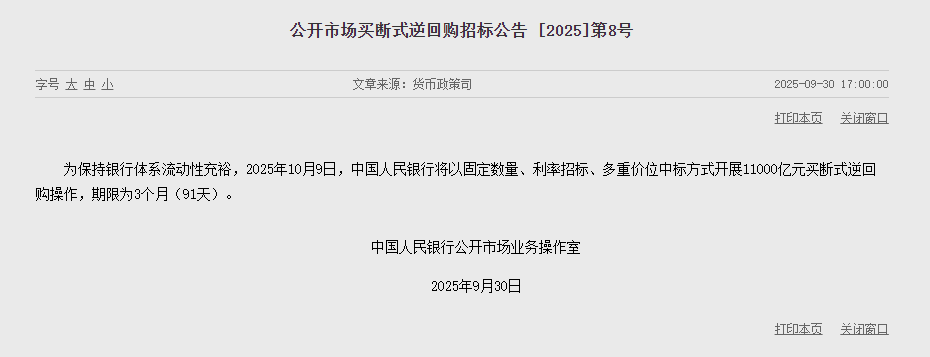
据中国人民银行(以下简称央行)官网消息,为保持银行体系流动性充裕,2025年10月9日, 央行将以固定数量、利率招标、多重 价位中标方式开展11000亿元买断式逆回购操作,期限为3个月(91天)。 10月9日,中国人民银行还以固定利率、数量招标方式开展了6120亿元7天期逆回购操作,投标量6120亿元,中标量6120亿元,操作 利率1.40%,与此前持平。据Wind数据,当日逆回购到期量高达20633亿元。 | 期限 | 操作利率 | 投标量 | 中标量 | | --- | --- | --- | --- | | 7天 | 1.40% | 6120亿元 | 6120亿元 | 市场分析认为,此举旨在应对资金面收紧压力,稳定市场预期。综合来看,10月政府债券还会进行较大规模发行;9月29日,国家发 展改革委宣布,当前正在加快推进5000亿元新型政策性金融工具相关工作,预计接下来会较大幅度拉动配套贷款投放。 东方金诚首席宏观分析师王青称,10月将有8000亿元3个月期买断式逆回购到期,由此央行10月9日开展11000亿元买断式逆回购操 作,意味着10月3个月期买断式逆回购加量续作3000亿元。此外,10月还有500 ...

央行再提“适度宽松”,节后会降息降准吗?
Sou Hu Cai Jing· 2025-09-30 09:20
Core Viewpoint - The People's Bank of China (PBOC) emphasizes the implementation of a moderately accommodative monetary policy, reflecting a shift from aggressive easing to a focus on policy execution and stability in response to current economic conditions [1][3][4]. Monetary Policy Adjustments - The PBOC has lowered the policy interest rate by 10 basis points, leading to a corresponding decrease in the 1-year and 5-year Loan Prime Rate (LPR) by 10 basis points, and has also reduced the deposit rate [1][4]. - The PBOC has cut the relending rate to 1.5% and lowered the reserve requirement ratio by 50 basis points [1]. Economic Context - The latest statements from the PBOC indicate a more cautious approach, removing references to significant economic risks and challenges, and instead focusing on maintaining policy continuity and flexibility [3][4]. - The emphasis on supporting financing for small and micro enterprises and stabilizing foreign trade reflects concerns over potential impacts from U.S. tariff policies [3]. Future Outlook - Analysts suggest that while there may still be room for further interest rate cuts in the fourth quarter, the likelihood of aggressive easing is low given the current economic conditions and the stability of the LPR [4][5]. - The PBOC's current stance is supportive, aiming to create a favorable monetary environment for economic recovery and financial market stability [5][6]. Market Reactions - The market has shown a relatively stable response to the recent U.S. Federal Reserve rate cut, indicating that the PBOC's approach is focused on domestic conditions rather than external influences [1][5]. - There is a consensus among analysts that the priority for the PBOC in the fourth quarter will be economic growth and employment, with potential for further monetary easing if necessary [7].

市场全天震荡攀升,三大指数集体上涨
Dongguan Securities· 2025-09-29 23:31
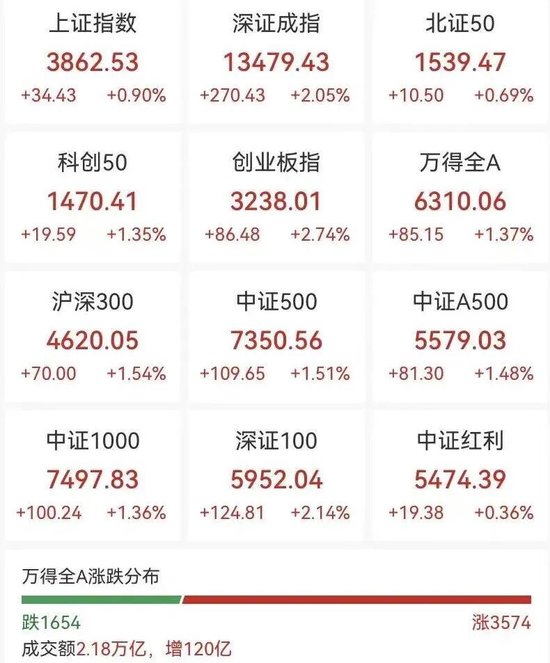
Market Overview - The A-share market experienced a day of oscillating gains, with all three major indices rising collectively. The Shanghai Composite Index closed at 3862.53, up 0.90%, while the Shenzhen Component Index rose by 2.05% to 13479.43, and the ChiNext Index increased by 2.74% to 3238.01 [1][3][5]. Sector Performance - The top-performing sectors included non-bank financials, which rose by 3.84%, and non-ferrous metals, which increased by 3.78%. Other notable sectors were electric power equipment (3.07%), steel (2.49%), and comprehensive sectors (1.82%). Conversely, coal and banking sectors saw declines of -0.84% and -0.46%, respectively [2][3]. Market Outlook - The market is expected to maintain a strong upward trend, driven by multiple positive factors. The focus will shift from pre-holiday policy expectations to post-holiday economic performance, with attention on high-frequency economic data such as the official PMI for September and consumption metrics during the holiday period [5]. Financial Policy Insights - The People's Bank of China emphasized the need for a moderately loose monetary policy to guide financial institutions in increasing credit supply. This includes utilizing securities, funds, and insurance company swap facilities to stabilize the capital market [4]. Trading Volume and External Influences - The trading volume in the Shanghai and Shenzhen markets reached 2.16 trillion yuan, an increase of 146 billion yuan from the previous trading day. Additionally, U.S. inflation data indicated a year-on-year increase of 2.7% in the PCE price index, which aligns with market expectations and has bolstered confidence in potential interest rate cuts by the Federal Reserve [5]. Investment Recommendations - It is suggested to focus on sectors such as technology growth, new energy, non-bank financials, and mechanical equipment for potential investment opportunities [5].
央行三季度货政例会:促进经济稳定增长和物价处于合理水平
Zhong Guo Jing Ying Bao· 2025-09-29 14:43
Core Viewpoint - The People's Bank of China (PBOC) emphasizes the need for a proactive monetary policy to promote stable economic growth and maintain reasonable price levels, reflecting a more nuanced understanding of the current economic challenges [1][2]. Group 1: Monetary Policy Direction - The PBOC's recent meeting indicates a shift from "maintaining" to "promoting" economic stability, highlighting a more active approach to monetary policy [1][2]. - The meeting introduced a new requirement to "ensure the effective implementation of various monetary policy measures," indicating a focus on the execution of existing tools [2][3]. Group 2: Structural Monetary Policy Tools - The meeting reiterated the importance of structural monetary policy tools, particularly in supporting small and micro enterprises and stabilizing foreign trade [4]. - The emphasis on financing support for key areas such as technology innovation, consumption, and small businesses is crucial, especially in light of potential impacts from U.S. tariffs on Chinese exports [4]. Group 3: Future Outlook - The expectation for the fourth quarter is to maintain a moderately loose monetary policy stance, with decisions on rate cuts or reserve requirement ratio adjustments to be based on comprehensive assessments of economic performance and external conditions [4].

央行建议下阶段抓好各项货币政策措施执行
Mei Ri Jing Ji Xin Wen· 2025-09-29 14:03
Core Viewpoint - The People's Bank of China (PBOC) emphasizes the need for effective implementation of monetary policy measures to enhance their impact, focusing on the use of existing tools rather than introducing new ones [1][2]. Monetary Policy Strategy - The third quarter meeting highlighted the importance of maintaining a moderately loose monetary policy, with a shift from "maintaining" to "promoting" stable economic growth and reasonable price levels [2]. - The meeting introduced a new focus on executing various monetary policy measures to fully release their effects, indicating a greater emphasis on the utilization of existing tools [2][3]. Financial Market Stability - The PBOC aims to guide large banks in supporting the real economy while encouraging small and medium-sized banks to enhance their capital strength, thereby maintaining financial market stability [3]. - Structural monetary policy tools are to be effectively implemented to support key areas such as technological innovation, consumption, small and micro enterprises, and stabilizing foreign trade [3]. Current Monetary Policy Effectiveness - As of the end of August, the total social financing stock reached 433.66 trillion yuan, with a year-on-year growth of 8.8%, slightly higher than the previous year [2]. - The growth rates of M2 and social financing remain between 8% and 9%, aligning with economic growth and price level expectations, reflecting a moderately loose monetary policy stance [2]. Future Outlook - The PBOC plans to utilize a variety of monetary policy tools based on macroeconomic conditions and changes in the economic landscape [4].
中国在世贸组织谈判中不寻求新特殊和差别待遇;央行:金融体制改革进一步深化|每周金融评论(2025.9.22-2025.9.28)
清华金融评论· 2025-09-29 11:36
Core Viewpoint - The article discusses China's commitment to global development and financial reforms, emphasizing the importance of creating a stable international environment and enhancing cooperation in various sectors, including finance and investment [5][6]. Group 1: Major Policies - The People's Bank of China (PBOC), the China Securities Regulatory Commission (CSRC), and the State Administration of Foreign Exchange (SAFE) jointly issued an announcement to further support foreign institutional investors in conducting bond repurchase transactions [9]. - The PBOC's monetary policy committee emphasized the need for a moderately loose monetary policy to maintain ample liquidity in the market [10]. - In August, China's foreign exchange market recorded a total transaction volume of 24.08 trillion yuan (approximately 3.38 trillion USD) [12]. - In August, profits of large-scale industrial enterprises in China surged by 20.4% year-on-year, marking a significant rebound compared to a decline of 1.5% in the previous month [12][14]. Group 2: Financial System Reform - The PBOC's Governor highlighted the deepening of financial system reforms, which have positively impacted market confidence and stability, optimized resource allocation, and enhanced international competitiveness [7]. - The PBOC's recent meeting indicated a shift in monetary policy focus from "implementation" to "enforcement," reflecting a stronger commitment to economic stability and reasonable price levels [11]. Group 3: Investment and Economic Development - The National Development and Reform Commission (NDRC) is working to enhance the synergy between industrial, investment, fiscal, and financial policies to stimulate private investment and promote economic growth [8]. - The article notes that private investment is a crucial indicator of economic activity and has been supported by the government through improved business environments and opportunities for private enterprises [8].

A50拉升,牛市旗手大爆发,外资密集看多A股
2 1 Shi Ji Jing Ji Bao Dao· 2025-09-29 07:43
Market Performance - On September 29, A-shares experienced a significant rally, with the Shanghai Composite Index rising by 0.90%, the Shenzhen Component Index increasing by 2.05%, and the ChiNext Index climbing by 2.74% [1][2] - The total trading volume reached 2.18 trillion yuan, with over 3,500 stocks advancing [1][2] Sector Performance - The financial sector, particularly brokerage firms, saw substantial gains, with stocks like GF Securities, Huatai Securities, and Guosheng Financial hitting the daily limit [4][5] - The gold and precious metals sector also surged, with international gold prices reaching a new high of over $3,815 per ounce, marking a year-to-date increase of approximately 45% [8][10] Foreign Investment Trends - Foreign investors have shown a bullish stance, with significant inflows into products tracking Chinese stocks and bonds, amounting to $1 billion by the end of August [7] - Over 90% of clients expressed interest in increasing exposure to Chinese markets during recent roadshows, indicating a strong recovery in foreign interest [7] Regulatory and Industry Developments - The central bank emphasized the need for a moderately loose monetary policy to support financial institutions in increasing credit supply, which is expected to stabilize the capital market [6] - The brokerage industry is undergoing accelerated consolidation, with several merger proposals in progress, potentially increasing the concentration of leading firms [6] Gold Market Insights - The rise in gold prices is attributed to lower opportunity costs due to interest rate cuts and a weaker dollar, alongside heightened geopolitical tensions in the Middle East [10]





A50拉升,牛市旗手大爆发,外资密集看多A股
21世纪经济报道· 2025-09-29 07:38
Market Overview - On September 29, A-shares experienced a significant rally, with the Shanghai Composite Index rising by 0.90%, the Shenzhen Component Index increasing by 2.05%, and the ChiNext Index climbing by 2.74% [1][2] - The total trading volume reached 2.18 trillion yuan, with over 3,500 stocks gaining [1][2] Sector Performance - The financial sector, particularly brokerage firms, saw substantial gains, with stocks like GF Securities, Huatai Securities, and Guosheng Financial hitting the daily limit [5][6] - The gold and precious metals sector also surged, with international gold prices reaching new highs, surpassing $3,815 per ounce, marking a year-to-date increase of approximately 45% [10][11] Foreign Investment Trends - Foreign investors have shown a bullish stance, with significant inflows into products tracking Chinese stocks and bonds, amounting to $1 billion by the end of August [8] - A recent survey indicated that over 90% of clients expressed a willingness to increase exposure to Chinese markets, the highest interest level since early 2021 [8] Brokerage Sector Developments - The brokerage industry is undergoing accelerated consolidation, with several mergers and acquisitions in progress, which may enhance the concentration of leading firms [8] - Analysts predict that the third-quarter performance of brokerages will show significant year-on-year growth due to increased trading activity and margin financing [9] Gold Market Insights - The rise in gold prices is attributed to lower opportunity costs for holding gold due to interest rate cuts and a weaker dollar, alongside heightened geopolitical tensions in the Middle East [10]

一周流动性观察 | 央行维持呵护投放 跨季窗口下资金利率跳升的概率不大
Xin Hua Cai Jing· 2025-09-29 07:22
Group 1 - The People's Bank of China (PBOC) conducted a 7-day reverse repurchase operation of 288.6 billion yuan at an interest rate of 1.40%, maintaining the previous rate, resulting in a net injection of 48.1 billion yuan after 240.5 billion yuan of reverse repos matured on the same day [1] - Last week, the PBOC's net injection in the open market was 640.6 billion yuan, with a net injection of 300 billion yuan through Medium-term Lending Facility (MLF) [1] - The liquidity situation shifted from loose to tight, with overnight funding rates rising from 1.46% to 1.52% and 7-day funding rates increasing significantly from 1.52% to 1.80% [1] Group 2 - The upcoming week will see a decrease in the scale of reverse repos maturing to 516.6 billion yuan, while government bond net payments will rise to 192.7 billion yuan, primarily concentrated on Monday [2] - Despite the approaching quarter-end, the current pace of institutions in crossing the quarter is relatively fast, and the limited scale of government bond payments and reverse repos maturing suggests that liquidity fluctuations will likely be limited [2] - Analysts expect that the funding environment will likely return to a loose state after the "Double Festival" holiday, supported by high fiscal spending levels typically seen at quarter-end [2] Group 3 - The PBOC's monetary policy committee recently shifted its focus from "implementing a moderately loose monetary policy" to "refining the implementation of a moderately loose monetary policy," emphasizing the execution of monetary policy measures [3] - The new policy direction includes support for small and micro enterprises and stabilizing foreign trade, while maintaining support for technology innovation and consumption [3] - Although there was no mention of interest rate cuts or reserve requirement ratio reductions, the monetary policy stance remains "moderately loose," with expectations for potential fiscal stimulus in the fourth quarter [3] Group 4 - Analysts predict that the PBOC will enhance liquidity in the interbank market through measures such as reserve requirement ratio cuts or increasing the volume of monetary policy tools [4] - Following the capital increase of four major state-owned banks, other types of banks are also expected to focus on capital replenishment [4]