
地缘政治

Search documents
国泰君安期货能源化工短纤、瓶片周度报告-20260201
Guo Tai Jun An Qi Huo· 2026-02-01 10:38
国泰君安期货·能源化工 短纤、瓶片周度报告 国泰君安期货研究所 钱嘉寅 投资咨询从业资格号:Z0023476 贺晓勤 投资咨询从业资格号:Z0017709 日期:2026年2月1日 Guotai Junan Futures all rights reserved, please do not reprint Special report on Guotai Junan Futures 瓶片(PR) 短纤:短期震荡市,中期偏弱 估值与利润 基本面运行情况 供需平衡表 03 短纤(PF) 估值与利润 基本面运行情况 CONTENTS 01 观点小结 上游观点汇总 瓶片:震荡偏弱 2 02 观点小结 01 本周短纤观点:高位震荡,控制仓位 供应 短纤工厂开始集中检修,平均负荷降低至85.3%,低熔点及中空短纤方面减停力度较大,棉型相对较小。 需求 终端开工率加速下行,以农历时间对比略早于往年。在原料快速上涨过程中,纱线、坯布价格跟涨不及,下游一方面担心年后价格上涨,另一 方面受制于利润,小幅补年前的库存为主。纱线、坯布环节的成品库存下降。出口订单环比好转,主要由于当前至美国的关税较东南亚无显著 劣势。短纤库存低位, ...
高盛交易员:大逻辑没有变化,不要"过度解读"过去两天的暴跌,尤其要考虑1月大涨
华尔街见闻· 2026-02-01 10:01
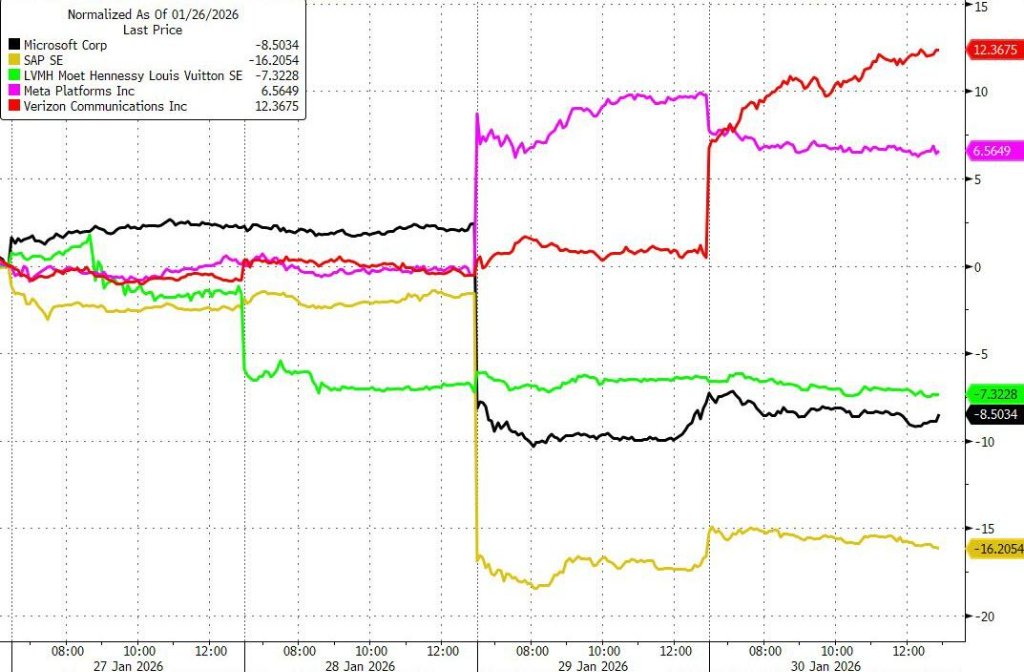
市场在本周创下多项极端纪录,微软遭遇史上第二大单日市值损失,SAP暴跌16%,白银单日重挫30%…… 高盛交易部门负责人Mark Wilson表示,尽管市场近期出现剧烈波动,但投资者不应过度解读这场"持仓清洗",因为 年初至今推动市场的核心驱动因素并未发 生实质性改变。 Wilson在周度报告中指出,评估此次调整的严重程度时, 应将其与1月以来的涨幅相提并论。 他强调,美元走势延续、AI投资热情不减、美国经济增长势头强 劲以及地缘政治重塑等关键变量均未改变。年初至今的市场表现依然反映这些核心趋势——稀土涨35%,核能股涨21%,欧洲防务涨20%。 这场调整的直接诱因是投资者持仓过度拥挤。 总敞口已处于99百分位数的极端水平,系统化量化策略的表现显示拥挤度成为突出问题。Wilson认为,此次快速 回调更多是技术性调整,而非基本面逻辑的转变。 市场本周的波动幅度令人瞠目。 微软单日下跌10%,遭遇史上第二大市值损失,但同时创下有史以来最高的名义成交额。SAP暴跌16%,同样伴随创纪录的交易量。涨幅方面同样惊人,Meta 上涨10%,Verizon飙升11%。 贵金属市场的波动更为极端。白银单日暴跌30%,SLV ...





美债风险因素逐步明朗
Bank of China Securities· 2026-02-01 07:33
Report Industry Investment Rating - The document does not provide the industry investment rating [1][2][4] Core Viewpoints of the Report - The US interest rate cut cycle is not over. After the current risk factors are released, the US Treasury market may return to the downward trend of yields [2][4][15] - China's bond market also needs to pay attention to the performance of technology stocks. Whether the performance growth of technology stocks can support their valuations will have an important impact on the bond market through factors such as stock - bond linkage and the flow of household savings [4][15] Summary by Relevant Catalogs High - frequency Data Panoramic Scan - Some important risk factors in the US Treasury market in the first quarter are gradually becoming clear. The next Fed chair nominee, tariff case alternatives, the Cook case, geopolitical factors, and technology stock performance are the main observation points [4][12][13] - The performance of technology stocks in the US may continue to drive economic growth, but has limited impact on overall employment, which in turn affects inflation through the salary channel [4][15] - In the week of January 30th, the average wholesale price of pork increased by 0.89% week - on - week, the average wholesale price of 28 key monitored vegetables decreased by 0.74% week - on - week, and the edible agricultural products price index increased by 0.90% week - on - week in the week of January 23rd [4][19] - In the week of January 30th, the domestic cement price index decreased by 1.03% week - on - week, the Nanhua iron ore index decreased by 0.09% week - on - week on average, the operating rate of coking enterprises with a capacity of over 2 million tons increased by 0.26% week - on - week, the rebar inventory index increased by 7.73% week - on - week, the rebar price index decreased by 0.18% week - on - week, and the blast furnace operating rate of 247 domestic steel mills increased by 0.46% week - on - week. The producer price index decreased by 0.40% week - on - week in the week of January 23rd [4][19] - In the week of January 30th, the average prices of Brent and WTI crude oil futures increased by 5.84% and 5.38% week - on - week respectively. The average price of LME copper spot increased by 2.90% week - on - week, the average price of aluminum spot increased by 2.32% week - on - week, and the copper - gold ratio decreased by 4.21% week - on - week [4][19] High - frequency Data and Important Macroeconomic Indicators Trend Comparison - The document shows multiple charts comparing high - frequency data with important macroeconomic indicators, such as the year - on - year change of the RJ/CRB price index and the year - on - year change of export volume, the year - on - year change of the producer price index and the year - on - year change of PPI for industrial products [25][27][30] Important High - frequency Indicators in the US, Europe and Japan - The document shows charts of the US weekly economic indicators and actual economic growth rate, the number of initial jobless claims and the unemployment rate in the US, the same - store sales growth rate and PCE year - on - year in the US, and the implied prospects of interest rate hikes/cuts by the central banks of Japan and the Eurozone in the derivatives market [90][94][96] Seasonal Trend of High - frequency Data - The document shows the seasonal trends (in terms of month - on - month increase) of various high - frequency data, including the average daily output of crude steel (decadal), producer price index, steel price index of rebar, and the blast furnace operating rate of 247 domestic steel mills [102][106][110] High - frequency Traffic Data in Beijing, Shanghai, Guangzhou and Shenzhen - The document shows the year - on - year changes in subway passenger volumes in Beijing, Shanghai, Guangzhou and Shenzhen [146][148]

油价调整谜团!1月31日,各地区92、95汽油新售价藏着啥?
Sou Hu Cai Jing· 2026-02-01 06:20
Group 1 - The international oil prices have experienced significant volatility, with WTI prices dropping from $71.71 to $59.58 in a short period, influenced by geopolitical factors and OPEC's unexpected decision to increase production [1][3] - Market sentiment has shifted, with speculative capital heavily shorting oil, leading to a tenfold increase in put option prices, creating a vicious cycle of capital withdrawal from the oil market [3] - The current oil price fluctuations are primarily driven by policy factors rather than historical events like the shale oil revolution or the pandemic-induced demand collapse [3] Group 2 - Geopolitical tensions, such as the potential blockade of the Strait of Hormuz and the ongoing Russia-Ukraine conflict, add uncertainty to oil prices, with possible scenarios leading to significant price increases or decreases [3][4] - Oil companies are facing challenges as upstream profitability is squeezed, requiring reassessment of project viability, while refining companies must balance raw material cost reductions with market demand [3] - The low oil price environment may delay the green transition for the traditional energy sector, as the cost advantages of fossil fuels could hinder investments in renewable energy [3] Group 3 - China, as the world's largest oil importer, spends over $100 billion annually on crude oil imports, and while lower oil prices can improve the international balance of payments, there are risks associated with over-reliance on external oil sources [4] - The market is divided on future oil price predictions, with some analysts suggesting a potential rebound to $70 if OPEC agrees on compensatory production cuts, while others warn of a drop to the $30-$40 range if trade tensions persist [6] - New variables, such as potential changes in the Federal Reserve's interest rate policy and geopolitical actions regarding Venezuela, are expected to influence the oil market dynamics leading into 2026 [7]

高盛交易员:大逻辑没有变化,不要"过度解读"过去两天的暴跌,尤其要考虑1月的大涨
Hua Er Jie Jian Wen· 2026-02-01 02:39
Core Viewpoint - Despite recent market volatility, the core drivers of the market have not changed significantly since the beginning of the year, according to Goldman Sachs' trading head Mark Wilson [1][5]. Market Volatility - The market experienced extreme volatility this week, with Microsoft suffering its second-largest single-day market value loss, dropping 10%, while SAP fell 16% [2]. - Silver saw a dramatic single-day drop of 30%, with the SLV ETF trading volume exceeding $32 billion, and the GLD ETF recorded over $30 billion in trading volume for two consecutive days [3][4]. Key Market Drivers - Key market drivers such as the continued strength of the dollar, sustained enthusiasm for AI investments, robust U.S. economic growth, and geopolitical shifts remain unchanged [1][6][8]. - Year-to-date market performance reflects these trends, with rare earths up 35%, nuclear stocks up 21%, and European defense stocks up 20% [8]. Investor Positioning - Investor positioning has reached extreme levels, with total exposure at the 99th percentile, indicating overcrowding in holdings [1][9]. - The semiconductor and semiconductor equipment sectors now account for 12% of hedge fund net risk exposure, up from just 1% two years ago, while the software sector has decreased from 18% to 3% [9]. Annual Core Views - Wilson maintains six core views established in December, including the notion that the AI narrative has reached a critical juncture, and the upcoming Federal Reserve chair appointment could be pivotal for the market [10][11]. - The importance of hard assets, particularly those linked to infrastructure demand, is emphasized, alongside the need for diversification in stock market investments [11]. Emerging Themes - Emerging themes include UK real estate stocks trading at over 30% discounts to net asset value, challenges for European equities amid a weakening dollar, and the significant shift in hedge fund exposure from software to semiconductors [12].
访华期间,英方人士驳斥特朗普言论
Xin Lang Cai Jing· 2026-01-31 15:24
Group 1 - UK Prime Minister Starmer emphasizes the importance of seizing business opportunities with China, highlighting it as the world's second-largest economy [1][3] - British business representatives express optimism about UK-China relations, stating there are no reasons to avoid mutually beneficial cooperation outside of national security concerns [3][6] - A recent UK-China business forum saw over 300 participants, with significant interest from British representatives in sectors like new energy, automotive, and pharmaceuticals [3][4] Group 2 - Liverpool City Council's CEO Andrew Lewis announces a partnership with Chinese automotive company Chery Commercial Vehicles, which will establish its European headquarters in Liverpool, marking a significant step in local economic development [4][5] - The collaboration in new energy and advanced manufacturing is expected to create job growth and enhance Liverpool's position in the European automotive industry [4][5] - UK clean energy company Ceres Power's chairman indicates that the visit signals a more stable and pragmatic phase in UK-China relations, which is crucial for business confidence [5][6] Group 3 - AstraZeneca plans to invest $15 billion (approximately 104.3 billion RMB) in China over the next four years, marking its largest single investment in the country to date [7] - Octopus Energy will enter the Chinese market for the first time, collaborating with Chinese company PCG Power to develop a digital platform for electricity trading [7]

原油周报:逢高止盈-20260131
Wu Kuang Qi Huo· 2026-01-31 13:56
逢高止盈 原油周报 2025/01/31 徐绍祖 (能源化工组) 从业资格号:F03115061 交易咨询号:Z0022675 严梓桑 (联系人) 0755-23375123 yanzs@wkqh.cn 从业资格号:F03149203 CONTENTS 目录 01 周度评估&策略推荐 05 原油需求 02 宏观&地缘 06 原油库存 03 油品价差 07 气象灾害 04 原油供应 08 另类数据 01 周度评估&策略推荐 行情回顾 图1:WTI主力合约近月走势($/桶) 50.0 55.0 60.0 65.0 70.0 75.0 80.0 85.0 2025/1/1 2025/1/8 2025/1/15 2025/1/22 2025/1/29 2025/2/5 2025/2/12 2025/2/19 2025/2/26 2025/3/5 2025/3/12 2025/3/19 2025/3/26 2025/4/2 2025/4/9 2025/4/16 2025/4/23 2025/4/30 2025/5/7 2025/5/14 2025/5/21 2025/5/28 2025/6/4 2025/6/11 20 ...
铜月报(2026年1月)-20260130
Zhong Hang Qi Huo· 2026-01-30 12:17
铜月报(2026年1月) 范玲 期货从业资格号:F0272984 投资咨询资格号:Z0011970 中航期货 2026-1-30 目录 01 后市研判 01 后市研判 02 行情回顾 02 行情回顾 03 宏观面 04 基本面 后市研判 PART 01 1月铜价波动加剧 1月铜价波动加剧 建议回调偏多对待 宏观面:美国就业市场弱平衡,通胀表现温和,1月份美联储按兵不动,但货币政策宽松预期不改,地缘潜在风险升级,影响全球资产情绪和资金流 动;国内方面,央行行长表示灵活高效运用降准降息等多种货币政策工具,今年降准降息还有一定的空间。 基本面来看,全球铜矿品位下降、新项目投产缓慢、资本开支不足等问题难以在短期内解决,智利、秘鲁、刚果(金)等主产区频发运营中断事件, 导致全年产量增速不及预期。铜精矿现货 TC/RC 导致全年产量增速不及预期。铜精矿现货 TC/RC 持续处于深度负值区间,冶炼端利润承 持续处于深度负值区间,冶炼端利润承 持续处于深度负值区间,冶炼端利润承压,国内冶炼厂检修影响将进一步深化。需求方面,尽管建 筑、家电等传统领域受宏观周期影响复苏缓慢,但"抢出口"政策窗口仍为出口订单提供一定支撑。整体来看 ...
沥青月报:强预期推升盘面,关注地缘局势演绎-20260130
Zhong Hang Qi Huo· 2026-01-30 12:06
Report Summary 1. Report Industry Investment Rating No information provided. 2. Core Viewpoint The current asphalt market shows a typical pattern of "strong expectations, weak reality." The upward movement of the futures market is mainly driven by the expected increase in raw material costs due to geopolitical factors, while the spot market is constrained by weak fundamentals, leading to a significant weakening of the basis. The deeply discounted structure may attract arbitrage funds, potentially bringing selling pressure to far - month contracts. The main upward driver for prices remains the cost side, and the key risk lies in the confirmation of the "weak reality" [54]. 3. Summary of Each Section According to the Table of Contents 3.1 Market Review - In January, affected by tight raw materials and strong oil prices, asphalt prices rebounded from the bottom, with a cumulative increase of 14.5% since the beginning of the year. Tensions in the Middle East and restricted imports of diluted asphalt supported the market [6]. 3.2 Macroeconomic Analysis - **Geopolitical Tensions**: The risk of intensified geopolitical tensions in the Middle East has increased, with potential impacts on the oil market. The outcome of US military intervention will determine the direction of oil prices. The Russia - Ukraine conflict continues in a pattern of "fighting while negotiating," with limited short - term direct impact on oil prices [9][10]. - **OPEC+ Policy**: OPEC+ continued to suspend production increases in January and reaffirmed the plan to suspend production increases in the first quarter. The group's crude oil production decreased month - on - month in December. The suspension of production increases provides support for oil prices [13]. - **Fed Policy**: The Fed paused interest rate cuts, but there were internal disagreements. The market expects no interest rate cuts in the next two meetings under Powell, but Trump's potential new Fed chair appointment may increase the market's expectation of rate cuts [16]. 3.3 Supply and Demand Analysis - **Supply**: In January, domestic asphalt production decreased month - on - month, and refinery operating rates also declined. If raw material imports are restricted, the cost of the industry may rise, and the operations of local refineries may be restricted [17][23]. - **Demand**: In January, domestic asphalt shipments decreased month - on - month, and the utilization rate of modified asphalt production capacity declined seasonally. The demand is expected to pick up after the Spring Festival [25][27]. - **Imports and Exports**: In December, asphalt imports decreased month - on - month with a slight decline in the average import price, while exports increased month - on - month with a slight decline in the average export price [32][37]. - **Inventory**: In January, factory inventories increased slightly, and social inventories entered a cumulative cycle. Factory inventories may face further accumulation pressure in the off - season [42][46]. - **Price Difference**: In January, the cracking spread of asphalt remained high, and the processing profit of diluted asphalt rebounded. The basis of asphalt weakened significantly under the "strong expectations, weak reality" background [50].
大越期货沪铜周报-20260130
Da Yue Qi Huo· 2026-01-30 11:54
Report Summary 1. Report Industry Investment Rating No information provided. 2. Core View Last week, Shanghai copper fluctuated at a high level, with the main contract of Shanghai copper rising 0.57% to close at 101,340 yuan/ton. Geopolitical factors and global instability supported copper prices, while domestic consumption was in the off - season with general downstream consumption willingness. The domestic spot trading was mainly for rigid demand. LME copper inventory increased significantly, and SHFE copper inventory increased by 12,422 tons to 225,937 tons. The copper market is in a tight balance in 2024 and will be in surplus in 2025 [4][11]. 3. Summary by Directory 3.1 Market Review - Last week, the main contract of Shanghai copper rose 0.57% to close at 101,340 yuan/ton. Geopolitical factors and global instability supported copper prices, and domestic consumption was in the off - season with general downstream consumption willingness. The domestic spot trading was mainly for rigid demand. LME copper inventory increased significantly, and SHFE copper inventory increased by 12,422 tons to 225,937 tons [4]. 3.2 Fundamental Analysis - **PMI**: No specific content provided. - **Supply - Demand Balance**: The copper market is in a tight balance in 2024 and will be in surplus in 2025. The Chinese annual supply - demand balance table shows the production, import, export, apparent consumption, actual consumption, and supply - demand balance from 2018 to 2024 [11][14]. - **Inventory**: Exchange inventory is in the process of destocking, and bonded area inventory remains at a low level [15][20]. 3.3 Market Structure - **Processing Fee**: The processing fee is at a low level [23]. - **CFTC Position**: CFTC non - commercial net long positions are flowing out [25]. - **Spot - Futures Price Difference**: No specific content provided. - **Import Profit**: No specific content provided. - **Warehouse Receipt**: No specific content provided.