
经济增长

Search documents
大摩邢自强最新研判:出口消费承压下市场仍活跃,杠杆可控 + 资金入市成核心底气
Zhi Tong Cai Jing· 2025-08-22 16:57
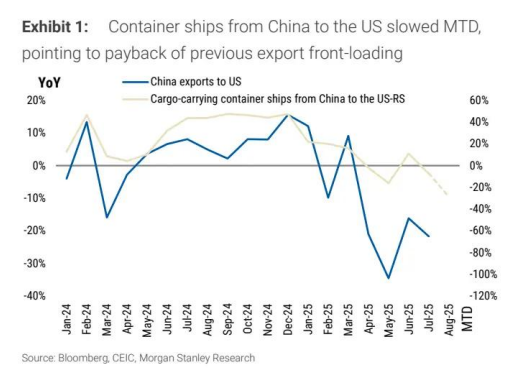
Economic Growth Observation - The economic growth in China is expected to slow down, with Morgan Stanley predicting a year-on-year growth rate of approximately 4.5% for the third quarter [2] - Export growth is anticipated to decline from 7.2% in July to 5%-6% in August due to high base effects and a pullback in pre-emptive demand [2] - Domestic consumption remains weak, particularly in the automotive and home appliance sectors, despite the central government allocating around 600 billion yuan in subsidies [4] - The real estate market's ongoing decline is contributing to a "negative wealth effect," further dampening consumer confidence [5] - Infrastructure investment has seen a slight rebound, but its sustainability is questioned due to a decrease in net financing from government bonds [6][7] Market Sentiment - Despite the economic slowdown, market sentiment in the A-share market remains resilient, supported by ample liquidity and proactive policy measures [11] - The financial environment is characterized by a shift towards capital markets, with significant inflows into offshore Chinese stocks, estimated at 15-17 trillion yuan in the first half of 2025 [13] - There is a notable shift in residents' asset allocation from savings to capital markets, as indicated by a decrease in household deposits and an increase in non-bank financial institution deposits [15] Policy Response - The Chinese government is addressing core challenges, termed the "3Ds" (de-leveraging, insufficient demand, structural transformation), with targeted policy measures [18] - Recent government meetings have emphasized the continuity of cyclical policies and the acceleration of consumer support measures to bolster domestic demand [18] Central Bank Stance - The central bank's recent monetary policy report indicates a focus on the quality of liquidity management rather than simply injecting liquidity into the market [19] - The central bank has reduced the scale of net liquidity injections since June, reflecting a recognition of the current level of liquidity [19] Leverage Levels - Current leverage levels in the market are deemed reasonable, with the margin trading balance exceeding 2 trillion yuan (approximately 290 billion USD) but remaining below historical peaks [22] - The proportion of margin trading balance to free float market value is about 4.8%, slightly below the 10-year average of 4.9% [22] - There is a low risk of immediate policy intervention regarding market leverage, although vigilance is advised if leverage indicators rise significantly [26]


德国下调二季度经济增速
Shang Hai Zheng Quan Bao· 2025-08-22 12:37
最新数据显示,德国第二季度最终消费支出环比增长0.3%,固定资本投资下降1.4%,外贸出口下降 0.1%。 2023年和2024年,德国经济分别萎缩0.3%和0.2%,今年第一季度德国经济环比增长0.3%。德国政府此 前将2025年经济增长预期下调至零增长,但多家主要经济研究机构预测,在基础设施基金等财政刺激措 施带动下,德国经济今年可能实现增长。 来源:新华社 新华社柏林8月22日电(记者张毅荣 车云龙)德国联邦统计局22日公布的数据显示,经价格、季节和工 作日调整后,今年第二季度德国国内生产总值环比下降0.3%,较此前公布的初步数据向下修正0.2个百 分点。 德国央行在21日公布的月报中说,全球贸易前景黯淡、订单情况依然疲软、产能利用率低可能继续抑制 企业投资。欧美贸易争端仍有问题未解决、美国经济政策反复无常导致不确定性依然很高,德国第三季 度经济可能停滞不前。 ...
新华社丨我国月度用电量首破万亿大关
国家能源局· 2025-08-22 12:17
Core Viewpoint - The article highlights the significant increase in electricity consumption in China, indicating robust economic growth and the emergence of new industries, particularly in high-tech and renewable sectors [2][4][5]. Group 1: Electricity Consumption Data - In July, China's total electricity consumption reached 10,226 billion kilowatt-hours, marking an 8.6% year-on-year increase, and the first time it surpassed the trillion-kilowatt-hour mark in a month [2]. - The average temperature in July was the highest since 1961, contributing to record electricity loads and a 18.0% increase in residential electricity consumption, which totaled 2,039 billion kilowatt-hours [2]. - From January to July, the second industry's electricity consumption was 37,400 billion kilowatt-hours, with a year-on-year growth of 2.8%, and July alone saw a 4.7% increase [2]. Group 2: Sector-Specific Growth - The high-tech and equipment manufacturing sectors saw a 4.6% increase in electricity consumption from January to July, outpacing the average growth of the manufacturing sector by 2.3 percentage points [3]. - The new energy vehicle manufacturing sector experienced a remarkable 25.7% increase in electricity consumption [3]. - The third industry's electricity consumption reached 11,300 billion kilowatt-hours from January to July, with a 7.8% year-on-year increase, and July's consumption grew by 10.7% [4]. Group 3: Future Projections - The China Electricity Council anticipates that electricity consumption growth in the second half of the year will exceed that of the first half, projecting a 5% to 6% increase in total electricity consumption by 2025 [4][5]. - By 2030, total electricity consumption is expected to exceed 13,000 billion kilowatt-hours, driven by the growth of new industries such as computing infrastructure and hydrogen production [5].

墨西哥央行考虑进一步降息
Jin Tou Wang· 2025-08-22 03:52
委员会表示,在本月稍早决定降息时"考虑到了汇率波动、经济活动的疲软以及全球贸易政策变化可能 带来的影响"。 周五(8月22日)亚洲时段,美元兑墨西哥比索震荡走跌,截至发稿前美元兑墨西哥比索汇率报 18.7497,跌幅0.02,墨西哥央行周四公布的会议记录显示,该央行表示将考虑进一步下调指标利率,大 多数成员认为,经济低迷和劳动力市场降温表明通胀将继续降温。 央行在决策会议记录报告中说,"未来管理委员会将考虑进一步下调指标利率,"会议记录表明了墨西哥 央行8月7日决定将利率下调25个基点至2022年中期以来低点7.75%的理由。 大多数管理委员会成员表示,他们预计通胀率将继续下降,并提到劳动力市场疲软以及墨西哥比索相对 于2024年下半年更加坚挺的表现。 墨西哥央行正面临着双重挑战,既要设法抑制通胀,又要通过降息来刺激经济增长。墨西哥总统希恩鲍 姆(Claudia Sheinbaum)表示支持央行的降息措施。 ...
美联储正站在关键路口银价震荡
Jin Tou Wang· 2025-08-22 03:30
今日周五(8月22日)亚盘时段,现货白银目前交投于38.16一线下方,今日开盘于38.13美元/盎司,截至发稿,现货白银暂 报38.12美元/盎司,下跌0.02%,最高触及38.19美元/盎司,最低下探38.06美元/盎司,目前来看,现货白银盘内短线偏向 震荡走势。 美联储正站在一个关键的十字路口。一方面,劳动力市场放缓的迹象和特朗普的降息压力要求货币政策更宽松;另一方 面,通胀率仍高于目标,且服务业通胀的上升为降息敲响了警钟。博斯蒂克、施密德、古尔斯比和柯林斯的不同表态反 映了美联储内部对经济前景的分歧:是优先抗击通胀,还是适度宽松以支持经济增长?这一问题不仅关乎美国经济,也 将对全球市场产生深远影响。 杰克逊霍尔研讨会为美联储提供了一个重要舞台,鲍威尔的讲话可能为市场提供方向感。然而,无论美联储最终选择何 种路径,政策的连续性和稳定性都将是关键。正如博斯蒂克所言,反复无常的政策可能动摇公众对美联储的信心,而施 密德和古尔斯比的谨慎态度则提醒我们,通胀的"最后一公里"往往最为艰难。柯林斯的开放态度则为市场保留了一线希 望,降息的可能性并未完全消失。 【最新现货白银行情解析】 白银市场昨日开盘在37.924的 ...

二季度智利经济增长超出预期
Shang Wu Bu Wang Zhan· 2025-08-21 17:19
智利《信使报》(电子版)8月18日报道,根据智利央行当日发布的报告,2025年上半 年智利国内生产总值(GDP)增长2.9%,其中一季度增长2.5%,二季度增长3.1%,二 季度经济增长幅度超出预期。智利央行表示,二季度经济增长与国内需求增长相一 致,其中投资做出突出贡献;GDP增长幅度较大的领域是个人服务、贸易、采矿业和 制造业。 (原标题:二季度智利经济增长超出预期) ...
美国8月Markit制造业PMI意外创三年多新高,通胀压力加剧
Sou Hu Cai Jing· 2025-08-21 15:26
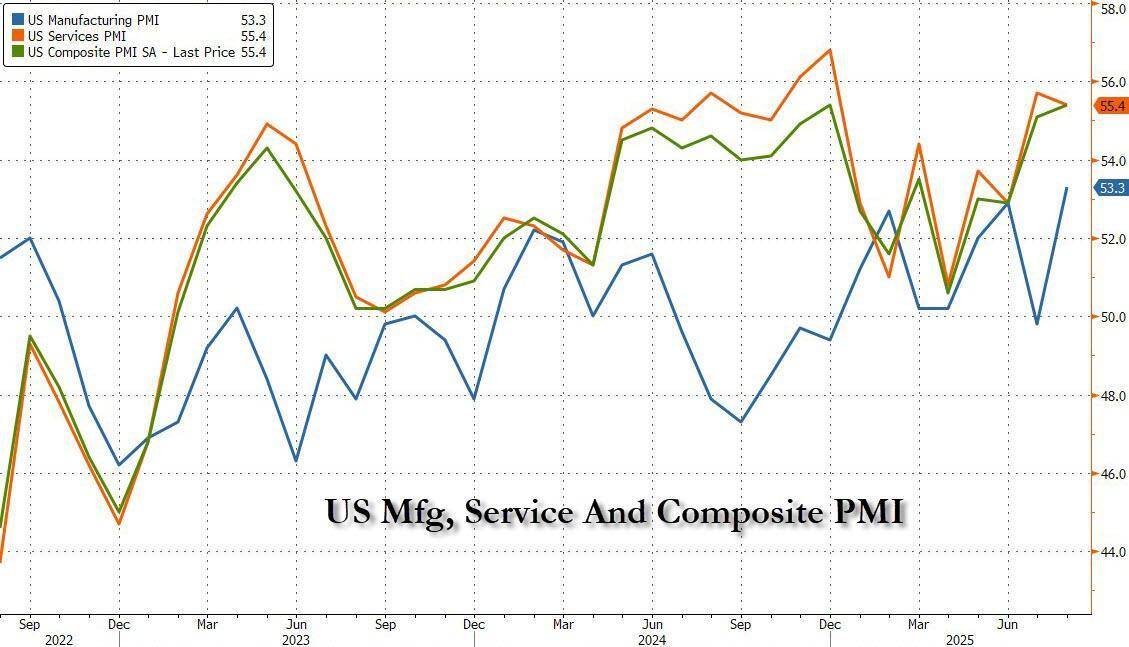
Group 1 - The core viewpoint of the article indicates that the U.S. manufacturing PMI has expanded at its fastest pace in over three years due to stronger demand, which has also pushed the composite PMI, including services, to its highest level of the year in August [1][7] - The initial reading of the U.S. August Markit manufacturing PMI is 53.3, the highest since May 2022, surpassing expectations of 49.7 and the previous value of 49.8. Both manufacturing output and backlog orders have reached their highest levels since mid-2022, while new orders have risen to their highest level since February 2024 [3][4] - The strong demand has led manufacturers to accelerate hiring, with employment growth reported as the strongest since March 2022 [4] Group 2 - The U.S. August Markit services PMI initial value is 55.4, a two-month low, but still indicates healthy business activity. The sales index has shown the fastest growth of the year, while the unfinished business index remains at its strongest level since May 2022 [6] - The composite PMI for August is 55.4, marking a nine-month high, exceeding expectations of 53.5 and the previous value of 55.1. The report indicates that rising import tariffs have pushed the sales price index to a three-year high, with consumers bearing the cost pressure as service firms' charge index also reaches a three-year peak [6][8] - Analysts suggest that the latest Markit PMI data reflects strong demand in the U.S. as the second half of the year begins, contributing to an optimistic economic outlook but also intensifying ongoing inflationary pressures [7] Group 3 - Chris Williamson, Chief Business Economist at S&P Global Market Intelligence, states that the strong PMI reading for August further indicates robust performance by U.S. businesses in the third quarter, aligning with an annualized growth rate of 2.5%, which is higher than the average growth rate of 1.3% in the first two quarters of the year [8] - Both manufacturing and service sectors report stronger demand, but they face challenges in meeting sales growth, leading to a significant increase in backlog orders and record growth in finished goods inventory due to concerns over future supply conditions [8] - The rebound in demand has spurred a surge in hiring, enhancing companies' pricing power, which has led to increased pass-through of tariff-related cost increases to customers, resulting in inflationary pressures reaching a three-year high [8]
有喜有忧!东莞镇街2025上半年经济“成绩单”陆续公布
Nan Fang Du Shi Bao· 2025-08-21 10:21
Core Insights - Dongguan's economy shows a mixed performance in the first half of 2025, with strong consumer markets and active foreign trade, but a slowdown in fixed asset investment [2][3][21] Economic Performance - Dongguan's GDP reached 606.78 billion yuan, growing by 4.8% year-on-year, which is 0.6 percentage points higher than the provincial average [3] - Among the 20 towns that reported, Dongkeng, Xiegang, and Gaobu had the highest GDP growth rates of 24.2%, 18.1%, and 8.1% respectively [3][4][6] Consumer Market - The total retail sales of social consumer goods in Dongguan amounted to 2,195.55 billion yuan, with a year-on-year increase of 3.4% [10] - Notably, the retail sales in Liubu and Dongcheng grew by 10.9% and 15.9% respectively, outperforming the city average [10][13] Foreign Trade - Dongguan's total import and export value reached 7,492.8 billion yuan, marking a year-on-year increase of 16.5%, ranking second in the province [17][19] - Noteworthy growth in foreign trade was observed in Tangxia and Xiegang, with increases of 184% and 2.8% respectively [19][20] Fixed Asset Investment - Fixed asset investment in Dongguan decreased by 10.9% year-on-year, although the decline was less severe than in the first quarter [21] - Some towns like Huangjiang and Tangxia experienced declines in fixed asset investment, while others like Dongcheng and Xiegang saw increases of 20.8% and 3.9% respectively [21][22][24]

马来西亚二季度经济增长稳健
Jing Ji Ri Bao· 2025-08-20 23:11
Economic Growth - Malaysia's GDP grew by 4.4% year-on-year in Q2, maintaining a steady growth trend despite a complex external environment, slightly below the earlier forecast of 4.5% but above market expectations of 4.3% [1] - Seasonally adjusted GDP increased by 2.1% quarter-on-quarter, significantly higher than the 0.7% growth in Q1, indicating economic resilience [1] Domestic Demand - Strong domestic demand was a key driver of economic growth, with household consumption rising by 5.3% year-on-year and public consumption increasing by 6.4% in Q2 [1] - Government policies, such as raising minimum wages and adjusting civil servant salaries, enhanced consumer purchasing power, contributing to a thriving consumption market [1] - Private and public investments grew by 10.2% and 6.8%, respectively, further supporting economic expansion [1] Sector Performance - The services sector grew by 5.1% year-on-year, driven by active performance in wholesale and retail, as well as food and beverage sub-sectors [2] - Manufacturing sector growth slowed but still achieved a 3.7% year-on-year increase, with electrical, electronic, and optical products showing sustained growth [2] - Agriculture and construction sectors also reported growth rates of 2.1% and 12.1%, respectively [2] Labor Market - Total employment in Malaysia increased by 2.9% year-on-year, reaching 16.86 million, with an unemployment rate stable at 3%, down 5.7% from the previous year [2] - Labor force participation rate rose to 70.8%, indicating a robust labor market that supports household consumption and sustainable economic growth [2] Trade Performance - Despite challenges, Malaysia's trade performance showed some highlights, with a significant 72.6% drop in net exports due to reduced commodity exports, particularly in mining [2] - Strong performance in electrical and electronic product exports partially offset the overall decline in exports [2] - Malaysia's important position in regional supply chains and trade cooperation with other countries provided some buffer against export market pressures [2] Inflation and Monetary Policy - Malaysia's inflation remained moderate in Q2, with the overall inflation rate decreasing from 1.5% in Q1 to 1.3%, and core inflation holding steady at 1.8% [3] - The decline in fuel prices and a slowdown in food price increases were the main reasons for the drop in inflation rates, providing stability for consumer purchasing power and room for monetary policy adjustments [3] - The central bank expects overall inflation to remain moderate, ranging between 1.5% and 2.3% for the year [3] Future Outlook - Analysts predict that Malaysia's economy may face challenges in the second half of the year, with potential further slowdown in exports [3] - However, continued domestic demand growth and stable investment activities are expected to provide some support for the economy [3] - The recovery of the tourism sector and the advancement of infrastructure projects are anticipated to inject new momentum into the economy [3]
2025年8月第3周:债市基本面高频数据跟踪报告:集运运价指数跌势放缓
SINOLINK SECURITIES· 2025-08-20 14:46
Group 1: Investment Rating - No investment rating information is provided in the report. Group 2: Core Views - Economic growth shows a slowdown in the decline of container shipping freight rate indices, with power plant daily consumption falling from a high level, and demand - side indicators showing mixed trends [1][4]. - Inflation presents a situation where pork prices are slowly falling at a low level, and there are fluctuations in CPI and PPI components [2][4]. Group 3: Summary by Directory 1. Economic Growth: Slowdown in the Decline of Container Shipping Freight Rate Indices 1.1 Production: Power Plant Daily Consumption Falls from a High Level - Power plant daily consumption has declined. On August 19, the average daily consumption of 6 major power - generating groups was 912,000 tons, a 4.5% drop from August 12. On August 14, the daily consumption of power plants in eight southern provinces was 2.369 million tons, a 5.3% drop from August 6 [4][11]. - Blast furnace operating rates fluctuated slightly. On August 15, the national blast furnace operating rate was 83.6%, down 0.2 percentage points from August 8, while the capacity utilization rate was 90.2%, up 0.2 percentage points. The blast furnace operating rate of Tangshan steel mills remained flat at 92.6% [4][17]. - Tire operating rates were weakly stable. On August 14, the operating rate of truck - used all - steel tires was 63.1%, up 2.1 percentage points from August 7, and that of car - used semi - steel tires was 72.1%, down 2.3 percentage points [4][19]. 1.2 Demand: Slowdown in the Decline of Container Shipping Freight Rate Indices - The decline in the month - on - month sales of new homes in 30 cities slowed down. From August 1 to 19, the average daily sales area of commercial housing in 30 large and medium - sized cities was 179,000 square meters, down 6.1% from July, 15.0% from August last year, and 32.4% from August 2023 [4][24]. - The retail sales of the auto market are gradually picking up. In August, retail sales increased by 2% year - on - year, and wholesale sales increased by 20% year - on - year [4][27]. - Steel prices generally fell. On August 19, rebar, wire rod, hot - rolled coil, and cold - rolled prices decreased by 3.5%, 3.1%, 2.8%, and 0.2% respectively compared to August 12 [4][32]. - Cement prices generally rebounded. On August 19, the national cement price index rose 1.4% from August 12, with prices in East China and the Yangtze River region rising 4.4% and 4.3% respectively [4][33]. - Glass prices stopped falling and rebounded. On August 19, the active glass futures contract price was 1,215 yuan/ton, up 13.9% from August 12 [4][37]. - The decline of container shipping freight rate indices slowed down. On August 15, the CCFI index decreased by 0.6% from August 8, and the SCFI index decreased by 2.0% [4][40]. 2. Inflation: Slow Fall of Pork Prices at a Low Level 2.1 CPI: Slow Fall of Pork Prices at a Low Level - Pork prices are slowly falling at a low level. On August 19, the average wholesale price of pork was 20.2 yuan/kg, a 0.2% drop from August 12 [4][46]. - The agricultural product price index is slowly rising. On August 19, the agricultural product wholesale price index rose 0.8% from August 12, with different fluctuations in various varieties [4][51]. 2.2 PPI: Weak Fluctuation of Oil Prices - Oil prices are weakly fluctuating. On August 19, the spot prices of Brent and WTI crude oil were $67.6 and $62.4 per barrel respectively, down 0.01% and 1.3% from August 12 [4][54]. - Copper and aluminum prices declined. On August 19, the LME 3 - month copper and aluminum prices decreased by 0.2% and 1.4% respectively compared to August 12 [4][58]. - The month - on - month increase of the domestic commodity index narrowed. On August 19, the Nanhua Industrial Products Index decreased by 2.5% from August 12, and the CRB index decreased by 0.3% from August 11 [4][58].