
高端化

Search documents
【机构调研记录】东兴基金调研三只松鼠、东芯股份
Zheng Quan Zhi Xing· 2025-08-29 00:07
Group 1: Company Insights - Dongxing Fund recently conducted research on two listed companies, including Three Squirrels and Dongxin Co., focusing on their strategic shifts and financial performance [1] - Three Squirrels is transitioning towards high-end, quality, and differentiated products, achieving a revenue of 5.478 billion yuan and a net profit of 138 million yuan, with over 20% growth in Q2 [1] - Dongxin Co. reported continuous improvement in revenue and gross profit, driven by the recovery in SLC NAND Flash demand and price increases, with significant contributions from SLC NAND products [1] Group 2: Industry Trends - The food and retail industry is undergoing changes, making it difficult to generate value through homogeneous competition, prompting companies to innovate [1] - The semiconductor market is experiencing a recovery in demand, particularly for SLC NAND Flash and NOR Flash products, with price adjustments following leading manufacturers [1] - The smart wearable device market is strong, with Dongxin Co. focusing on TWS headphones, feature phones, and smart wristbands, while also advancing Wi-Fi 7 wireless communication chip development [1] Group 3: Fund Performance - Dongxing Fund, established in 2020, has an asset management scale of 39.205 billion yuan, ranking 92 out of 210 in total public funds [2] - The fund's best-performing product in the past year is Dongxing Future Value Mixed A, with a net value of 1.52 and a growth of 83.82% over the last year [2]


传音“下南洋”:今年出货增速夺冠,高端化或成下一战
2 1 Shi Ji Jing Ji Bao Dao· 2025-08-28 23:52
Core Insights - Transsion Holdings has emerged as a significant player in the Southeast Asian smartphone market, achieving a shipment volume of 4.5 million units in Q2, capturing an 18% market share, surpassing Samsung [1][10] - The overall smartphone market in Southeast Asia saw a slight decline of 1% in shipments, while Transsion experienced a 17% year-on-year growth, leading the regional growth rate [1][10] - Transsion's strategy focuses on emerging markets with large populations and low smartphone penetration, avoiding traditional high-end markets [1][3] Market Dynamics - Chinese smartphone manufacturers have rapidly expanded in Southeast Asia, with their market share exceeding 60% [2][9] - The competition in the high-end smartphone segment is expected to intensify as brands like Transsion increase their R&D investments in key areas such as imaging and AI [2][14] - The Southeast Asian market, with a population of over 600 million and a median age of around 30, presents significant growth potential due to a young consumer base eager for new technology [4][9] Transsion's Strategy - Transsion's entry into Southeast Asia mirrors its successful approach in Africa, focusing on underserved markets and leveraging local partnerships for distribution [3][5] - The company has adopted a localized strategy, tailoring products to meet regional preferences, such as camera features that cater to local beauty standards [13][12] - Transsion's three sub-brands—TECNO, Infinix, and itel—target different consumer segments, enhancing its market reach [10][12] Competitive Landscape - The competitive environment in Southeast Asia is more intense than in Africa, with established brands like OPPO, vivo, and Xiaomi also vying for market share [8][9] - Transsion's focus on affordable smartphones has positioned it well in the entry-level market, where demand remains strong [11][14] - The company has successfully utilized e-commerce and social media strategies to engage consumers, particularly in Indonesia [7][10] Future Outlook - Transsion plans to enhance its product offerings by investing in high-end features and exploring new product forms like foldable smartphones [16][17] - The company aims to balance cost-effectiveness with innovation to capture the growing demand for mid-range and high-end devices [17][14] - As the Southeast Asian market continues to evolve, Transsion's ability to adapt its strategies will be crucial for maintaining its competitive edge [12][17]

传音“下南洋”:今年出货增速夺冠 高端化或成下一战|东盟观察
2 1 Shi Ji Jing Ji Bao Dao· 2025-08-28 23:48
Core Insights - Transsion Holdings has emerged as a significant player in the Southeast Asian smartphone market, achieving a shipment volume of 4.5 million units in Q2 2023, capturing an 18% market share and surpassing Samsung, which previously held the top position [1][10] - The company has demonstrated a remarkable 17% year-on-year growth rate, leading the regional market in growth despite an overall decline of 1% in smartphone shipments in Southeast Asia [1][10] - Transsion's strategy focuses on emerging markets with large populations and low smartphone penetration, avoiding competition in saturated high-end markets [1][3][4] Market Dynamics - Chinese smartphone manufacturers have rapidly expanded in Southeast Asia, with their market share exceeding 60%, driven by competitive pricing and localized products [2][9] - The Southeast Asian market, characterized by a young population and increasing middle-class consumers, presents significant growth opportunities for smartphone brands [4][9] - Transsion's entry into Southeast Asia began in Indonesia, where smartphone penetration was below 40%, allowing the company to target underserved markets [5][6] Competitive Strategy - Transsion has adopted a localized approach, leveraging its experience from Africa to establish distribution networks through small local dealers, enhancing its bargaining power [3][5][6] - The company has focused on online sales and community engagement, utilizing social media and e-commerce platforms to reach consumers effectively [7][10] - Differentiation in product offerings is key, with Transsion's brands TECNO, Infinix, and itel targeting distinct consumer segments, from budget-conscious buyers to tech-savvy youth [10][11] Future Outlook - As competition intensifies with other Chinese brands like OPPO and Xiaomi, Transsion plans to enhance its product offerings in imaging, AI, and charging technologies to meet the demands of higher-end consumers [2][15] - The company is also exploring high-end market segments, with plans to invest in innovative product designs and features, including foldable smartphones [15][16] - The shift towards higher-value markets is seen as essential for sustaining growth, especially as entry-level market profits diminish [15][16]

传音“下南洋”:今年出货增速夺冠,高端化或成下一战|东盟观察
2 1 Shi Ji Jing Ji Bao Dao· 2025-08-28 23:41
Core Insights - Transsion Holdings has emerged as a significant player in the Southeast Asian smartphone market, achieving a shipment volume of 4.5 million units in Q2 2023, capturing an 18% market share, surpassing Samsung [1][10] - The company has demonstrated a remarkable 17% year-on-year growth rate, leading the regional market in growth despite a slight overall decline in smartphone shipments in Southeast Asia [1][10] - Transsion's strategy focuses on emerging markets with large populations and low smartphone penetration, avoiding direct competition in saturated high-end markets [3][4] Market Dynamics - The Southeast Asian smartphone market is characterized by a competitive landscape with Chinese brands like OPPO, vivo, and Xiaomi also vying for market share [8][10] - Chinese smartphone manufacturers have collectively captured over 60% of the local market, driven by competitive pricing and localized product offerings [2][14] - The region's young population and increasing middle class are key drivers of smartphone demand, with a median age of around 30 years [4][10] Transsion's Strategy - Transsion's approach includes localized innovation and product differentiation, with three main brands targeting different consumer segments: TECNO for the middle class, Infinix for tech-savvy youth, and itel for budget-conscious consumers [10][12] - The company has successfully replicated its African market strategy in Southeast Asia by partnering with local distributors and leveraging e-commerce platforms for sales [5][7] - Transsion plans to increase R&D investment in key areas such as imaging, AI, and charging technology to meet the demands of higher-end smartphone consumers [2][16] Competitive Landscape - The competition in Southeast Asia is intensifying, with established brands like OPPO and Xiaomi enhancing their product offerings to cater to local preferences [8][10] - The market is expected to see a shift towards higher-end devices as consumer preferences evolve, with brands like Honor and OPPO also targeting the mid-to-high-end segments [16][10] - Transsion's focus on cost-effective solutions and supply chain efficiency has positioned it well against competitors, particularly in the entry-level smartphone segment [14][15] Future Outlook - The Southeast Asian market is projected to continue its double-digit growth, contrasting with the stagnation in more mature markets like North America and Europe [9][10] - Transsion aims to enhance its competitive edge by investing in high-end product development and local market adaptations, including tailored camera solutions for different regional preferences [16][13] - The company is also exploring opportunities in the foldable smartphone segment, indicating a strategic shift towards innovation and premium offerings [16][15]
三只松鼠2025年中报简析:增收不增利,公司应收账款体量较大
Zheng Quan Zhi Xing· 2025-08-28 22:59
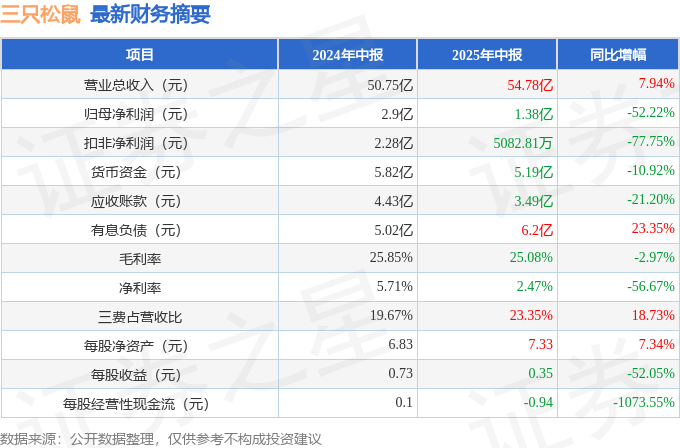
Core Viewpoint - The recent financial report of Three Squirrels (300783) indicates a mixed performance with a revenue increase but a significant decline in net profit, highlighting challenges in cost management and market dynamics [1][5]. Financial Performance - Total revenue for the first half of 2025 reached 5.478 billion yuan, a year-on-year increase of 7.94% [1]. - Net profit attributable to shareholders was 138 million yuan, down 52.22% year-on-year [1]. - In Q2 2025, total revenue was 1.754 billion yuan, reflecting a 22.77% increase year-on-year, while net profit was -101 million yuan, a decline of 441.41% [1]. - Gross margin stood at 25.08%, down 2.97% year-on-year, and net margin was 2.47%, down 56.67% [1]. - Total expenses (selling, administrative, and financial) amounted to 1.279 billion yuan, accounting for 23.35% of revenue, an increase of 18.73% year-on-year [1]. Cash Flow and Receivables - The company reported a significant receivables issue, with accounts receivable accounting for 85.7% of net profit [1][2]. - Cash flow per share was -0.94 yuan, a drastic decrease of 1073.55% year-on-year [1]. Business Model and Market Dynamics - The company's performance is primarily driven by marketing, necessitating a deeper analysis of the underlying factors [2]. - The food and retail industry is undergoing changes, with a shift from homogeneous competition to value creation, which presents strategic opportunities for sustainable growth [5]. Fund Holdings - The company is held by notable funds, including the CITIC Construction Rotation Mixed Fund, which has increased its holdings [4]. - The largest fund holding Three Squirrels is the CITIC Construction Rotation Mixed A, with a total scale of 866 million yuan and a recent net value increase of 0.1% [4]. Future Outlook - Analysts project the company's performance for 2025 to reach 412 million yuan, with an average earnings per share of 1.03 yuan [2].
松井股份:上半年乘用车业务营收增长109.60% 前沿布局固态电池新赛道
Zhong Zheng Wang· 2025-08-28 15:00
Core Insights - Matsui Co., Ltd. reported a record high revenue of 348 million yuan for the first half of 2025, marking a year-on-year increase of 7.48% [1] - The passenger vehicle segment saw significant growth, with revenue reaching 97.83 million yuan, a remarkable increase of 109.60% year-on-year [1] Financial Performance - The company's R&D expenses amounted to 50.92 million yuan, reflecting a year-on-year growth of 6.73% [1] - The R&D expense ratio slightly decreased to 14.65% of total revenue compared to the same period last year [1] - The R&D team expanded to 291 members, representing 33.33% of total employees, with a year-on-year growth of 21.76% [1] Strategic Initiatives - Matsui is advancing its "three verticals and three horizontals" strategic framework to enhance multi-field collaborative innovation [2] - The company is focusing on upgrading existing technologies and developing new products, including eco-friendly printing technologies and innovative coatings for automotive interiors [2] - Key strategic projects, such as body paint and aftermarket repair paint, are progressing towards market application [2] Technological Advancements - Matsui has developed integrated solutions for insulation frame printing and materials for all-solid-state batteries, addressing manufacturing challenges and enhancing battery performance and safety [2] - The new technology is currently in the joint verification phase with leading downstream companies, aiming for commercial breakthroughs [2] Industry Context - The company is strengthening its core competitiveness in the new functional coating sector amid the global manufacturing industry's shift towards high-end and green transformation [2]

河钢股份上半年净利润增长44.75% 板材业务营收达470亿元
Zheng Quan Shi Bao Wang· 2025-08-28 14:45
Core Insights - The company reported a revenue of 66.308 billion yuan for the first half of 2025, a year-on-year increase of 12.73% from 58.821 billion yuan, with a net profit attributable to shareholders of 0.598 billion yuan, up 44.75% [1] - The company aims to enhance its competitiveness in the steel industry by improving operational management and maximizing the potential of its core steel business [1] - The company has a production capacity of 30 million tons of high-quality steel annually and maintains a leading position in steel production technology [1] Financial Performance - The company achieved a net profit of 0.598 billion yuan, representing a 44.75% increase year-on-year, and a non-recurring net profit of 0.355 billion yuan, with a growth rate of 63.71% [1] - Basic earnings per share were approximately 0.05 yuan [1] Product Performance - The steel product categories include plates, bars, wires, and profiles, with the plate business generating 47.028 billion yuan, accounting for 70.92% of total revenue, and showing an 18.97% year-on-year growth [2] - The vanadium product segment also experienced significant growth, achieving revenue of 0.075 billion yuan, a 29.51% increase year-on-year [2] Market and Regional Performance - The North China region contributed 41.866 billion yuan in revenue, a 34.40% increase year-on-year, representing 63.13% of total revenue [2] - The company's international market expansion was notable, with revenue reaching 1.608 billion yuan, a staggering 84.46% increase year-on-year [2] Innovation and R&D - The company invested 0.939 billion yuan in R&D, a 3.09% increase year-on-year, and has established a comprehensive R&D system with multiple recognized platforms [2] - The company is committed to high-end, intelligent, and green development, focusing on innovation-driven strategies to lead the steel industry's transformation [3]

*ST松发上半年营收66.80亿元 同比增长315.49%
Zheng Quan Ri Bao Wang· 2025-08-28 13:44
Group 1 - The core viewpoint of the articles highlights the significant turnaround in *ST Songfa's financial performance, with a revenue increase of 315.49% year-on-year and a net profit of 647 million yuan, marking a substantial recovery from previous losses [1] - The turnaround is attributed to a major asset restructuring, where *ST Songfa transitioned from traditional ceramic manufacturing to shipbuilding by integrating with Hengli Heavy Industry Group [1] - The restructuring has led to enhanced profitability and performance, with the shipbuilding business expected to significantly contribute to the company's earnings post-2025 [1] Group 2 - Hengli Heavy Industry's "Future Factory" project will enable an annual processing capacity of approximately 2.3 million tons of steel and the production of around 180 marine engines, covering various dual-fuel types [2] - The annual output value of Hengli Heavy Industry is projected to exceed 70 billion yuan, reflecting its rapid growth and contribution to the high-quality and green transformation of China's shipbuilding industry [2] - Hengli Heavy Industry's advancements are reshaping the development path of China's shipbuilding sector and enhancing its global competitive position, while also contributing to the green and low-carbon transition in global shipping [2]

港迪技术(301633) - 301633港迪技术投资者关系管理信息20250828
2025-08-28 09:50
Group 1: Business Expansion and Strategy - The company has established a strategic framework of "one core and three wings," focusing on regional development with new branches in Shenzhen, Hainan, and Shanghai to enhance core competitiveness [2][3] - The company aims for sustainable and high-quality development over the next 3-5 years, emphasizing technology R&D, new product development, and overseas market expansion [3][4] Group 2: Market and Product Development - The company is currently focused on domestic markets, with overseas business still relatively small, but is expanding its overseas team and communication efforts [3][4] - The development of medium and high-voltage frequency converters is progressing well, with some models in testing, aiming for a comprehensive product line in automation [3][4] Group 3: Mergers and Acquisitions - The company is open to potential mergers and acquisitions but will prioritize internal technology development and market adaptability [4][5] Group 4: Industry Trends and Performance - The company is monitoring the humanoid robot sector but has not yet entered this market, focusing instead on existing product lines [5] - The company has maintained a leading position in the domestic market for shield machine frequency converters for five consecutive years [5] - Key downstream industries such as shipping, railways, oil, and cement have shown strong performance, supporting business growth [5][6] Group 5: Market Challenges and Confidence - Despite challenges like slowing investment in manufacturing and price wars, the company remains confident in its operational stability due to strong customer relationships and strategic partnerships [6] - The company plans to expand market efforts and optimize product structures to mitigate external impacts [6]
宝钢股份2025年半年度业绩说明会将于8月29日举行
Quan Jing Wang· 2025-08-28 09:24
Core Viewpoint - Baosteel Co., Ltd. is a leading modern steel enterprise aiming for high-quality development and global competitiveness in the steel industry [1][2] Group 1: Company Overview - Baosteel Co., Ltd. is a flagship subsidiary of China Baowu Steel Group, founded in February 2000 and listed on the Shanghai Stock Exchange in December 2000 [1] - The company operates under a "1+6" development strategy, focusing on efficient and market-oriented operations across multiple bases [1] - It ranks second globally in crude steel production, first in automotive sheet production, and first in silicon steel production, making it one of the most comprehensive steel producers in terms of carbon steel varieties [1] Group 2: Product Development and Innovation - The company emphasizes integrity and customer-centricity, leading industry development with its advanced products [2] - Baosteel has developed high-end products such as new-generation automotive high-strength steel, high-end silicon steel, and energy marine steel, which are at the international advanced level [2] - The company is committed to green and low-carbon development, focusing on advanced manufacturing and energy-saving technologies [2] Group 3: Future Outlook - Baosteel aims to enhance core functions and competitiveness while adhering to high-end, intelligent, and green development [2] - The company plans to contribute to national rejuvenation and economic transformation through its steel production capabilities [2]
