
自主可控

Search documents
逆市狂飙210%!
Zhong Guo Ji Jin Bao· 2025-10-14 12:17
Core Viewpoint - HMVOD Video experienced a significant stock surge of 210% following a partnership with Mango Super Media's subsidiary, indicating potential investment opportunities amidst market volatility [11][14]. Market Overview - The Hong Kong stock market faced a downturn, with the Hang Seng Index dropping 1.73% to 25,441.35 points, marking a seven-day decline [2][3]. - The Hang Seng Technology Index fell 3.62% to 5,923.26 points, while the Hang Seng China Enterprises Index decreased by 1.55% to 9,079.16 points [2][3]. - Notable declines were observed in major stocks, including SMIC, which plummeted 8.48%, and Kuaishou, which fell 6.77% [3][5]. Sector Performance - The semiconductor sector saw a significant pullback, with the Hong Kong semiconductor index dropping as much as 9.20% and closing down 8.05% [8]. - Key semiconductor stocks like Hua Hong Semiconductor and Junma Semiconductor experienced declines of 13.08% and 10.22%, respectively [9][10]. Investment Insights - In light of recent market fluctuations, Invesco's Chief Investment Officer, Ma Lei, suggested that these conditions may present a buying opportunity for long-term investors, particularly in companies with strong fundamentals and pricing power [7]. - The report emphasized the importance of bottom-up stock selection to identify resilient companies that can benefit from potential market consolidation [7]. Company-Specific Developments - HMVOD Video's stock surged after announcing a collaboration with Happy Sunshine for a new program, with an initial licensing fee of 2 million RMB [14]. - The company is currently awaiting the outcome of an appeal regarding a court order, which has delayed the hearing for its liquidation case [14].



兴业证券:10月13日ETF重点流入哪些领域?
Zhi Tong Cai Jing· 2025-10-14 12:09
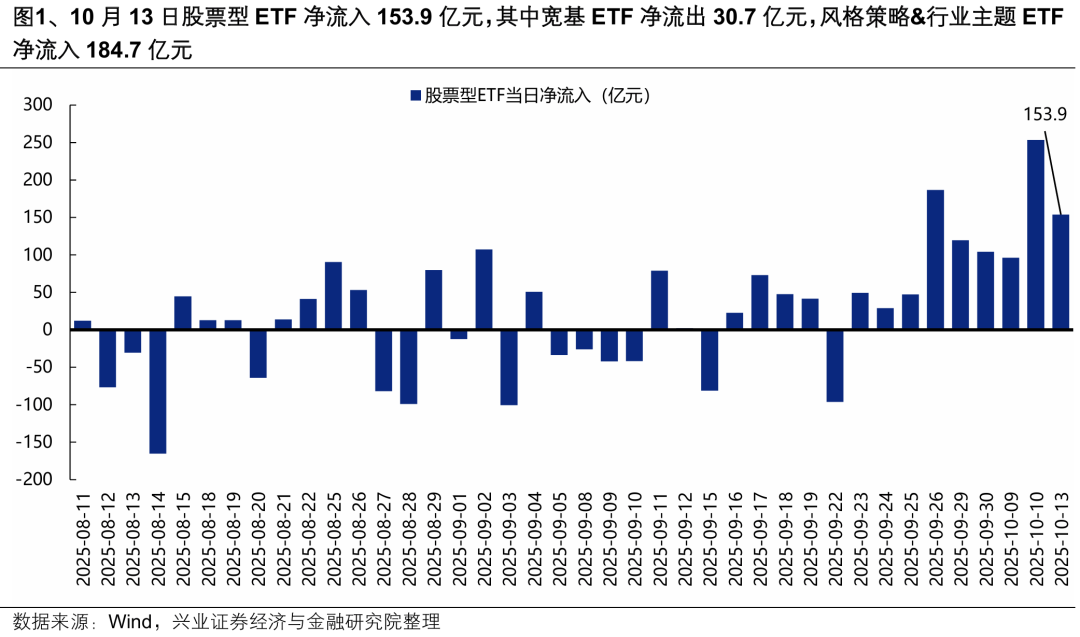
Group 1 - On October 13, the net inflow of equity ETFs was 15.39 billion, with broad-based ETFs experiencing a net outflow of 3.07 billion and style strategy & industry theme ETFs seeing a net inflow of 18.47 billion [1] - Among broad-based ETFs, the CSI 300 saw significant inflows, while the STAR Market, CSI A500, and CSI 1000 experienced outflows [4] - In terms of industry theme ETFs, the major inflow directions were concentrated in cyclical (non-ferrous), large finance (non-bank, banks), self-controllable (electronics, military, computers), advanced manufacturing (new energy, pharmaceuticals), and consumption, while the outflow directions were mainly in real estate, telecommunications, free cash flow, machinery, media, and chemicals [8]

东兴证券晨报-20251014
Dongxing Securities· 2025-10-14 11:53
Economic News - The Ministry of Commerce of China has taken countermeasures against five U.S. subsidiaries of Hanwha Ocean Corporation in response to the U.S. investigation into China's maritime, logistics, and shipbuilding sectors [2] - The Chinese automotive industry has seen significant growth in the first nine months of the year, with production and sales reaching 24.43 million and 24.36 million vehicles, respectively, marking year-on-year increases of 13.3% and 12.9% [2] - The China Nuclear Group has made significant progress in key technologies for magnetic confinement nuclear fusion energy extraction, establishing a research platform for liquid metal and helium gas working fluids [2] Company Insights - ZTE Corporation has completed testing for 5G-A cellular passive IoT technology, achieving a 100% success rate in inventory success for both single and multiple tags [4] - CATL has established a new five-year strategic cooperation with Dongfeng Commercial Vehicle, focusing on electric vehicle technology development and market expansion [4] - Tongyu Communication has entered the low-orbit satellite supply chain and received overseas orders, aiming to enhance its capabilities in satellite-ground collaboration [4] Daily Research - The report indicates that external shocks have limited impact on the market, with the A-share market maintaining a mid-term upward trend despite recent volatility [5] - The report suggests a dual mainline investment strategy, emphasizing the importance of the technology sector while also considering cyclical sectors like military, pharmaceuticals, and new energy [6] Satellite Internet Industry - The report reviews the development of SpaceX's Falcon 1 rocket, highlighting the importance of engine components and testing services in the commercial space industry [8] - The Merlin 1A engine is identified as a core component of the Falcon 1 rocket, with the combustion chamber being critical for its performance [9] - The report emphasizes the significance of extensive testing in achieving a high success rate for rocket launches, with SpaceX achieving a 97.76% success rate across its missions [12] Investment Strategy - The report recommends focusing on domestic suppliers of rocket engine components and testing services as promising investment opportunities in the commercial space sector [13] - Specific companies highlighted include Srey New Materials and Guoji Precision Engineering as key players in the rocket engine supply chain [14]




从 “卡脖子” 到 “自主可控”:科蓝软件自研数据库撑起技术安全防线
Quan Jing Wang· 2025-10-14 11:32
Core Insights - The article highlights the risks associated with using open-source databases for sensitive information storage, emphasizing the advantages of proprietary databases like those developed by Kelaun [2][3][4] Group 1: Vulnerabilities of Open-Source Databases - Open-source databases have slow vulnerability patching processes, exemplified by the 47-day delay in fixing the "Log4j2" vulnerability in MySQL, during which 30% of global financial apps were at risk [3] - Contracts associated with open-source databases may contain hidden clauses that allow service providers to access user data, leading to potential data breaches, as seen in a case where 3 million users' data was compromised [4] Group 2: Advantages of Proprietary Databases - Kelaun's proprietary database can fix vulnerabilities within 2 hours, significantly faster than open-source alternatives, enhancing data security for users [3][6] - Kelaun's databases are designed with customized security features for sensitive applications, such as encrypting transaction records for banks and anonymizing patient data for hospitals [6] Group 3: National Security Implications - The reliance on foreign-controlled databases poses significant risks to critical national infrastructure, such as power and water systems, which could be compromised if foreign entities gain access [7][8] - Kelaun's databases are installed in energy companies, ensuring data remains within domestic servers and is not subject to foreign control, thus maintaining operational integrity [8] Group 4: Industrial Resilience - Proprietary databases provide operational continuity for industries like automotive manufacturing, which faced significant downtime due to reliance on foreign open-source components [9] - Kelaun's databases are designed to operate independently of foreign technology, ensuring uninterrupted production processes even amidst international restrictions [9] Group 5: Establishing Domestic Standards - The article discusses the need for Chinese enterprises to establish their own standards for database usage, reducing dependency on foreign regulations that may not align with domestic needs [10] - Kelaun is leading the formation of a "Financial-Level Database Open Source Alliance," which aims to create rules that cater to the specific requirements of Chinese companies, promoting industry safety and autonomy [10]


转债市场跟踪:对比4月,转债TACO交易再现?
Tianfeng Securities· 2025-10-14 11:20
1. Report Industry Investment Rating No information provided regarding the industry investment rating in the given content. 2. Core Viewpoints of the Report - The market or still favors TACO trading, but the volatility of equity asset prices may be weaker than that during the April 2025 tariff 1.0 period [6]. - In the short - term, with relatively weak equity elasticity, it's recommended to maintain a moderately low position and focus on low - price convertible bonds with clause resonance, especially export - chain convertible bonds affected by tariff policies [7]. - In the medium - term, the upward repair of domestic micro - enterprise performance is becoming a consensus, and the high - price equity - biased strategy may still be structurally dominant, with high attention on the rotation strategy of small - cap growth convertible bonds in technology self - controllable directions [7]. 3. Summary According to Relevant Catalogs 3.1 April 2025 Market Phases and Performance - **Tariff Upgrade Pre - period (April 2 - 7)**: A - shares and convertible bonds declined. The Shanghai Composite Index dropped 7.34% on April 7, and the Wind Convertible Bond Underlying Stock Weighted Index fell over 12%. High - price convertible bonds led the decline, and the equity - biased convertible bond strategy underperformed the market [1]. - **Tariff Counter - measure Initiation (April 8 - 11)**: A - shares and convertible bonds rebounded. The CSI Convertible Bond Index rebounded 2.45%, and high - price convertible bonds rose 5.38% [1]. - **Trade Friction Continuation (April 12 - 20)**: Market risk - aversion sentiment was high, and financial real - estate and dividend industries performed relatively well. Convertible bonds fluctuated narrowly [2]. - **Trade Friction Easing (April 21 onwards)**: Advanced manufacturing and technology sectors drove the market up, while the financial real - estate sector corrected [2]. 3.2 April 2025 Convertible Bond Market Performance by Industry - **High External - demand Exposure Industries**: Industries such as power equipment, machinery, and electronics had deep declines during the tariff upgrade pre - period and weak rebounds later. For example, electronics and home appliance industry convertible bonds' underlying stocks fell over 15% initially and only rebounded about 5% later [3]. - **Balanced Internal and External - demand Exposure Industries**: Industries like national defense and military, computer, and environmental protection had high declines initially but strong rebounds later [3]. - **Domestic - demand - led Industries**: Industries such as agriculture, forestry, animal husbandry, and fishery, food and beverage, and transportation had low initial declines and led the rebounds [3]. 3.3 April 2025 Performance of Key Export - chain Convertible Bonds - **Good Initial and Rebound Performance**: Convertible bonds in chemical pesticides (Limin Convertible Bond, Suli Convertible Bond), textile and apparel (Shengtai Convertible Bond), and medical equipment (Yirui Convertible Bond, Kangyi Convertible Bond) had low initial declines and good rebounds [4]. - **High Initial Decline but Strong Rebound**: Convertible bonds in semiconductors (Huaya Convertible Bond, Weil Convertible Bond), military (Ruichuang Convertible Bond, Hangxin Convertible Bond), and agriculture, forestry, animal husbandry, and fishery (Zhongchong Convertible Bond 2) had high initial declines but strong rebounds [4]. - **Deep Initial Decline and Weak Rebound**: Convertible bonds in consumer electronics, cleaning home appliances, medical outsourcing, and tires had deep initial declines and weak rebounds [4]. 3.4 Current Situation of the Convertible Bond Market - **Investor Behavior**: Since the end of August, investors have tended to "take profits". By the end of September, the scale of Shanghai - listed convertible bonds decreased naturally by 7.1% compared to the end of July. Insurance institutions were the main force in reducing holdings, with a 33% reduction, and other major holders also reduced their holdings [6]. - **Valuation**: Thanks to the reverse increase of public funds, convertible bond valuations are still at a relatively high historical level, and valuation indicators have slightly repaired upwards since late September [6].
A股风格突变,两大板块尾盘逆势拉升,多股封板
Zheng Quan Shi Bao· 2025-10-14 10:17
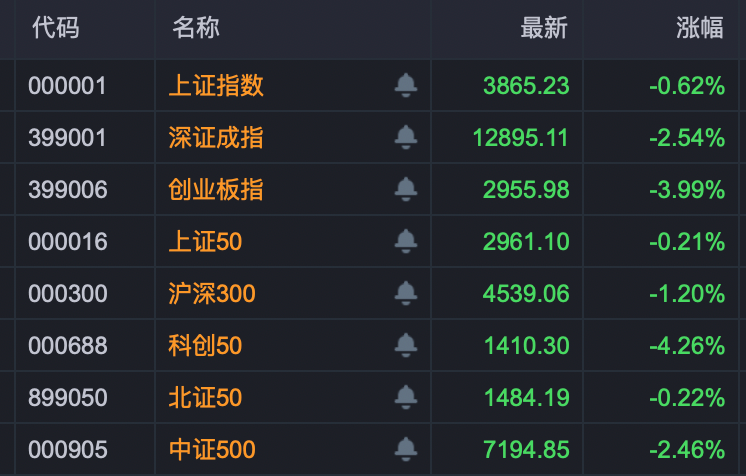
Market Overview - A-shares opened high but closed lower, with the Sci-Tech 50 index dropping by 4.26% and the ChiNext index falling by 3.99%, breaking below the 3000-point mark, reaching a one-month low, with total market turnover at 2.6 trillion yuan [1][2] Index Performance - The Shanghai Composite Index closed at 3865.23, down 0.62% - The Shenzhen Component Index closed at 12895.11, down 2.54% - The ChiNext Index closed at 2955.98, down 3.99% - The Sci-Tech 50 Index closed at 1410.30, down 4.26% [2] Sector Performance - Sectors such as cultivated diamonds, banks, coal, and insurance saw gains, while sectors like communication equipment, energy metals, semiconductors, and consumer electronics experienced declines [2] Fund Flow Analysis - Market funds flowed into high-dividend and banking sectors, with banks receiving over 5.7 billion yuan in net inflows, and food and beverage sectors receiving over 3.2 billion yuan [3] - The electronic sector faced significant net outflows exceeding 30.6 billion yuan, with computing, non-ferrous metals, and communication also seeing outflows exceeding 10 billion yuan [3] Market Outlook - Dongxing Securities maintains that the mid-term core trend of A-shares remains unchanged, with limited impact from short-term external shocks, and anticipates an upward trend in the future [3] - Datong Securities suggests that the market is currently facing more negative factors, leading to increased volatility, but still shows strong resilience [3] Hot Sectors - The cultivated diamond sector saw significant gains, with the index rising nearly 6% to reach a historical high, driven by stocks like Huanghe Xuanfeng and Lili Diamond hitting their daily limits [4] Regulatory News - The Ministry of Commerce and the General Administration of Customs announced export control measures on superhard materials and related products, effective November 8, indicating a strategic focus on cultivated diamonds [7] - The market for cultivated diamonds is expanding, with potential applications in various fields, which is expected to invigorate the industry [7] Investment Trends - Insurance funds are increasingly favoring high-dividend stocks, particularly in the banking sector, with expectations of further increases in holdings of bank stocks [10]
华安基金科创板ETF周报:多空博弈加剧,科创芯片指数涨0.22%
Xin Lang Ji Jin· 2025-10-14 09:18
Group 1: Core Insights - The China Securities Regulatory Commission (CSRC) emphasizes advancing capital market reforms with a focus on the Sci-Tech Innovation Board (STAR Market) to enhance market attractiveness and inclusivity [1][2] - The CSRC plans to optimize systems for issuance, refinancing, and mergers and acquisitions, while encouraging listed companies to increase dividends and share buybacks to enhance investment value [1][2] - The Shanghai government has introduced guidelines for venture capital funds to focus on early-stage investments in hard technology and scientific innovation [1][2] Group 2: Market Performance - The STAR Market indices showed mixed performance, with the Sci-Tech 50 Index rising by 0.13%, while the Sci-Tech Information Index fell by 0.15% [3] - Year-to-date returns for major indices are significant, with the Sci-Tech 50 Index up by 46.89% and the Sci-Tech Chip Index up by 69.62% [4] Group 3: Sector Analysis - The new generation information technology sector, particularly the electronic chip industry, is experiencing rapid growth driven by increased demand from artificial intelligence [5][6] - The high-end equipment manufacturing sector is seeing policy support and commercialization of humanoid robots, with significant growth in production and sales data [7] - The pharmaceutical sector is showing signs of recovery, with innovative drugs and medical devices driving growth, particularly in overseas markets [7] Group 4: ETF and Investment Opportunities - The Sci-Tech Information ETF (588260) tracks major companies in next-generation information technology, reflecting the overall performance of the sector [8] - The Sci-Tech Chip ETF (588290) represents key players in the semiconductor industry, indicating strong market interest in this area [13]






基础化工 2025 年 Q3 业绩前瞻:Q3 淡季叠加成本走高,周期品价差回落,化工盈利季节性承压
Shenwan Hongyuan Securities· 2025-10-14 09:00
Investment Rating - The report maintains an "optimistic" rating for the chemical industry [4] Core Insights - Q3 is traditionally a low season for downstream chemical products, with prices of chemical products retreating from high levels. However, high demand in sub-sectors like agricultural chemicals supports performance [3][4] - The supply side of the chemical sector is nearing the end of capital expenditure, and policies aimed at reducing excess capacity are expected to accelerate the exit of outdated production capacity. Demand is anticipated to trend upward in the long term due to stabilizing oil prices and easing liquidity [4] Summary by Relevant Sections Agricultural Chemicals - The agricultural chain is expected to see steady growth in fertilizer demand due to increasing cultivated areas and higher penetration of genetically modified crops. Key companies to watch include Hualu Hengsheng and Baofeng Energy for nitrogen fertilizers, Yuntianhua and Xingfa Group for phosphate fertilizers, and Yara International for potash fertilizers [4] Textile and Apparel Chain - The textile and apparel chain has maintained high growth rates, with supply-side production peaks having passed. Companies like Luxi Chemical and Tongkun Co. are highlighted for their potential in this sector [4] Export-Related Chemicals - With overall overseas inventory at historical lows and expectations of interest rate cuts, demand for export-related chemical products is expected to rise. Key companies include Juhua Co. and Sanmei Co. in the fluorochemical sector, and Wanhua Chemical in the MDI segment [4] New Materials - The report emphasizes the acceleration of domestic self-sufficiency in key materials, particularly in semiconductor materials and OLED panel materials. Companies like Yake Technology and Ruijie New Materials are noted for their growth potential [5]



美国加强基础软件出口管制,科蓝软件SUNDB真国产数据库迎来战略机遇期——穿马甲、套壳假的国产何去何从?
Quan Jing Wang· 2025-10-14 08:34
Core Insights - The U.S. government has tightened export controls on foundational software technologies to China, including core database management systems and middleware, creating unprecedented opportunities for domestic software companies in China [1] - The export restrictions are expected to accelerate the shift towards domestic database solutions, as industries move from merely using to actively adopting and trusting Chinese databases [2] - Companies like Kylin Software's SUNDB are positioned to benefit significantly from this shift, as they offer fully autonomous databases that meet high performance and security standards [3] Industry Impact - The tightening of U.S. export controls is seen as a "stress test" for China's information technology supply chain, prompting a reevaluation of security standards across various sectors [3][4] - Key industries such as finance, government, and military are expected to increase their budgets and prioritize the procurement of domestic software solutions due to heightened security concerns [3] - The move away from reliance on foreign database products, particularly Oracle, is anticipated to create substantial market opportunities for domestic players like SUNDB [3][4] Company Opportunities - Kylin Software's SUNDB has established a significant first-mover advantage in the domestic database market, supported by years of technical accumulation and industry experience [3] - The company is expected to leverage favorable policies and market demand to expand its market share and deepen its industry presence [4] - SUNDB's architecture supports high availability and scalability, making it suitable for critical applications in sectors that require zero data loss and high service continuity [2]
权益基金扎堆发行,上车的机会来了吗?
Guo Ji Jin Rong Bao· 2025-10-14 07:40
Core Insights - The issuance of public funds remains strong as the market shows positive trends, with 54 new funds launched in the week following the National Day holiday, particularly on October 13, when 31 new funds were issued, predominantly equity funds [1][3] Fund Issuance Trends - A significant portion of the new funds issued on October 13 were equity funds, with 25 out of 31 funds falling into this category, representing over 80% of the total. Among these, passive index funds accounted for more than half, totaling 14 funds [3] - The trend towards issuing ETFs (Exchange-Traded Funds) is notable, driven by the accelerated development of the ETF market and increasing investor preference for this investment vehicle as the equity market rises [3][4] Market Performance and Sector Focus - The A-share market has shown a preference for growth styles, particularly in the technology sector, which has performed strongly. New funds launched include those focused on themes such as aviation, robotics, and artificial intelligence [4] - The recent recovery in the equity market has boosted confidence among fund companies, leading to several equity funds setting their initial fundraising caps at 8 billion yuan, with subscription periods generally under 20 days [4] Sector-Specific Insights - The rare earth sector has seen significant gains, with the Wind rare earth concept index rising by 9.49% on October 13, driven by policy tightening and structural demand increases from industries like new energy vehicles and wind power [6] - The core logic for technology investments remains unchanged, with domestic demand and policy support for domestic substitution expected to sustain the sector's growth trajectory [7] Investment Outlook - The current market environment is characterized by significant internal structural differences, leading to varied valuations and sentiments across sectors. The impact of tariffs differs among sectors, with domestic substitution concepts benefiting from the trend towards self-sufficiency [7] - Investors are advised to focus on companies with reasonable valuations based on fundamental trends over a 1 to 3-year horizon, rather than being overly concerned with short-term geopolitical fluctuations [7]