
AI算力

Search documents
帮主郑重收评:4600股下跌!电网白酒逆势涨停,明日抄底还是观望?
Sou Hu Cai Jing· 2026-02-02 08:17
Core Viewpoint - The market experienced a significant decline, with major indices dropping over 2% and more than 4,600 stocks in the red, primarily driven by a sell-off in commodities and hawkish expectations from the Federal Reserve [1][3][4] Group 1: Market Analysis - The sell-off in commodities was triggered by a stronger dollar, which diminished the attractiveness of precious metals and energy stocks, leading to substantial profit-taking in previously high-performing resource stocks [3][4] - Semiconductor stocks faced declines, with companies like Zhaoyi Innovation hitting the limit down, attributed to a retreat from AI hype and some companies failing to meet earnings expectations [4] - Despite the overall market downturn, certain sectors like electric grid equipment and liquor stocks showed resilience, supported by genuine demand and seasonal consumption trends [3][4] Group 2: Sector Performance - Electric grid equipment stocks surged due to explosive demand for AI computing power and significant domestic investment plans, with orders extending into the next year, indicating strong policy and demand support [4] - Liquor stocks remained stable, benefiting from the upcoming Spring Festival consumption peak and serving as a safe haven for investors amid market volatility [4][5] Group 3: Investment Strategy - Investors holding resource and semiconductor stocks are advised against panic selling, especially for undervalued leaders, as short-term adjustments do not alter long-term fundamentals [6] - Those invested in electric grid equipment and liquor stocks should maintain their positions unless there is a significant volume drop or a change in market conditions [6] - For investors looking to enter the market, it is recommended to focus on undervalued stocks in the electric grid sector and those with expected earnings growth in the liquor sector, employing a cautious approach with small positions and stop-loss measures [6]

2月2日主题复盘 | 三大指数集体调整,智能电网再度大涨,白酒、光纤等反复活跃
Xuan Gu Bao· 2026-02-02 08:16
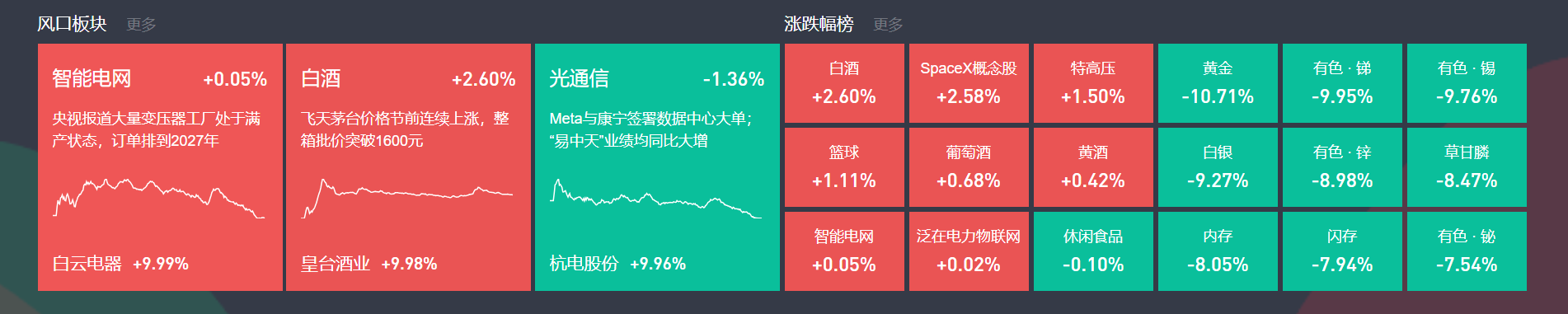
二、当日热点 1.智能电网 一、行情回顾 市场全天震荡调整,三大指数均跌超2%。电网设备板块逆势走强,通光线缆、双杰电气等多股涨停。白酒股延续涨势,皇台酒业3连板,金徽酒3天2板。下 跌方面,资源股集体调整,贵金属、油气方向领跌,中金黄金、四川黄金、准油股份等多股跌停;半导体芯片股下挫,兆易创新、闻泰科技等跌停,华虹公 司、北京君正等跌超10%。个股呈现普跌态势,沪深京三市近4700股飘绿,超百股跌停,今日成交2.61万亿。 | 股票名称 | | 最新价 = | 涨跌幅 = | 涨停时间 = | 换手率 = | 流通市值 ◆ | | | --- | --- | --- | --- | --- | --- | --- | --- | | | | | | | | | 1、公司已完成数据 750V直流方案已在 | | 白云电器 | | | | | | | 术, 服务中国联通、 | | 603861.SS | 2天2板 | 18.28 | +9.99% | 09:30:01 | 2.03% | 96.63亿 | 字化、智能化需求, | | | | | | | | | 投入,为智能电网 | | | | | | | | ...
大摩:AI算力一路向西
Ge Long Hui· 2026-02-02 08:10
Core Insights - Morgan Stanley's latest report highlights a positive trend in the data center sector driven by demand scale, resource availability, and the "East Data West Computing" policy, which encourages large-scale cloud service providers to shift data center deployments to remote areas, benefiting local data center builders [1] Group 1: Market Demand and Investment - The capital expenditure of mainland China's large-scale cloud service providers is projected to reach 440 billion RMB by 2026, with an estimated 32% (approximately 141 billion RMB) allocated for domestic computing power [1] - The report estimates that the total new orders for third-party data centers (excluding self-built data centers by cloud service providers) will increase by 66% to 3.4 gigawatts by 2026 [1] Group 2: Impact of AI Chips and Policy Changes - If the import of H200 chips by ByteDance, Alibaba, Tencent, and DeepSeek is fully approved, the forecast for new orders in China's third-party data centers could be revised upwards to approximately 4.5 gigawatts by 2026, representing a year-on-year increase of 120% [1] - In a baseline scenario, remote data centers are expected to contribute 2.4 gigawatts of new orders by 2026, increasing to 3.3 gigawatts by 2027, accounting for about 70% of new orders [1] Group 3: Regional Development and Infrastructure - The "East Data West Computing" initiative effectively consolidates supply into ten major clusters, primarily focused on four remote cities, with Inner Mongolia's Ulanqab and Ningxia's Zhongwei identified as key beneficiaries in the AI era [1] - Zhongwei is emerging as a new data center hub, aiming for a total capacity of 750 megawatts by the end of 2025, with a long-term goal of achieving 2 gigawatts by the end of 2027 [1] - Alibaba is a key player in the Zhongwei cluster, having established infrastructure connecting the hub with data transmission capabilities [1] Group 4: Historical Context and Future Prospects - Since 2016, Zhongwei has welcomed its first batch of data center projects, with clients including AWS China, Qihoo 360, and Meituan, indicating a mature local network infrastructure and talent pool [1] - Several internet and cloud companies, including Tencent, Alibaba, and Baidu, are interested in establishing parks in Zhongwei, along with AI firms like Zhipu [1]

LED驱动芯片三巨头2025业绩图谱 盈利与亏损缘何分化?
Ju Chao Zi Xun· 2026-02-02 07:52
Core Insights - The LED driver chip market in 2025 faces significant challenges due to intense competition and price pressures, leading to a situation of "increased revenue but no profit" for many companies [2][8] - There is a notable divergence in performance among major listed companies, with Jingfeng Mingyuan successfully reversing losses, while Fumanwei and Mingwei Electronics continue to struggle with losses, highlighting the differences in strategic paths during industry downturns [2][3] Performance Analysis - Jingfeng Mingyuan achieved a revenue of approximately 1.57 billion yuan, a year-on-year increase of 4.41%, and a net profit of 36 million yuan, a substantial increase of 208.92% from 2024, indicating a significant improvement in its core business profitability [3] - Mingwei Electronics is in a "revenue without profit" situation, with expected revenue between 660 million to 670 million yuan, a year-on-year growth of 8.66% to 10.31%, but a net loss of 45 million to 54 million yuan, with further losses in non-recurring profit [3] - Fumanwei anticipates revenue of 850 million to 870 million yuan, showing growth compared to 2024, but a net loss of 150 million to 190 million yuan, primarily impacted by inventory impairment losses and share-based payment expenses [3] Business Structure - Jingfeng Mingyuan has built a diversified product ecosystem through mergers and self-research, focusing on multiple areas including LED lighting, AC/DC, motor control, wireless charging, and automotive chips, achieving a dual-driven growth model [4] - Fumanwei has expanded into 5G RF chips, power management chips, and storage chips, but new business contributions are limited due to project delays, and it has attempted to raise prices for LED display products to mitigate cost pressures [5] - Mingwei Electronics focuses on LED driver chips with a "Fabless + self-built testing" model, emphasizing cost and delivery efficiency, but its single business structure limits profitability elasticity under price pressure [5] Technological Development - The intensified competition has prompted companies to increase technological investments, with process upgrades and cost control becoming key strategies [6] - Jingfeng Mingyuan has achieved mass production of its sixth-generation BCD-700V high-voltage process platform, enhancing its high-voltage technology advantage, while also reducing unit costs through new packaging solutions [6] - Mingwei Electronics is iterating products in line with Mini/MicroLED technology trends, but the overall price pressure in the industry has hindered the full realization of cost benefits from technological upgrades [6] - Fumanwei's R&D investment accounted for 21.98% of its revenue in 2024, but project delays have affected the efficiency of technology conversion, leading to a "high investment, low output" situation [6] Industry Trends and Company Strategies - The LED driver chip industry is experiencing a dual trend of "traditional market contraction and emerging demand rise," with Mini/MicroLED and automotive electronics becoming new growth points [7] - Jingfeng Mingyuan employs a strategy of "technology positioning and ecological layout," achieving breakthroughs in high-end markets while avoiding low-end price wars [7] - Fumanwei is addressing short-term pressures through price increases and accelerating project implementation, but it needs to optimize its revenue structure in the long term [7] - Mingwei Electronics focuses on its core business and technology, aiming to establish competitive advantages in niche areas through continued investment in new display technologies [7] Summary - 2025 marks a critical year of increasing divergence in the LED driver chip industry, with Jingfeng Mingyuan achieving profitability through diversified strategies, while Fumanwei faces challenges despite revenue growth, and Mingwei Electronics continues to incur losses due to its single business structure [8] - The competition is expected to intensify in 2026, with the commercialization of Mini/MicroLED and the demand for automotive electronics and high-performance computing power driving industry growth [8] - Companies need to strengthen their technological depth, product breadth, and integration within the supply chain to navigate the evolving landscape [8]



长城投研速递:宏观波动加剧,市场或迎来节前配置窗口期
Sou Hu Cai Jing· 2026-02-02 07:47
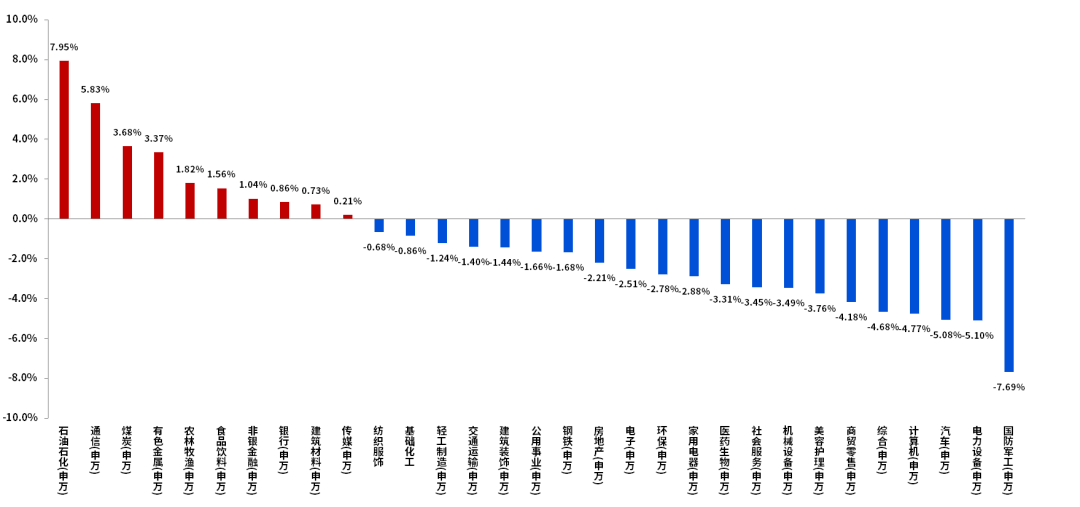
Policy Direction - The top-level design of urban renewal is continuously strengthened, and urban renewal practices are deepening across various regions, which is expected to stabilize the real estate market and expand domestic demand [4] - The Ministry of Natural Resources and the Ministry of Housing and Urban-Rural Development issued a notice to support urban renewal actions, evaluating and optimizing detailed plans for proposed urban renewal areas [4] - In 2024, there will be 60,015 urban renewal projects nationwide, with a total investment of 2.9 trillion yuan, focusing on the renovation of old urban communities, urban village transformations, and underground pipeline upgrades [4] Domestic Macro - In January 2026, the manufacturing PMI was 49.3%, a decrease of 0.8 percentage points from the previous month, falling below the average level for the same period in recent years [5] - The decline in PMI is stronger than seasonal trends, indicating a cautious expansion in production and a need for demand stimulation [5] - The Ministry of Finance has stated that overall expenditure will "only increase" and key areas will be "stronger," suggesting a more proactive macro policy to support total demand in 2026 [5] Foreign Macro - The Federal Reserve's decision to maintain interest rates in January 2026 was in line with market expectations, with a more optimistic outlook on the economy, employment, and inflation, adding uncertainty to the potential for restarting interest rate cuts [6] - The nomination of Kevin Warsh as the next Federal Reserve Chairman suggests a balance between maintaining the Fed's independence and aligning with Trump's policies, with expectations of 2-3 rate cuts in 2026 [8] Bond Market - The bond market is expected to maintain a volatile pattern due to mixed factors, with the 10-year government bond yield approaching a resistance level of 1.8% [9] - The market suggests patience in waiting for better allocation or trading opportunities amid the current fluctuations [12] Equity Market - The market structure shifted last week, with cyclical and financial sectors leading gains, while military and power equipment sectors declined [21] - The Shanghai Composite Index fell by 0.44%, while the Shenzhen Component Index decreased by 1.62%, with 10 out of 31 industries showing gains [13] - The overall value style outperformed growth style, with the National Value Index rising by 1.01% and the National Growth Index falling by 0.59% [14] Investment Strategy - The focus is on emerging technologies as the main line of investment, with value stocks also showing potential [22] - Specific areas of interest include technology growth sectors, non-bank financials benefiting from increased wealth management demand, and cyclical sectors poised for recovery due to domestic demand expansion policies [22]
芯片股集体回调,关注科创芯片ETF易方达(589130)、科创芯片设计ETF易方达(589030)等产品投资机会
Mei Ri Jing Ji Xin Wen· 2026-02-02 07:02
Group 1 - The semiconductor sector experienced a collective pullback, with the Sci-Tech Chip Index down by 4.4% and the Sci-Tech Chip Design Index down by 4.8% as of 14:35 on February 2 [1] - Recent data from Wind indicates that the Sci-Tech Chip ETF (E Fund 589130) and the Sci-Tech Chip Design ETF (E Fund 589030) have seen net inflows for three consecutive trading days, attracting market attention [1] - A price increase trend is emerging across the entire semiconductor supply chain, with major companies like MediaTek and Analog Devices announcing price adjustments to reflect rising manufacturing costs [1] Group 2 - China Galaxy Securities notes a revival in the analog chip design sector, with companies like Analog Devices and Texas Instruments announcing price hikes, suggesting a potential shift in supply-demand dynamics within the analog chip industry [1] - In the digital chip sector, advanced design fields such as AI computing power and domestic CPUs are showing strong performance, indicating that the direction of self-controlled domestic digital chips will remain a long-term focus [1] - The Shanghai Stock Exchange Sci-Tech Chip Index covers various segments of the semiconductor industry, with digital chip design and semiconductor equipment accounting for approximately 65% of the index [2]
研报掘金丨东吴证券:维持凯格精机“买入”评级,公司业绩进入加速兑现阶段
Ge Long Hui A P P· 2026-02-02 06:23
Core Viewpoint - The report from Dongwu Securities highlights that Kaige Precision Machinery has experienced significant profit growth in 2025, driven by improvements in product structure and increased profitability due to the surge in AI computing power demand [1] Group 1: Financial Performance - The company achieved rapid growth in annual performance, primarily benefiting from the explosive demand for AI computing power, which led to a substantial increase in capital expenditures (CAPEX) from server OEMs [1] - The sales of high-margin products are expected to increase in 2025, indicating an optimization in the product structure [1] Group 2: Market Demand - The current explosion in AI computing demand is driving a high increase in sales of the company's high-end solder paste printing equipment, marking a phase of accelerated performance realization for the company [1] Group 3: Profit Forecast - The projected net profits attributable to the parent company for 2025-2027 are estimated to be 190 million, 400 million, and 600 million yuan respectively, with current stock prices corresponding to dynamic price-to-earnings ratios of 69x, 33x, and 22x [1] - The report maintains a "Buy" rating for the company based on these projections [1]


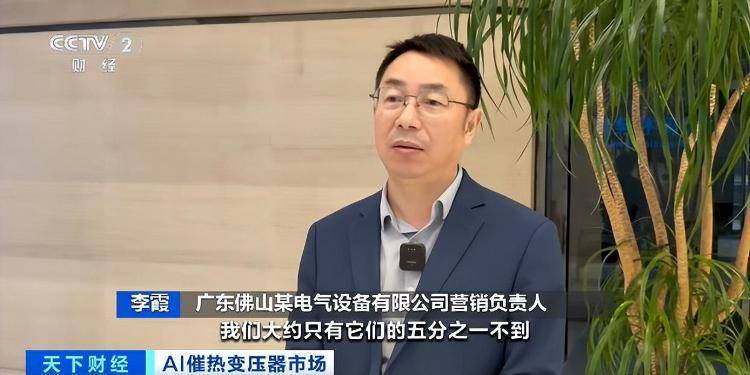
AI算力催生变压器稀缺性,订单排至2027年!科创人工智能ETF(589010)单边下行,思看科技逆势涨超9%
Mei Ri Jing Ji Xin Wen· 2026-02-02 06:13
Group 1 - The core viewpoint of the news highlights the current performance of the Sci-Tech Innovation Artificial Intelligence ETF (589010), which has seen a decline of 3.58% from its opening price, with 27 out of 30 constituent stocks experiencing losses, indicating a bearish trend in the AI sector [1] - The ETF's trading volume reached 58.87 million yuan, with a turnover rate of 2.36%, suggesting moderate trading activity [1] - The global demand for AI computing power is driving transformer upgrades, with factories in regions like Guangdong and Jiangsu operating at full capacity, and some data center orders extending to 2027 [1] Group 2 - Guolian Minsheng Securities maintains a positive outlook on AI investment opportunities, validating the industry's high prosperity through four dimensions: increased capital expenditure by tech giants, the transition of AI tools to executors, ongoing supply-demand tension in computing infrastructure, and the acceleration of AI application demand [2] - The Sci-Tech Innovation Artificial Intelligence ETF closely tracks the Shanghai Stock Exchange Sci-Tech Innovation Board AI Index, covering high-quality enterprises across the entire industry chain, benefiting from high R&D investment and policy support [2] - The ETF aims to capture the "singularity moment" in the AI industry, leveraging a 20% price fluctuation range and the elasticity of small and mid-cap stocks [2]
国产“电力心脏”全球爆单,订单排到2027年
Sou Hu Cai Jing· 2026-02-02 06:05
Core Insights - The global AI computing power construction is experiencing explosive growth, making high-power and stable electricity supply crucial for computing clusters, with transformers becoming a core component of computing infrastructure [1][9][16] Group 1: Transformer Industry Overview - Many transformer factories in regions like Guangdong and Jiangsu are operating at full capacity, with some orders for data center transformers extending to 2027 [1][3] - The U.S. market has seen delivery cycles for transformers extend from 50 weeks to 127 weeks due to the surge in demand [1] - China has become the world's largest transformer producer, accounting for approximately 60% of global production capacity [8][19] Group 2: Market Growth and Projections - China's transformer export value is projected to reach 64.6 billion yuan by 2025, representing a nearly 36% increase from 2024 [6] - The domestic transformer market is expected to grow by over 20% year-on-year by 2025, with AI computing and ultra-high voltage related high-end product orders exceeding 35% of total orders [15] Group 3: Technological Advancements - The transformer industry in China is accelerating technological iterations to meet the high power quality demands of AI supercomputing clusters, focusing on the development of solid-state and high-frequency transformers [16][21] - New technologies, such as carbon-silicon power electronic transformers, are being explored to enhance efficiency and reduce energy loss in the context of high renewable energy integration [18] Group 4: Regional Developments - Significant projects are underway to enhance power supply capabilities, such as the 500 kV transformer project in Beijing and the 220 kV transformer project in Wuhu, which improve the reliability of power supply for computing centers [9][11]
2月铜月报:供应紧缺支撑铜价,宏观情绪放大波动-20260202
Chang Jiang Qi Huo· 2026-02-02 05:43
供应紧缺支撑铜价,宏观情绪放大波动 2月铜月报 2026-2-2 01 行情回顾 02 宏观因素分析 03 基本面分析 目 录 04 后市展望 01 行情回顾 01 沪铜行情回顾 位。智利Mantoverde铜矿因谈判无果将持续罢工,南方铜业(Southern Copper)预计未来两年产量因矿石品位下降而下滑。美国总统特朗普表示,暂不 考虑对关键矿产包括铜加征关税,LME-COMEX套利空间随即收窄。铜价高位国内下游开工承压,国内库存连续累库。随着美元指数走强,叠加资金止盈 情绪升温,有色金属及贵金属价格回调。长期新能源、电力及AI算力需求支撑仍存,基本面支撑较强,但凯文·沃什被提名下届美联储主席下美联储货币政 策不确定性强,预计铜价宽幅震荡运行。 60000 70000 80000 90000 100000 110000 120000 26-01-30 26-01-26 26-01-20 26-01-14 26-01-08 25-12-31 25-12-25 25-12-19 25-12-15 25-12-09 25-12-03 25-11-27 25-11-21 25-11-17 25-11-11 25 ...