保护主义

Search documents
李强同爱尔兰总理会谈
Yang Shi Wang· 2026-01-06 12:11
央视网消息(新闻联播):国务院总理李强1月6日下午在京同来华进行正式访问的爱尔兰总理马丁举行 会谈。 李强表示,昨天,习近平主席同总理先生举行会晤,就深化中爱关系作出战略指引。在中爱共同努力 下,两国互惠战略伙伴关系持续走深走实,各领域合作不断取得新的成果。中方愿同爱方巩固增强政治 互信,照顾彼此重大利益和核心关切,高质量推进务实合作,推动双边关系不断迈上新台阶,实现更高 水平的互利共赢。 马丁表示,爱尔兰坚定致力于进一步深化两国互惠战略伙伴关系,愿同中方加强各层级交往,促进经 贸、绿色经济、人文等领域交流合作。欢迎更多中国企业赴爱投资。爱方愿同中方密切多边协调,反对 单边主义、保护主义,共同维护世界和平稳定与发展繁荣。爱方愿为促进欧中对话与合作发挥建设性作 用。 吴政隆参加上述活动。 李强指出,中爱两国的经济互补性强,双方应当加强发展战略对接,深挖各领域合作潜力。中方愿同爱 方拓展飞机租赁、保险、医疗、健康等服务贸易,深化绿色能源、数字经济、人工智能等领域合作,同 时进一步便利人员往来,加强人文领域交流合作,不断夯实两国友好的民意基础。当前,国际经贸秩序 遭受严重冲击。中方愿同爱方加强多边沟通协作,维护多边 ...
中韩元首两月两次见面
Xin Lang Cai Jing· 2026-01-06 05:03
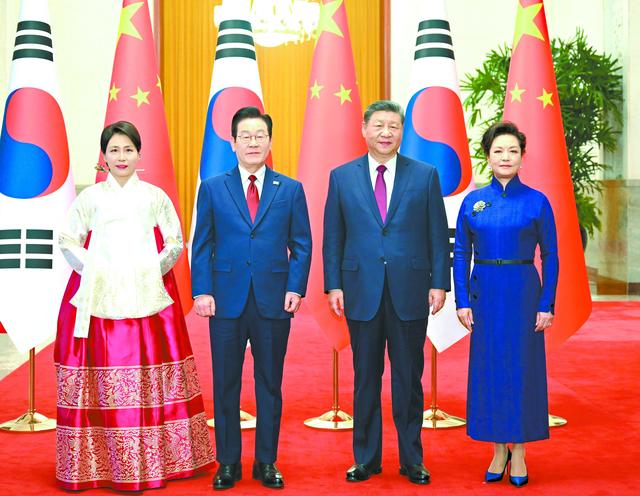
Group 1 - The meeting between Chinese President Xi Jinping and South Korean President Lee Jae-myung on January 5 marks a significant diplomatic engagement, emphasizing the importance of China-South Korea relations and mutual respect for core interests [3][4][5] - Both leaders expressed a commitment to enhance cooperation in various sectors, including technology, environmental protection, transportation, and trade, with 15 cooperation documents signed [6][8] - The discussions highlighted the historical context of cooperation between China and South Korea, particularly in the face of regional challenges, and the need to strengthen economic ties amidst global changes [5][9] Group 2 - The South Korean government aims to leverage this visit as a pivotal moment to restore and enhance bilateral relations, with a focus on economic collaboration and addressing mutual concerns [9][10] - The business forum held in Beijing saw participation from major South Korean corporations, indicating strong interest in deepening economic ties, particularly in emerging technologies like artificial intelligence [7][8] - The establishment of regular meetings between trade ministers from both countries is expected to accelerate negotiations on the second phase of the China-South Korea Free Trade Agreement [9]

《环球时报》社评:“搬不走的重要近邻”有了务实合作新起点
Bei Jing Ri Bao Ke Hu Duan· 2026-01-05 23:23
习近平主席在会谈中强调,作为朋友和邻居,中韩应该多走动、常来往、勤沟通;要加强发展战略对接 和政策协调,做大共同利益蛋糕;要增进人员往来,让正面叙事成为民意主流;应当坚定站在历史正确 一边,作出正确战略选择;要共同反对保护主义,践行真正的多边主义。这一重要论述以战略高度精准 概括了中韩关系的本质,也为巩固中韩关系全面恢复发展势头提供了指引。 转自:北京日报客户端 1月5日下午,国家主席习近平在北京人民大会堂同来华进行国事访问的韩国总统李在明举行会谈。习近 平主席指出,我和李在明总统已两次见面并实现互访,体现了双方对中韩关系的重视。会谈后,双方共 同见证签署科技创新、生态环境、交通运输、经贸合作等15份合作文件。韩国媒体普遍将此访视为"务 实外交"在新年的重要开局,认为其为中韩关系全面恢复发展提供了现实支点。 去年11月习近平主席与李在明总统在韩国庆州会晤时指出:"中韩是搬不走的重要近邻。"是邻居就应该 常来常往。中韩现在各自实施了对对方公民的单方面免签政策,"周末去上海"掀起热潮,《原神》《鸣 潮》《燕云十六声》等中国游戏火爆韩国,见证着"多走动"的民生温度;大湾区韩国氢能科创企业"走 进来",中韩合作绿色技 ...
社评:“搬不走的重要近邻”有了务实合作新起点
Huan Qiu Wang· 2026-01-05 17:03
Group 1 - The meeting between Chinese President Xi Jinping and South Korean President Lee Jae-myung emphasizes the importance of bilateral relations and mutual visits, reflecting both countries' commitment to strengthening ties [1] - A total of 15 cooperation documents were signed, covering areas such as technological innovation, ecological environment, transportation, and economic trade, indicating a significant step towards comprehensive recovery and development of China-South Korea relations [1][2] - The economic cooperation remains a cornerstone of the China-South Korea relationship, with China being South Korea's largest trading partner and the bilateral trade expected to grow in 2024 despite global challenges [2][3] Group 2 - The stable and improving China-South Korea relationship is seen as beneficial for both countries' development needs and responds to global expectations amid rising unilateralism and protectionism [3] - Historical ties, particularly the shared experience of resisting Japanese militarism, provide a foundation for cooperation on major issues such as maintaining post-World War II international order and regional stability [3] - The ongoing friendly cooperation and mutual development between China and South Korea are viewed as essential for building trust and contributing to global prosperity [3]
习近平向瑞士新任联邦主席致贺电
Yang Shi Wang· 2026-01-01 12:04
Core Viewpoint - The communication between Chinese President Xi Jinping and Swiss Federal President Parmelin highlights the strengthening of Sino-Swiss relations, particularly through the advancement of the free trade agreement negotiations initiated during Xi's 2017 state visit to Switzerland [1] Group 1: Bilateral Relations - The free trade agreement upgrade negotiations have made positive progress under President Parmelin's leadership [1] - Both countries are committed to supporting free trade amidst rising unilateralism and protectionism, reflecting the high-level development of Sino-Swiss relations [1] Group 2: Future Opportunities - The year 2026 marks the 10th anniversary of the Sino-Swiss innovative strategic partnership and the beginning of China's 14th Five-Year Plan, presenting broad opportunities for innovation cooperation between the two nations [1] - There is a strong emphasis on expanding mutually beneficial cooperation to elevate Sino-Swiss relations to new heights for the betterment of both peoples [1]
肥价高20%,用量被迫削减!欧盟化肥制裁得不偿失
Xin Lang Cai Jing· 2025-12-31 16:01
Core Insights - The rising fertilizer prices in the EU, coupled with regulatory changes from Brussels, have put thousands of European farmers in a difficult position of increasing costs and shrinking profits [1][3] - The EU's sanctions on Russian and Belarusian fertilizers, which are significant suppliers to the European market, have exacerbated the situation, potentially increasing EU fertilizer expenditures by approximately €4 billion [1][3] - The increase in input costs has led to reduced fertilizer usage among European farmers, resulting in decreased crop yields and heightened risks of food shortages and inflation [1][3] Regulatory Impact - Domestic policies, such as the Nitrates Directive, aimed at limiting the environmental impact of fertilizer use, have added extra costs and restricted operational methods for European farmers [2][4] - European farmers face strict compliance requirements, while many foreign producers are not subject to the same regulations, allowing their products easier access to the EU market [2][4] - Efforts to limit external suppliers have not revitalized the domestic fertilizer industry but have instead weakened the competitiveness of most local producers [2][4] Industry Criticism - Agricultural organizations have criticized EU agricultural policies as mere "smoke and mirrors," with warnings that rising costs and declining profits are driving the new generation of farmers away from the industry [5] - China's significant reduction in phosphate exports, which account for nearly 30% of global supply, has further tightened the already fragile EU market [5] - The EU's various restrictions have not only failed to boost domestic production but have also exposed the region to new external supply risks [5]
美国关税高压不好使了
Xin Lang Cai Jing· 2025-12-30 16:03
Core Viewpoint - The global public increasingly criticizes the U.S. tariff war as "unilateral bullying," with over 60% of respondents supporting China's countermeasures against these tariffs [1] Group 1: Global Perception - More than 70% of global respondents recognize and support China's retaliatory measures against U.S. tariffs [1] - The survey indicates a significant shift in global sentiment towards U.S. trade policies, highlighting a growing consensus against unilateral actions [1] Group 2: China's Position - Liu Ying, a researcher at Renmin University, emphasizes that smaller countries often have no choice but to accept tariffs imposed by larger nations, but China's active countermeasures have encouraged other nations to lower their tariffs [1] - China's approach to countering U.S. tariffs is seen as a defense of justice and a stand against unilateralism, hegemony, and protectionism [1]
第二个抢劫中国资产的国家出现,中国企业撤资,整个欧洲信誉破产
Sou Hu Cai Jing· 2025-12-28 17:40
曾经被视为投资乐土的欧洲,正以国家安全为名上演一场针对中国资产的掠夺狂欢。从荷兰强行接管安世半导体,到英国追溯性剥夺FTDI公司股权,短短 数月间欧洲多国接连撕下市场经济伪装。 这种用法律包装的强制征收行为,不仅违背了欧盟长期宣扬的私有财产保护原则,更让全球投资者看清一个事实:当西方规则不利于自身时,它们会毫不犹 豫地改写规则。2025年末欧盟900亿欧元援乌计划的破产,以及成员国对没收俄罗斯资产的激烈争吵,进一步暴露了欧洲正陷入战略焦虑与信用崩塌的恶性 循环。 荷兰政府2025年对安世半导体的接管堪称教科书式的强制征收案例。这场行动启动于9月30日清晨,荷兰王室动用了二战时期《物资可用法案》这一特殊法 律工具,在24小时内完成资产冻结、管理层更换和股权转移全套程序。 具有讽刺意味的是,安世半导体被中资收购后业绩大幅改善,2024年营收达到37亿美元,较2017年增长近三倍,且实现零负债运营。荷兰方面的突击行动直 接触发了中国商务部的反制,安世半导体在中国境内的工厂被禁止向欧洲出口芯片,这对每三辆汽车就有一辆使用安世芯片的欧洲汽车业造成立即冲击。 英国政府对FTDI公司的股权剥夺展现出更隐蔽的法律操纵手段。2 ...

如何理解高质量共建“一带一路”
Xin Lang Cai Jing· 2025-12-27 19:43
Core Viewpoint - The Belt and Road Initiative (BRI) is a significant global economic cooperation initiative proposed by China, emphasizing high-quality development and international collaboration in the context of current global challenges [1][2]. Group 1: Achievements of the Belt and Road Initiative - The BRI has evolved from a Chinese initiative to a global practice, becoming the largest and most influential international economic cooperation platform, benefiting over 150 countries [2]. - Infrastructure connectivity has improved significantly, with over 80,000 passenger trains operating on the China-Laos Railway and more than 62.5 million passengers transported, while the China-Europe Railway Express has surpassed 120,000 trips [2]. - Cultural exchanges and cooperation in areas such as tourism and education have strengthened ties with partner countries, creating a diverse and interactive cultural exchange landscape [2]. Group 2: New International Context - The BRI faces new challenges due to rising unilateralism and protectionism, as well as frequent local conflicts, but the overall opportunities outweigh the challenges [3]. - There is a need for strategic confidence and determination to address risks and challenges effectively, while enhancing the sense of gain among partner countries [3]. Group 3: New Requirements for High-Quality Development - The BRI should focus on eight actions guided by high-quality development, emphasizing systematic and mechanized approaches, and integrating various aspects of development and security [4]. - Key priorities include strengthening cooperation with partner countries, enhancing infrastructure connectivity, improving practical cooperation quality, and ensuring a diversified and sustainable financing system [4].
利润逆势上扬,中国何以成跨国企业“增长福地”?
Sou Hu Cai Jing· 2025-12-27 06:50
Core Viewpoint - The latest industrial profit data from China's National Bureau of Statistics indicates a resilient and hopeful development amidst global economic challenges, with a 0.1% year-on-year increase in profits for large-scale industrial enterprises from January to November 2025, primarily driven by a 2.4% growth in profits from foreign and Hong Kong, Macau, and Taiwan-invested enterprises [1][2]. Group 1: Data Comparison - There is a significant divergence in profit trends among different types of enterprises, with state-owned enterprises experiencing a 1.6% year-on-year decline, joint-stock enterprises down 0.4%, and private enterprises down 0.1%, while foreign and Hong Kong, Macau, and Taiwan-invested enterprises saw a profit increase of 2.4%, totaling 1,635.53 billion yuan [2]. Group 2: Factors Supporting Growth - The success of foreign-invested enterprises amidst challenges is attributed to China's ongoing high-level opening-up, the creation of a market-oriented, law-based, and international business environment, and the continuous reduction of the negative list for foreign investment [3]. - China's vast market, characterized by a complete industrial system, an upgrading consumer market, and efficient infrastructure, provides robust support for foreign enterprises, which view China as a strategic market rather than just a low-cost production base [3]. - The stability and predictability of policies in China, in contrast to the frequent policy shifts in other economies, instill long-term investment confidence in multinational companies [3]. Group 3: Win-Win Effects - The performance of foreign-invested enterprises not only reflects their profit growth but also enhances the overall competitiveness of China's industrial system through collaboration in the supply chain, technology spillover, and management demonstration [4]. - Foreign enterprises contribute to the stability of employment and increase orders for upstream and downstream small and medium-sized enterprises by deeply embedding themselves in local supply chains [4]. - They serve as a crucial link in connecting domestic and international dual circulation, aiding Chinese manufacturing in moving up the global value chain [4]. Group 4: Open vs. Closed Logic - Some countries are adopting protectionist measures and market barriers, attempting to gain benefits through isolation. However, China's experience demonstrates that true competitiveness arises from open cooperation and fair competition [5]. - The profit growth of foreign enterprises in China is a direct affirmation of the fairness and profitability of the Chinese market, showcasing the success of China's economy and the effectiveness of an open logic against a closed one [5]. Group 5: Future Prospects - Chinese leadership has emphasized that the door to openness will only widen, with future initiatives aimed at opening up service sectors, digital economy, and green low-carbon fields, creating a more transparent, convenient, and fair investment environment [6]. - For multinational companies, the Chinese market is not only a "must-have" but also a "source of growth" [6]. Group 6: Reflection of Market Conditions - The reverse growth of foreign enterprises in China reflects the true temperature of the Chinese market, characterized by a broad arena for fair competition without barriers like "glass doors" or "revolving doors" [7]. - The 2.4% growth signifies not just numerical progress but also a vivid interpretation of China's commitment to openness and win-win development in the context of globalization [7].