
新消费

Search documents
从“中国版立顿”到欠薪风波,茶里发生了什么?
3 6 Ke· 2026-02-05 22:58
Core Insights - The article discusses the rise and fall of ChaLi, a brand that was once considered a "star brand" in the new consumption wave, and examines the strategic missteps that led to its current challenges [2][20]. Company Overview - ChaLi was founded in 2013 by Tan Qiong, who initially had no background in tea but became involved through a feasibility study for a B2B tea trading platform [3][6]. - The brand focuses on high-quality, convenient tea products, primarily using original leaf triangular tea bags, which cater to modern consumption habits [4][5]. Financial and Market Performance - ChaLi experienced rapid growth during the new consumption boom from 2018 to 2021, achieving significant sales milestones, including nearly 10 million sales during the 2016 Double Eleven shopping festival [9]. - The brand was often referred to as the "Chinese version of Lipton," benefiting from multiple rounds of financing and a strong market presence [8][9]. Strategic Challenges - The brand faced significant challenges as the market for bagged tea matured, leading to increased competition and a shift in consumer preferences [12][14]. - A strategic miscalculation in the ready-to-drink (RTD) tea segment resulted in cash flow issues, contributing to delayed salary payments and supplier settlements [2][11][17]. Industry Context - The tea market in China is characterized by diverse consumer preferences and fragmented consumption scenarios, making it difficult for any single brand to dominate [14][20]. - The decline of traditional bagged tea sales and the challenges faced by established brands like Lipton indicate that the market may not support a "next Lipton" scenario [12][14]. Lessons Learned - The experience of ChaLi highlights the importance of aligning organizational capabilities with market demands, especially when transitioning to new product categories [20]. - The brand's journey underscores that the second growth curve is not guaranteed and requires a robust organizational structure and financial resilience [20][21].


“舞”动青春:让“热爱”在湖南生根
Xin Lang Cai Jing· 2026-02-05 20:14
街舞教师海涛。 受访者 供图 "5,6,7,走!"2月4日,长沙HUK街舞工作室里,32岁的POPPING街舞教师海涛在镜子前,拆解着一 个个舞蹈动作,反复地跟学生进行讲解。从2008年在湖南第一次接触街舞,到辗转东北求学、远赴美国 和澳大利亚探寻街舞文化源流,再到回湖南深耕教学与创作,海涛的人生轨迹,恰好折射出越来越多年 轻人的选择:走得再远,依然愿意回到湖南,把热爱落地生根。 "过去,年轻人是否留在一座城市,往往取决于一份工作;而如今,更多年轻人关心的是:这座城市, 是否允许我慢慢成长?是否尊重我的选择?"海涛说。 对于像海涛这样的文化艺术从业者而言,现实问题从来不是"有没有梦想",而是"梦想能不能被托住"。 "长沙的舞蹈行业有很大的发展空间,机会也有很多。只要你专业够扎实,就能找到对应的岗位或合作 方式。"海涛表示,回到湖南就业后,他感受到的是一种相对包容的环境——允许尝试,也接受不同节 奏。 "湖南人'吃得苦,霸得蛮',我在很多人身上都看到了这种不服输的精神。"海涛告诉记者,"这样的精神 也常常给我很大的激励,也让我更能看清自己未来发展的方向。" 现在海涛已经找到了自己热爱的、想为之奋斗的事业,他说: ...

确认!张忆东,入职海通国际!
证券时报· 2026-02-05 10:00
Group 1 - Zhang Yidong, the former global chief strategy analyst of Industrial Securities, is set to join Haitong International Securities as a committee member, head of the equity research department, and chief economist [1] - Zhang aims to enhance Haitong International's research capabilities and implement the group's strategy for integrated research operations both domestically and internationally, leveraging resources from the headquarters and subsidiaries [1] - The strategy focuses on attracting foreign investment back to China and increasing foreign holdings in the Chinese stock market while also strengthening overseas research capabilities to meet the asset allocation needs of Chinese institutions abroad [1][2] Group 2 - Zhang Yidong emphasizes four key investment opportunities for 2026: growth sectors such as AI, military industry, energy technology, new consumption, and innovative pharmaceuticals; strategic high-yield assets in a low-interest-rate environment; traditional industries benefiting from supply chain restructuring and globalization; and core assets like gold and rare earths amid global order restructuring [3] - Zhang has expressed strong confidence in both A-shares and Hong Kong stocks, highlighting the importance of focusing on structural highlights and medium to long-term development while downplaying short-term economic fluctuations [2] - The macroeconomic outlook for 2026 includes an expected improvement in nominal GDP growth and a moderate recovery in inflation compared to 2025 [2]


港股复盘 | 近250亿港元!南向资金疯狂抄底
Mei Ri Jing Ji Xin Wen· 2026-02-05 09:00
恒生科技指数一度跌近2%,最终收盘报收5406.13点,上涨39.69点,涨幅0.74%。 市场焦点方面,腾讯控股(HK00700)近期持续回落,今日一度跌超3%,本月以来最大累计跌幅超过 10%。不过午后强势回升,最终收盘报558.5港元,微涨0.09%。 其他科网股集体反弹,小米、百度涨超2%,美团涨超1%。 今日(2月5日),港股市场探底回升,恒生指数和恒生科技指数双双报收红盘。 市场热点方面,新消费概念强势,名创优品(HK09896)涨超6%。 恒生指数今日一度跌超1.6%,最终收盘报26885.24点,上涨37.92点,涨幅0.14%。 | 分时 5日 = 5分 15分 30分 00分 图K 用K 月K #K = | | | | MAN INNER (00060) BJ100 P 11 / II + W | | | | --- | --- | --- | --- | --- | --- | --- | | 名僧忧品 4. 3807 | | | 0000 | | | | | 9-43.820 | | | | | | | | | | | 旺情报价 | | | | | | | | 成交量 | 634万股 ...
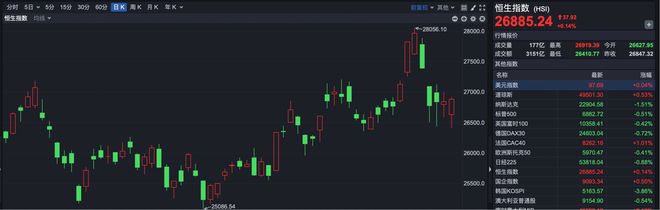
港股收盘 | 恒指收涨0.14% 科网股午后回暖 百胜中国绩后大涨11%
Zhi Tong Cai Jing· 2026-02-05 08:50
Market Overview - Hong Kong stocks opened lower but closed higher, with the Hang Seng Index rising by 0.14% to 26,885.24 points and a total turnover of HKD 315.11 billion [1] - Morgan Stanley noted that despite recent market volatility, effective measures to cool A-shares, a stronger USD against RMB, and long-term regulatory support for Hong Kong are expected to provide positive liquidity support for both A-shares and Hong Kong stocks [1] Blue-Chip Performance - Baidu Group-SW (09888) saw a 2.7% increase, closing at HKD 140.9, contributing 7.38 points to the Hang Seng Index. The company announced a new stock buyback plan of up to USD 5 billion, effective until December 31, 2028, and plans to adopt a dividend policy by 2026 [2] - Other blue-chip stocks included Haidilao (06862) up 4.03%, Lenovo Group (00992) up 3.67%, while Zijin Mining (601899) fell 4.76% and New Oriental-S (09901) dropped 3.13% [2] Sector Performance - Large tech stocks rebounded, with Xiaomi and Baidu both rising nearly 3%. Consumer stocks performed well, with Yum China surging over 11% post-earnings [3] - The precious metals sector saw a sharp decline, with gold and silver prices dropping significantly. The market for precious metals is expected to remain volatile due to various economic pressures [4] - The space photovoltaic concept saw a decline, with companies like Junda Co. (02865) dropping 12.35% [4][5] Chip Sector - Chip stocks faced pressure, with companies like Zhaoyi Innovation (03986) down 4.47% and Shanghai Fudan (01385) down 3.34%. The decline was influenced by AMD's significant drop of 17.31% following its earnings report [6] Company Earnings - Yum China reported total revenue of USD 11.797 billion for 2025, a 4% increase, with a net profit of USD 929 million, up 2%. The company plans to pay a dividend of 29 cents per share [7] - MGM China (02282) reported a net revenue of approximately USD 4.462 billion for the year ending December 31, 2025, a 10.92% increase [8] - Tianqi Lithium (002466) saw a significant drop of 13.33% after announcing a placement of 65.05 million new H-shares at a discount [9] - New World Development (01030) fell 13.17% after announcing a placement of 198 million shares at a discount to raise funds for future development and debt repayment [10]

港股收盘(02.05) | 恒指收涨0.14% 科网股午后回暖 百胜中国(09987)绩后大涨11%
智通财经网· 2026-02-05 08:48
Market Overview - Hong Kong stocks opened lower but closed higher, with the Hang Seng Index rising by 0.14% to 26,885.24 points and a total turnover of HKD 315.12 billion [1] - Morgan Stanley noted that despite recent market volatility, effective measures to cool A-shares, a stronger USD against RMB, and long-term regulatory support for Hong Kong are expected to provide positive liquidity support for both A-shares and Hong Kong stocks [1] Blue-Chip Performance - Baidu Group-SW (09888) saw a 2.7% increase, closing at HKD 140.9 with a turnover of HKD 3.238 billion, contributing 7.38 points to the Hang Seng Index [2] - Baidu announced a new stock buyback plan with a maximum amount of USD 5 billion, effective until December 31, 2028, and approved a dividend policy expected to be announced in 2026 [2] - Other blue-chip stocks included Haidilao (06862) up 4.03%, Lenovo Group (00992) up 3.67%, while Zijin Mining (02899) fell 4.76% and New Oriental-S (09901) dropped 3.13% [2] Sector Performance Consumer Sector - Large consumer stocks performed well, with Yum China rising over 11% post-earnings, and other consumer stocks like Mao Ge Ping (01318) up 5.29% and Haidilao (06862) up 4.03% [3] - Citigroup highlighted that the 2026 consumer recovery will rely on sustainable profit growth rather than short-term policy stimulus, naming several companies as industry favorites [3] Precious Metals - The precious metals sector saw a significant decline, with gold and silver prices dropping sharply, and major companies like China Aluminum (02600) and Jiangxi Copper (00358) also experiencing losses [4] - Guojin Securities indicated that the gold and silver markets are becoming increasingly volatile, influenced by various macroeconomic factors [4] Space Photovoltaics - The space photovoltaic concept saw a decline, with companies like Junda Co. (02865) dropping 12.35% as the technology is still in the early exploration phase [5] - The China Photovoltaic Industry Association stated that the technology is not yet ready for large-scale commercialization [5] Semiconductor Sector - Semiconductor stocks faced pressure, with companies like Zhaoyi Innovation (03986) down 4.47% following a significant drop in AMD shares, which fell 17.31% after disappointing guidance despite strong revenue growth [6] - The decline in AMD affected other major storage companies, leading to collective losses in the sector [6] Notable Company Updates - Yum China reported total revenue of USD 11.797 billion for 2025, a 4% increase, with a net profit of USD 929 million, reflecting a 2% growth [7] - MGM China (02282) reported a net revenue of approximately USD 4.462 billion for the year ending December 31, 2025, a 10.92% increase [8] - Tianqi Lithium (09696) saw a significant drop of 13.33% after announcing a placement of new H-shares and convertible bonds, raising a total of HKD 58.61 billion [9] - New City Development (01030) fell 13.17% after announcing a share placement at a discount to raise funds for future development and debt repayment [10]
单点爆款如何走远?湖南两会寻路新消费发展
Xin Lang Cai Jing· 2026-02-05 07:53
Group 1 - The core viewpoint is that new consumer brands in Hunan, represented by Wenheyou and Chayan Yuesheng, are rapidly emerging and creating a complete ecosystem covering various aspects of life, leading to discussions on transforming "single-point hits" into "healthy business models" [1] - Wenheyou has successfully integrated local cultural memories with dining experiences by recreating the old street scenes of Changsha in shopping malls, which has attracted attention as a case of turning "internet-famous" into "long-lasting" [1] - The transformation of one-time consumption into ongoing experiences through cultural narratives is seen as key to extending the lifecycle of new consumer brands, according to Yang Feiwen, a member of the Hunan Provincial Political Consultative Conference [1] Group 2 - There is a call for breaking down commercial barriers and planning a consumption corridor along the Xiangjiang River to enhance the synergy of the consumption ecosystem, as suggested by Li Hongquan, a representative of the Hunan Provincial People's Congress [1] - The proposal includes deepening the cross-industry integration of culture, commerce, tourism, sports, and performances to cultivate new nighttime business formats and establish a new consumption pattern across the region [1] - The emotional value, social attributes, and digital empowerment are shaping a new type of consumption among the youth, with suggestions to create youth-friendly districts and consumer circles by transforming industrial sites and traditional malls into comprehensive social consumption spaces [2]
震荡市方显消费价值!段永平调仓买入茅台,消费ETF(159928)涨近1%冲击三连阳!港股通消费ETF汇添富(159268)涨超2%!
Xin Lang Cai Jing· 2026-02-05 02:20
Core Viewpoint - The consumer sector is experiencing a strong performance, particularly in the context of the Hong Kong Stock Connect Consumer ETF, which has seen significant inflows and notable gains in key stocks [1][5]. Group 1: Market Performance - The Hong Kong Stock Connect Consumer ETF (159268) has surged over 2%, with net inflows exceeding 46 million yuan over the past five days [1]. - Key stocks within the ETF include Baisheng China, which rose over 7%, and other notable performers like Giant Bio and Pop Mart, which increased by over 6% and 4% respectively [3][4]. Group 2: Company Earnings - Baisheng China reported a total revenue of $11.797 billion for the fiscal year 2025, marking a 4% year-on-year increase, with a net profit of $929 million, up 2% [3]. - In Q4 alone, Baisheng China achieved a revenue of $2.823 billion, reflecting a 9% increase year-on-year, and a net profit of $140 million, which is a 22% growth [3]. Group 3: Consumer Sector Insights - The consumer sector is showing a divergence in performance, with essential consumption industries experiencing a recovery while discretionary consumption faces challenges [8]. - The valuation of the consumer sector remains attractive, with the PE historical percentile for A-share food and beverage at 17%, indicating a slight increase from the previous month [9]. Group 4: Investment Trends - There is a notable shift in investment strategies, with international capital increasing its exposure to Chinese markets, particularly in consumer sectors [12]. - The report suggests focusing on leading brands in the liquor sector and those with improving fundamentals and dividend yields, such as dairy products and beer [14].





研趣科技IPO:定价全凭胆量,质检造假虚标成色、买断陷阱隐私窃取与押金监管黑洞
Xin Lang Cai Jing· 2026-02-04 13:30
Core Viewpoint - The article critiques the business practices of Guangzhou Yanqiu Information Technology Co., Ltd. (Yanqiu Technology) and its platform "Renren Rent," highlighting systemic issues that undermine consumer rights and ethical business conduct, while questioning the legitimacy of its upcoming IPO on the Hong Kong Stock Exchange [2][9]. Financial Performance - Yanqiu Technology reported a revenue of 294 million yuan in 2023, projected to increase to 421 million yuan in 2024, with net profit rising from 79.64 million yuan to 119 million yuan. However, by 2025, revenue growth slowed significantly, with a 9-month revenue of 356 million yuan reflecting an 18.9% year-on-year increase, and net profit growth stagnating at 0.2% [3]. - The company's marketing expenses surged from 33.2% of revenue in 2023 to 42.5% in the first three quarters of 2025, while R&D expenditure decreased from 8.3% to 7.4% during the same period, indicating a troubling focus on customer acquisition over technological advancement [3]. Consumer Rights Violations - Investigations revealed that the platform engages in exploitative practices, such as charging excessive buyout fees for rented items, with total costs exceeding 1.28 times the official price, effectively resembling predatory lending [5]. - The platform's claims of rigorous quality checks were found to be false, with internal admissions that no inspections were conducted before shipment, leading to consumer exploitation through misrepresented product conditions [5]. Privacy and Security Issues - The platform reportedly allows merchants to install remote control software on rented devices, which can lock users out of their phones for minor payment delays, raising serious privacy concerns and potential legal violations [6]. - Users have reported severe breaches of privacy, including unauthorized access to personal data, highlighting a lack of compliance with data protection laws [6][7]. Regulatory Scrutiny - In August 2025, multiple government agencies identified significant compliance failures within the Renren Rent app, including unclear privacy policies and inadequate data protection measures, leading to a growing number of consumer complaints [7]. - The company has not adequately addressed these regulatory concerns, with over 17,000 complaints filed against it, indicating systemic operational failures [7]. Financial Management Concerns - Yanqiu Technology's management of user deposits remains opaque, with no disclosure on the total amount of deposits collected or whether they are held in separate accounts, raising concerns about potential misuse of funds [8]. - The company's failure to establish a proper deposit management system could lead to financial instability, especially in the event of a cash flow crisis [8]. Market Position and Future Outlook - Despite the ongoing compliance crisis, Yanqiu Technology continues to market itself as a technology-driven platform, emphasizing AI and big data, while neglecting fundamental ethical business practices [9]. - The rental consumption market in China is projected to grow significantly, but the presence of established players like JD and Tmall poses a threat to Yanqiu Technology's business model, which relies on exploitative practices [9][10].

2026年商社美护行业年度策略:布局服务消费,掘金新消费
Guoyuan Securities· 2026-02-04 05:45
Group 1 - The report highlights that the new consumption sector performed well, with service consumption policies expected to continue catalyzing growth in 2026 [2][27] - In 2025, the overall performance of the optional consumption sector was weak, but sub-sectors like new consumption showed significant gains, particularly in the first half of the year [16][21] - The retail sales of consumer goods grew moderately, with service retail growth outpacing that of goods retail, indicating a shift towards service consumption [21][27] Group 2 - The tourism sector is expected to benefit from extended holiday periods and improved vacation policies, with companies like Trip.com and Tongcheng Travel being key focuses [3] - The hotel market is showing signs of recovery, with a narrowing decline in RevPAR and increasing leisure demand, highlighting companies like Jin Jiang Hotels and Huazhu Group [3] - The duty-free sector is experiencing a boost from new policies, particularly in Hainan, with a focus on high-end consumption recovery [3] Group 3 - The cosmetics industry saw a slight growth of 6.18% in 2025, with domestic brands continuing to gain market share [4][30] - The medical beauty market is projected to reach approximately 366.6 billion in 2025, with a K-shaped consumption differentiation emerging [4][30] - Innovations in core ingredients and the integration of biotechnology are driving brand growth in the cosmetics sector [4][36] Group 4 - The IP derivative market is expanding due to a flourishing supply of IP and commercial operations, with domestic policies expected to further mature the industry ecosystem [5] - Key players in the IP space include Shanghai Film, Light Media, and Pop Mart, with a focus on both domestic and international market expansion [5] Group 5 - The gold and jewelry sector saw a cumulative growth of 12.78% in retail sales from January to December, with a focus on brand premium capabilities and international expansion [6][9] - The rise of "self-wearing" scenarios is driving gold jewelry sales, with brands like Chao Hong Ji and Lao Pu Gold being highlighted for their international strategies [9]