
贸易政策

Search documents
国际时政周评:中美会谈及特朗普亚洲之行
CMS· 2025-10-26 11:55
Economic Developments - The fifth round of China-US trade talks reached a preliminary consensus, with discussions covering various topics including export controls and tariff extensions[8] - The Nasdaq Composite Index rose by 2.3%, the Nikkei Index increased by 3.6%, and the Korean Composite Index surged by 5.1% in response to positive market expectations[8] Geopolitical Factors - The US and EU imposed new sanctions on Russian oil, leading to a 5.8% increase in Brent crude oil prices, while the Russian RTS index fell by 6.5%[13] - Ongoing challenges in the Russia-Ukraine negotiations include territorial sovereignty, post-war guarantees for Ukraine, and ceasefire timelines, with significant differences remaining between the parties[16] Future Outlook - Attention is focused on upcoming China-US trade talks and high-level interactions, as well as the implications of US domestic politics on government operations and tariffs[18] - The US Supreme Court is set to review the legality of tariffs imposed by the Trump administration, which could impact future trade policies[18] Risks - Potential unexpected changes in US policies and international relations could significantly affect market dynamics[5] - The ongoing geopolitical conflicts, particularly in the Middle East and Latin America, may introduce further uncertainties into the global economic landscape[20][21]
West Fraser(WFG) - 2025 Q3 - Earnings Call Transcript
2025-10-23 16:30
Financial Data and Key Metrics Changes - West Fraser Timber Co. Ltd. reported an adjusted EBITDA of negative $144 million for Q3 2025, indicating continued operation within an extended cycle trough [3][4] - The lumber segment's adjusted EBITDA was negative $123 million, a significant decline from $15 million in Q2 2025, primarily due to lower pricing and a $67 million duty expense [6][8] - Cash flow from operations was $58 million, with a net cash balance of $212 million, down from $310 million in the previous quarter [9] Business Line Data and Key Metrics Changes - The North America EWP segment posted negative $15 million in adjusted EBITDA for Q3 2025, down from $68 million in Q2, driven by lower OSB pricing [6] - The pulp and paper segment reported negative $6 million in adjusted EBITDA, compared to negative $1 million in Q2, largely due to a maintenance shutdown [7] - The Europe business generated $1 million in adjusted EBITDA, similar to the $2 million reported in the previous quarter [8] Market Data and Key Metrics Changes - U.S. housing starts averaged 1.31 million units annually through August, reflecting stable but uninspiring levels of new home construction [4] - The company noted subdued demand in repair and remodeling, continuing a trend observed in previous quarters [4] Company Strategy and Development Direction - The company has removed 820 million board feet of capacity, approximately 12% of its lumber capacity, to optimize its asset portfolio and create a more resilient business [11][12] - West Fraser aims to maintain a flexible operating strategy to meet customer needs while focusing on cost reduction and safety [12][13] - The company plans to continue a balanced capital allocation strategy, investing in value-enhancing projects and pursuing opportunistic growth [13] Management's Comments on Operating Environment and Future Outlook - Management acknowledged the challenges posed by macroeconomic conditions and shifting trade policies but expressed confidence in the company's strong financial position to navigate these difficulties [11] - The company remains optimistic about the long-term prospects for the industry despite a challenging year-to-year outlook [16] Other Important Information - The U.S. Department of Commerce announced final combined duty rates of 26.5% for softwood lumber, with West Fraser having the lowest duty rate in the Canadian industry [10] - The company confirmed its 2025 capital expenditure guidance range of $400 to $450 million [9] Q&A Session Summary Question: Approach to managing production in a tough market - Management emphasized actions taken early in the cycle, including mill closures and adjustments to shift configurations, to remain nimble in production management [18][19] Question: Implied Q4 operating rate for OSB - The implied operating rate for OSB in Q4 is expected to be around 80%, with maintenance shutdowns strategically scheduled during this weaker seasonal period [20][21] Question: M&A opportunities in the current down cycle - Management reiterated a quality-first approach to M&A, emphasizing the importance of asset quality and the company's flexibility to pursue growth opportunities [22][24] Question: Federal support for the lumber industry - Management noted ongoing discussions with the government regarding support measures for the lumber industry, but specific details were not disclosed [28][29] Question: Inventory levels in the U.S. channel - Management indicated that their own inventory levels are intentionally lean, but they do not have visibility into customer inventory levels [30][32] Question: Conditions in the Canadian market - The Canadian market remains competitive, but it does not drive demand as significantly as the U.S. market [44][45] Question: Capital expenditures outlook for 2026 - Management indicated that they will provide 2026 capital expenditure guidance in February, noting that they have been busy with major projects [47] Question: State of the Caribou Pulp facility - The Caribou Pulp facility has been repaired and is back up and running after a recent incident [48]

大宗商品周报:关税仍存在不确定性扰动商品短期或震荡运行-20251020
Guo Tou Qi Huo· 2025-10-20 11:03
Report Industry Investment Rating No relevant content provided. Report's Core View - The commodity market may fluctuate in the short - term due to uncertainties such as Trump's trade policy, Sino - US trade negotiations, the US government shutdown, and geopolitical situations. The precious metals sector has strong potential, while other sectors have different trends [2]. Summary by Related Catalogs 1. Market Performance Review - The commodity market declined by 1.14% last week. Only the precious metals sector rose by 10.76%, while the non - ferrous, agricultural products, black, and energy - chemical sectors fell by 1.07%, 1.52%, 1.66%, and 3.43% respectively. The 20 - day average volatility of the commodity market increased with a narrowing margin, and the precious metals and energy - chemical sectors had significant volatility increases. The overall market scale increased, with only the non - ferrous sector having net capital outflows, mainly concentrated in Shanghai copper [2][6]. - Among specific varieties, gold, silver, and soybean No.1 had the highest gains of 10.9%, 10.53%, and 2.03% respectively, while glass, crude oil, and fuel oil had the largest declines of 9.28%, 6.34%, and 5.54% respectively [6]. 2. Outlook for Different Sectors Precious Metals - The uncertainty of Sino - US economic and trade relations strengthens the sector's hedging properties. Powell's statement that balance - sheet reduction may end in the next few months strengthens the expectation of monetary easing, leading to a significant rise in the sector. The actual overall position of gold is at a low level, with potential for further growth. Short - term fluctuations may intensify [2]. Non - Ferrous Metals - The Fed's October Beige Book shows weakening consumer spending and a labor shortage. Domestically, the economy continues to improve. The raw material supply is tight, and inventory increases, with overall supply and demand remaining relatively loose. The sector may fluctuate in the short - term, waiting for a clear macro - environment [3]. Black Metals - The apparent demand for rebar has recovered significantly after the holiday but is still weak year - on - year. Production continues to decline, and inventory has decreased. The high - level hot metal has slightly declined, and downstream carrying capacity is insufficient. With the contraction of steel mill profits, the pressure for steel mills to cut production increases, and the negative feedback expectation of the industrial chain strengthens. The price of coking coal may be prone to rise and difficult to fall. The sector may fluctuate in the short - term, with coking coal and coke relatively stronger [3]. Energy - Oil prices continued to decline last week. The US refinery utilization rate dropped sharply, causing crude oil inventory to increase by 352,400 barrels more than expected. The three major institutions' October reports raised the supply - demand surplus for this year and next year by 210,000 barrels per day and 460,000 barrels per day respectively. The easing of the Russia - Ukraine situation and Sino - US trade games have increased market risk - aversion. Oil prices may continue to be weak in the short - term [3]. Chemicals - For polyester products, the industrial chain may continue to be weak due to weak oil prices and weakening demand expectations. For building materials, PVC domestic demand is stable, but exports face policy pressure, and cost support is not obvious. Glass has high intermediate inventory pressure and continues to be under pressure [4]. Agricultural Products - The sales progress of new - season US soybeans is slow, and China has not purchased US new - season soybeans, putting pressure on US soybean prices. Domestic soybean supply in the fourth quarter is generally stable, and soybean meal inventory is high. If Sino - US trade relations do not improve, soybean meal may fluctuate downward. The pattern of strong oil and weak meal may continue [4]. 3. Commodity Fund Overview - Gold ETFs had significant gains, with most having a weekly return rate of around 11%. The total scale of gold ETFs was 21.8244 billion yuan, with a growth of 10.76%. The trading volume increased by 204.56%. Other commodity funds such as energy - chemical, agricultural product, and non - ferrous metal ETFs had different performance trends [38].
瑞达期货菜籽系产业日报-20251020
Rui Da Qi Huo· 2025-10-20 09:45
1. Report Industry Investment Rating - No relevant information provided 2. Core Views of the Report - The rapeseed meal market is in a situation of weak supply and demand. Domestically, the import of Canadian rapeseed in the fourth quarter is still restricted, with less pressure on the supply side. However, the demand for rapeseed meal is decreasing due to the decline in aquaculture demand and the sufficient supply of soybeans and the good substitution advantage of soybean meal. The market is in a bearish trend overall, and attention should be paid to China - Canada and China - US trade policies [2]. - The rapeseed oil market will continue the de - stocking mode in the fourth quarter, which supports its price. But the sufficient supply of soybean oil and its good substitution advantage keep the demand for rapeseed oil mainly at a rigid level. The rapeseed oil price has adjusted at a high level recently, and short - term observation is recommended. Attention should also be paid to the China - Canada trade policy [2]. 3. Summary by Relevant Catalogs 3.1 Futures Market - Futures closing prices: The closing price of rapeseed oil (active contract) is 9918 yuan/ton, up 57 yuan; the closing price of rapeseed meal (active contract) is 2350 yuan/ton, up 44 yuan; the closing price of ICE rapeseed (active) is 631 Canadian dollars/ton, down 0.5 Canadian dollars; the closing price of rapeseed (active contract) is 5280 yuan/ton, up 12 yuan [2]. - Month - to - month spreads: The rapeseed oil month - to - month spread (1 - 5) is 370 yuan/ton, down 16 yuan; the rapeseed meal month - to - month spread (1 - 5) is 45 yuan/ton, up 15 yuan [2]. - Main contract positions: The main contract position of rapeseed oil is 278,716 lots, down 2,655 lots; the main contract position of rapeseed meal is 363,641 lots, down 4,227 lots [2]. - Net long positions of the top 20 futures holders: The net long position of rapeseed oil is 13,361 lots, up 1,764 lots; the net long position of rapeseed meal is - 82,063 lots, up 11,892 lots [2]. - Warehouse receipt quantities: The warehouse receipt quantity of rapeseed oil is 7,590 pieces, unchanged; the warehouse receipt quantity of rapeseed meal is 7,702 pieces, unchanged [2]. 3.2 Spot Market - Spot prices: The spot price of rapeseed oil in Jiangsu is 10,120 yuan/ton, unchanged; the spot price of rapeseed meal in Nantong is 2,430 yuan/ton, up 20 yuan; the spot price of rapeseed in Yancheng, Jiangsu is 5,700 yuan/ton, unchanged; the spot price of fourth - grade soybean oil in Nanjing is 8,600 yuan/ton, up 20 yuan; the spot price of palm oil (24 - degree) in Guangdong is 9,300 yuan/ton, up 50 yuan; the spot price of soybean meal in Zhangjiagang is 2,900 yuan/ton, down 20 yuan [2]. - Average prices: The average price of rapeseed oil is 10,213.75 yuan/ton, unchanged; the import cost price of imported rapeseed is 7,502.74 yuan/ton, up 4.63 yuan [2]. - Price differences: The oil - meal ratio is 4.06, down 0.03; the basis of the rapeseed oil main contract is 202 yuan/ton, down 57 yuan; the basis of the rapeseed meal main contract is 80 yuan/ton, down 24 yuan; the spot price difference between rapeseed oil and soybean oil is 1,520 yuan/ton, down 20 yuan; the spot price difference between rapeseed oil and palm oil is 820 yuan/ton, down 50 yuan; the spot price difference between soybean meal and rapeseed meal is 470 yuan/ton, down 40 yuan [2]. 3.3 Upstream Situation - Output forecast: The annual forecast output of rapeseed is 12,378 thousand tons, unchanged; the forecast annual output of global rapeseed is not provided with a specific change [2]. - Import volume: The total monthly import volume of rapeseed is 24.66 tons, up 7.06 tons; the monthly import volume of rapeseed oil and mustard oil is 14 tons, up 1 ton; the monthly import volume of rapeseed meal is 18.31 tons, down 8.72 tons [2]. - Pressing profit: The imported rapeseed crushing profit is 749 yuan/ton, down 50 yuan [2]. - Inventory and operating rate: The total inventory of rapeseed in oil mills is 5 tons, unchanged; the weekly operating rate of imported rapeseed is 3.2%, down 0.53 percentage points [2]. 3.4 Industry Situation - Inventory: The coastal rapeseed oil inventory is 6 tons, down 1.67 tons; the coastal rapeseed meal inventory is 0.78 tons, down 0.37 tons; the rapeseed oil inventory in East China is 50.9 tons, unchanged; the rapeseed meal inventory in East China is 27.9 tons, down 0.69 tons; the rapeseed oil inventory in Guangxi is 2.8 tons, down 0.75 tons; the rapeseed meal inventory in South China is 22.5 tons, up 1.4 tons [2]. -提货量: The weekly rapeseed oil delivery volume is 0.22 tons, down 2.96 tons; the weekly rapeseed meal delivery volume is 1.09 tons, down 1.32 tons [2]. 3.5 Downstream Situation - Output: The monthly output of feed is 2,927.2 tons, up 99.9 tons; the monthly output of edible vegetable oil is 450.6 tons, up 30 tons [2]. - Consumption: The monthly total retail sales of social consumer goods in the catering industry is 449.57 billion yuan, down 8.4 billion yuan [2]. 3.6 Option Market - Implied volatility: The implied volatility of at - the - money call options for rapeseed meal is 21.22%, up 1.16 percentage points; the implied volatility of at - the - money put options for rapeseed meal is 21.2%, up 1.14 percentage points; the implied volatility of at - the - money call options for rapeseed oil is 13.92%, down 0.22 percentage points; the implied volatility of at - the - money put options for rapeseed oil is 13.92%, down 0.21 percentage points [2]. - Historical volatility: The 20 - day historical volatility of rapeseed meal is 25.22%, up 1.23 percentage points; the 60 - day historical volatility of rapeseed meal is 24.94%, up 0.31 percentage points; the 20 - day historical volatility of rapeseed oil is 16.82%, up 0.07 percentage points; the 60 - day historical volatility of rapeseed oil is 14.72%, down 0.23 percentage points [2]. 3.7 Industry News - On October 17 (Friday), ICE rapeseed futures closed lower, and the rapeseed harvest in the Canadian prairies was nearly completed. The November rapeseed futures contract fell 1.40 Canadian dollars, and the most actively traded January rapeseed futures contract fell 1.20 Canadian dollars [2]. - Due to favorable weather conditions, the harvest in the US Midwest is advancing actively. The expected high - yield of US soybeans restricts its market price. The China - US trade relationship has not improved significantly, and China has not ordered US soybeans for the current year, so the export pressure of US soybeans remains. However, the crushing volume of US soybeans has increased significantly, supporting the price of US soybeans. The US government is in a shutdown state, with a lack of data and a cautious market [2]. - The Indonesia government plans to increase biodiesel to B50 in the second half of next year, and the biodiesel blending volume in the US in September increased month - on - month, which is beneficial to the international oil market [2].

英大证券晨会纪要-20251020
British Securities· 2025-10-20 02:52
Market Overview - The market experienced a decline with shrinking trading volume, indicating a cautious sentiment among investors as they await clarity on trade policies [2][12][15] - The Shanghai Composite Index fell by 1.95%, closing at 3839.76 points, while the Shenzhen Component and ChiNext Index saw declines of 3.04% and 3.36% respectively [6][7] - The decline was attributed to several factors, including a drop in trading volume below 2 trillion yuan for two consecutive days, concerns over the performance of the technology sector amidst the earnings season, and uncertainties related to tariff negotiations [2][12][15] Sector Performance - Defensive sectors such as banking and public utilities showed strength, while technology stocks faced significant selling pressure [3][8] - The precious metals sector saw a notable increase due to rising international gold prices, driven by expectations of interest rate cuts and geopolitical tensions [9][10] - Coal stocks also performed well, supported by anticipated improvements in economic conditions and potential policy measures in the fourth quarter [10] Investment Strategy - Investors are advised to adopt a dual approach, focusing on defensive assets in the short term while positioning for growth in sectors like AI, semiconductors, and robotics in the medium term [3][13] - Emphasis is placed on selecting stocks with solid earnings or future earnings potential, while avoiding technology stocks that have risen significantly without performance support [3][13] - There is a recommendation to monitor cyclical sectors and consumer demand for potential rebounds, particularly in undervalued core assets or blue-chip stocks [3][13]
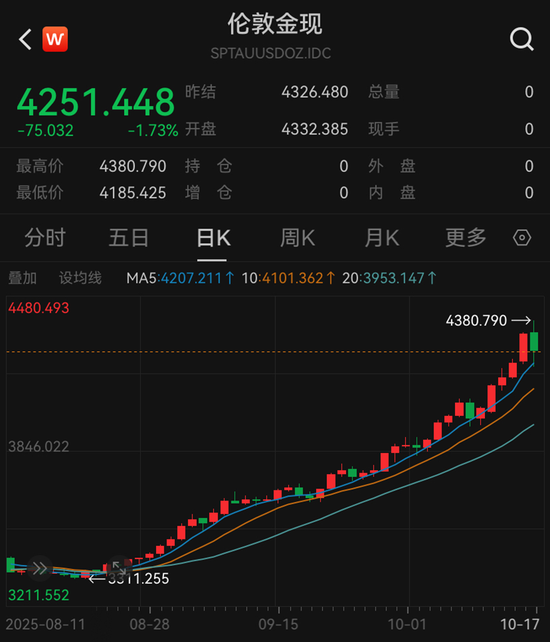
集体上调!华尔街“高看”金价
Shang Hai Zheng Quan Bao· 2025-10-20 00:41
Group 1 - U.S. stock indices rose across the board last week, with the Dow Jones up 1.56%, S&P 500 up 1.7%, and Nasdaq up 2.14%, driven by strong tech stocks and easing risk sentiment in bank stocks [1] - The U.S. Consumer Price Index (CPI) data for September, originally scheduled for October 15, will now be released on October 24, which is expected to provide insights into the Federal Reserve's interest rate decisions [2] - The upcoming CPI report is highly anticipated due to its proximity to the Federal Reserve's FOMC meeting on October 28-29, with expectations of another rate cut [2] Group 2 - Gold prices have seen a significant increase of over 60% this year, driven by geopolitical tensions, central bank purchases, and a shift of funds from the dollar to gold [6] - Major investment banks have raised their gold price targets for 2026, with Bank of America setting a target of $5000 per ounce and Goldman Sachs raising its forecast to $4900 per ounce, reflecting a nearly 14% increase from previous estimates [6] - The strong performance of gold is supported by expectations of continued central bank purchases and a diversified reserve structure in emerging markets, alongside anticipated interest rate cuts by the Federal Reserve [6]

贸易政策及高库存 菜籽粕期货维持偏弱震荡
Jin Tou Wang· 2025-10-17 07:05
Core Viewpoint - The domestic futures market for oilseeds is experiencing a downward trend, particularly in canola meal futures, which are influenced by trade policies and inventory levels [1][2]. Group 1: Market Performance - Canola meal futures opened at 2366.00 CNY/ton and experienced a decline, with a maximum of 2376.00 CNY and a minimum of 2308.00 CNY, reflecting a drop of approximately 2.24% [1]. - As of October 16, the average spot price for canola meal was reported at 2533.68 CNY/ton, which is 169.68 CNY/ton higher than the futures price [1]. Group 2: Export and Inventory Data - According to the Canadian Grain Commission, canola seed exports increased by 97.8% to 159,200 tons for the week ending October 12, compared to 80,500 tons the previous week [1]. - On October 16, the number of canola meal futures warehouse receipts was 8,699, a decrease of 390 from the previous trading day [1]. Group 3: Future Market Outlook - Zhonghui Futures indicates that trade policies and high inventory levels are creating mixed factors for canola meal, suggesting a range-bound market [2]. - Ruida Futures notes that the lack of substantial progress in China-Canada trade negotiations will limit canola seed imports in Q4, while the demand for canola meal may decline due to reduced aquaculture needs and the availability of soybean meal as a substitute [2].
Swiss government slashes growth outlook as Trump tariffs put 'heavy burden' on economy
CNBC· 2025-10-16 10:33
Economic Forecast - Switzerland's government has cut its 2026 economic growth forecast to 0.9%, down from a previous estimate of 1.2% due to the impact of U.S. tariffs [2] - The economy is expected to grow by 1.3% this year, which is considered "significantly below-average" for the country [2] Trade Impact - The U.S. is Switzerland's top export destination, and the country faced a 39% tariff on goods sent to the U.S. after failed negotiations [3] - Key exports include watches, pharmaceuticals, and precious metals, with branded pharma products now subject to 100% tariffs unless produced in the U.S. [4] Economic Challenges - Swiss officials noted that the current trade policy environment presents significant challenges, with additional tariffs burdening export-oriented sectors [6] - The rising Swiss franc, gaining over 12% this year, adds to economic woes by putting downward pressure on prices [7] Risks and Forecast Adjustments - Risks for the Swiss economy are increasing, with exposure to the U.S. market amounting to 4% of GDP [11] - A senior economist revised the growth forecast for 2026 down to 0.8%, indicating a cumulative direct impact of U.S. tariffs on Swiss GDP of about 0.86% in the first two years [11] Recession Outlook - A fall in goods exports and declining investment are expected to lead the Swiss economy into recession in the second half of this year, with GDP projected to fall by 0.2% quarter-to-quarter in Q3 and Q4 [13]
Bungee shares jump as Trump threatens to cut Chinese cooking oil imports
Invezz· 2025-10-15 17:32
Core Viewpoint - Shares of Bunge Global SA increased by over 13% following President Donald Trump's statement regarding the potential cessation of U.S. purchases of Chinese cooking oil [1] Company Summary - Bunge Global SA experienced a significant stock price surge, indicating a positive market reaction to geopolitical developments affecting trade [1] Industry Summary - The announcement from President Trump suggests a shift in U.S. trade policy that could impact the cooking oil market, particularly concerning imports from China [1]


格力博:美国关税政策暂未对公司在美销售产生显著影响
Zheng Quan Shi Bao Wang· 2025-10-15 08:56
Core Viewpoint - Greebo has established production bases in China, Vietnam, and the United States, achieving strategic synergy and cost parity in production between Vietnam and China [1] Group 1: Production and Manufacturing - The products shipped to the United States are manufactured in Vietnam, which has advanced manufacturing capabilities to meet the company's vertical manufacturing requirements [1] - The Vietnam base has achieved economies of scale, making production costs comparable to those in China [1] Group 2: Impact of Tariff Policies - In the short term, the company's global business layout and supply chain arrangements have mitigated significant impacts from U.S. tariff policies on sales [1] - Long-term effects remain uncertain due to the complex and changing international trade environment, which could affect global supply chain costs, market access, and competitive landscape [1] Group 3: Strategic Response - The company will continue to monitor trade policy developments and dynamically assess potential impacts [1] - Strategies include optimizing global layouts, diversifying market approaches, and flexible capacity allocation to achieve stable growth in a complex environment [1]