资产配置多元化

Search documents
债券通“南向通”迎来四周年!
Jin Rong Shi Bao· 2025-09-24 08:46
Core Insights - The "Southbound Bond Connect" has marked its fourth anniversary, enhancing the connectivity and integration of financial markets between mainland China and Hong Kong, while providing new opportunities for mainland investors to access global markets [1][2]. Group 1: Market Performance and Growth - As of the end of August 2023, the "Southbound Bond Connect" has 971 bonds with a total balance of 574.21 billion yuan, reflecting a year-on-year increase of 21% in custodial balance [2]. - The demand for diversified overseas bond assets among investors and supportive policies from regulatory bodies have been crucial for the growth of the "Southbound Bond Connect" [2]. Group 2: Institutional Impact and Opportunities - The "Southbound Bond Connect" offers mainland investors a wider range of investment channels and supports the growth of Hong Kong's offshore RMB bond market, enhancing the international recognition of RMB financing [3]. - Participation in the "Southbound Bond Connect" is seen as an opportunity for domestic institutions to improve their international operational capabilities and risk management skills [3][4]. Group 3: Policy Enhancements and Future Prospects - Recent policy measures have optimized the "Southbound Bond Connect," including facilitating the purchase of multi-currency bonds and extending settlement times [4]. - The expansion of eligible domestic investors to include various non-bank financial institutions is expected to enhance liquidity and activity in the Hong Kong bond market [4]. Group 4: Market Dynamics and Challenges - The increasing demand for overseas asset allocation among domestic investors is a key driver for the "Southbound Bond Connect," alongside ongoing policy support and infrastructure improvements [6]. - There is a need for more risk mitigation tools and international cooperation to address cross-border risks and enhance the development of regulatory standards [6].
未来2年房价会持续下跌?普通老百姓挣钱越来越难,要看清楚未来趋势
Sou Hu Cai Jing· 2025-09-22 23:28
Core Viewpoint - The Chinese real estate market is undergoing a prolonged downturn, raising concerns about future housing prices amidst increasing income pressure on households [1] Group 1: Market Performance - The price index for newly built residential properties in 70 major cities has decreased by 3.2% year-on-year, while the second-hand housing price index has dropped by 5.7%, marking the eighth consecutive quarter of decline [2] - In first-tier cities like Beijing, Shanghai, Guangzhou, and Shenzhen, housing prices are showing signs of fatigue, with some regions experiencing price declines exceeding 10%, reaching the lowest levels in nearly a decade [2] Group 2: Demographic Changes - By the end of 2024, China's population is projected to decrease by approximately 2.21 million, with the birth rate falling to a record low of 5.5‰ [3] - The population of the primary home-buying age group (25 to 45 years) is expected to decline by about 120 million over the next 20 years, leading to a significant drop in housing demand [3] Group 3: Urbanization and Market Challenges - China's urbanization rate has reached 66.5%, nearing developed country levels, but the pace of expansion is slowing [4] - There are nearly 50 million idle residential properties nationwide, with an average absorption period extending to 26 months, far exceeding healthy market standards [4] Group 4: Household Debt and Purchasing Power - As of Q1 2025, the household leverage ratio in China has risen to 64.7%, approaching the internationally recognized warning line [7] - The total household mortgage balance exceeds 38 trillion yuan, with an average mortgage burden of approximately 80,000 yuan per family, significantly constraining purchasing power and willingness to buy [7] Group 5: Local Government and Policy Responses - Despite the declining real estate market, local governments remain heavily reliant on land finance, with land transfer revenue still reaching 3.2 trillion yuan, accounting for about 24% of local fiscal revenue [8] - Over 200 cities have relaxed purchase and loan restrictions, with first-time home loan rates in major cities dropping to around 3.8%, a historical low [8] Group 6: Economic Transition and Income Constraints - In the first half of 2025, the actual growth rate of per capita disposable income for residents was only 2.7%, lower than GDP growth, leading to squeezed purchasing power [10] - Average monthly income in third and fourth-tier cities hovers around 5,000 yuan, creating a severe imbalance with local housing prices [10] Group 7: Employment and Skills Development - The internet economy's golden age has passed, with an average layoff rate of 15% in the internet sector and a 20% drop in starting salaries for fresh graduates compared to three years ago [11] - There is a growing demand for high-skilled talent in emerging fields, with a significant increase in users of vocational training and online education platforms [16] Group 8: Market Outlook and Consumer Behavior - Economists predict that the real estate market will continue to adjust over the next two years, with a potential further decline of 5-10% in housing prices [11] - A survey indicates that over 67% of respondents plan to postpone home purchases and invest more in education and skills, with 78.3% of young people prioritizing career competitiveness over buying a home [13]



大摩最新发声:美国投资者对中国市场兴趣创2021年以来新高
Zhong Guo Ji Jin Bao· 2025-09-11 08:08
Core Insights - Morgan Stanley reports that U.S. investor interest in the Chinese stock market has reached its highest level since 2021, with over 90% of investors willing to increase their allocation to China [1][2] Group 1: Reasons for Increased Interest - The first reason is China's leading position in global technology, particularly in humanoid robots, automation, biotechnology, and drug development, which has gained global recognition [2] - The second reason is positive policy signals from the Chinese government, which aims to stabilize the economy and support the capital market, suggesting that the worst may be over [2] - The third reason is the significant improvement in liquidity conditions in the Chinese market, which supports a longer-lasting market rally [3] - The fourth reason is the rising demand for diversified asset allocation among global investors, as U.S. portfolios are highly concentrated in domestic markets, making diversification into Chinese assets a necessary choice [3] Group 2: Investment Preferences and Strategies - U.S. investors are particularly interested in sectors such as artificial intelligence, semiconductors, humanoid robots, automation, and new consumption [3] - Morgan Stanley notes that quantitative and macro funds have mentioned the convenience of participating in the Chinese market through A-share ETFs and index futures, especially when lacking resources for individual stock research [3] - The preferred order of investment for U.S. investors is American Depositary Receipts (ADRs), Hong Kong stocks, and A-shares [3] Group 3: Current Status of Capital Flow - Despite the increased interest, the process of U.S. capital flowing back into the Chinese market has just begun, with only slight increases in allocations to China from certain funds [4] - The report indicates that global and emerging market investors are primarily engaging with the Chinese market, suggesting potential for further increases in allocations [4] Group 4: Areas of Focus for Investors - Investors are advised to monitor inflation data and the real estate market, as it may take 10 to 12 months to digest the excess inventory in China's primary housing market [5] - The direction of policies is crucial, with a focus on stabilizing prices and promoting economic rebalancing, in addition to technology and high-end manufacturing [5] - The availability of hedging tools is essential for macro and quantitative funds to increase their participation in the A-share market [5] - Investors express a desire for greater participation in China's capital market activities, particularly in A-share IPOs, although foreign investors currently cannot participate in IPOs through the stock connect mechanism [6] Group 5: Geopolitical Considerations - Geopolitical factors, particularly U.S.-China relations, remain significant in influencing market volatility, with U.S. policy uncertainties potentially exacerbating market fluctuations [6] - Morgan Stanley assesses that the likelihood of more U.S. administrative orders is low, but any related news causing market declines could present buying opportunities for Chinese assets [6]
大摩最新发声:美国投资者对中国市场兴趣创2021年以来新高
中国基金报· 2025-09-11 08:08
Core Viewpoint - Morgan Stanley reports that American investors' interest in the Chinese stock market has reached its highest level since 2021, with over 90% of investors willing to increase their allocation to the Chinese market [2][4]. Group 1: Reasons for Increased Interest - Four main reasons drive the return of American funds to China: 1. China's leading position in global technology, particularly in humanoid robots, automation, biotechnology, and drug development [4]. 2. Positive policy signals from the Chinese government aimed at stabilizing the economy and supporting the capital market [4]. 3. Improved liquidity conditions in the Chinese market, which supports a longer-lasting market rally [5]. 4. Increased demand for diversified asset allocation among global investors, prompting a shift from a concentrated U.S. portfolio to include Chinese assets [5]. Group 2: Areas of Focus for American Investors - American investors are particularly interested in sectors such as artificial intelligence, semiconductors, humanoid robots, automation, and new consumption [6]. - The preferred methods for participating in the Chinese market include A-share ETFs and index futures, especially for those lacking resources for individual stock research [6]. Group 3: Current Status of Fund Flows - Despite the heightened interest, the process of American funds returning to the Chinese market is just beginning, with only slight increases in allocations observed in certain funds [8]. - The report indicates that global and emerging market investors are primarily engaging with the Chinese market, suggesting potential for further increases in allocations [8]. Group 4: Recommendations for Investors - Morgan Stanley suggests investors pay attention to: 1. Inflation data and the real estate market, noting that it may take 10 to 12 months to digest excess inventory in the primary housing market [9]. 2. Policy direction, emphasizing the need for continued focus on stabilizing prices and promoting economic rebalancing [10]. 3. The availability of hedging tools, which are crucial for macro and quantitative funds to increase their participation in the A-share market [9]. 4. The openness of the capital market, with investors seeking more opportunities to participate in A-share IPOs [10]. 5. Geopolitical factors, particularly U.S.-China relations, which remain a significant influence on market volatility [10].


全球债市 “风暴眼”:收益率飙升,危机警钟敲响?
Sou Hu Cai Jing· 2025-09-04 05:41
Core Viewpoint - The global bond market is experiencing unprecedented turmoil, with rising yields in major economies like the US, Japan, Germany, and the UK, raising concerns about future economic stability and potential crises [2][3][11] Group 1: Market Dynamics - Long-term bond yields have surged, with the US 30-year Treasury yield surpassing 5%, reaching levels not seen since 2006, while the UK and Germany also hit historical highs [3][4] - The inverse relationship between bond prices and yields indicates that rising yields lead to significant declines in bond prices, resulting in substantial asset value losses for investors [4][9] - The volatility in bond yields is causing ripple effects across the financial ecosystem, impacting stock, foreign exchange, and commodity markets, thereby threatening overall market stability [4][9] Group 2: Economic Factors - Government debt levels are rising, with the US federal deficit projected at $1.7 trillion, necessitating increased bond issuance to fund operations, amidst persistent inflation concerns [5][9] - High inflation is eroding the real yields of bonds, leading investors to reduce their holdings in favor of assets with better inflation protection, thus increasing bond supply and pushing yields higher [5][9] Group 3: Political Uncertainty - Political events, such as the potential no-confidence vote in France regarding debt reduction plans, are exacerbating market volatility and investor anxiety, leading to increased bond yields [6][9] - In the UK, economic challenges coupled with political instability are putting pressure on the bond market, with rising yields reflecting investor concerns over fiscal health [6][9] Group 4: Market Structure Changes - Central banks and pension funds, traditionally major buyers of long-term bonds, are reducing their participation, leading to decreased demand and increased volatility in the bond market [7][8] - The shift from defined benefit to defined contribution pension plans is reducing the stable demand for long-term bonds, further destabilizing the market [7][8] Group 5: Negative Feedback Loop - The rising yields are creating a vicious cycle where increased borrowing costs worsen fiscal conditions for governments, leading to more bond issuance and further supply concerns [9][11] - This cycle threatens to undermine financial market stability and economic growth, as higher yields increase corporate financing costs and consumer loan rates, dampening investment and consumption [9][11]

调改成效显著!重庆百货中报毛利率创新高 券商重申“增持”评级
Quan Jing Wang· 2025-08-28 10:20
Core Viewpoint - Chongqing Department Store reported strong financial performance in the first half of the year, with significant growth in revenue and profit, indicating effective operational adjustments and a solid market position [1][2]. Financial Performance - The company achieved operating revenue of 8.042 billion yuan, with a total profit of 857 million yuan, representing a year-on-year increase of 8.29% [1]. - The net profit attributable to shareholders reached 774 million yuan, up 8.74% year-on-year, showcasing a notable improvement in profitability [1]. Business Segments Performance - The overall gross margin increased to 28.43%, marking a historical high for the same period [1]. - In the department store segment, the company implemented a tailored strategy ("one store, one policy") to meet regional consumer demands, enhancing customer experience [1]. - The supermarket segment saw significant sales growth through direct sourcing and supply chain management, alongside expansion in dining and private label products [1]. - The appliance segment experienced substantial revenue growth by strengthening strategic brand partnerships and introducing high-end products [1]. - The automotive trade segment reported a surge in both new energy and traditional fuel vehicle sales, with new energy vehicle sales reaching 3,621 units, a 59.5% increase year-on-year [1]. Investment and Asset Management - The company generated investment income of 359 million yuan from joint ventures, benefiting from rising stock prices of its holdings in companies like Dengkang Dental and Rainbow Group [2]. - The diversified and stable asset allocation has enhanced the company's earnings resilience [2]. Market Rating - Guotai Junan Securities maintained an "overweight" rating for Chongqing Department Store, with a target price of 40.95 yuan per share, reflecting confidence in the company's operational improvements and profit growth [2].

国信证券收购万和证券获批;中国ETF规模达5.07万亿,再创历史新高 | 券商基金早参
Mei Ri Jing Ji Xin Wen· 2025-08-26 01:23
Group 1: Guosen Securities Acquisition - Guosen Securities has received approval from the China Securities Regulatory Commission to acquire a 96.08% stake in Wanhe Securities, making it the major shareholder [1] - The approval is valid for 12 months from the date of issuance, and the company will proceed with necessary actions as authorized by the shareholders' meeting [1] - The performance of the first batch of securities firms' semi-annual reports shows significant revenue and net profit growth, indicating an improvement in the securities industry [1] Group 2: Growth of China's ETF Market - The scale of China's ETF market has reached 5.07 trillion yuan, marking a historic high and reflecting a strong preference for passive investment tools among investors [2][3] - The number of ETFs has increased to 1,271, with 101 ETFs exceeding 10 billion yuan in scale, and 6 ETFs surpassing 100 billion yuan [2] - The rapid development of the ETF market is expected to enhance market liquidity and efficiency, providing investors with more diverse investment options [3] Group 3: Huatai Securities Asset Management - Huatai Securities Asset Management plans to invest up to 32 million yuan of its own funds into its equity public funds, with a holding period of no less than one year [4] - This move reflects confidence in the long-term healthy development of China's capital market and aims to enhance trust in its equity products [4] - The self-purchase behavior may encourage other institutions to follow suit, potentially stabilizing market sentiment and promoting healthy capital market development [4] Group 4: Public Fund Institutions' Self-Purchase Activity - A total of 127 public fund institutions have initiated self-purchases of their equity funds this year, with equity funds making up a significant portion of these purchases [5] - The large-scale self-purchase by public fund institutions signals positive market sentiment and indicates professional investors' recognition of current market valuations [5] - This trend is expected to boost fund inflows for related companies and enhance overall market confidence, injecting new vitality into the A-share market [5]

现在卖房是聪明还是愚蠢?王健林给出标准答案,让我恍然大悟!
Sou Hu Cai Jing· 2025-08-20 20:48
Core Insights - The article discusses the dilemma faced by property owners regarding whether to sell their properties amidst declining real estate prices, emphasizing the need for rational decision-making based on individual circumstances [1][3]. Market Analysis - As of 2025, China's urban housing vacancy rate has surged to 21.8%, significantly exceeding the internationally recognized warning line of 5%. Additionally, 53 out of 70 major cities have seen year-on-year declines in new residential property prices, with the highest drop reaching 7.9%. The average transaction period for properties has extended to 97 days, indicating a notable decrease in market liquidity [5][7]. Key Decision Factors - Wang Jianlin identifies three critical factors for property decision-making: regional development prospects, personal financial status, and asset diversification [7]. - **Regional Development**: Properties in core urban areas with population inflow and industrial upgrades retain long-term investment value, while those in declining areas face potential depreciation [7]. - **Personal Financial Status**: The average mortgage burden for Chinese households reached 41.3% in 2024, surpassing the 40% warning threshold. High debt levels necessitate careful consideration of selling to alleviate financial pressure [8]. - **Asset Diversification**: Concentrating wealth solely in real estate is deemed imprudent. Alternative investment channels, such as A-shares and REITs, offer competitive returns, suggesting the importance of a diversified investment strategy [8]. Property Holding Recommendations - Properties in high-demand urban areas should be retained, while those in less desirable locations, particularly older buildings in third and fourth-tier cities, should be approached with caution [9]. - Distinctions should be made between primary residences and investment properties, with the former being less advisable to sell due to their emotional and functional significance [9]. Changing Investor Sentiment - A survey indicates that 38.7% of homeowners are considering selling idle properties within the next year, reflecting a shift from improvement-driven motives to more rational asset optimization and cash flow improvement strategies [10]. Conclusion - The article underscores the importance of maintaining cash flow over asset accumulation in uncertain times, advocating for rational decision-making tailored to individual circumstances rather than following market trends blindly [13].
终于把存款逼出银行了!2025年8月银行最新数据,存款去哪儿了?
Sou Hu Cai Jing· 2025-08-17 05:54
Core Viewpoint - The significant outflow of resident deposits, amounting to 1.11 trillion yuan in July 2025, indicates a shift in investment behavior and highlights the need for policy guidance to direct funds towards the real economy to prevent asset bubbles [1][8]. Group 1: Deposit Outflow and Market Impact - The outflow of deposits has disrupted the previously high levels of bank deposits, with funds primarily flowing into the A-share market, which saw a surge in non-bank financial institution deposits by 2.14 trillion yuan in July, marking a year-on-year increase of 1.39 trillion yuan, the highest in a decade [3]. - The stock market experienced significant gains, with the Shanghai Composite Index rising by 3.74%, the Shenzhen Component Index by 5.20%, and the ChiNext Index by 8.14% in July [3]. - Trading volumes in the Shanghai and Shenzhen markets reached new highs for the year, exceeding 15.6 trillion yuan and 21.4 trillion yuan, respectively, reflecting unprecedented market enthusiasm [3]. Group 2: Fund Allocation Trends - Public funds attracted substantial investments, with the total scale of public funds reaching 34.39 trillion yuan by the end of June 2025, marking the ninth historical high since early 2024 [3]. - Bond funds saw the most significant growth, increasing by 507.8 billion yuan in June, while stock and mixed funds grew by 148.3 billion yuan and 121.3 billion yuan, respectively [3]. - Bank wealth management products also gained traction, with a market size of 30.67 trillion yuan as of June 2025, offering a 2.12% annualized return, which is significantly higher than the 0.95% return on one-year fixed deposits from major state-owned banks [4]. Group 3: Consumer Behavior and Loan Repayment - A portion of the outflowed deposits was directed towards early mortgage repayments, with personal housing loan balances decreasing by 852 billion yuan in the first seven months of 2025 [6]. - Consumer demand has rebounded, particularly in the mid-to-low-end markets such as dining, entertainment, and tourism, with domestic tourism reaching 3.08 billion trips in the first half of 2025, a year-on-year increase of 18.5% [6]. - Total tourism revenue surpassed 3.2 trillion yuan, and outbound tourism increased by over 40%, reaching 89.5 million trips, indicating a strong recovery in consumer spending [6]. Group 4: Changing Investment Preferences - The diminishing yield advantage of bank deposits is evident, with bank wealth management products and dividend stocks offering returns above 2%, compared to just 0.95% for one-year fixed deposits [9]. - Residents are diversifying their asset allocation strategies, opting for a mix of low-risk, medium-risk, and high-risk investments to balance risk and return [11].
全球资金大迁徙!非美股市7月吸金136亿美元创纪录 美股连续三月被抛售
Zhi Tong Cai Jing· 2025-08-13 07:49
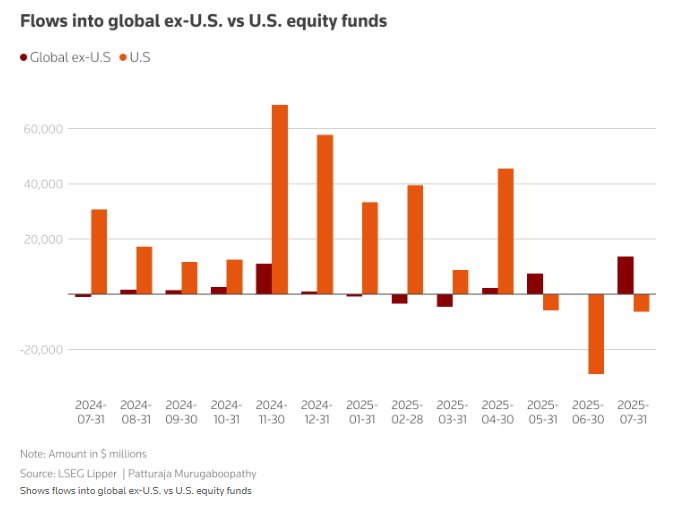
Group 1 - In July, global non-U.S. equity funds experienced the largest net inflow in four and a half years, driven by investor concerns over the U.S. economic outlook, high stock market valuations, and a weakening dollar [1] - The net inflow for global non-U.S. equity funds in July reached $13.6 billion, the highest since December 2021, while U.S.-focused equity funds faced $6.3 billion in redemptions, marking three consecutive months of outflows [1] - The trend of diversification in asset allocation is strengthening, particularly towards Europe and emerging markets, which are benefiting from a loose monetary environment and improved growth prospects [1] Group 2 - Regional market performance has diverged, contributing to the outflow from U.S. equities, with the MSCI Asia-Pacific (excluding Japan) index up approximately 14% and the MSCI Europe index up over 19%, significantly outperforming the S&P 500 index's 7.2% increase [3] - The valuation disparity is notable, with the MSCI U.S. index having a forward P/E ratio of 22.6, compared to 14.4 for Asia, 14.2 for Europe, and 19.7 for the global index [3]