
AI泡沫

Search documents
英伟达云端GPU卖光了,黄仁勋称AI没有泡沫
2 1 Shi Ji Jing Ji Bao Dao· 2025-11-20 02:34
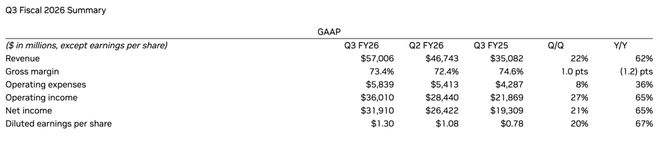
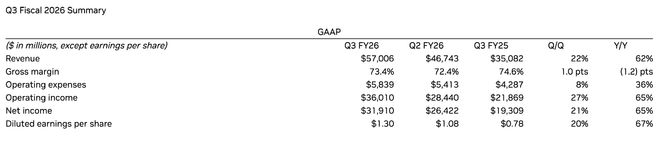
Core Viewpoint - Nvidia reported strong Q3 FY26 earnings, with revenue of $57.006 billion, a 62% year-over-year increase, and net income of $31.910 billion, up 65% year-over-year, surpassing market expectations [1][2][3] Financial Performance - Revenue for Q3 FY26 reached $57.006 billion, up 22% quarter-over-quarter and 62% year-over-year [2] - Gross margin was 73.4%, a slight increase of 1.0 percentage points from the previous quarter but a decrease of 1.2 percentage points year-over-year [2] - Operating income was $36.010 billion, reflecting a 27% increase quarter-over-quarter and a 65% increase year-over-year [2] - Diluted earnings per share were $1.30, up 20% from the previous quarter and 67% year-over-year [2] Market Sentiment and Guidance - Despite a cautious investor sentiment, Nvidia's performance countered concerns about "peak growth" and "AI bubble" [3] - The company provided strong guidance for Q4, expecting sales to reach $65 billion, exceeding the consensus estimate of $62 billion [3] - Nvidia's stock price rose 2.85% to $186.52, with a market capitalization of $4.53 trillion [3] Business Segments - The data center segment generated $51.2 billion in revenue, a 66% year-over-year increase, accounting for nearly 90% of total revenue [6] - Within the data center, the "compute business" (GPU products) contributed $43 billion, while the networking business brought in $8.2 billion [6] - Nvidia's gaming and AI PC business achieved $4.3 billion in revenue, a 30% year-over-year increase, and the professional visualization segment generated $760 million, up 56% [7] Strategic Partnerships - Nvidia announced a strategic partnership with Microsoft and Anthropic, involving investments of up to $100 billion from Nvidia and $50 billion from Microsoft [8] - This partnership aims to enhance AI training and inference capabilities, indicating ongoing demand for large-scale AI infrastructure [8] AI Market Dynamics - CEO Jensen Huang emphasized that the AI sector is not experiencing a bubble, citing continuous growth in compute demand and a rapidly expanding AI ecosystem [10] - Analysts noted that AI investments should be viewed as a parallel explosion rather than short-cycle linear growth, with significant demand expected to persist [11]


科技当自强,五年再出发-从十五五规划初窥
2025-11-20 02:16
Summary of Key Points from Conference Call Industry and Company Overview - The conference call primarily discusses China's economic development goals and macroeconomic policies as outlined in the 14th and 15th Five-Year Plans, focusing on high-quality development and technological self-reliance [1][4][5]. Core Insights and Arguments - **Economic Growth Targets**: By 2035, China's per capita GDP is targeted to exceed $20,000, implying a nominal growth rate of approximately 3.5% and a real growth rate of about 4.17% over the next decade [1][2]. - **High-Quality Development**: The 15th Five-Year Plan emphasizes high-quality development and technological advancement, marking a shift from previous plans that prioritized economic growth alone [4][5]. - **Supply-Side Policies**: Future demand-side policies will focus on supply-side stimulation, such as providing financial support to enterprises and encouraging innovation, rather than direct fiscal stimulus [9][10]. - **Consumer Spending**: There is an increasing market focus on the consumer sector, with expectations for policies aimed at boosting consumer spending, although the effectiveness of these measures may be gradual [6][7]. - **Export Performance**: China's strong export performance in 2025 is attributed to the expansion into non-U.S. markets and increased overseas investment, rather than a strategy of "grabbing exports" [3][14][15]. - **Fiscal Policy Outlook**: Despite a projected fiscal deficit rate of 4.0% in 2025, the overall fiscal policy will remain prudent, focusing on enhancing fiscal efficiency and supporting national strategic tasks [12][13]. Additional Important Insights - **Technological Self-Reliance**: The emphasis on technological self-reliance indicates a significant shift in policy priorities, reflecting the need to enhance domestic capabilities in the face of global competition [4][5]. - **Impact of Global Economic Environment**: The anticipated shift towards expansive fiscal and monetary policies in developed countries by 2026 is expected to improve the global demand environment, benefiting China's exports [16]. - **Consumer Services Expansion**: Efforts to expand high-quality service consumption include large-scale events and reforms to reduce barriers to consumer spending, such as easing restrictions on car purchases [8][11]. - **AI and Economic Outlook**: The discussion on AI suggests that current valuations in the tech sector do not indicate a bubble similar to the 2000 internet bubble, as AI's impact on economic growth is still developing [17][18]. This summary encapsulates the key points discussed in the conference call, providing insights into China's economic strategies and the implications for various sectors.
黄仁勋回击“AI泡沫论”!英伟达净利润激增65%,GPU售罄
2 1 Shi Ji Jing Ji Bao Dao· 2025-11-20 02:12
Core Insights - Nvidia reported strong Q3 FY26 earnings, with revenue of $57.006 billion, a 62% year-over-year increase, and net income of $31.910 billion, up 65% year-over-year, surpassing market expectations [1][2][3] Financial Performance - Revenue: $57,006 million, up 22% quarter-over-quarter and 62% year-over-year [2] - Gross Margin: 73.4%, a slight increase of 1.0 percentage points from Q2 FY26, but down 1.2 percentage points from Q3 FY25 [2] - Operating Income: $36,010 million, reflecting a 27% increase year-over-year [2] - Diluted Earnings Per Share: $1.30, a 20% increase year-over-year [2] Business Segments - Data Center Revenue: $51.2 billion, up 66% year-over-year and 25% quarter-over-quarter, accounting for nearly 90% of total revenue [4] - GPU Products: Contributed $43 billion in revenue, with Blackwell products being a key driver of growth [4][5] - Other Segments: Gaming and AI PC business generated $4.3 billion, up 30% year-over-year; Professional Visualization revenue was $760 million, up 56% year-over-year; Automotive and Robotics revenue reached $592 million, up 32% year-over-year [5] Market Position and Outlook - Nvidia's CEO, Jensen Huang, emphasized the ongoing demand for AI and GPU resources, countering claims of an AI bubble [3][7] - The company provided a strong Q4 FY26 revenue guidance of $65 billion, exceeding market expectations of $62 billion [3] - Nvidia's strategic partnerships, including a $100 billion investment in Anthropic, indicate a robust demand for AI infrastructure [6] Investor Sentiment - Following the earnings report, Nvidia's stock rose by 2.85% to $186.52, with a total market capitalization of $4.53 trillion [4] - Despite some hedge funds reducing their positions in Nvidia, the overall market sentiment remains positive due to strong demand and growth prospects [6][7] - Analysts maintain a "buy" rating on Nvidia, with Citigroup raising the target price from $210 to $220, citing supply constraints for AI chips [8]
当下是牛市“中场休息”,看好五大方向!周应波最新研判
中国基金报· 2025-11-20 02:08
Core Viewpoint - The current A-share market is in a "mid-game break" of a bull market, with significant long-term allocation value despite reduced valuation advantages compared to below 3000 points [3][14]. Investment Directions - The company is optimistic about five key investment directions: AI infrastructure, new energy, overseas consumption, global infrastructure, and "anti-involution" sectors [3][15]. Investment Philosophy Iteration - The investment philosophy has evolved to focus on "growth" while integrating core principles of "value investing," applicable to both technology and growth stocks [6][7][9]. Investment Strategy - The core strategy since 2025 has been to maintain a high position while focusing on "AI+" and quality companies in sectors like domestic computing power, internet, overseas computing power, new energy, and overseas consumption [7][8]. Ability Circle - The company has defined a clear ability circle, focusing on TMT, manufacturing, cyclical, and consumer sectors, adhering to the principle of operating within understood domains [8][12]. Stock Selection Criteria - Emphasis is placed on identifying leading stocks with competitive advantages, applying qualitative and quantitative frameworks for stock selection [8][12]. Market Analysis - The company highlights that while the current market valuation is less attractive, the long-term potential of Chinese enterprises has significantly improved, with notable advancements in industries like AI and new energy [14][15]. AI and Storage Industry Insights - AI is viewed as a major market driver, with the current phase characterized as the "AI infrastructure era," while the storage industry is entering a golden development period, driven by the expansion of lithium battery scales and renewable energy [16][17]. Investment Mindset - The transition from public to private equity has led to a deeper understanding of the complexities and long-term nature of business operations, fostering a more disciplined investment approach focused on sustainable, absolute returns [18].

锌:LME累库
Guo Tai Jun An Qi Huo· 2025-11-20 01:58
Report Summary 1) Report Industry Investment Rating - No industry investment rating is provided in the report. 2) Core Views - BCA Research warns that the AI bubble may burst within 6 to 12 months, advising investors to be neutral in the short - term and underweight stocks in the medium - term, and to focus on forward - looking indicators such as analyst expectations and GPU costs [2] - Morgan大通 believes the power equipment bull market is in the early to mid - stage. AI - driven power consumption growth is accelerating, and leading power equipment companies' order backlogs are 2.5 to 2.8 times their revenues, with profitability visibility locked until 2027 - 2028. Asian and Chinese companies with cost advantages and delivery capabilities may gain more market share and enjoy higher overseas profits [2][3] 3) Summary by Relevant Catalogs [Fundamental Tracking] - **Price and Volume**: The closing price of SHFE zinc futures was 22,420 yuan/ton, up 0.49%, and the LME zinc 3M electronic trading closed at $2,990.5/ton, up 0.03%. The trading volume of SHFE zinc futures was 91,247 lots, down 2,222 lots, and the LME zinc trading volume was 14,603 lots, up 3,454 lots. The open interest of SHFE zinc futures was 67,487 lots, down 14,839 lots, and the LME zinc open interest was 224,451 lots, down 3,059 lots [1] - **Premium and Discount**: The premium of Shanghai 0 zinc was 30 yuan/ton, up 10 yuan/ton; the LME CASH - 3M premium was $129.76/ton, up $29.76/ton. The import bill of lading premium was $135/ton, unchanged [1] - **Inventory**: SHFE zinc futures inventory was 75,314 tons, down 1,473 tons; LME zinc inventory was 45,075 tons, up 1,550 tons. The LME zinc cancelled warrants were 3,525 tons, up 100 tons; the LME off - warrant (T + 3) was 23,736 tons, up 921 tons [1] - **Related Products**: The price of 1.0mm hot - dipped galvanized coil was 4,150 yuan/ton, down 7 yuan/ton. The price of Shanghai Zamak - 5 zinc alloy was 23,645 yuan/ton, up 100 yuan/ton; the price of Shanghai Zamak - 3 zinc alloy was 23,095 yuan/ton, up 100 yuan/ton; the price of zinc oxide ≥99.7% was 21,500 yuan/ton, up 100 yuan/ton [1] [News] - **AI Bubble Warning**: BCA Research analyzed four capital expenditure booms and summarized five collapse rules. The current AI boom shows warning signs, and the AI bubble may burst within 6 to 12 months [2] - **Power Equipment Market**: Morgan大通 believes the power equipment bull market is in the early to mid - stage. AI drives power consumption growth, leading to supply - demand imbalance. Asian and Chinese enterprises may benefit [2][3] [Trend Intensity] - The zinc trend intensity is 0, indicating a neutral outlook [3]
谷歌发布Gemini 3 专家称AI行业难逃投资“过热”问题
Bei Jing Shang Bao· 2025-11-20 01:42
Core Insights - Google has officially launched its most powerful AI model, Gemini 3, which is expected to redefine the competitive landscape in AI, achieving top scores in major benchmarks [1][3][4] - The focus of the capital market has shifted from mere model upgrades to the ability of these models to enhance platform lock-in effects and generate substantial returns for core businesses [1][5] Product Launch and Performance - Gemini 3 was released on November 18 and immediately integrated into various Google products, including Google Search and the Gemini app, with plans for broader rollout in the coming weeks [3][4] - The model scored 1501 points on the LMArena global leaderboard, becoming the first to surpass 1500 points, and showed significant improvements in doctoral-level reasoning benchmarks [3][4] - The launch marks a shift from AI programming as an "assistive" tool to a "self-sufficient" capability, as demonstrated by the creation of a complete flight tracking application from a simple natural language command [3] Competitive Landscape - The release of Gemini 3 comes just eight months after Gemini 2.5 and eleven months after Gemini 2.0, indicating a rapid development cycle [4] - The AI industry has seen a shift in focus from technical breakthroughs to monetization, with companies like Meta and OpenAI facing challenges in commercializing their models [5] - Gemini 3's impressive performance has overshadowed recent releases from competitors, including OpenAI's GPT 5.1 and xAI's Grok 4.1, prompting congratulatory messages from industry leaders [5] Financial Performance and Market Position - Google's AI-related revenue has become a significant growth driver, with Google Cloud's Q3 revenue reaching $15.2 billion, a 33.5% year-over-year increase, and AI-related income exceeding "tens of billions" quarterly [6] - The company has raised its capital expenditure forecast for 2025 to between $91 billion and $93 billion, indicating strong investment in AI and related technologies [6] Industry Challenges and Concerns - There is ongoing debate in Wall Street regarding the potential for an AI bubble, with concerns about over-investment and the sustainability of AI business models [7] - Google CEO Sundar Pichai acknowledged the risks associated with the current investment climate, comparing it to the early days of the internet, while emphasizing the company's comprehensive technology strategy to mitigate potential market disruptions [7][8] - The energy consumption of AI, which accounts for 1.5% of global electricity usage, poses challenges for energy supply and climate goals, highlighting the need for advancements in energy infrastructure [8]

黄仁勋:卖光了!
第一财经· 2025-11-20 00:52
Core Viewpoint - Recent discussions about a potential AI bubble have been sparked by the stock price corrections of several US tech stocks, including the news of Bridgewater reducing its holdings and Peter Thiel liquidating his Nvidia shares. Nvidia's latest quarterly earnings report is seen as a barometer for real AI demand [3]. Group 1: Nvidia's Financial Performance - Nvidia reported a revenue of $57 billion for Q3 of fiscal year 2026, a 62% year-over-year increase, exceeding market expectations [3]. - The net profit for the same quarter was $31.9 billion, reflecting a 65% year-over-year growth, with a GAAP gross margin of 73.4% [3]. - The data center business achieved record revenue of $51.2 billion, up 66% year-over-year, also surpassing market expectations [3][4]. Group 2: AI and Data Center Business - Nvidia's CEO highlighted that the demand for training and inference computing is growing exponentially, indicating a positive cycle in the AI ecosystem [3]. - The company has established strategic partnerships with OpenAI and plans to deploy at least 10 gigawatts of Nvidia systems, collaborating with major firms like Google, Microsoft, and Oracle to build AI infrastructure in the US [4]. - Nvidia's network business revenue reached $8.2 billion, a significant 162% increase year-over-year [4]. Group 3: Other Business Segments - Revenue from Nvidia's gaming and AI PC business was $4.3 billion, up 30% year-over-year, while professional visualization revenue was $760 million, a 56% increase [5]. - The automotive and robotics segment generated $592 million, reflecting a 32% year-over-year growth [5]. - Nvidia anticipates fourth-quarter revenue of approximately $65 billion, exceeding previous market expectations [5]. Group 4: Future Outlook and Challenges - Nvidia's CFO indicated that revenue from the Blackwell and Rubin platforms is expected to reach $500 billion by the end of next year, with additional opportunities on the horizon [6]. - The company is facing challenges in supply chain management, particularly regarding power, memory supply, and manufacturing constraints, but is confident in its ability to manage these issues [6]. - Nvidia's market share in data center construction is increasing, with Blackwell contributing around 30% and Rubin expected to exceed this figure [7]. Group 5: Investments and Market Position - Nvidia has announced investments in AI companies like OpenAI and Anthropic, viewing these investments as crucial for expanding its ecosystem [7]. - The company's stock price rose by 2.85% to $186.52 per share, with a market capitalization of $4.53 trillion, and increased by over 5% in after-hours trading [8].

X @外汇交易员
外汇交易员· 2025-11-20 00:44
英伟达CEO黄仁勋表示,公司最新一代Blackwell架构的芯片销量远超预期,云端GPU已售罄;“训练和推理的计算需求持续加速增长,均呈指数级增长。我们已进入AI的良性循环”;关于AI泡沫的说法很多,但从英伟达的角度看截然不同。🗒️继续反驳AI泡沫论,安抚市场对AI泡沫和需求放缓的担忧。外汇交易员 (@myfxtrader):英伟达交出亮眼财报,三季度营业收入570.1亿美元,增62%(预期551.9亿美元);非GAAP调整后EPS 1.30美元,增60%(预期1.26美元);调整后毛利率73.6%,降1.4个百分点(预期74.0%),指引73%至74%,降3个百分点;营业费用42.15亿美元,增38%(预期42.2亿美元) https://t.co/LKpOovxv5v ...
Q3业绩大涨后,黄仁勋回应“AI泡沫论”安抚华尔街 | 巴伦精选
Tai Mei Ti A P P· 2025-11-20 00:42
这恐怕是2025年最受瞩目的一份财务报表。 10月末,AI芯片霸主英伟达成为人类历史上首家市值5万亿美元的公司,11月"AI泡沫论"引发华尔街焦 虑,以"美股科技七巨头"为牛首的标普500指数几乎遭遇了2008年金融危机以来最糟糕的一个11月。 人们都在屏息以待这份关键的业绩报表,试图从中找出人工智能需求是否持续、资本支出是否过热、 AI是否会重蹈互联网泡沫覆辙等的答案。 美东时间11月19日美股盘后(北京时间11月20日凌晨5时),英伟达公布了这份重要"成绩单",并再次 超出市场预期。 市场在焦灼和等待什么? 财报发布前,市场对英伟达的财报关注焦点主要集中在三个方面。 一是,最基本的营收和利润问题。 这最直接的折射出最近一段时间市场对AI芯片的真实需求,以及企业基本面。 此前,华尔街对英伟达的预期相对一致。LSEG的分析师调查中对英伟达三季度营收(截至今年10月)预 测为549亿美元,FactSet的分析师调查为548.3亿美元。而最终,英伟达三季度营收达到创纪录的570.1亿 美元,同比增长62%,环比增长22%。值得一体的是,这也是该公司自2023年以来连续第11个财季超出 市场预期。 在利润方面,此前 ...

综合晨报:美联储会议纪要显示内部分歧,美俄据悉拟定和谈框架-20251120
Dong Zheng Qi Huo· 2025-11-20 00:42
1. Report Industry Investment Ratings No relevant content provided. 2. Core Views of the Report - The Fed's latest interest rate meeting minutes show that most officials tend not to cut rates, meaning a December rate cut is highly unlikely, and the market risk appetite remains volatile while the US dollar rebounds [1][12][19]. - Against the backdrop of the Ministry of Finance's early allocation of part of the 2026 budget for urban affordable housing projects, the Shanghai Composite Index closed slightly higher with reduced trading volume, but the market style is chaotic and risk - averse trading persists. It is recommended to reduce long positions [2][22]. - The bond market failed to break through the upper limit of the trading range and had adjustment pressure. With the stock market strengthening slightly, Treasury bond futures declined. It is advisable to view the market from a volatile perspective [3][25]. - The EPA's re - emphasis on increasing RVO has boosted the rebound of edible oils, but the short - term supply pressure remains unrelieved. For industrial silicon, it is advisable to take profit on previous long positions and look for short - selling opportunities on price rallies [4]. - EIA commercial crude oil inventories decreased, and oil prices declined with a reduction in risk premium [5]. 3. Summary by Directory 3.1 Financial News and Comments 3.1.1 Macro Strategy (US Stock Index Futures) - NVIDIA's Q3 revenue accelerated by 62% year - on - year, and its Q4 revenue guidance also exceeded expectations. However, the Fed's internal officials have significant differences on a December rate cut, and the market's rate - cut expectation remains low. It is recommended to wait for the release of non - farm payroll data to see the market's new direction [11][12][13]. 3.1.2 Macro Strategy (Gold) - The Fed's meeting minutes show serious internal differences. Gold prices fluctuated and closed higher, but in the short term, there is a lack of direct positive factors for a new wave of upward movement. It is expected that gold prices will fluctuate widely around $4000, with increased long - short competition [14][15]. 3.1.3 Macro Strategy (Foreign Exchange Futures - US Dollar Index) - The Trump administration is trying to promote a cease - fire between Russia and Ukraine. The Fed's meeting minutes show that most officials tend not to cut rates, so a December rate cut is unlikely. The US dollar index is expected to rebound [16][17][19]. 3.1.4 Macro Strategy (Stock Index Futures) - The Ministry of Finance has advanced the allocation of part of the 2026 budget for urban affordable housing projects. The Shanghai Composite Index closed slightly higher with reduced trading volume, and technology stocks underperformed. It is recommended to reduce long positions instead of chasing the market [21][22][23]. 3.1.5 Macro Strategy (Treasury Bond Futures) - The central bank conducted 310.5 billion yuan of 7 - day reverse repurchase operations. The bond market failed to break through the upper limit of the trading range and had adjustment pressure. With the stock market strengthening slightly, Treasury bond futures declined. It is recommended to view the market from a volatile perspective [24][25][26]. 3.2 Commodity News and Comments 3.2.1 Agricultural Products (Soybean Meal) - USDA reported that private exporters sold 330,000 tons of soybeans to China, and a 30,000 - ton shipment of Argentine soybean meal cleared customs in China. It is expected that futures prices will likely remain range - bound, and attention should be paid to China's soybean purchases from the US and weather conditions in South American production areas [27][28][29]. 3.2.2 Agricultural Products (Soybean Oil/Rapeseed Oil/Palm Oil) - The import cost of 24 - degree palm oil in South China has risen significantly. The EPA's re - emphasis on RVO has boosted the rebound of edible oils, but the short - term supply pressure remains. It is recommended to pay attention to the resistance level of 9000 yuan/ton [30][31]. 3.2.3 Black Metals (Rebar/Hot - Rolled Coil) - The workload of construction machinery increased in October, and the retail and wholesale of passenger cars from November 1 - 16 showed different trends. Steel prices are in a volatile pattern, and it is recommended to view them from a volatile perspective [32][33][34]. 3.2.4 Agricultural Products (Jujubes) - The price of jujubes in Xinjiang has slightly declined. The futures market is volatile. It is recommended to operate with caution and pay attention to upstream procurement [35][36]. 3.2.5 Agricultural Products (Corn Starch) - The operating rate of corn starch has slightly decreased, and inventory has been reduced. It is expected that the price difference between 01 futures and rice flour will fluctuate, and it is advisable to conduct band trading [37][38]. 3.2.6 Agricultural Products (Corn) - The spot corn market shows a pattern of strength in the south and weakness in the north. In the short term, the near - month contracts may not experience a significant decline. It is recommended to wait and see, and look for short - selling opportunities on rallies for 03 and 05 contracts when the situation becomes clear [39][40][41]. 3.2.7 Black Metals (Steam Coal) - The 2026 medium - and long - term coal contracts have been signed, with the supply guarantee ratio and long - term contract price basically the same as in 2025. It is expected that coal prices will continue to fluctuate around 800 yuan [42]. 3.2.8 Black Metals (Iron Ore) - The production and sales of air conditioners in December are expected to decline. The fundamentals of iron ore remain stable with a volatile trend. Although the supply pressure is high and port inventories are increasing, the risk of a sharp decline is reduced [43]. 3.2.9 Agricultural Products (Hogs) - Tangrenshen terminated a fixed - increase project. In the short term, it is advisable to short - sell LH2601 and LH2603 on price rallies, and in the long term, pay attention to the opportunity to build long positions for LH2607 and distant - month contracts at low prices [44][45]. 3.2.10 Non - Ferrous Metals (Polysilicon) - From January to October 2025, solar power generation increased. The polysilicon spot price depends on the game between policy and fundamentals. It is expected to return to a volatile market, and attention should be paid to range - trading opportunities [46][48]. 3.2.11 Non - Ferrous Metals (Industrial Silicon) - Organic silicon manufacturers plan to jointly reduce production and adjust prices. Although the price of industrial silicon has risen, the reduction in organic silicon production is negative for industrial silicon. It is recommended to take profit on previous long positions and look for short - selling opportunities on price rallies [49][52][53]. 3.2.12 Non - Ferrous Metals (Lead) - The LME lead market shows a downward trend, and the trading volume of domestic lead contracts has decreased. It is recommended to look for short - selling opportunities on price rallies and remain on the sidelines for arbitrage and cross - border trading [54]. 3.2.13 Non - Ferrous Metals (Zinc) - The LME zinc market is volatile, and domestic social inventories have decreased. It is recommended to manage positions well for long positions, continue to hold positive - spread arbitrage positions, and manage positions for cross - border arbitrage [55][56]. 3.2.14 Non - Ferrous Metals (Nickel) - A nickel - related transaction has occurred. The nickel market is fundamentally weak and technically bearish. In the short term, the price may continue to decline or rebound depending on production cuts. In the medium term, attention should be paid to Indonesia's supply - contraction actions [57][58][59]. 3.2.15 Non - Ferrous Metals (Lithium Carbonate) - Sigma has adjusted its lithium mine production. The lithium carbonate market has strong short - term support, but the demand is expected to weaken from the end of the year to Q1 2026. It is not recommended to chase long positions, and short - selling opportunities on price rallies can be considered [61][62][63]. 3.2.16 Energy and Chemicals (Crude Oil) - EIA commercial crude oil inventories decreased, and oil prices declined. It is expected to maintain a short - term volatile trend [64][65]. 3.2.17 Energy and Chemicals (Asphalt) - The capacity utilization rate of domestic heavy - traffic asphalt has decreased, and the supply has tightened. The market is in a situation of both supply and demand decline, and the price is expected to be volatile in the short term [66][67]. 3.2.18 Energy and Chemicals (Methanol) - China's methanol port and production enterprise inventories have decreased, but the port inventory decline is due to low arrivals. It is recommended to hold short positions and add short positions on price rebounds, with a profit - taking target around 2000 yuan/ton [68][69]. 3.2.19 Energy and Chemicals (Styrene) - South Korea's pure benzene exports from November 1 - 10 showed certain trends. The styrene market is affected by external factors, and it is recommended to view it from a volatile perspective in the short term [70][71]. 3.2.20 Energy and Chemicals (Caustic Soda) - The price of liquid caustic soda in Shandong has been slightly adjusted. The supply is high, and the demand is weak. The short - term market is expected to remain weak, and attention should be paid to whether supply reduction will occur due to profit compression [72][73][74]. 3.2.21 Shipping Index (Container Freight Rates) - Germany will impose a 23% tax on Chinese cross - border small packages. The container freight market is currently weak, but with the approaching long - term contract season, the price may be supported. It is recommended to view the market from a volatile range perspective and look for short - long opportunities for the 02 contract on price dips [75][76].