
能源转型

Search documents
华能英国门迪二期项目正式开工建设!
中关村储能产业技术联盟· 2025-12-24 05:38
Core Viewpoint - China Huaneng Group has officially commenced construction of the Mendi Phase II battery energy storage project in the UK, marking a significant step in its international development strategy [2] Group 1: Project Overview - The Mendi Phase II project has an installed capacity of 49.9 megawatts and a storage capacity of 149.7 megawatt-hours, representing a key achievement following the successful operation of Phase I [2] - The project aims to be connected to the grid by the end of 2026, enhancing the power system's regulation capabilities and promoting energy transition in the UK [2] Group 2: Technological and Strategic Significance - The Mendi Phase II project utilizes a fully domestic battery storage system, which effectively extends storage duration through deep iterative technological advancements [2] - The Mendi Phase I project, with an installed capacity of 99.8 megawatts, began commercial operation in June 2021, featuring over 70% localization in equipment manufacturing and integration by Chinese enterprises [2]



国金证券:能源转型叠加AI驱动 储能周期反转步入繁荣期
Zhi Tong Cai Jing· 2025-12-24 02:48
Core Insights - The global energy storage industry is entering a new growth cycle, with an expected addition of 438 GWh of new installations by 2026, representing a year-on-year growth of 62% [1] - The growth drivers have shifted from solely renewable energy consumption to a combination of "AI computing infrastructure + energy transition demand + grid congestion" [1] - The supply-demand relationship in the industry is significantly improving, transitioning from a destocking phase to a replenishment boom, leading to simultaneous increases in both volume and price in certain segments of the supply chain [1] Regional Insights - China is projected to install 250 GWh by 2026, a year-on-year increase of 67%, with policies shifting from "strong allocation" to "profitability" [2] - The United States is expected to add 70 GWh of installations by 2026, a 35% increase year-on-year, driven by AI [2] - Europe is forecasted to install 51 GWh by 2026, a 55% increase year-on-year, with long-term contracts locking in gigawatt-level demand [2] - Emerging markets are anticipated to add 67 GWh by 2026, a 91% increase year-on-year, with significant growth in Australia, the Middle East, and Chile [2] Technological Developments - AI computing is becoming synonymous with electricity, with energy storage evolving from merely backup power to active supply, addressing voltage fluctuations and serving as a strategic infrastructure for AI data centers [3] - The mismatch between rapid renewable energy generation and slow grid development is intensifying, making energy storage a critical solution for congestion [4] - Solid-state batteries are expected to enter small-scale production by 2026, marking a significant step towards commercialization across various applications [7] Supply Chain and Market Dynamics - The lithium battery supply is expected to recover by 2026 after a two-year destocking phase, driven by sustained high demand from AI and energy storage, while supply expansion slows due to reduced capital expenditure [6] - Trade barriers are increasing, with the U.S. and EU implementing stricter regulations, favoring companies with localized production capabilities [5] Investment Recommendations - Focus on midstream materials that are expected to benefit from supply-demand reversals, particularly lithium fluoride, lithium carbonate, separators, and electrolyte additives [8] - Invest in leading companies with localized manufacturing capabilities and strong ESG frameworks, such as CATL and Sungrow, to capitalize on high-profit markets while mitigating tariff risks [8][9] - Target companies that can integrate into the overseas data center supply chain, providing solar-storage solutions and microgrid systems [9]



能源转型叠加AI驱动,周期反转步入繁荣期 | 投研报告
Zhong Guo Neng Yuan Wang· 2025-12-24 02:02
Core Viewpoint - The global energy storage industry is entering a new growth cycle, with an expected addition of 438 GWh of new installations by 2026, representing a 62% year-on-year increase. The growth drivers have shifted from solely renewable energy consumption to a combination of "AI computing infrastructure, energy transition needs, and grid congestion" [1][2]. Group 1: Global Market Insights - The global energy storage market is expected to see significant improvements in supply-demand dynamics, transitioning from a destocking phase to a replenishment boom, with some segments of the supply chain experiencing simultaneous increases in volume and price [2]. - In China, the expected installation for 2026 is 250 GWh, a 67% increase year-on-year, with policies shifting from "strong allocation" to "profitability" [2]. - In the United States, the anticipated installation for 2026 is 70 GWh, a 35% increase year-on-year, driven by AI-related demand [2]. - In Europe, the expected installation for 2026 is 51 GWh, a 55% increase year-on-year, with long-term contracts locking in gigawatt-level demand [2]. - Emerging markets are projected to install 67 GWh in 2026, a 91% increase year-on-year, with significant growth in Australia, the Middle East, and Chile [2]. Group 2: Technological and Structural Changes - Energy storage is evolving from merely providing backup power to actively supplying electricity, addressing voltage fluctuations, and becoming a strategic infrastructure for AI data centers [3]. - The mismatch between rapid renewable energy generation and slow grid development is intensifying, making energy storage the only immediate solution to grid congestion [3]. - The U.S. is tightening regulations on supply chains, which will favor companies with localized production capabilities, enhancing their pricing power [3]. Group 3: Lithium Battery Supply and Demand - The lithium battery supply is expected to recover in 2026 after a two-year destocking phase, driven by sustained high demand from AI and energy storage, while supply growth slows due to reduced capital expenditures [3]. - The industry is shifting from price wars to collaborative pricing strategies, leading to a recovery in prices and a redistribution of profits towards upstream materials with high barriers to entry [3]. Group 4: Emerging Technologies - The trend towards solid-state batteries is becoming clearer, with expectations for small-scale production by 2026 and advancements in various battery technologies [4]. Group 5: Investment Recommendations - Investment focus should be on midstream materials experiencing supply-demand reversals, particularly lithium fluoride, lithium carbonate, separators, and electrolyte additives [5]. - Companies with localized manufacturing capabilities and strong ESG frameworks, such as CATL and Sungrow, are recommended for their ability to capture high-profit markets while mitigating tariff risks [5]. - Firms that can integrate solar storage and microgrid solutions into overseas data center supply chains, such as Sungrow and Aters, are also recommended [5]. - Attention should be given to core materials and equipment for solid-state batteries, including lithium anodes and dry-process technologies [5].
智利将启动13个铜矿项目 准备迎接乐观的2026年
Wen Hua Cai Jing· 2025-12-24 01:05
分析师表示,国际铜业研究小组(ICSG)预测,2026年将出现15万吨的供应缺口,如果智利的项目停 滞不前,这一缺口还会扩大。 "从长远来看,建设新矿并非易事。全球经济想要投资的几乎所有领域都离不开铜,包括能源转型和人 工智能领域,"Benchmark Minerals公司铜分析师Albert Mackenzie 表示。 Guzmán称,智利2026年项目面临的主要风险在于社区关系,而非市场动态或2026年3月上任的新政府。 12月22日(周一),随着全球供应紧张的担忧导致铜价上涨,预计2026年,13个价值148亿美元的智利 铜矿项目将达到关键里程碑。 据官方数据显示,智利有望从中受益,其中7个国内项目计划于明年投产,新增近50万吨年产能,投资 额达71亿美元。 这些项目包括英美资源集团/嘉能可的Collahuasi基础设施和产能升级项目(即C20 项目)、智利国家铜 业公司(Codelco)的Rajo Inca结构项目、Capstone Copper公司的Mantos Blancos项目以及备受争议的 Andes Iron的Dominga项目。 另有六个开发项目计划开工建设,与铜在能源和技术领域的战略作用 ...
欧盟经济整体温和增长
Jing Ji Ri Bao· 2025-12-23 22:49
在经济增长方面,2025年欧盟GDP预计将实现1.4%的温和扩张,高于2024年的1%。这一增长主要由私 人消费和投资驱动。受益于工资上涨和通胀放缓,欧盟居民实际可支配收入增加,推动了零售和服务业 复苏。但值得注意的是,成员国经济预测差异显著:波兰得益于基础设施投资和欧盟资金注入,预计 2025年GDP将增长3.2%;西班牙由于旅游业和房地产逐步复苏,预计将增长2.9%。相较之下,德国作 为欧盟最大经济体,预计增长0.2%,其中,制造业下滑是主要拖累因素。整体而言,今年欧盟经济总 量预计将达19.99万亿美元(名义值),约占全球经济的六分之一。 通货膨胀得到控制是2025年欧盟经济的一大亮点。11月欧元区消费者通胀年率稳定在2.1%,与10月持 平,接近欧洲央行的中期目标水平,这主要得益于能源价格回落和供应链恢复。今年年初,能源通胀曾 因中东地缘政治紧张而短暂上升,但欧洲央行通过多次降息有效抑制了价格压力。在成员国中,爱沙尼 亚的年通胀率最高,为4.7%,其次是克罗地亚(4.3%)和奥地利(4%)。与2024年相比,2025年欧盟 通胀更趋稳定,为货币政策转向刺激增长提供了空间。 总体而言,2025年欧盟经济 ...
锂电行业前景广阔企业积极“出海”寻矿
Zheng Quan Ri Bao· 2025-12-23 16:16
Core Viewpoint - Hualian Holdings plans to acquire lithium salt lake mining assets in Argentina for $175 million, aiming to diversify its business and enter the lithium production sector [1] Group 1: Company Actions - Hualian Holdings intends to acquire 100% of Argentum Lithium S.A. from LithiumChile Inc. and Steve William Cochrane, gaining 80% interest in the Arizaro project located in Salta Province, Argentina [1] - The Arizaro project covers approximately 205 square kilometers and has completed a pre-feasibility study, with plans for further feasibility studies and environmental impact assessments [1] - The acquisition aligns with Hualian's existing investments in the lithium extraction industry, which includes patented technologies and solutions for lithium extraction [1] Group 2: Industry Trends - The move by Hualian Holdings is part of a broader trend where companies are seeking to secure lithium resources globally, with several firms already engaging in overseas mining ventures [2] - Other companies, such as Suzhou Tianhua New Energy and Ganfeng Lithium, are also expanding their lithium resource portfolios through international investments and partnerships [2][3] - The demand for lithium is expected to grow due to the energy transition and the increasing need for lithium in electric vehicles and energy storage systems, making it a strategic resource [3]



俄罗斯驻华大使:俄中几乎完全用卢布人民币结算
Xin Lang Cai Jing· 2025-12-23 15:58
Core Viewpoint - Russia and China have established a reliable bilateral settlement system, primarily using the ruble and yuan for trade transactions, with a projected trade volume of $244.819 billion in 2024 [1] Group 1: Bilateral Trade and Economic Cooperation - Russia and China have a strong mutual willingness to deepen cooperation, with China being Russia's largest trading partner for 15 consecutive years, while Russia ranks as China's fifth-largest trading partner [1] - The two countries have successfully opened efficient communication and collaboration channels, creating new production and logistics chains [1] Group 2: Transportation and Logistics - The first Arctic container route from China to Europe has commenced, significantly reducing transit time to 20 days compared to the traditional Suez Canal route, which takes 30 to 40 days [1] - Russia and China are collaborating on developing the potential of the Arctic shipping route [1] Group 3: Energy Cooperation - Russia is a major supplier of oil and natural gas to China, with ongoing discussions about a new gas pipeline through Mongolia to secure long-term gas supplies for Chinese consumers [1] - Both countries share a strong alignment on energy transition, believing that the accelerating decarbonization process will create new growth opportunities for their cooperation [1] Group 4: Cultural and Educational Exchange - The mutual visa exemption between Russia and China has significantly boosted people-to-people exchanges, with a notable increase in tourist flows [1] - There are currently 66,000 Chinese students studying in Russia, and over 21,000 Russian students in China, with a 25% year-on-year increase in visa applications for Chinese citizens studying in Russia [1] - The two countries are on track to meet the target of 100,000 people-to-people exchanges set in the "2030 China-Russia Cultural Cooperation Roadmap" ahead of schedule [1]
美国缺电、欧洲陷入转型困境,中国能源战略如何?马斯克道出真相
Sou Hu Cai Jing· 2025-12-23 15:30
今天来给大家聊一下我国的能源战略布局。"搞什么核聚变?太阳本身就是一个巨大的核聚变体,太阳能不就是现成的核聚变能源吗?" 马斯克的这番言论,近期在全球能源圈引发轩然大波。看似简单的吐槽,实则精准点破了全球能源转型的核心逻辑,更意外为中国能源战略"站台"。 此时,中国光伏产业正迎来关键升级,国内龙头企业联合搭建统一对外报价平台,终结行业内卷,掌控全球定价权。 一边是全球科技大佬的理念认同,一边是中国产业的落地实践,这背后是否暗藏必然?中国的能源战略布局,究竟有多前瞻? 马斯克力挺光伏,绝非一时兴起,而是对全球能源供需矛盾的深刻洞察,更是对中国能源布局的间接认可。 当前,人工智能的爆发式增长打开了电力需求的"潘多拉魔盒"。2025年前三季度,中国发电量达7.43万亿千瓦时,美国为3.37万亿千瓦时,中美差距已扩大 至2.21倍。 全球AI全年预估用电量将突破1100太瓦时,相当于日本全年用电量,其中美国消耗45%、中国占25%,两国合计垄断70%需求。电力需求激增的背后,是各 国能源供给的普遍乏力,而美国的困境尤为突出。 美国正陷入"需求爆炸"与"供给短缺"的双重危机:AI服务器堪称"电力吞金兽",甲骨文股价暴跌 ...

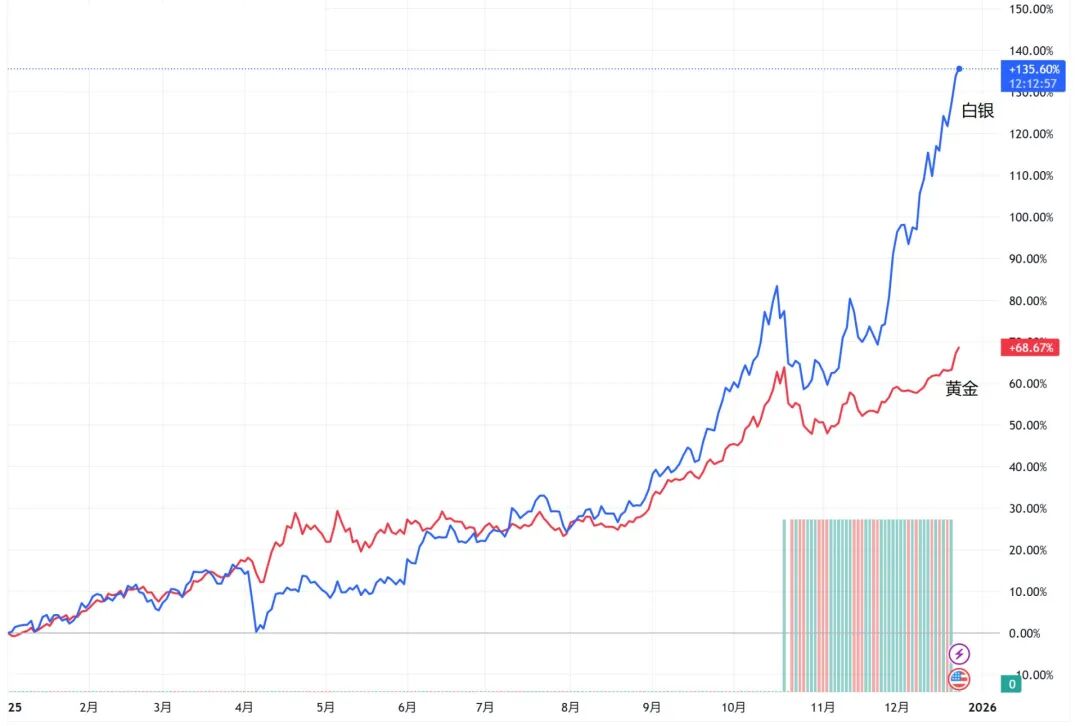
太疯狂!今年涨幅是黄金的2倍 再创历史新高!
Mei Ri Jing Ji Xin Wen· 2025-12-23 13:36
Core Insights - The price of silver has reached a historic high of over $70 per ounce, while gold has also surpassed $4,497 per ounce, marking significant annual increases of over 140% for silver and over 70% for gold [1][2][3] Price Movements - As of December 23, 2023, silver's price has increased by 140.77% year-to-date, significantly outperforming gold's 70.89% increase [3] - The historical price ratio between gold and silver typically fluctuates between 50 to 80 times, but this year it exceeded 100 times after a surge in gold prices [5] Market Dynamics - The recent surge in precious metal prices is attributed to multiple macroeconomic factors, including the Federal Reserve's monetary policy, which has reduced the attractiveness of cash and short-term bonds, driving investment towards gold and silver [5] - Geopolitical tensions have also heightened market uncertainty, contributing to increased demand for precious metals as a safe haven [6] Industrial Demand for Silver - Silver's industrial demand is projected to grow by approximately 5,000 tons from 2016 to 2024, with its applications in solar energy, electric vehicles, and AI data centers becoming increasingly critical [9] - The World Silver Association reports that industrial demand for silver is expected to rise from 153,000 tons in 2016 to 204,000 tons in 2024 [9] Comparison with Oil Market - In contrast to the booming silver market, the oil market is experiencing a downturn, reflecting a slowdown in global economic activity and a long-term trend towards energy transition [10] - The rise of electric vehicles is expected to peak global oil demand around 2030, while non-OPEC countries are increasing production, leading to an oversupply in the oil market [10]
储能与锂电行业2026年度策略:能源转型叠加AI驱动,周期反转步入繁荣期
SINOLINK SECURITIES· 2025-12-23 13:18
Investment Rating - The report indicates a positive investment outlook for the energy storage industry, highlighting a new growth cycle driven by multiple factors [2]. Core Insights - The global energy storage industry is expected to see significant growth, with new installations projected to reach 438 GWh by 2026, representing a 62% year-on-year increase. This growth is driven by the transition from a single focus on renewable energy consumption to a triad of drivers: AI computing infrastructure, energy transition needs, and grid congestion [2]. - In China, new installations are expected to reach 250 GWh in 2026, a 67% increase year-on-year, as policies shift from "strong allocation" to "profitability" [2]. - The U.S. is projected to see 70 GWh of new installations in 2026, a 35% increase year-on-year, with AI driving rigid growth [2]. - Europe is expected to install 51 GWh in 2026, a 55% increase year-on-year, with long-term contracts locking in demand [2]. - Emerging markets are anticipated to see a 91% year-on-year increase in installations, reaching 67 GWh by 2026, driven by economic benefits from "diesel replacement" [3]. Summary by Sections Macro Section: Restructuring Demand and Barriers - The mismatch between the rapid expansion of AI computing and the slow growth of power grids is creating significant bottlenecks in the U.S. and Europe, with average waiting times for grid connections extending to 3-10 years [13]. - Energy storage is becoming a strategic infrastructure to bypass grid bottlenecks, allowing data centers to meet load reduction requirements and avoid lengthy approval processes for grid expansion [13][17]. Demand Section: New Growth Cycle Driven by AI and Energy Transition - The report emphasizes that the energy storage market is transitioning from a focus on backup power to active supply, with storage systems now capable of peak shaving and grid support [17]. - The demand for energy storage is expected to surge due to the increasing need for AI data centers and the ongoing energy transition [2][3]. Supply Section: Navigating Through Oversupply Cycles - The lithium battery supply chain is expected to recover from a period of oversupply, with a significant rebound anticipated in 2026 as demand driven by AI and energy storage continues to grow [4]. - The report highlights the importance of focusing on midstream materials that are experiencing supply-demand reversals, recommending investments in critical segments such as lithium hexafluorophosphate and carbonates [4]. New Technology: Advancements in Solid-State Batteries - The report forecasts that solid-state batteries will begin small-scale production in 2026, with significant advancements in materials and manufacturing processes expected [4]. - The commercialization of solid-liquid batteries is anticipated to occur in 2026, with applications across various sectors including robotics and consumer electronics [4]. Investment Recommendations - The report suggests investing in critical supply chain segments that are expected to see price increases, as well as companies with localized manufacturing capabilities that can navigate trade barriers effectively [4]. - Companies providing integrated energy solutions for data centers and those involved in solid-state battery technology are highlighted as key investment opportunities [4].