产品创新

Search documents
2025年NFC果汁品牌推荐:NFC 果汁赛道暗战升级,健康饮品市场谁沉浮?
Tou Bao Yan Jiu Yuan· 2025-07-08 12:13
Investment Rating - The report does not explicitly provide an investment rating for the NFC juice industry Core Insights - The NFC juice industry in China has transitioned from a nascent stage to a mature phase, characterized by intense competition and a significant market potential driven by changing consumer preferences towards health and wellness [5][7] - The market size of NFC juice is projected to grow from 30.5 billion yuan in 2023 to 33.39 billion yuan in 2025, with a compound annual growth rate (CAGR) of 3-4% [8][9] - The demand for NFC juice is primarily driven by health-conscious consumers, with 65% prioritizing "no additives" as a key purchasing factor, reflecting a 22 percentage point increase since 2018 [9] Market Background - NFC juice, defined as non-concentrated fruit juice made directly from fresh fruits, has gained traction in the beverage market, particularly among urban women and families with children [5][6] - The market has experienced a "V-shaped" recovery from a low of 26.78 billion yuan in 2020, following a peak of 39.44 billion yuan in 2018 [8][9] Market Status - The NFC juice market is expected to reach 33.39 billion yuan by 2025, with a projected growth trajectory indicating a recovery from previous downturns [8][9] - The average product price has decreased by approximately 25%, while the consumer base has expanded by nearly 40%, setting a healthier foundation for future growth [9] Market Competition - The competitive landscape is characterized by a tiered structure, with leading brands like Nongfu Spring and Wei Chuan holding over 30% market share, while emerging brands focus on differentiation through innovative products and marketing strategies [18] - The market concentration has increased, with the top five brands (CR5) accounting for 61% of the market share in 2023, up from 43% in 2018 [9][18] Development Trends - Product innovation is driving market segmentation, with mixed juices and functional products expected to capture 35% of the market share by 2025 [24] - The integration of online and offline channels is reshaping consumer purchasing experiences, with convenience stores contributing significantly to sales [25][26] - Sustainability initiatives are becoming central to brand strategies, with the use of eco-friendly packaging increasing from 12% to 38% over three years [27]

痛失“探花”座次董事长辞职,洋河股份业绩承压如何突围?
Sou Hu Cai Jing· 2025-07-08 02:40
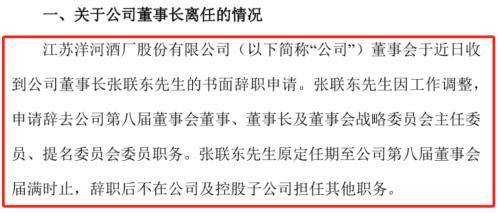
Core Viewpoint - Yanghe Co., Ltd. is undergoing significant leadership changes, with Zhang Liandong resigning as chairman, raising questions about the company's future performance amid declining financial results and increased competition in the liquor industry [2][4][39]. Group 1: Leadership Changes - On July 1, 2024, Zhang Liandong announced his resignation from the position of chairman and other roles at Yanghe Co., Ltd. [2] - Zhang Liandong, who took over from the company's previous leader Wang Yao in February 2021, had a term set to end in April 2027 [3][4]. - Gu Yu has been appointed as the new party secretary of Jiangsu Yanghe Distillery Co., Ltd. on the same day [6]. Group 2: Financial Performance - Yanghe's financial performance has seen a downturn, with 2024 revenues and net profits both declining significantly; revenues fell to approximately 289 billion yuan, a 13% year-on-year decrease, while net profits dropped to around 67 billion yuan, down 33% [9][10][12]. - The company's revenue growth has slowed over the past few years, with 2021-2023 revenues of 254 billion, 301 billion, and 331 billion yuan, reflecting growth rates of 20%, 19%, and 10% respectively [9][12]. - In 2024, Yanghe's revenue ranking in the liquor industry fell from third to fifth, losing its position as a top player for the first time in 14 years [16]. Group 3: Market Challenges - The liquor industry is experiencing intensified competition, particularly in the mid-range and premium segments where Yanghe's main products are concentrated [13]. - The company's mid-to-high-end liquor revenue declined by 15% in 2024, marking a significant drop compared to previous years [13]. - Yanghe's domestic market revenue fell by over 11%, while the external market saw a decline of more than 14% [14]. Group 4: Sales and Marketing Efforts - Yanghe has increased its number of distributors to 8,866, with a notable presence in both domestic and external markets [16]. - The company has invested heavily in sales expenses, amounting to 5.5 billion yuan in 2024, which is significantly higher than competitors like Shanxi Fenjiu and Luzhou Laojiao [19][21]. - Despite high sales expenses, the effectiveness of these investments has been questioned, as the company has not seen corresponding growth in performance [21]. Group 5: Innovation and Product Development - Yanghe's product innovation has been lacking, with R&D expenditures decreasing over the past four years, contrasting with competitors who have increased their R&D investments [27]. - The company's main products, such as "Dream Blue" and "Sky Blue," have been in the market for over 20 years, leading to market saturation [27]. - The need for innovative products is critical as the market for liquor is becoming increasingly competitive, especially with the introduction of lower-alcohol products by competitors [28]. Group 6: Stock Performance and Investor Sentiment - Yanghe's stock price has significantly declined, dropping 74% from its peak of 249.55 yuan per share in January 2021 to 64.80 yuan as of July 7, 2024 [30]. - The number of institutional investors holding Yanghe shares has decreased dramatically from 866 to 48 since 2022, indicating a loss of confidence among investors [33]. - The recent leadership change has sparked interest in whether the new management can reverse the company's fortunes and restore investor confidence [35][39].


研判2025!中国米酒行业市场规模、区域分布、竞争格局及未来发展趋势分析:米酒市场扩容提质,多元趋势引领新程[图]
Chan Ye Xin Xi Wang· 2025-07-08 01:29
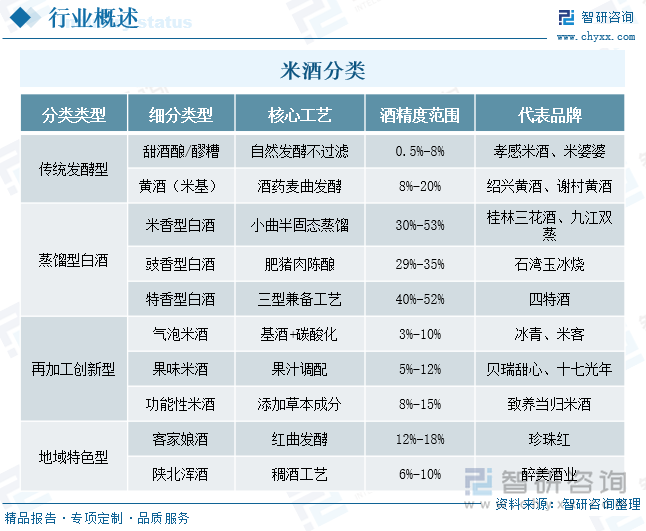
Core Insights - The Chinese rice wine industry, with a market size projected to reach approximately 33 billion yuan in 2024, is experiencing steady growth driven by health-conscious consumption trends and product innovation [11][19][20] - The market is expected to surpass 35 billion yuan by 2025, fueled by the expansion of the young consumer demographic and the introduction of new product categories such as sparkling and functional rice wines [11][19] Industry Overview - The rice wine industry in China is characterized by its production and sales of alcoholic beverages made primarily from rice and glutinous rice through fermentation, holding significant cultural importance [11][19] - Rice wine can be categorized into three main types: traditional fermented rice wine, yellow wine, and distilled rice wine, each with distinct characteristics and alcohol content [11][19] Market Dynamics - The market share of rice wine in the overall alcoholic beverage market is currently around 4%-5%, with a slight increase expected due to the rising trend of low-alcohol consumption and innovative product offerings [13][19] - The industry is witnessing a shift towards healthier consumption patterns, with rice wine's low alcohol content and nutritional benefits appealing to modern consumers [7][19] Development Background - The growth of the rice wine industry is supported by the steady increase in disposable income and consumer spending in China, with per capita disposable income reaching 41,314 yuan in 2024, a 5.3% increase from the previous year [5][19] - Food and beverage expenditures remain a dominant part of consumer spending, accounting for 29.8% of total expenditures, providing a robust market for rice wine [5][19] Competitive Landscape - The competitive landscape features a mix of traditional brands like Ta Pai and Nu Er Hong, which dominate the high-end market, and emerging brands that target younger consumers with innovative products [16][18] - Regional brands leverage local resources and unique production techniques to establish a strong market presence, while some white liquor companies are entering the rice wine sector to enhance their product lines [16][18] Future Trends - The rice wine industry is expected to accelerate product innovation, focusing on health-oriented and diverse flavor profiles to cater to evolving consumer preferences [19][20] - Digital transformation will play a crucial role in enhancing production efficiency and expanding market reach through e-commerce and social media [20][21] - International expansion and sustainable practices will be prioritized, with a focus on brand building and environmental responsibility to enhance global competitiveness [21]
绿城抗压增长样本:上半年销售额1222亿元位居行业第二
Sou Hu Cai Jing· 2025-07-07 15:23
Core Viewpoint - The real estate industry is undergoing a deep adjustment period, but Greentown China is demonstrating steady development and exploring breakthrough paths amidst this environment [1][12]. Group 1: Sales Performance - In the first half of 2025, Greentown China achieved a total contract sales amount of approximately 122.2 billion yuan, with a total sales area of about 5.35 million square meters [1]. - Greentown ranked second among the top 100 real estate companies in terms of sales, with four companies exceeding 100 billion yuan in sales [1]. - Multiple projects in cities like Hangzhou and Taizhou have received enthusiastic market responses, contributing to strong sales performance [1]. Group 2: Investment Strategy - Greentown China's investment strategy focuses on "high certainty," utilizing precise layouts and efficient conversions to achieve steady development [2]. - The company added 42 new projects in 2024, with a total construction area of 4.18 million square meters and a new value of 114.7 billion yuan, with 92% of the value coming from first- and second-tier cities [3]. - In the first half of 2025, Greentown's new value exceeded 80 billion yuan, supported by a comprehensive risk control mechanism in investment decisions [4]. Group 3: Product Innovation - Greentown China has established a "Good House" standard to guide product quality, which includes 226 clauses, with 189 being stricter than national and industry norms [7]. - The company focuses on addressing real-life pain points for customers, using feedback as a driving force for innovation [7][8]. - Recent projects like Hangzhou Zhilang Yuhua showcase Greentown's commitment to innovative design and high-quality delivery, receiving positive market feedback [8][10]. Group 4: Financial Stability and Governance - Greentown China successfully issued a fourth tranche of medium-term notes at a record low interest rate of 3.94%, reflecting improved credit quality and market confidence [11][12]. - The company has completed six credit bond financings in 2025, totaling 5.5 billion yuan, indicating a robust financing channel and positive long-term development expectations [12]. - The combination of precise investment strategies, continuous product innovation, and optimized governance has allowed Greentown to navigate the challenging real estate market effectively [12].

首批10只科创债ETF一日结募,后续持营成真正“赛场”
Sou Hu Cai Jing· 2025-07-07 11:58
Core Viewpoint - The launch of the first batch of Sci-Tech Bond ETFs by ten public funds marks a significant innovation in the bond ETF market, reflecting strong market interest and institutional backing [1][5][6]. Group 1: Market Dynamics - Ten public funds, including major players like China Southern and E Fund, launched Sci-Tech Bond ETFs, with seven companies completing fundraising on the same day [1][5]. - The fundraising for these ETFs was primarily driven by institutional investors, with many companies opting for a one-day fundraising period to expedite listing [1][5]. - The rapid issuance of these ETFs is a response to policy support from the central bank and the China Securities Regulatory Commission (CSRC), which aims to accelerate the development of the Sci-Tech bond market [5][6]. Group 2: Product Characteristics - The Sci-Tech Bond ETFs are designed to fill a gap in the public fund market for technology-related bond products, providing essential funding support for innovative enterprises [6]. - The ETFs are expected to enhance the liquidity of Sci-Tech bonds and enrich investment tools for the Sci-Tech theme, thereby promoting the rapid development of China's technology innovation sector [6][9]. - The underlying assets for these bonds are expected to be of high quality, driven by the ongoing transformation and upgrading of the domestic economy [6][9]. Group 3: Industry Growth - The bond ETF market has seen significant growth, with the total scale surpassing 350 billion yuan by June 30, 2023, up from 200 billion yuan in February [7]. - The introduction of credit bond ETFs earlier in the year has revitalized the bond ETF market, with some products now exceeding 10 billion yuan in scale [7][8]. - Despite the rapid growth, the bond ETF market remains relatively underdeveloped compared to stock ETFs, presenting opportunities for expansion and increased market share [8]. Group 4: Future Outlook - The largest bond ETF, the China Universal 7-10 Year Policy Financial Bond ETF, has grown to over 50 billion yuan, indicating strong investor interest [8][9]. - The macroeconomic environment is expected to maintain low interest rates, which may support a continued bullish trend in the bond market [9]. - The successful commercialization of research outcomes from Sci-Tech bond issuers could enhance their profitability, positively impacting bond values and ETF net asset growth [9].

太平人寿上半年累计完成44.7万件理赔
Zheng Quan Ri Bao Wang· 2025-07-07 11:53
Core Insights - Taiping Life Insurance reported a total of approximately 447,000 claims processed in the first half of 2023, benefiting around 324,000 customers, with a mobile claims usage rate of about 88.7%, indicating an improvement in service quality and efficiency [1][2] Group 1: Claims Service Efficiency - The company emphasizes "full compensation" as part of its service ethos, providing significant support to clients in need, such as a recent case where over 330,000 yuan was paid out to a family of a 4-year-old diagnosed with leukemia [1] - Taiping Life has leveraged technology to enhance claims service efficiency, exemplified by a case where a claim was processed in just 3 hours for a client in Finland, despite the geographical distance of 8,000 kilometers [2] Group 2: Product Innovation and Market Strategy - The company is committed to continuous product innovation, aligning with national policies to optimize its insurance product offerings, thereby expanding coverage and addressing the needs of key demographics such as the elderly and new citizens [2] - Taiping Life aims to provide more accessible and impactful financial products, focusing on inclusive finance and pension finance to meet the risk protection demands of targeted customer groups [2]
在拼多多卖百货年销千万,义乌95后群体如何破局同质化竞争?
Zhong Jin Zai Xian· 2025-07-07 08:26
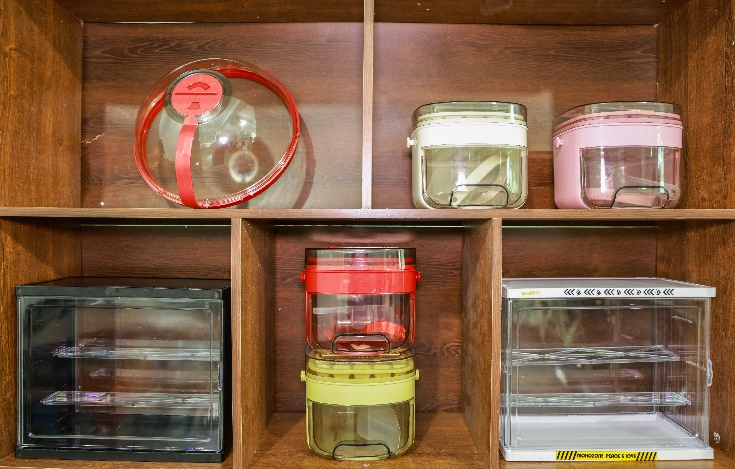
Core Insights - The article highlights the transformation of the Yiwu small commodity industry, driven by new e-commerce platforms like Pinduoduo, which have enabled local entrepreneurs to innovate and escape the trap of homogeneous competition [1][2][3] Group 1: Industry Challenges - Yiwu, known as the "World Capital of Small Commodities," faces intense homogenization and price competition, leading to declining profits for local businesses [1] - The low production barriers for plastic products have resulted in a saturated market, making it difficult for businesses to maintain profitability [5] Group 2: Entrepreneurial Innovation - New generation entrepreneurs, particularly those born in the 1990s, are leveraging product innovation to create significant business opportunities, transforming small items into million-dollar ventures [2][3] - Entrepreneurs like Yu Yongyuan and Zhang Xiaojie have successfully introduced innovative products, such as a high-cost curling iron and a press-type ice tray, which have achieved impressive sales figures on Pinduoduo [4][8] Group 3: E-commerce Support - Pinduoduo has played a crucial role in supporting local businesses by providing resources and guidance for product innovation, which has led to increased sales and market presence [7][9] - The platform's initiatives, such as the "New Quality Merchant 100 Billion Support Plan," aim to assist merchants in transitioning to higher-quality products and brands [7][11] Group 4: Future Aspirations - Entrepreneurs are now focusing on building their own brands to differentiate themselves from competitors, with plans to expand into offline channels such as supermarkets and exhibitions [11][12] - Yu Yongyuan and Zhang Xiaojie are both in the process of applying for Pinduoduo's black label authorization, which would enhance their brand visibility and market reach [9][11]

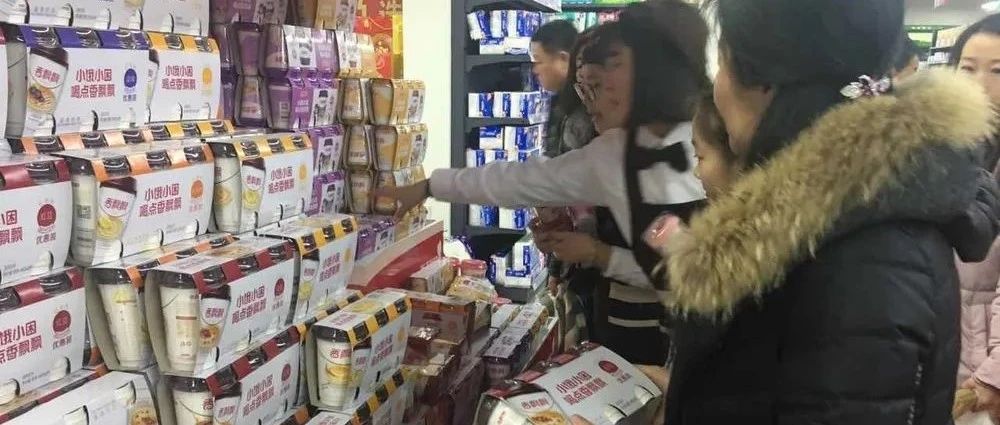
香飘飘居然还在卷?
虎嗅APP· 2025-07-07 00:05
Core Viewpoint - Xiangpiaopiao is actively seeking to regain its consumer base by exploring various channels, including snack stores, Sam's Club, and convenience stores, while also launching pop-up stores to engage with consumers directly [1][2][3]. Group 1: Market Challenges and Internal Changes - Xiangpiaopiao, founded in 2005, was once a market leader in cup-based instant milk tea but now faces challenges due to market fragmentation and evolving consumer demands [2][4]. - The company is undergoing a gradual internal transformation, integrating product development with channel management to streamline operations and enhance product launch speed [3][5]. - The chairman, Jiang Jianqi, aims to position Xiangpiaopiao as the "Zara of the milk tea industry," focusing on rapid product development and market responsiveness [3][6]. Group 2: Product Development and Market Strategy - Xiangpiaopiao is exploring new product lines, transitioning from instant to ready-to-drink options, and experimenting with various flavors and formats to meet diverse consumer preferences [6][8]. - The company has established two main product lines: instant and ready-to-drink, with a focus on creating a rich product matrix within these categories [6][7]. - The ready-to-drink segment, particularly the Meco brand, has shown significant growth, with sales increasing from over 300 million to nearly 1 billion in five years [9]. Group 3: Channel Expansion and Consumer Engagement - In 2024, Xiangpiaopiao plans to embrace the rapid expansion of snack stores, aiming to customize products for these new channels to differentiate from traditional offerings [25][26]. - The company is also testing new products through pop-up stores, which serve as a platform for consumer interaction and product validation [20][21]. - Xiangpiaopiao's strategy includes launching over 20 new SKUs targeted at different channels, reflecting a commitment to adapt to market changes and consumer segmentation [11][14]. Group 4: Operational Adjustments and Future Outlook - The company is working on enhancing production flexibility to meet the diverse and evolving demands of consumers, moving from large-scale production to smaller, customized batches [26][27]. - Jiang Jianqi emphasizes the importance of maintaining strong relationships with distributors while navigating the challenges posed by new market dynamics [33][34]. - The company aims to leverage its established brand recognition while innovating to stay competitive in a rapidly changing beverage market [30][34].

食品饮料周观点:关注健康化消费趋势、产品创新与渠道迭代-20250706
GOLDEN SUN SECURITIES· 2025-07-06 09:34
Investment Rating - The report maintains an "Increase" rating for the food and beverage industry, indicating a positive outlook for the sector [4]. Core Insights - The report emphasizes the trend towards health-conscious consumption, product innovation, and channel iteration as key drivers in the food and beverage industry [1]. - In the liquor segment, the report highlights the ongoing adjustments in management teams and anticipates a new cycle for the industry, suggesting that the sector is entering a phase of stabilization after a deep adjustment period [2]. - The beer and beverage sector is witnessing a diversification of products, with new offerings such as sugar-free drinks and unique flavors, which are expected to drive growth [3]. Summary by Sections Liquor Industry - The report identifies three main investment themes: 1. Leading brands with increasing market share, such as Kweichow Moutai and Wuliangye 2. High-certainty regional brands benefiting from local market advantages 3. Elastic stocks that may benefit from recovery and increased risk appetite [1][2]. Beer and Beverage Sector - The report notes the upcoming launch of new beer products and the continued popularity of craft beers, suggesting that companies like Yanjing Beer and Zhujiang Beer are well-positioned for growth [3]. - In the beverage segment, the introduction of a new sugar-free drink by Dongpeng is highlighted, aligning with the health trend and expected to attract consumers [3]. Food Sector - The approval of D-allohexose as a new food ingredient is expected to accelerate growth in the sugar substitute market, with companies like Bailong Chuangyuan being potential beneficiaries [6]. - The report also mentions the entry of Meituan's discount supermarket "Happy Monkey," which is anticipated to enhance competition in the discount retail space [6].
深陷召回风波后,大卖被曝已停工停产
Sou Hu Cai Jing· 2025-07-04 08:53
Core Viewpoint - The recent recall crisis involving leading power bank brands Romoss and Anker Innovation has triggered significant repercussions across the consumer electronics industry, highlighting vulnerabilities in supply chains and product safety standards [1][10]. Group 1: Company Impact - Romoss has reportedly notified employees to cease operations and production since July 1, with salaries only paid up to June, indicating severe operational challenges due to the recall [2][3]. - The recall involves over 490,000 power banks, leading to direct costs exceeding 40 million yuan, and the suspension of product sales on all domestic e-commerce platforms [3][10]. - Romoss has experienced a significant cash flow disruption, with reports of consumer refunds being hindered due to insufficient account balances [3][10]. Group 2: Industry Repercussions - The recall crisis has affected multiple brands, with Anker recalling approximately 1.158 million power banks overseas and 712,900 units domestically, indicating widespread industry implications [10]. - Anker's recall process has seen over 200,000 user applications submitted, representing more than 30% of the total recall, which may impact its overall performance [10]. - The crisis has underscored the risks of over-reliance on single products and the importance of robust supply chain management, as companies face potential disruptions from upstream suppliers [10]. Group 3: Supply Chain Issues - The root cause of the recall for Romoss is linked to its battery supplier, Amperes, whose certifications were suspended, affecting multiple brands in the industry [8][9]. - Amperes has reportedly halted production on some lines and is facing significant unpaid debts, raising concerns about the stability of the supply chain [9][10]. - The situation has prompted Anker to switch its core battery supplier to CATL, aiming to mitigate future risks associated with supply chain dependencies [10].