供给侧改革

Search documents
“反内卷”成果来了!多晶硅单周涨超16%
证券时报· 2025-07-12 23:56
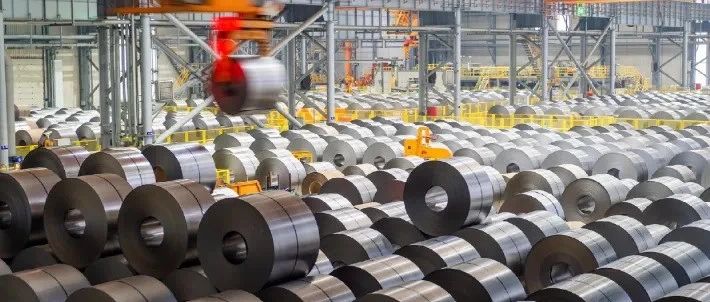
全行业都在"反内卷"。 这一轮"反内卷"行情中,多晶硅一马当先,自6月25日以来,从阶段低点30400元/吨一路上行至7月11日盘 中最高42265元/吨,在14个交易日大涨39%,单周涨幅达到16.39%。此外,焦煤等资源品价格也在连续上 涨,单周涨幅超8%。 业内人士指出,国内供给侧最敏感的是黑色板块和新能源金属。而随着近期更多资源行业关于行业自律和供给 侧改革加码的密集推动,市场再度憧憬供给侧改革加快推进,并期待资源行业实现困境反转。 "反内卷"在多个行业落地 随着近日"反内卷"进一步明确,各行业纷纷响应,多晶硅、焦煤、钢铁等资源品价格出现持续上涨。"反内 卷"政策旨在通过规范市场竞争、淘汰落后产能,引导行业从"量的扩张"转向 "质的提升"。 7月11日,多晶硅期货突破4.1万元大关,主力合约盘中最高报42265元/吨,触及近三个月新高,成交量在前 一日101.5万手基础上稍有回落,仍然达到87.8万手的历史次高水平,单周上涨幅度达到16.39%。 为避免光伏玻璃企业之间竞争加剧使得市场恶性循环,多数玻璃企业计划7月开始减产改善供应端,行业倡议 减产规模达到30%。市场预计在现阶段短期更多依靠市场化手段 ...

“反内卷”成果来了!多晶硅单周涨超16%
券商中国· 2025-07-12 15:37
全行业都在"反内卷" 资源品出现价格持续上涨预期 "从季节性来看,随着资源品下半年迎来需求旺季,价格有持续上行的预期。"兴业证券分析师张启尧认为,进 入7月,受高温天气影响,国内进入用电高峰,煤炭、石油石化等资源品也随之迎来需求高峰期;而供给端的 开工率也会因为高温天气甚至可能会出现限电停产而受到影响,往往会呈现需求旺盛但供给偏紧的局面。 这一轮"反内卷"行情中,多晶硅一马当先,自6月25日以来,从阶段低点30400元/吨一路上行至7月11日盘中最 高42265元/吨,在14个交易日大涨39%,单周涨幅达到16.39%。此外,焦煤等资源品价格也在连续上涨,单周 涨幅超8%。 业内人士指出,国内供给侧最敏感的是黑色板块和新能源金属。而随着近期更多资源行业关于行业自律和供给 侧改革加码的密集推动,市场再度憧憬供给侧改革加快推进,并期待资源行业实现困境反转。 "反内卷"在多个行业落地 随着近日"反内卷"进一步明确,各行业纷纷响应,多晶硅、焦煤、钢铁等资源品价格出现持续上涨。"反内 卷"政策旨在通过规范市场竞争、淘汰落后产能,引导行业从"量的扩张"转向 "质的提升"。 7月11日,多晶硅期货突破4.1万元大关,主力合 ...

AH股市场周度观察(7月第2周)-20250712
ZHONGTAI SECURITIES· 2025-07-12 13:19
A-Share Market Overview - The A-share market experienced an overall increase, with small-cap stocks showing significant gains while mid and large-cap value stocks faced pressure. The CSI 2000 index rose by 2.32%, and the ChiNext index increased by 2.36%, while the SSE 50 index only saw a modest rise of 0.60%. The average daily trading volume reached 1.50 trillion, a week-on-week increase of 3.80% [5][6]. - The real estate sector saw a notable increase of 6.06%, with steel rising by 3.90%, building materials by 3.07%, and construction by 2.71%. The recent "anti-involution" policies have raised expectations for production limits, leading to a continuation of strong performance in certain cyclical sectors. Additionally, there has been an acceleration in debt restructuring among real estate companies, with several debt resolution plans approved, significantly reducing risks in the real estate sector [5][6]. Market Outlook - Compared to the supply-side reforms of 2015, the current "anti-involution" policy is expected to be less aggressive, with the overall capacity reduction likely to be milder. The focus of the current policies is anticipated to be primarily on the new energy vehicle and photovoltaic sectors, with implications for other industries. Despite the recent increase in risk appetite due to policy expectations, there remains considerable pressure on overall market profitability in the second half of the year, necessitating caution regarding potential policy disappointments leading to market corrections [6]. Hong Kong Market Overview - The Hong Kong market showed signs of recovery, with the Hang Seng China Enterprises Index rising by 0.91% and the Hang Seng Technology Index increasing by 0.62%. The industrial and financial sectors performed well, while the materials sector experienced significant declines [7]. - The recovery in the Hong Kong market was supported by expectations of an imminent interest rate cut by the Federal Reserve, leading to a decline in long-term U.S. Treasury yields, which positively impacted the Hong Kong dollar's liabilities. Additionally, the appreciation of the Renminbi, influenced by the interest rate cut expectations and the "Big and Beautiful" legislation, contributed to the rise in Hong Kong stocks [7]. Future Expectations - Looking ahead, the "Big and Beautiful" legislation has raised the debt ceiling, and the high yield characteristics of U.S. Treasuries are expected to reduce uncertainties surrounding Trump, allowing international capital inflows to effectively offset liquidity constraints from increased borrowing. Therefore, the short to medium-term risk of a "black swan" event related to U.S. Treasuries has decreased. On the asset side, the AI capital expenditure wave is likely to favor leading technology stocks in Hong Kong, with high demand for upstream computing power and servers expected to continue into the second half of the year, providing strong earnings support for the Hang Seng Technology sector [7].
通威股份子公司获近50亿元融资 11家机构入场同时已备好“退路”
Mei Ri Jing Ji Xin Wen· 2025-07-12 08:39
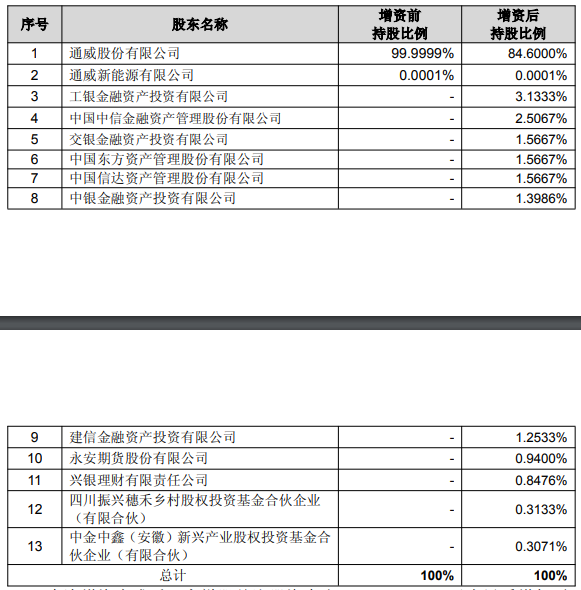
Core Viewpoint - Tongwei Co., Ltd. has successfully completed a strategic capital increase of 4.916 billion yuan for its subsidiary, Sichuan Yongxiang Co., Ltd., attracting 11 investment institutions, including several with state-owned backgrounds, despite the amount being half of the previously estimated scale [1][4]. Group 1: Capital Increase Details - The total capital increase amount is approximately 4.916 billion yuan, which is the largest single private equity financing amount disclosed in Sichuan Province for 2025 [3][4]. - After the capital increase, Tongwei's shareholding in Yongxiang has been diluted to 84.60%, while new investors hold a combined 15.40% [2][3]. - The funds from this capital increase will be used to repay bank loans and supplement working capital for Yongxiang and its subsidiaries [4]. Group 2: Company Performance and Market Context - Yongxiang Co., Ltd. has a production capacity of over 900,000 tons of high-purity crystalline silicon and has ranked first globally in market share and shipment volume since 2021 [5]. - In 2023, Yongxiang achieved a revenue of 45.03 billion yuan and a net profit of 15.18 billion yuan, but faced a net loss of nearly 1 billion yuan in the first three quarters of 2024 due to a downturn in the photovoltaic industry [5]. - Analysts suggest that the financing indicates that leading companies in the photovoltaic sector can endure longer despite the industry's challenges, but it does not change the overall trend of the market [5]. Group 3: Analyst Perspectives - Citigroup upgraded Tongwei's rating from "Sell" to "Buy," raising the target price from 14 yuan to 25 yuan, anticipating benefits from supply-side reforms that will reduce excess industry capacity [6]. - The analyst believes Tongwei is well-positioned to capitalize on potential benefits from supply-side reforms in the polysilicon production sector, enhancing its competitive cost structure [6].

ETF日报:“反内卷”或是下半年潜在主线之一,但相关板块节奏存在差异,上游或领先于下游
Xin Lang Ji Jin· 2025-07-11 14:55
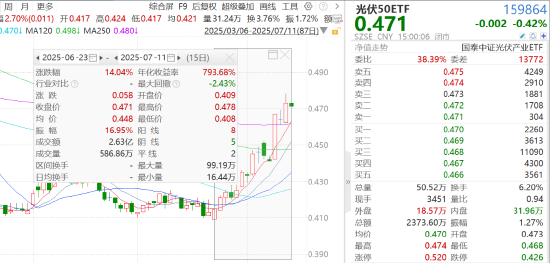
Market Overview - A-shares experienced a slight increase today, with the Shanghai Composite Index rising by 0.01% to 3510.18 points, while the Shenzhen Component Index increased by 0.61% and the ChiNext Index rose by 0.80% [1] - The total trading volume in the Shanghai and Shenzhen markets reached 1.71 trillion yuan, an increase of 218 billion yuan compared to the previous trading day [1] - The market sentiment appears to be strong in the short term, with over 2900 stocks rising [1] Sector Performance - Leading sectors today included securities, non-ferrous metals, pharmaceuticals, and steel, while financials, telecommunications, photovoltaics, and dividends lagged [1] - The market showed a preference for small-cap stocks over large-cap stocks, with growth stocks outperforming value stocks [1] Policy Insights - The "anti-involution" theme is identified as a potential main line for the second half of the year, with a focus on upstream sectors leading the way [3][4] - Recent meetings emphasized the need to regulate low-price competition and promote the exit of backward production capacity, reminiscent of the supply-side reforms of 2015 [3][4] - The ongoing decline in PPI has drawn policy attention, suggesting potential supply-side adjustments in sectors like steel, coal, and cement [3] Demand and Supply Dynamics - The supply-demand mismatch in upstream resource products is significant, leading to price declines as firms engage in price competition [4][6] - Current demand conditions are similar to those in July of the previous year, but prices have adjusted downward, aligning better with supply-demand dynamics [6] - The performance of consumer goods differs, with companies increasingly adopting price reductions to boost sales volumes [6][7] Historical Context - Historical cases of supply-side contraction have shown that market reactions often lag behind policy announcements, with stock prices typically responding after initial skepticism [7][9] - Past supply-side reforms have led to significant price increases in commodities, although demand-side pressures remain a concern [9][12] International Factors - The U.S. labor market remains resilient, with recent non-farm payroll data exceeding expectations, which has tempered interest rate cut expectations from the Federal Reserve [12][13] - The ongoing trade negotiations and tariff strategies under the Trump administration are expected to create uncertainty in the market [15][16]
拉长交易周期,大宗商品和股票在下半年存在什么样的交易机会?
对冲研投· 2025-07-11 12:26
自2024年7月政治局会议提出防止"内卷式"恶性竞争,至2025年7月1日中央财经委员会正式提出依法依规治理企业低价无序竞争,推动 落后产能有序退出,反内卷相关政策是在不断推进加强的。当前外有关税冲击、出口环境恶劣,加剧国内产能过剩;内有多行业长期有 规模无利润,行业生态日益恶劣,已陷入低价通缩循环。因此治理无序竞争、调整产能结构、促进产业升级的反内卷势在必行。特别是 光伏、汽车、钢铁等重点行业。 此次会议研讨后,我们认为反内卷影响周期长,至少是下半年一条交易主线,部分板块存在投资机会。商品主要关注多晶硅,股票关注 通威和隆基,同时股指300也是较好的标的。 具体商品来看: 以下文章来源于混沌天成研究 ,作者能化组 混沌天成研究 . 混沌天成研究院官方公众号。基于混沌天成的地方触角和国际化架构,我们致力于打造一家草根信息与高科技结合,中国国情和国际视野兼备的商品期货 和全球宏观研究院。 来源 | 混沌天成研究 编辑 | 杨兰 审核 | 浦电路交易员 观点概述 进入7月,"反内卷"新一轮供给侧改革论调,已开始成为近期商品交易的一大主线。此轮反内卷与以往有何不同,是否将是下半年的投资 主线,各板块又存在哪些投资机 ...


“陪爬”服务何以走红?
Bei Jing Qing Nian Bao· 2025-07-11 11:12
Core Insights - The rise of "accompanying climbing" services reflects a new definition of travel experiences among younger consumers, emphasizing emotional value and personalized support over traditional guiding roles [1][2][3] - The growth in visitor numbers at Wugong Mountain is linked to the younger demographic becoming the main force in the tourism market, seeking both challenge and social companionship [2][3] Group 1: Market Dynamics - In June alone, the team led by Zhu Jianfeng completed 29 days of accompanying climbing orders, indicating a surge in demand for this service [1] - Wugong Mountain received 2.6285 million visitors in the first half of the year, with an increasing number of young people opting for emotional support services [1] Group 2: Industry Challenges - The majority of "accompanying climbing" services are currently operated individually, leading to non-standardized transactions that pose various risks [2] - There is a need for improved institutional design to regulate market behavior, including establishing qualifications, service standards, and safety guarantees for practitioners [2] Group 3: Service Evolution - The emergence of "accompanying climbing" services fills a gap between traditional guiding and self-guided experiences, offering a third option that combines exploration freedom with necessary professional support [3] - Understanding the underlying emotional value demands from tourists can lead to a transformation in the tourism industry from merely providing scenery to offering meaningful experiences [3]
东兴首席周观点:2025年第28周-20250711
Dongxing Securities· 2025-07-11 11:00
Investment Rating - The industry investment rating is optimistic, indicating a potential recovery in profitability and valuation levels for the steel industry due to the "anti-involution" policy [1][4]. Core Insights - The "anti-involution" policy aims to shift the steel industry from low-cost homogeneous competition to high-end differentiated competition, which is expected to lead to a reversal in industry profitability and valuation levels [1][4]. - The steel industry is currently facing weak demand, with prices and profit levels declining. The Producer Price Index (PPI) for black metal smelting and rolling industries has dropped to 89.8, the lowest among five sub-industries [2][4]. - The current state of the steel industry shows a divergence in profitability between upstream and midstream sectors, with upstream mining absorbing most of the industry's profits [2][4]. Summary by Sections Current Industry Status - The steel industry is experiencing weak demand, with PPI for black metal smelting and rolling industries at 89.8, indicating a decline in prices and profits [2]. - The gross profit margin for black metal smelting and rolling industries is only 5.48%, significantly lower than the 19.57% margin for black metal mining [2]. Comparison with 2015 Supply-Side Reform - The supply-demand situation in the steel industry has improved compared to 2015, with a reduction in the degree of supply surplus [3][4]. - The current "anti-involution" policy is less administratively forceful than the 2015 supply-side reforms, which were primarily focused on eliminating outdated production capacity [3]. Policy Impact and Guidance - The "anti-involution" policy aims to prevent homogeneous competition and emphasizes the need for market mechanisms and industry self-regulation to optimize and upgrade production capacity [4]. - The policy includes stricter standards for capacity elimination and encourages the adoption of green and intelligent production methods [5]. Inventory and Profitability Outlook - The steel inventory is expected to rise from the bottom, with significant reductions in social inventory levels for rebar and wire rod [6]. - The industry's return on equity (ROE) and return on assets (ROA) have declined due to the real estate market downturn, but the "anti-involution" policy may help restore market sentiment and improve profitability [6]. Valuation Observations - The current median price-to-earnings (P/E) ratio for the steel industry is 35.51X, indicating potential for valuation recovery as supply-demand structures improve [6].
冠通每日交易策略-20250711
Guan Tong Qi Huo· 2025-07-11 10:42
Report Summary Overall Market Performance - As of July 11, 2025, domestic futures main contracts showed mixed performances. Coking coal rose over 3%, coke and glass rose over 2%, while aluminum oxide fell over 2%. Regarding stock index futures, CSI 1000 Index Futures (IM) rose 1.25%. In terms of capital flow, CSI 1000 2509 had an inflow of 4.43 billion, while Shanghai Gold 2510 had an outflow of 435 million [7]. Industry - Specific Analysis Coking Coal - The price of coking coal opened high and strengthened during the day. The mainstream price in the Shanxi market was 970 yuan/ton, up 10 yuan/ton from the previous trading day. Due to the closure of the Sino - Mongolian border during Mongolia's National Naadam Festival and the impact of supply - side reforms, the supply pressure eased. Coke enterprises proposed a price increase, and the short - term market remained strong [3]. Crude Oil - The easing of Middle East geopolitical risks reduced concerns about supply disruptions. OPEC + agreed to increase oil production by 548,000 barrels per day in August, exceeding market expectations. OPEC also lowered its global oil demand forecast for the next four years. The market was expected to be volatile, and attention should be paid to the development of the Middle East situation and the outcome of trade negotiations [4][5]. Copper - Copper opened high and weakened during the day. Trump announced a 50% tariff on copper starting from August 1. Supply was expected to improve, and demand was expected to enter the off - season. The market was bearish in the short term, and prices were expected to be volatile [9]. Carbonate Lithium - Carbonate lithium opened high and closed down after fluctuations. The spot price continued to rise, but the market deviated from the fundamental logic. Supply was abundant, and the market was mainly affected by news and macro - sentiment. The price was expected to be high and volatile, and there was a risk of a sharp decline [10][11]. Asphalt - The asphalt production rate increased, while the downstream construction rate mostly decreased. The inventory was at a low level. With the approaching peak season and the narrowing of the price range of crude oil, it was recommended to go long on the 09 - 12 spread at low prices [12]. PP (Polypropylene) - The downstream开工率 of PP decreased, and the production rate of enterprises increased. The market was affected by tariffs and the expected slowdown of global oil demand. Supply pressure was relieved to some extent, but demand recovery was slow. The price was expected to fluctuate at a low level [14]. Plastic - The production rate of plastic increased, while the downstream开工率 decreased. The market was affected by tariffs and the situation of global oil demand. Although the cost might decrease, demand recovery was slow, and the price was expected to fluctuate at a low level [15]. PVC - The PVC production rate decreased, and the downstream开工率 was low. Export was restricted, and inventory was high. The market was affected by the real - estate situation and new production capacity. The price was expected to fluctuate at a low level [18]. Soybean Oil - The price of soybean oil showed a high - opening and volatile trend, approaching the 8000 - yuan/ton pressure level. Supply was abundant, and demand increased recently. The price was expected to be volatile and strong, but the upside was limited [19]. Soybean Meal - The price of soybean meal rose. Supply was under pressure due to high domestic oil - mill operating rates, and demand improved slightly. The price was affected by factors such as US soybean production, trade policies, and livestock farming. It was necessary to pay attention to relevant factors [21]. Rebar - Rebar showed a strong - oscillating trend. Supply and demand were both weak, with production decreasing and demand in the seasonal off - season. Inventory was still high, but cost support was strong. The price was expected to remain strong in the short term [23]. Hot Rolled Coil - Hot rolled coil showed a strong - oscillating trend with "high - rising and falling back". Supply and demand both decreased, and inventory increased slightly. The market was affected by policies and raw - material prices. The price was expected to remain strong in the short term [24][25]. Urea - The urea price closed down after fluctuations. Production was stable, and demand was weak in the industrial sector but had local increases in the agricultural sector. Inventory decreased continuously. The price was expected to be volatile and strong in the short term, and attention should be paid to export policies [26].
钢铁,“反内卷”能复刻“供给侧改革”行情吗?
和讯· 2025-07-11 10:00
Core Viewpoint - The recent announcements from the Central Financial Committee regarding the governance of low-price disorderly competition and the orderly exit of backward production capacity have reignited optimism in the steel industry, leading to price increases in various steel products and stocks [1][2][6]. Group 1: Supply-Side Reform Restart - The Central Financial Committee's sixth meeting emphasized the need to promote the orderly exit of backward production capacity, marking the beginning of a new round of supply-side reform [2][3]. - The focus of the reform includes promoting high-quality production capacity and the consolidation of the industry through mergers and acquisitions [2][3]. - A joint initiative from 33 construction companies aims to combat "involution" in the industry, indicating a collective push for transformation [2]. Group 2: Steel Industry Dynamics - The China Iron and Steel Association has been actively promoting self-discipline among major steel companies to control production and reduce inventory [3][4]. - Major steel companies like China Baowu and Ansteel have undergone multiple rounds of restructuring, contributing to an increase in industry concentration from 41.4% in 2021 to 42% in 2024 [3]. - Current data indicates that while total crude steel capacity is not excessively overbuilt, actual production often exceeds designed capacity, leading to a higher overcapacity ratio [4]. Group 3: Cautious Optimism for Steel Prices - The phenomenon of "involution" in the steel industry is characterized by price competition leading to overall profit decline and resource wastage [5]. - The challenges facing the steel market are more complex than in previous cycles, with structural changes in demand and a weak real estate market limiting the potential for a repeat of past bullish trends [7]. - Despite the current low price levels of steel, the overall market environment is better than in 2015, but significant improvements in supply-demand dynamics are unlikely, necessitating close attention to policy implementation [7].