
商业航天

Search documents
收盘丨沪指涨0.85%重返4100点,煤炭股掀涨停潮
Di Yi Cai Jing· 2026-02-04 07:16
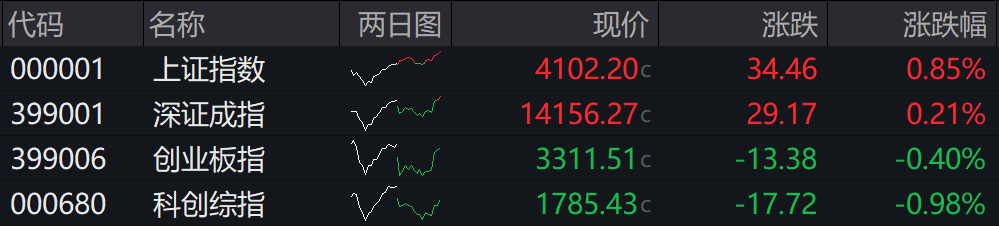
沪深两市成交额2.48万亿,较上一个交易日缩量633亿。 2月4日,A股三大指数分化,沪指震荡上行。截至收盘,沪指涨0.85%,深成指涨0.21%,创业板指跌0.4%,科创综指跌0.98%。 | 代码 | 名称 | 涨幅量 | 现价 | | --- | --- | --- | --- | | 000517 | 荣安地产 | +10.27% | 2.04 | | 600683 | 京投发展 | +10.09% | 6.00 | | 000560 | 我爱我家 | +10.06% | 3.61 | | 600325 | 华发股份 | +9.95% | 4.42 | | 000838 | 财信发展 | +9.92% | 2.66 | | 000042 | 中洲控股 | +7.91% | 9.00 | | 601155 | 新城控股 | +7.62% | 18.08 | | 600791 | 京能量化 | +7.60% | 6.51 | | 001979 | 招商蛇口 | +7.31% | 10.87 | | 600649 | 城投控股 | +6.94% | 5.55 | | 600463 | 空港股份 | +6.7 ...




A股收评:沪指涨0.85%重回4100点上方,煤炭、太空光伏概念股掀涨停潮,房地产板块活跃,AI应用股普跌
Jin Rong Jie· 2026-02-04 07:15
Market Performance - The A-share market showed a rebound after an initial decline, with the Shanghai Composite Index closing at 4102.20 points, up 34.46 points or 0.85% [1] - The Shenzhen Component Index rose by 29.17 points, or 0.21%, closing at 14156.27 points, while the ChiNext Index fell by 13.38 points, or 0.40%, to 3311.51 points [1] - The total trading volume in the Shanghai and Shenzhen markets reached 2.48 trillion yuan, with over 3200 stocks rising [1] Sector Highlights - The coal sector emerged as a star performer, with multiple stocks such as Yanzhou Coal and Shenhua Group hitting the daily limit [2] - The space photovoltaic and perovskite battery concepts saw significant gains, with stocks like Zhonglai Co. and Dongfang Wealth Securities showing strong performance [2] - The real estate sector rebounded, with companies like Rong'an Real Estate and Caixin Development reaching their daily limits [2] - The hydrogen energy concept also surged, with stocks like Beijing Capital and Zhiyuan New Energy hitting the daily limit [1][2] Declining Sectors - The AI application sector experienced a widespread decline, with stocks like Worth Buying and Kaipu Cloud dropping over 10% [3] - The gaming and Tencent-related stocks also fell, with companies like Lito Electronics and Yingu Media hitting the daily limit down [3] - The precious metals sector saw a decline, with Sichuan Gold dropping nearly 9% [1][3] Institutional Insights - Guosheng Securities noted that AI's impact extends beyond software, with opportunities arising in various sectors, emphasizing the need to observe individual companies' core competitiveness in the AI era [4] - Huatai Securities highlighted that risk appetite is constrained, with a notable decrease in trading participation and net outflows from funds, indicating a cautious market sentiment [4] - Zhongshan Securities suggested that fiscal policy should remain proactive in 2026, focusing on consumption as a key counter-cyclical variable for the stock market [5] Industry Trends - CITIC Construction pointed out that the global commercial space industry is entering a new phase focused on large-scale deployment and ecosystem building, with significant competition emerging in reusable rocket technology and satellite manufacturing [6] - The industry is expected to expand into diverse areas such as space computing and tourism, marking a shift from state-driven projects to key drivers of future economic growth and strategic competition [6]





军工ETF(512660)盘中涨超1%,关注军工板块行情
Mei Ri Jing Ji Xin Wen· 2026-02-04 07:08
Group 1 - The core viewpoint of the article highlights the positive outlook for the military industry, driven by the "14th Five-Year Plan" and the centenary goal of military development in China [1] - The military equipment construction efforts in China are expected to strengthen further, with a clear upward trend in military trade over the next 5 to 10 years [1] - Specific areas of focus include the "two aircraft" industry chain, where demand for military aviation engines remains robust, and the supply chain replenishment trend has begun [1] Group 2 - The commercial aerospace sector is experiencing accelerated industrial progress, presenting investment opportunities in satellites, rockets, and ground terminal segments due to the acceleration of industrialization [1] - The military ETF (512660) tracks the CSI Military Industry Index (399967), which selects listed companies related to the military industry from the Chinese A-share market, covering sectors such as aerospace, weaponry, and electronics [1]
上海经济2025成绩单:GDP实现5.67万亿,居民年收入首破9万
Sou Hu Cai Jing· 2026-02-04 07:05
Economic Growth Targets - Shanghai's economic growth target for 2026 is set at 5%, slightly lower than the 5.4% growth achieved in 2025, with GDP reaching 5.67 trillion yuan [2][4] - In 2025, Shanghai's key economic indicators, including consumption, exports, and investments, all showed growth exceeding the national average [2][4] Key Economic Indicators - Retail sales in Shanghai grew by 4.6% in 2025, surpassing the national average of 3.7% [7] - The total foreign trade volume in Shanghai reached 45.1 trillion yuan in 2025, with a growth rate of 5.6%, also above the national average of 3.8% [10] - Fixed asset investment in Shanghai increased by 4.6% in 2025, significantly better than the national average decline of 3.8% [5] Income and Employment - The per capita disposable income in Shanghai reached 91,987 yuan in 2025, marking a 4.1% increase, which is lower than the GDP growth rate [9] - The average urban unemployment rate in Shanghai was 4.2% in 2025, with a target to keep it below 5% in 2026 [9][8] Strategic Industries - The three leading industries in Shanghai—integrated circuits, biomedicine, and artificial intelligence—saw manufacturing output growth of 9.6% in 2025, with integrated circuits growing by 15.1% [4][6] - Strategic emerging industries accounted for 45% of Shanghai's industrial output, with a 6.5% increase in output in 2025 [4] Consumption and Services - The government plans to enhance consumption by promoting initiatives such as the transformation of key shopping districts and the introduction of consumption vouchers [3][8] - In 2025, Shanghai's service sector saw significant growth, with a focus on cultural, tourism, and health services to boost consumption [8] Export Performance - Shanghai's exports reached a record high of 20.15 trillion yuan in 2025, with a growth rate of 10.8% [10] - The export of high-end manufacturing products, including electric vehicles and industrial robots, showed significant growth, with electric vehicle exports exceeding 100 billion yuan [11] Future Development Plans - Shanghai aims to establish a national service trade innovation development demonstration zone by 2026, focusing on high-end design and knowledge-intensive service trade [12][10] - The city plans to develop the low-altitude economy and other emerging industries as new growth points [5][6]

光大期货金融期货日报-20260204
Guang Da Qi Huo· 2026-02-04 06:53
Group 1: Report Industry Investment Rating - The investment rating for stock index futures is "volatile", and for treasury bond futures is "relatively strong" [1] Group 2: Core Viewpoints of the Report - The A-share market rebounded from a low level, with the Wind All A rising 2.12% and a turnover of 2.57 trillion yuan. Multiple sectors except finance rose. Recent economic control policies provide fundamental support for the index. The central bank's interest rate cut on structural monetary policy tools helps guide funds into relevant sectors and push up valuations in the long run. However, due to the adjustment of the minimum margin ratio for margin trading, the market has entered a high-level volatile mode, and short-term fluctuations have increased [1] - Treasury bond futures showed mixed performance. The central bank conducted 105.5 billion yuan of 7-day reverse repurchase operations, with a net withdrawal of 29.65 billion yuan. In the short term, with the continuous introduction of growth-stabilizing policies, the bond market lacks the impetus for continuous strengthening, and the pattern of interest rate range fluctuations continues [1][2] Group 3: Summary by Relevant Catalogs 1. Research Views - **Stock Index Futures**: The A-share market rebounded, with the CSI 1000 rising 2.93%, the CSI 500 rising 3.11%, the SSE 50 rising 1.05%, and the SSE 300 rising 1.18%. Policy support includes the possible establishment of a national-level merger fund, comprehensive rectification of "involutionary" competition, and the promotion of high-tech projects. The central bank cut the interest rate of structural monetary policy tools by 25BP, which is beneficial for specific sectors. The adjustment of the margin ratio for margin trading has increased market volatility [1] - **Treasury Bond Futures**: On February 3, 2026, the 30-year main contract fell 0.10%, the 10-year main contract rose 0.02%, the 5-year main contract rose 0.06%, and the 2-year main contract rose 0.03%. The central bank conducted reverse repurchase operations, resulting in a net withdrawal of funds. The bond market lacks the impetus for continuous strengthening, and interest rates will fluctuate within a range [1][2] 2. Daily Price Changes - **Stock Index Futures**: On February 3, 2026, compared with February 2, 2026, IH rose 0.96%, IF rose 1.65%, IC rose 4.79%, and IM rose 3.95% [3] - **Stock Indexes**: The SSE 50 rose 1.05%, the SSE 300 rose 1.18%, the CSI 500 rose 3.11%, and the CSI 1000 rose 2.93% [3] - **Treasury Bond Futures**: TS rose 0.02%, TF rose 0.04%, T rose 0.01%, and TL fell 0.09% [3] 3. Market News - **Overall Trend**: The market recovered after hitting a low, with the Shanghai Composite Index rising 1.29%, the Shenzhen Component Index rising 2.19%, and the ChiNext Index rising 1.86%. Over 4,800 stocks rose, and the trading volume was 2.56 trillion yuan [4] - **Industry Sectors**: Sectors such as space photovoltaics, CPO, commercial aerospace, and engineering machinery led the gains, while sectors such as banking, insurance, and brewing fell [4] - **Popular Concepts**: The space photovoltaic concept exploded, with many stocks hitting the daily limit. CPO and other computing hardware stocks continued to rise, and commercial aerospace concept stocks strengthened [4] 4. Chart Analysis - **Stock Index Futures**: The report presents the historical price trends and basis trends of IH, IF, IC, and IM [6][8][10] - **Treasury Bond Futures**: It shows the historical price trends, spot bond yields, basis, inter - period spreads, cross - variety spreads, and funding rates of treasury bond futures [13][18][20] - **Exchange Rates**: The report includes the historical trends of the central parity rates of the US dollar, euro against the RMB, and forward exchange rates, as well as the US dollar index, euro - US dollar, pound - US dollar, and US dollar - yen exchange rates [22][26][27]
商业航天强势回归,航空航天ETF(159227)再度翻红,规模位居同类第一
Mei Ri Jing Ji Xin Wen· 2026-02-04 06:40
Group 1 - The A-share market showed mixed performance on February 4, with the Shanghai Composite Index slightly up and the ChiNext Index rising in the afternoon, while the commercial aerospace sector rebounded after a previous surge [1] - The Aerospace ETF (159227) increased by 0.14% with a trading volume of 4.83 billion yuan, maintaining its position as the leader in its category [1] - The Aerospace ETF has seen net inflows in 4 out of the last 5 trading days, totaling 257 million yuan, with the latest fund size reaching 3.381 billion yuan, also leading in its category [1] Group 2 - SpaceX has submitted an application to the FCC to launch and operate a constellation of up to 1 million satellites, while also acquiring xAI to integrate aerospace, communication, and AI technologies, accelerating the fusion of commercial aerospace and AI [1] - The Aerospace ETF closely tracks the National Aerospace Index, covering leading companies across the entire industry chain, including fighter jets, aircraft engines, rockets, missiles, satellites, and radars, aligning perfectly with the "integrated aerospace" strategic direction [1] - The ETF has a high commercial aerospace content of 69.65%, with top holdings including Aerospace Development, China Satellite, Aerospace Electronics, and other industry leaders [1]
红利低波ETF华泰柏瑞(512890)成交额4.15亿元领跑同类 机构:关注高股息策略
Xin Lang Cai Jing· 2026-02-04 04:24
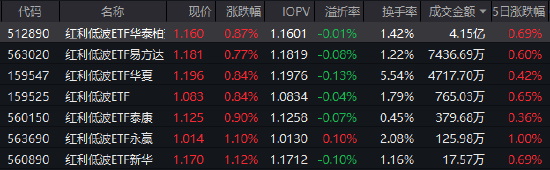
Core Viewpoint - The market experienced a downturn on February 4, with the Shanghai Composite Index turning negative and the ChiNext Index dropping over 2%. Despite this, the Huatai-PineBridge Low Volatility ETF (512890) rose by 0.87%, reaching a price of 1.160 yuan, with a turnover rate of 1.42% and a transaction volume of 415 million yuan, leading among similar ETFs [1][7]. ETF Performance - The Huatai-PineBridge Low Volatility ETF (512890) reported a price of 1.160 yuan, reflecting a 0.87% increase, with an indicative net asset value (IOPV) of 1.1601 yuan and a slight discount of -0.01% [2][8]. - The ETF's trading volume was 415 million yuan, with a 5-day price change of 0.69% [2][8]. Top Holdings - The top ten holdings of the Huatai-PineBridge Low Volatility ETF showed mostly positive performance during the morning session, with notable increases in Shanghai Bank (up 1.08%), Nanjing Bank (up 2.08%), and Ping An Bank (up 0.65%). However, COFCO Sugar fell by 1.61% [3][9]. Fund Inflows - The Huatai-PineBridge Low Volatility ETF has seen significant net inflows, with 670 million yuan over the last 5 trading days, 2.94 billion yuan over the last 20 days, and 4.68 billion yuan over the last 60 days. As of February 3, 2026, the ETF's latest circulation scale was 29.011 billion yuan [3][9]. Market Analysis - According to China International Capital Corporation (CICC), the A-share market is expected to experience short-term consolidation, but medium-term support factors remain unchanged, indicating a slow bull market. They recommend focusing on four key areas: the AI industry chain and commercial aerospace, supply-demand supported non-ferrous metals, cyclical sectors like chemicals and home appliances, and high-dividend strategies based on quality cash flow [5][11]. - Pacific Securities emphasized the attractiveness of bank sector valuations, highlighting significant dividend yield advantages and strong demand for high-dividend asset allocation. They noted that state-owned banks and quality regional banks have advantages in capital, dividends, and regional economic resilience, supporting low-volatility dividend strategies [6][11].
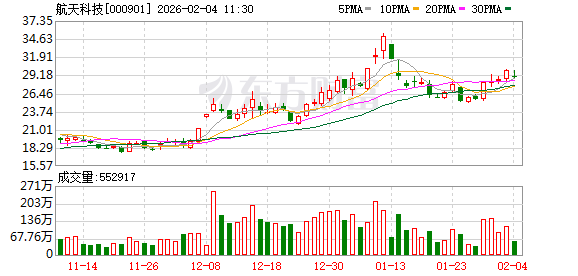
航天科技:公司部分航天应用产品配套于固体火箭
Mei Ri Jing Ji Xin Wen· 2026-02-04 04:20
Core Viewpoint - The company does not include solid rocket technology in its main business, although some of its aerospace application products are compatible with solid rockets [1]. Group 1 - An investor inquired about the company's leading domestic solid rocket core technology and noted that the revenue from related aerospace application businesses is currently small [3]. - The investor emphasized the importance of seizing the historical opportunity presented by the booming commercial aerospace sector and questioned whether the company needs to focus more on independent research and development or on industry chain integration [3]. - The investor also asked if there are any resource support plans at the group level to accelerate this process [3].

A股午评 | 创业板指跌1.74% 煤炭、太空光伏概念走强 AI产业链全线回调
智通财经网· 2026-02-04 03:59
Market Overview - The three major indices collectively declined in early trading on February 4, with the Shanghai Composite Index closing flat, the Shenzhen Component down 0.92%, and the ChiNext Index down 1.74%. The half-day trading volume in the Shanghai and Shenzhen markets reached 1.62 trillion yuan, an increase of 11.6 billion yuan compared to the previous trading day [1]. Sector Performance AI Industry - The AI application sector experienced a widespread pullback, with stocks like Zhiwuzhai and Kaipuyun dropping over 10%. The decline was triggered by the release of an AI legal plugin by Anthropic, which caused a significant drop in U.S. software companies, impacting those potentially replaceable by AI [3]. Oil and Gas Sector - The coal, chemical, natural gas, and electricity sectors saw a strong performance, with stocks like Shanxi Black Cat and Meijin Energy hitting the daily limit. This was supported by a rise in international crude oil prices, with WTI crude settling at $63.21 per barrel, up 1.7%, and Brent crude at $67.33 per barrel, up 1.6% [3]. Consumer Sector - The consumer sector, including airport transportation, hotel catering, duty-free shops, and dairy, experienced a rally, with stocks like China Eastern Airlines and Youhao Group reaching the daily limit. Analysts predict a golden decade for new consumption as China's economy grows and income distribution improves [4]. Real Estate Sector - The real estate sector rebounded, with stocks like Caixin Development and Rong'an Real Estate hitting the daily limit. Research indicates that by 2026, the focus should be on "controlling increments and reducing inventory," particularly regarding new land supply and existing housing policies [5]. Institutional Insights - Zheshang Securities emphasized that consumption will be the most important counter-cyclical variable in 2026, suggesting that the market should focus more on consumption rather than interest rates. A sustained optimistic market sentiment could lead to a "slow bull" market [7]. - Huatai Securities noted that while risk appetite is currently constrained, there remains resilience in the funding environment. Despite a significant outflow of funds, there are signs of recovery in certain investment areas [8]. - Ray Dalio, founder of Bridgewater Associates, stated that the current geopolitical tensions are nearing a "capital war" threshold, asserting that gold remains the safest asset despite recent volatility [9].

1月A股新开户数超490万户
Jin Rong Shi Bao· 2026-02-04 03:19
A股股票与基金开户量激增,是市场行情向好的直接体现与有力印证。 刚刚过去的1月,A股三大指数悉数收涨,上证指数、深证成指、创业板指分别上涨3.76%、5.03%、4.47%,科创综指则大幅收涨近12%。市场整体呈 现"小盘成长占优,大盘价值承压"的结构性分化格局,有色金属与科技两大主线交替领涨。 《金融时报》记者2月3日从上交所获悉,2026年1月,A股新开户数491.58万户,刷新2024年11月以来的单月开户纪录,环比增长89.3%,同比增长 213.1%。同月,基金新开户54.63万户,环比增长123.8%,同比增长168.7%。 | 日期 | 总数 | A股 | B股 | 基金 | | --- | --- | --- | --- | --- | | 2026.01 | 546.27 | 491.58 | 0.05 | 54.63 | 展望后市,国泰海通证券策略团队认为,A股市场有望逐步企稳。一是国内政策重心正转向内需主导,并作为首要任务,有望提振中国经济前景与资产回 报;二是中国证监会近期再次强调"全力巩固资本市场稳中向好势头"。 博时基金宏观团队表示,近期ETF资金流出、海外波动加大,对A股市场形成 ...
