
固定资产投资

Search documents
【光大研究每日速递】20260116
光大证券研究· 2026-01-15 23:04
Macro Insights - China's exports showed a year-on-year growth of 6.6% in December 2025, with an annual growth rate of 5.5%, driven primarily by high-tech products, integrated circuits, and automobiles. The outlook for exports remains optimistic despite a high comparative base in 2026, supported by overseas fiscal expansion and alignment of China's advantageous industries with global demand [5] - In the U.S., retail sales data for November 2025 indicated a month-on-month increase of 0.6%, surpassing expectations. The rebound in consumer data is attributed to the resolution of tariff policies and government shutdown impacts, with expectations for significant economic data improvements in Q1 2026 if government operations stabilize [5] Industry Developments - The State Grid of China plans to invest 4 trillion yuan in fixed assets during the 14th Five-Year Plan period, representing a 40% increase from the previous plan. This investment aims to enhance the new power system's industrial chain and supply chain, reinforcing the State Grid's role as an economic stabilizer [6] Company Performance - CITIC Bank reported a slight decline in operating revenue to 212.5 billion yuan for 2025, a decrease of 0.5% year-on-year, while net profit attributable to shareholders increased by 3% to 70.62 billion yuan. The bank's expansion remains steady, with a stable profit growth rate [7] - Li Ning Company announced a low single-digit year-on-year decline in retail revenue for Q4 2025, with offline and online channels experiencing mid-single-digit and flat growth, respectively. The company anticipates new contributions from upcoming Olympic and outdoor series [7]


重磅年度经济数据即将发布 5%左右目标有望较好实现
Di Yi Cai Jing· 2026-01-15 23:01
备受市场关注的2025中国经济年报即将揭晓。 国家统计局将于1月19日发布2025年度经济数据。机构预计,2025年,稳增长政策持续加力,5%左右的 经济增长目标有望较好实现。虽然2025年四季度GDP增速或回落,但12月份内需相关指标有望企稳回 升。 第一财经研究院发布的最新一期"第一财经首席经济学家信心指数"为50.32,较上月回升,维持景气状 态。经济学家们认为,2025年我国经济运行稳中有进,顺利收官。2026年,逆周期政策将加大力度维稳 房地产,推动投资回升并进一步刺激消费,内需将逐步趋向改善。 稳中有进、进中承压 从先行指标来看,2025年12月份制造业采购经理指数(PMI)为50.1%,比上月上升0.9个百分点,在连 续8个月运行在50%以下后升至扩张区间。 中国物流与采购联合会特约分析师张立群认为,12月份PMI指数出现较明显回升,表明市场预期进一步 向好。同时也要看到,市场引导的需求收缩力度仍大,企业产品销售面对的困难仍多。 兴业银行首席经济学家鲁政委表示,临近年末企业冲刺生产目标,赶工效应或支撑2025年12月工业增加 值增速季节性走高。2025年12月重点电厂煤炭日耗环比大幅增加14.5 ...
重磅年度经济数据即将发布,5%左右目标有望较好实现
第一财经· 2026-01-15 12:57
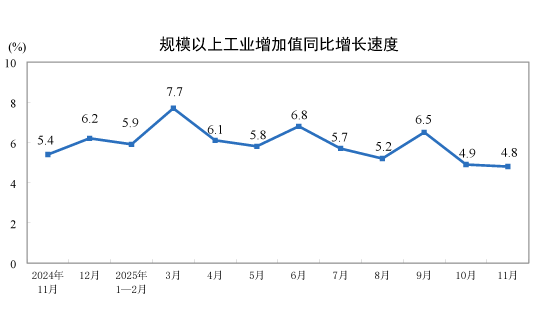
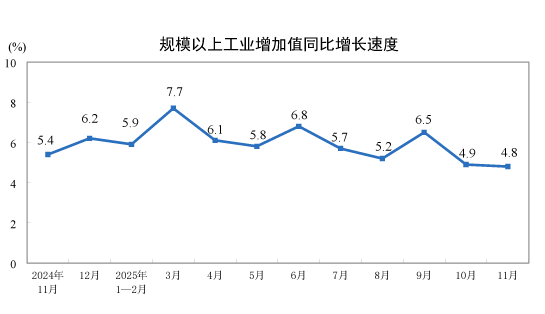
Core Viewpoint - The 2025 China Economic Year Report is set to be released on January 19, with expectations of achieving a GDP growth target of around 5% due to ongoing growth stabilization policies. Despite a potential slowdown in Q4 GDP growth, indicators related to domestic demand are expected to stabilize and improve in December [3][4]. Economic Performance - In the first three quarters of 2025, China's economy showed a complex trend of "steady progress with pressure," with a GDP growth of 5.2% year-on-year. However, the growth rate fell to 4.8% in Q3, indicating weakening growth momentum and structural issues [5]. - The GDP growth for Q4 2025 is projected to be 4.6%, a decrease of 0.2 percentage points from Q3 and 0.8 percentage points from the same period in 2024. The overall GDP growth for the year is expected to be around 5% [6]. Industrial Growth - The predicted year-on-year growth rate for industrial added value in December 2025 is 4.9%, slightly above the previous month's figure of 4.8%. The manufacturing PMI for December is forecasted to be 50.1%, indicating a return to expansion after eight months below 50% [8][10]. Domestic Demand - The average predicted year-on-year growth rate for social retail sales in December 2025 is 1.8%, up from 1.3% in the previous month. Consumer spending showed signs of stability, with a 0.9% increase in December 2025 compared to the previous year [12]. - In December 2025, the real estate market showed signs of recovery, with a 39.8% increase in daily average transaction area for residential properties in 30 major cities compared to the previous month [13]. Investment Trends - The average predicted year-on-year growth rate for fixed asset investment in December 2025 is -2.2%, an improvement from -2.6% in November. Infrastructure projects are expected to benefit from new policy financial tools and increased special bond quotas [14]. - Excavator sales, a key indicator of infrastructure investment, reached 23,095 units in December 2025, a year-on-year increase of 19.2%, with domestic sales up 10.9% and exports up 26.9% [14]. Overall Investment Outlook - The overall fixed asset investment growth for 2025 is expected to be -3.0%. Manufacturing investment growth is projected to slow to 1.6%, while real estate development investment is anticipated to decline further by 16.5% year-on-year [15].

重磅年度经济数据即将发布,5%左右目标有望较好实现
Di Yi Cai Jing· 2026-01-15 11:59
Core Viewpoint - The Chinese economy is expected to stabilize and improve in 2026, driven by counter-cyclical policies aimed at supporting the real estate sector, boosting investment, and stimulating consumption [2][3]. Economic Growth - The GDP growth for 2025 is projected to be around 5%, with a slight decline in growth rate expected in the fourth quarter to approximately 4.6% [3][4]. - The first three quarters of 2025 saw a GDP growth of 5.2%, but the third quarter experienced a slowdown to 4.8%, indicating weakening economic momentum [3]. Investment Trends - Fixed asset investment is forecasted to decline by 2.2% in December 2025, showing a slight recovery from November's -2.6% [9]. - Infrastructure projects are expected to benefit from new policy financial tools, with a 28% increase in project bidding amounts in December [9][10]. - Excavator sales, a key indicator of infrastructure investment, rose by 19.2% year-on-year in December 2025, with domestic sales increasing by 10.9% [9][10]. Consumption Insights - The retail sales growth for December 2025 is predicted to be 1.8%, an increase from the previous month's 1.3% [8]. - Consumer spending showed signs of recovery during the New Year holiday, with a 6.1% year-on-year increase in consumption from January 1 to 3, 2026 [8]. - However, service consumption remains weak due to seasonal effects and high base comparisons from the previous year [8]. Industrial Performance - The industrial output growth for December 2025 is expected to be 4.9%, slightly up from 4.8% in the previous month [5]. - The manufacturing PMI rose to 50.1% in December, indicating a return to expansion after eight months below 50% [7]. - Increased coal consumption by key power plants in December suggests a high level of production activity [7].
北京:抓好投资和项目落地 加快一季度重点工程进度
Zheng Quan Shi Bao Wang· 2026-01-15 10:55
人民财讯1月15日电,据北京日报,1月15日上午,北京市委常委会召开会议,研究2026年固定资产投资 计划和一季度经济社会发展工作等事项。会议强调,一季度是全年经济的风向标,对实现"十五五"开好 局起好步至关重要。要抓好投资和项目落地,加快一季度重点工程进度,压茬推进二季度项目。在重大 科技基础设施建设、基础研究和关键核心技术攻关方面加大投入力度,巩固重点产业支撑作用,深入挖 掘新增长点。要抓好消费提振和预期管理,谋划一批岁末年初促消费活动,促进文商旅体展融合发展, 营造喜庆祥和节日氛围。接续实施提振消费专项行动,统筹惠民生和促消费,推动养老、育幼、家政等 服务扩容提质。 ...
从“三驾马车”看2026,华创证券张瑜:出口成核心引擎,中游制造景气可持续
Xin Lang Cai Jing· 2026-01-15 08:59
Core Viewpoint - The chief economist of Huachuang Securities, Zhang Yu, predicts that the nominal GDP growth rate for 2026 will be around 4.5%-4.6%, with the real GDP growth rate expected to be in the range of 4.8%-5.0% [7][10]. Group 1: Economic Growth Analysis - Exports are expected to become the core driving force of economic growth, with growth rates likely to exceed the overall economic growth, providing crucial support for overall price levels and industrial prosperity [3][9]. - Consumption is viewed as a stabilizing force in the economy, with growth rates not being strong but also not too low, serving as a central stabilizing power [4][10]. - The main challenge lies in fixed asset investment, which is deeply tied to real estate and traditional economies, with growth rates expected to fall into a low range of 0-1%, posing downward pressure on the economy [4][10]. Group 2: Investment Insights - The prosperity of the midstream manufacturing sector is expected to be sustainable, driven by exports, and is not a short-term phenomenon. This trend is likely to continue for two to three years, leading to new market value structures and investment opportunities [5][10]. - The consumption sector holds value for allocation. Although consumption growth is stabilizing and lacks high growth potential, when valuations are adjusted appropriately and cost-effectiveness is highlighted, its stable high dividend characteristics will make it a valuable allocation choice [5][10].
1-11月阿塞拜疆固定资产投资增长3%
Shang Wu Bu Wang Zhan· 2026-01-13 15:21
阿塞拜疆"Media"网12月29日报道,阿塞拜疆国家统计委员统计数据显示, 2025年1-11月,阿固定资产投资总额达166.6亿马纳特(98亿美元),同比增长 3%。其中,油气行业投资额下降8.5%,非油气行业投资额增长8.3%。工业部 门的固定资本投资总额为68.3亿马纳特(40.2亿美元),同比增长9.8%。 (原标题:1-11月阿塞拜疆固定资产投资增长3%) ...
五年来石景山区地区生产总值连跨4个百亿台阶
Xin Jing Bao· 2026-01-13 07:01
Core Insights - The core viewpoint of the article highlights the economic growth and development achievements of Shijingshan District over the past five years, with a focus on GDP growth, fixed asset investment, and the modernization of its industrial system [1] Economic Performance - Shijingshan District's GDP has crossed four hundred billion thresholds in the past five years, with an expected annual growth rate of around 6% [1] - The average annual growth rate of general public budget revenue is 6.7%, with tax revenue accounting for over 90% [1] - Fixed asset investment totaled 230.96 billion, with an average annual growth rate of 9.3% [1] Industrial Development - The industrial system has evolved from "1+3+1" high-tech to a modernized system characterized by "leading +特色 + future" [1] - The added value of the digital economy accounts for 57.4% of the GDP, exceeding the city average by 12.4 percentage points [1] Future Goals - The main economic and social development targets for this year include a GDP growth of 5%, general public budget revenue growth of 2%, and a market total consumption growth of around 5% [1] - The fixed asset investment targets are set to meet city-level requirements, with an unemployment rate controlled within 5% [1] - The per capita disposable income of residents is expected to grow in line with economic growth [1]
萨拉热窝州2024年新增投资同比大幅增长33.6%
Shang Wu Bu Wang Zhan· 2026-01-09 13:55
Core Viewpoint - Sarajevo Canton is experiencing a significant increase in fixed asset investments, reaching 1.779 billion marks in 2024, which represents a substantial growth of 33.6% compared to the previous year [1] Investment Growth - The investment growth trend that began in 2022 has continued, indicating a positive impact of systematic investment promotion on the business environment in Sarajevo Canton [1] - Sarajevo Canton has achieved investment growth for three consecutive years, with investment amounts nearly doubling compared to 2021 [1] Investor Confidence - Despite facing inflationary pressures, the high growth rate of investments suggests that investors are regaining confidence in the business environment of Sarajevo Canton [1] - The Sarajevo Canton Investment and Privatization Agency is actively engaging with international investors and promoting the region's business advantages, which has been recognized by investors [1]
2025年经济运行稳中有进 顺利收官
Sou Hu Cai Jing· 2026-01-07 17:15
Economic Outlook - The global economy in 2026 is expected to exhibit a complex system characterized by non-linearity, path dependence, and adaptability, showing high instability but resilience [1] - The "First Financial Chief Economist Confidence Index" for January 2026 is reported at 50.32, indicating a recovery and maintaining a prosperous state [2][3] Inflation and Price Predictions - The average predicted year-on-year CPI growth for December 2025 is 0.8%, while the PPI is forecasted at -2% [5][6] - CPI predictions range from a minimum of 0.5% to a maximum of 0.9%, indicating a slight increase from November's 0.7% [6] - The PPI predictions range from -2.3% to -1.9%, showing a slight improvement from the previous month's -2.2% [6] Industrial and Investment Growth - The predicted growth rate for industrial added value in December 2025 is 4.9%, slightly above the previous month's 4.8% [9][10] - Fixed asset investment is expected to decline by an average of -2.2%, showing a recovery from November's -2.6% [11] - Real estate development investment is forecasted to decrease by -15.8%, with signs of a narrowing decline in transaction volumes [12] Trade and Export Forecasts - The trade surplus for December 2025 is predicted to be $1113.5 billion, remaining stable compared to the previous month [13][14] - Exports are expected to grow by 2.5%, down from 5.9% in the previous month, while imports are forecasted to increase by 0.7% [14][15] Financing and Monetary Policy - New loans are projected to reach 7182.5 billion yuan in December 2025, recovering from the previous month's 3900 billion yuan [15][16] - The total social financing is expected to average 1.8 trillion yuan, lower than the previous month's 2.5 trillion yuan [16][17] - M2 growth is predicted to remain at 8%, consistent with November's figures [18] Policy Directions - Fiscal policy is anticipated to become more proactive, with an increase in the scale of government debt and continued support for local debt initiatives [20][21] - Monetary policy is expected to remain moderately accommodative, with potential for further interest rate cuts and reserve requirement reductions [20][21]