
PPI

Search documents
高频数据扫描:上下游物价继续分化
Bank of China Securities· 2025-05-11 11:31
1. Report Industry Investment Rating - No industry investment rating is provided in the report [160][161] 2. Core View of the Report - In April 2025, CPI and PPI continued to diverge, with upstream prices continuing to decline. If trade frictions ease, the divergence between upstream and downstream prices is expected to narrow. Core CPI and food - related CPI have stabilized, indicating that consumption - promotion policies have had a positive impact on terminal consumption demand. However, trade frictions still affect upstream prices such as energy prices [2] 3. Summary by Directory 3.1 High - Frequency Data Panoramic Scan - **Food and Consumer Goods**: From May 5 - 10, 2025, the average wholesale price of pork by the Ministry of Agriculture increased by 0.81% week - on - week and 2.15% year - on - year. The Shandong Vegetable Wholesale Price Index decreased by 5.11% week - on - week and 20.89% year - on - year. The price index of edible agricultural products decreased by 0.70% week - on - week, and the year - on - year decline widened to 4.76%. Movie box office revenue increased by 283.76% week - on - week [2][14] - **Commodities and Energy**: Brent and WTI crude oil futures prices decreased by 2.02% and 1.00% week - on - week respectively. The average daily price of LME copper spot increased by 1.56% week - on - week, while the average daily price of aluminum spot decreased by 0.82% week - on - week. The domestic cement price index decreased by 2.39% week - on - week, and the Nanhua Iron Ore Index decreased by 1.01% week - on - week. The operating rate of coking enterprises with a capacity of over 2 million tons decreased by 0.48% week - on - week [2][14] - **Real Estate**: The average daily transaction area of commercial housing in 30 large - and medium - sized cities in April 2025 was about 229,000 square meters per day, compared with about 260,000 square meters per day in April 2024. From May 1 - 7, 2025, the average daily transaction area was about 136,000 square meters per day, compared with about 114,000 square meters per day in the same period of 2024. The weekly transaction area of commercial housing in 30 large - and medium - sized cities decreased by 9.60% week - on - week [2] 3.2 Comparison of High - Frequency Data and Important Macroeconomic Indicators - The report presents multiple charts showing the relationship between high - frequency data and important macroeconomic indicators, such as the relationship between the year - on - year change of copper spot price and the year - on - year change of industrial added value and PPI, and the relationship between the year - on - year change of daily crude steel production and the year - on - year change of industrial added value [16][22] 3.3 Important High - Frequency Indicators in the United States - The report includes charts on important high - frequency indicators in the United States, such as the year - on - year change of electricity generation and industrial output, the Chicago Fed Financial Conditions Index, the implied prospects of interest rate hikes or cuts in US federal funds futures, and the relationship between the same - store sales growth rate and PCE year - on - year [84][86] 3.4 Seasonal Trends of High - Frequency Data - The seasonal trends of high - frequency data are presented, with indicators mainly showing month - on - month growth rates. The data sources include high - frequency data on crude steel average daily production, production material price index, etc. [97] 3.5 High - Frequency Traffic Data in Beijing, Shanghai, Guangzhou, and Shenzhen - The report provides charts on the year - on - year changes in subway passenger volume in Beijing, Shanghai, Guangzhou, and Shenzhen [147][149]
4月广东CPI环比上涨0.3%,PPI环比降幅收窄
Guang Zhou Ri Bao· 2025-05-11 05:58
Group 1: Consumer Price Index (CPI) Analysis - In April 2025, Guangdong's Consumer Price Index (CPI) decreased by 0.4% year-on-year, with the decline narrowing by 0.1 percentage points compared to the previous month [1][4] - Month-on-month, the CPI increased by 0.3%, reversing the previous month's decline of 0.4%, resulting in a difference of 0.7 percentage points [1][3] - The core CPI, excluding food and energy prices, rose by 0.1% year-on-year, compared to a decline of 0.1% in the previous month, indicating a 0.2 percentage point difference [2] Group 2: Food and Non-Food Price Changes - Food prices increased by 0.3% month-on-month, contrasting with a 0.9% decline in the previous month, leading to a 1.2 percentage point difference [3] - Pork prices decreased by 1.1%, but the decline was less than the previous month's drop of 2.1% [3] - Non-food prices shifted from a 0.3% decline to a 0.2% increase, contributing approximately 0.19 percentage points to the CPI increase [3] Group 3: Producer Price Index (PPI) Analysis - In April 2025, Guangdong's Producer Price Index (PPI) decreased by 1.4% year-on-year, with the decline expanding by 0.1 percentage points compared to the previous month [5][6] - Month-on-month, the PPI fell by 0.3%, with production material prices decreasing by 0.4% and living material prices declining by 0.1% [5] - In the PPI survey of 38 major industries, 34.2% experienced price increases, an increase of 5.3 percentage points from the previous month [5][6] Group 4: Industry-Specific Price Movements - Significant price increases were observed in the non-ferrous metal mining industry, which rose by 12.5%, and in the cultural, educational, and sports goods manufacturing sector, which increased by 11.1% [6][7] - Conversely, prices in the petroleum, coal, and other fuel processing industries decreased by 10.4%, while prices in the oil and gas extraction industry fell by 9.8% [6][7] - The overall impact of last year's price changes on the PPI decline was approximately -0.66 percentage points, with new price increases contributing about -0.76 percentage points [7]
4月国内物价数据维持低位运行,核心CPI涨幅稳定体现经济韧性
Bei Ke Cai Jing· 2025-05-11 05:25
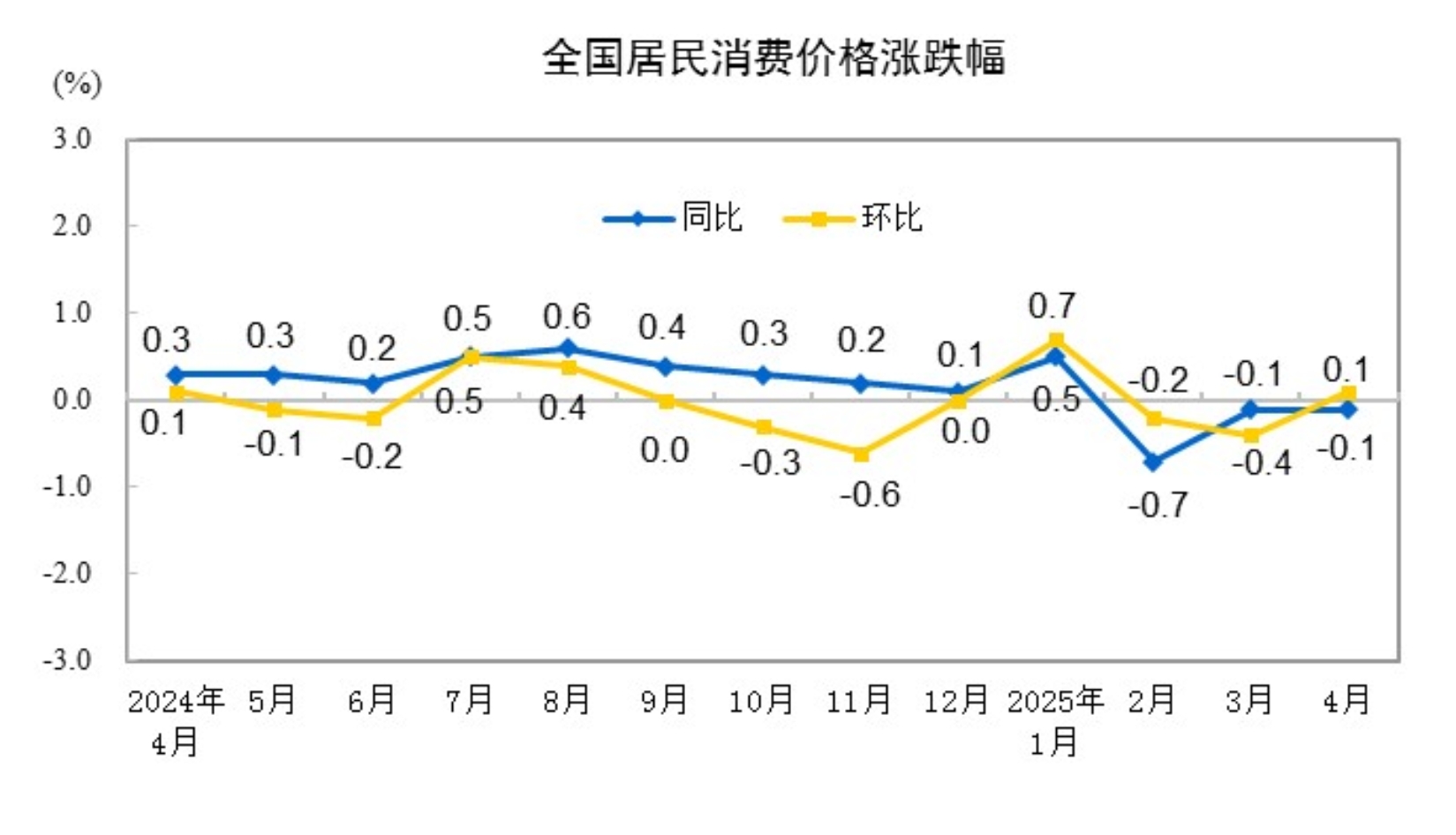
Core Insights - In April, the Consumer Price Index (CPI) shifted from a month-on-month decline of 0.4% to an increase of 0.1%, while the year-on-year CPI decreased by 0.1%, maintaining the same decline as the previous month [1][4] - The core CPI increased by 0.2% month-on-month and rose by 0.5% year-on-year, indicating stable growth [1][8] - The Producer Price Index (PPI) decreased by 0.4% month-on-month and fell by 2.7% year-on-year, with the decline expanding by 0.2 percentage points compared to the previous month [1][17] CPI Analysis - The month-on-month increase in CPI was primarily driven by a rebound in food prices, which rose by 0.2%, exceeding seasonal levels by 1.4 percentage points, and a notable recovery in travel service prices due to demand recovery and holiday effects [6] - Year-on-year, the CPI decline was influenced by a drop in energy prices, which fell by 4.8%, with gasoline prices decreasing by 10.4%, contributing approximately 0.38 percentage points to the year-on-year CPI decline [7] - The stable growth of core CPI reflects the resilience of the domestic economy, supported by a recovery in travel demand and the impact of consumption promotion policies implemented since last year [3][8] PPI Analysis - The PPI's month-on-month decline was consistent with the previous month, influenced by international input factors and seasonal declines in domestic energy prices [17] - Despite the overall decline, some industrial sectors showed signs of improvement due to enhanced demand and the implementation of consumption-boosting macro policies, leading to price increases in certain areas [17][18] - The ongoing development of high-tech industries is expected to positively impact related sector prices, contributing to a potential recovery in PPI [18] Future Outlook - Market analysts generally anticipate a moderate recovery in CPI in the upcoming period, supported by new incremental policies aimed at boosting consumption [11][13] - The focus on expanding domestic demand and enhancing consumption is expected to lead to a gradual increase in core CPI from its current low levels [14]

4月份CPI环比由降转涨 部分工业行业价格稳中向好
Sou Hu Cai Jing· 2025-05-11 00:56
Group 1 - In April, the Consumer Price Index (CPI) turned from a decrease of 0.4% in the previous month to an increase of 0.1%, driven by a rebound in food and travel services [1] - Food prices increased by 0.2% month-on-month, exceeding seasonal levels by 1.4 percentage points, with significant price hikes in air tickets (13.5%), transportation rentals (7.3%), hotel accommodations (4.5%), and tourism (3.1%) [1] - The core CPI also showed improvement, rising 0.2% month-on-month and 0.5% year-on-year, indicating a steady enhancement in the overall economic environment [1] Group 2 - The Producer Price Index (PPI) decreased by 0.4% month-on-month, maintaining the same decline rate as the previous month, primarily influenced by external factors such as U.S. tariffs and falling prices of international commodities like crude oil and iron ore [2] - Domestic policies aimed at boosting consumption and investment are showing positive effects, with high-tech industries experiencing growth and some sectors witnessing price increases [2] - Prices in specific sectors such as wearable smart devices and integrated circuit packaging have risen by 3.0% and 2.7% respectively, reflecting the impact of policies promoting consumption and equipment upgrades [2]
物价的结构特征与阶段性回落压力——4月通胀数据点评
一瑜中的· 2025-05-10 16:03
文 : 华创证券研究所副所长 、首席宏观分析师 张瑜(执业证号:S0360518090001) 联系人:付春生 (18482259975) 事 项 4月,CPI同比下降0.1%,预期下降0.15%,前值下降0.1%;核心CPI同比上涨0.5%,前值上涨0.5%。PPI同比下降2.7%,预期下 降2.8%,前值下降2.5% 。 报告摘要 一、4月CPI的结构性特征 本月CPI略高于我们的预期,或因没考虑到金价上涨的影响 。CPI同比和环比均较我们的预期高0.1个百分点,预期差在核心CPI。 据统计局解读,金饰品价格上涨10.1%,拉动CPI环比约0.06个百分点,据此推算,金饰品在CPI中的权重占比大约0.6%,对本月 核心CPI环比的拉动约0.1个百分点。 本月CPI项目环比上涨或好于季节性的:1) 受需求回暖及假日因素共同影响,机票、交通工具租赁费、宾馆住宿和旅游等出行服 务价格好于季节性。 2) 在供给减少等因素影响,食品价格上涨0.2%,好于季节性。比较明显的是,牛肉价格上涨3.9%,创2019 年10月以来最高(过去两年因供给扩张牛肉价格大幅下跌),在需求淡季下鲜菜和猪肉价格跌幅偏小。 3) 房租环比 ...

4月CPI环比由降转升,政策合力有望利好部分领域价格
Hua Xia Shi Bao· 2025-05-10 12:37
Core Insights - In April, the Consumer Price Index (CPI) showed a month-on-month increase of 0.1%, reversing a previous decline of 0.4%, while the year-on-year CPI decreased by 0.1% [2] - The Producer Price Index (PPI) recorded a year-on-year decline of 2.7%, slightly better than market expectations, with a month-on-month decrease of 0.4% [2][4] CPI Analysis - The month-on-month CPI increase was primarily driven by a rebound in food and travel service prices, exceeding seasonal levels by 0.2 percentage points [2][4] - Year-on-year, energy prices fell by 4.8%, with gasoline prices dropping by 10.4%, contributing approximately 0.38 percentage points to the CPI decline [4][5] - Core CPI, excluding food and energy, rose by 0.5%, indicating stable inflation in essential goods [4][5] PPI Analysis - The PPI's month-on-month decline was influenced by international factors, particularly falling crude oil prices, which affected domestic oil-related industries [7] - The coal mining and processing sectors also saw a seasonal decline in prices, contributing to the overall PPI decrease [7] - Despite current pressures, there are expectations for a potential rebound in PPI due to targeted policies aimed at boosting demand in real estate and consumption [7][8] Policy Implications - The government is expected to maintain a loose monetary policy into 2025, with potential room for a 50 basis point reserve requirement ratio cut and a 20 basis point interest rate reduction [3] - Policies focusing on increasing income for low- and middle-income groups and promoting service consumption are anticipated to support stable price levels [6] - The ongoing implementation of macroeconomic policies is expected to enhance domestic demand, particularly in technology, consumption, and foreign trade sectors [6][8]
【新华解读】4月份我国核心CPI同比涨幅持稳彰显经济韧性,后期物价走势如何?
Xin Hua Cai Jing· 2025-05-10 11:52
Core CPI and Economic Resilience - In April, China's core CPI remained stable year-on-year, reflecting the resilience of the domestic economy despite external fluctuations [1][2] - The core CPI, excluding food and energy prices, increased by 0.5% year-on-year, indicating a stable inflationary environment [1][2] CPI and Price Movements - The overall CPI in April saw a month-on-month increase of 0.1%, reversing a previous decline of 0.4% [1][2] - Food prices rose by 0.2% month-on-month, influenced by seasonal factors and demand recovery, particularly in travel services [2][3] - Energy prices decreased by 4.8% year-on-year, with gasoline prices dropping by 10.4%, contributing significantly to the overall CPI decline [2][3] PPI Trends - The Producer Price Index (PPI) fell by 0.4% month-on-month and 2.7% year-on-year, indicating a consistent downward trend in industrial prices [3][4] - The gap between purchase prices and factory prices has narrowed, suggesting synchronized adjustments in upstream and downstream prices [4] Policy Measures and Economic Outlook - The Chinese government is intensifying economic stabilization policies, including a comprehensive financial policy package aimed at stabilizing the market and expectations [5][6] - Upcoming holidays and strong tourism demand are expected to drive service prices up, leading to a moderate recovery in CPI [6]
新华全媒+|CPI环比由降转涨 部分工业行业价格稳中向好——透视4月份物价数据
Sou Hu Cai Jing· 2025-05-10 08:27
Group 1: CPI and Core CPI Trends - In April, the national Consumer Price Index (CPI) shifted from a decrease of 0.4% in the previous month to an increase of 0.1% [1] - The core CPI, excluding food and energy prices, rose by 0.5% year-on-year, indicating stable growth [1][4] - The increase in core CPI reflects the internal resilience of the economy, supported by ongoing macro policies [4] Group 2: Price Changes in Specific Sectors - Prices in the wearable smart device manufacturing sector increased by 3% year-on-year, while aircraft manufacturing prices rose by 1.3% [1][4] - Service prices showed a steady upward trend, with significant increases in travel-related services, such as airfares rising by 13.5% and hotel accommodation by 4.5% [2] - The prices of black metal smelting and non-metal mineral products saw a narrowing decline, indicating a recovery in demand due to infrastructure projects [5] Group 3: Energy Prices and Their Impact - International oil prices fell significantly due to production increases from countries like Saudi Arabia and Russia, leading to a 4.8% year-on-year decline in energy prices [3] - The drop in gasoline prices by 10.4% contributed approximately 0.38 percentage points to the year-on-year decline in CPI [2][3] Group 4: Policy Impacts on Consumption and Prices - Various policies aimed at boosting consumption and upgrading service quality have been implemented, contributing to the recovery of service consumption [2][5] - The ongoing promotion of trade diversification has led to price increases in certain export sectors, such as integrated circuit packaging, which rose by 2.7% year-on-year [5]
CPI环比强于季节性——4月物价数据解读【陈兴团队•财通宏观】
陈兴宏观研究· 2025-05-10 07:49
报 告 正 文 CPI 环比 超季节性回升, PPI 同比降幅再走扩。 CPI 方面, 4 月 CPI 环比由降转涨,超出季节性,但由于受 到国际油价的拖累, CPI 同比降幅持平上月。核心 CPI 环比由平转涨,同比涨幅持平上月。 PPI 方面, 受到 输入性因素和国内需求暂弱影响, 4 月 PPI 环比降幅持平上月,同比降幅走扩 0.2 个百分点。 CPI 环比上涨主要由食品和出行拉动。 4 月 CPI 环比增速录得 0.1% ,较上月回升 0.5 个百分点,食品和出 行是带动 CPI 环比回升的主要动力。食品方面,食品价格环比上涨 0.2% ,高于季节性水平 1.4 个百分点, 创下历年同期次高。其中,鲜菜和猪肉价格降幅均小于季节性。服务方面,需求回暖和假日因素影响下,机 票、交通工具租赁、宾馆住宿等价格涨幅均高于季节性。其次,国际金价波动带动国内金饰品价格有所上涨。 CPI 同比下降主因国际油价同比降幅走扩,扣除食品和能源价格的核心 CPI 上涨 0.5% ,涨幅持平上月。 国际输入性因素和国内需求暂弱继续拖累 PPI 。 4 月 PPI 环比降幅持平上月,同比降幅再走扩,一是国际原 油价格下行,二是 ...

国家统计局:4月PPI环比降幅与上月相同
news flash· 2025-05-10 02:02
Core Viewpoint - In April, the national industrial producer price index (PPI) decreased by 2.7% year-on-year and 0.4% month-on-month, indicating a continued downward trend in industrial prices [1] Group 1: PPI Trends - The PPI in April fell by 0.4% compared to the previous month, maintaining the same decline rate as in March [1] - The primary reasons for the PPI decline include international input factors affecting domestic industry prices and seasonal decreases in certain domestic energy prices [1] Group 2: Economic Policies and Industry Growth - The Chinese government's macro policies aimed at boosting consumption are being intensified, leading to an expansion in high-tech industries [1] - There is an increase in demand in certain sectors, resulting in positive price changes in some areas [1]