数智化转型

Search documents
依托数智新生态实现国企突破性创新
Sou Hu Cai Jing· 2025-08-10 20:52
Core Insights - The digital economy is emphasized as a significant direction for global development, with a focus on the digital transformation of various industries, including manufacturing, services, and agriculture [1] - Breakthrough innovation in state-owned enterprises (SOEs) is identified as a key support for the development of new quality productivity, enabling them to overcome traditional industry challenges and seize opportunities in emerging sectors [1][2] - The establishment of a digital ecosystem is crucial for SOEs to achieve breakthrough innovations, enhancing their core competitiveness and driving industrial structure upgrades [3] Group 1: Breakthrough Innovation - Breakthrough innovation is essential for SOEs to enhance their core competitiveness and lead industrial upgrades, particularly in the context of digital transformation [3] - SOEs in Beijing are positioned as key players in activating regional industrial ecosystems, leveraging their innovation outcomes to create widespread upgrades across the industry chain [2] - The collaborative model of "SOEs leading, industry-university-research cooperation" is breaking technological monopolies and enhancing the autonomous control of key industries in Beijing [2] Group 2: Digital Ecosystem - The digital ecosystem is characterized as a dynamic interdependent system formed by core enterprises and auxiliary entities, focusing on value co-creation through data flow, resource sharing, and technological collaboration [3] - The establishment of a digital ecosystem involves breaking down data barriers, integrating resources, and fostering collaboration between government, enterprises, and research institutions [4] - A sustainable innovation framework is necessary for the continuous evolution of the digital ecosystem, including the cultivation of a talent pool and the establishment of an innovation error-tolerance mechanism [4]
酒品篇:以数智化升级实现降本增效
Sou Hu Cai Jing· 2025-08-10 11:03
Core Viewpoint - The domestic liquor industry is actively promoting technological innovation and digital transformation to enhance quality, reduce costs, and improve efficiency in response to changing consumer demands and increasing market competition [1][2]. Market Overview - The Chinese liquor market is undergoing a rapid transformation, with changes in consumption patterns, structures, and philosophies. Major liquor companies are focusing on digitalization to improve production efficiency and product quality while reducing operational costs [2][4]. - According to the China Alcoholic Drinks Association, by the end of 2024, the total consumption of alcoholic beverages in China will remain below 50 million kiloliters, with baijiu and beer dominating the market, accounting for approximately 93% of total consumption [4]. Baijiu Industry - The baijiu industry, as the absolute leader in the Chinese liquor market, has seen a slowdown in growth after rapid expansion. In 2024, the production of baijiu from large-scale enterprises is expected to be 4.145 million kiloliters, a year-on-year decrease of 1.8%, while sales revenue is projected to reach 796.384 billion yuan, a growth of 5.3% [5]. - The market is increasingly concentrated among leading brands, with top companies like Kweichow Moutai and Wuliangye capturing a significant share of industry profits. In 2024, 20 A-share baijiu companies are expected to generate total revenue of 442.2 billion yuan and net profits of 166.6 billion yuan [5][6]. - Changing consumer preferences, particularly among younger consumers, are driving the industry towards lower-alcohol products and international market expansion [6]. Beer Industry - The beer industry in China is experiencing a "volume decline and price increase" trend, with 2024 beer production expected to be 35.213 million kiloliters, a decrease of 0.6% year-on-year. However, revenue and profits are on the rise, with sales revenue increasing from 147.45 billion yuan in 2018 to 186.3 billion yuan in 2023 [9][10]. - Major players like Budweiser APAC, China Resources Beer, and Tsingtao Brewery are leveraging brand strength and market share to maintain their leading positions. The industry is also seeing a shift towards high-end products and digital transformation [10][13]. - Craft beer and non-alcoholic beer are emerging as rapidly growing segments, with craft beer consumption expected to reach 230,000 kiloliters by 2025, reflecting a compound annual growth rate of 17% [10]. Digital and Intelligent Transformation - The liquor industry is embracing digital and intelligent technologies as core drivers of transformation. Companies are implementing automation, big data analytics, and blockchain technology to enhance production efficiency and consumer trust [15][21]. - Kweichow Moutai is leading in digital transformation with initiatives like the "i Moutai" platform, which integrates various operational aspects and utilizes blockchain for product traceability [17][18]. - Wuliangye is investing in multiple projects to enhance its digital capabilities, including smart warehousing and supply chain management [19][20]. - China Resources Beer is integrating IoT and data-driven approaches to automate production processes and enhance operational efficiency [21][22]. - Tsingtao Brewery is advancing its digital strategy across its entire business chain, focusing on data collection, product development, and smart logistics [26][27]. Notable Projects - The Luzhou Laojiao Intelligent Packaging Center, recognized as the first "lighthouse factory" in the baijiu industry, showcases advanced automation and digital integration in its operations [29][31]. - China Resources Snow Beer has launched a JIT intelligent corridor project to enhance supply chain efficiency, marking a significant step towards digital transformation in the beverage supply chain [33].






业内专家山东博兴共研化工行业数智化转型实践路径
Zhong Guo Xin Wen Wang· 2025-08-09 14:07
中新网山东博兴8月9日电 (记者沙见龙)以"数启新程·智领未来"为主题的数智化转型标杆实践交流会8月 9日在山东省滨州市博兴县召开。来自相关领域的专家、学者及知名企业代表等与会,分享前沿数智化 技术和先进转型经验,助力石化行业数智化转型。 当前,数字技术的飞速发展正在重塑各行各业的竞争格局,而数智化转型已成为企业提升核心竞争力的 关键路径。 "要实现'多打粮食',就得通过数字化、流程化、智能化三步走,聚焦效率、效益,做好资源配置、人 才培养、组织优化,提升客户价值的实现能力。"山东京博控股集团有限公司数智化转型运营中心助理 总经理吴家安现场介绍"数智京博"建设经验。 目前京博数智化基于三大主线提升客户价值、赋能高效运营及驱动可持续发展:以客户为中心,赋能端 到端价值链,促成客户满意的价值创造主线;推动数字化深度融合,构建公司可持续发展体系的内部运 营主线;打造先进可靠的数字化基础设施的数智化保障主线。 "随着新一轮科技革命和产业变革深入发展,我们积极整合数字科技创新资源,加快形成新质生产 力。"吴家安表示,京博将聚焦"AI+研发""AI+生产""AI+经营"三大产业场景,围绕"算力与智能装备 线""模型算法线 ...
又一家银行“落子”金融科技
Zhong Guo Jing Ying Bao· 2025-08-09 05:39
Core Viewpoint - The establishment of Shanghai Pudong Development Bank's financial technology subsidiary, PuYin JinKe, marks a significant step in the bank's digital transformation strategy, aiming to enhance its technological capabilities and support its overall digitalization efforts [2][3]. Group 1: Company Overview - PuYin JinKe is fully owned by Shanghai Pudong Development Bank International Investment Co., Ltd. and aims to operate independently to foster innovation and reduce regulatory constraints [2]. - The company focuses on three main areas: providing IT shared services for group subsidiaries, supporting overseas branches in non-transactional business system development, and creating a platform for corporate clients to enhance financial and non-financial services [3]. Group 2: Strategic Goals - Shanghai Pudong Development Bank has set 2025 as a "Strategic Enhancement Year," with a focus on digital finance as a core driver for transformation, aiming to establish a benchmark for digitalization in the banking industry [3][4]. - The bank is actively developing a data center and an artificial intelligence center to accelerate the application of AI technologies, moving from scenario-based planning to large-scale implementation [4]. Group 3: Industry Trends - The trend of banks establishing financial technology companies is growing, with most major state-owned banks and several national joint-stock banks having already set up their own fintech subsidiaries [5]. - The core driving logic behind these fintech companies includes transitioning from "technology dependence" to "self-operating capabilities," enhancing technological autonomy, and exploring market opportunities for external technology output [6]. Group 4: Competitive Advantages - Bank-affiliated fintech companies benefit from high brand recognition, strong offline service capabilities, and prudent compliance risk management, making them more appealing to smaller banks seeking reliable solutions [7].


中国移动公布2025年中期业绩
Ke Ji Ri Bao· 2025-08-08 12:16
Core Insights - China Mobile reported steady growth in its mid-year performance for 2025, with significant achievements in digital transformation and operational quality [1][2] Financial Performance - In the first half of 2025, China Mobile achieved operating revenue of 543.8 billion yuan, with communication service revenue reaching 467 billion yuan, a year-on-year increase of 0.7% [1] - Shareholder profit was 84.2 billion yuan, reflecting a 5.0% year-on-year growth [1] - EBITDA margin reached 34.2%, an increase of 0.9 percentage points, maintaining a leading position among global operators [1] Revenue Structure - Digital transformation revenue was notable at 156.9 billion yuan, up 6.6% year-on-year, accounting for 33.6% of communication service revenue [1] - Revenue from household, government-enterprise, and emerging market businesses (HBN) increased to 47.6%, a rise of 2.6% year-on-year [1] - Government-enterprise market revenue was 118.2 billion yuan, growing by 5.6% year-on-year, with mobile cloud revenue reaching 56.1 billion yuan, an 11.3% increase [1] - 5G private network revenue surged to 6.1 billion yuan, a 57.8% year-on-year growth [1] Emerging Markets - Revenue from emerging markets, including international business, digital content, fintech, and equity investment, totaled 29.1 billion yuan, a 9.3% increase [1] - International business revenue grew by 18.4%, while digital content revenue reached 14.9 billion yuan [1] Technological Advancements - China Mobile has accelerated investment in new infrastructure, opening over 2.59 million 5G base stations and establishing the first small-scale 6G experimental network [2] - The company’s intelligent computing capacity reached 61.3 EFLOPS, with 33.3 EFLOPS self-built [2] - The establishment of China Mobile Jiutian AI Technology Company and the upgrade of the "Jiutian" model matrix to version 3.0, with over 50 industry-specific models [2] - The company leads in the number of international standards for 5G-A and 6G, with a total of over 18,000 effective patents [2]

2025年上半年中国海外投资概览报告
Sou Hu Cai Jing· 2025-08-08 09:32
Group 1: Overview of China's Overseas Investment in H1 2025 - In the first half of 2025, China's overseas investment showed resilience amidst global economic fluctuations, with a focus on high-quality development rather than mere expansion [1][8] - China's GDP grew by 5.3% year-on-year, and foreign trade increased by 2.9%, reaching a historical high for the same period [2][8] - The investment landscape is characterized by structural highlights in three main areas: foreign direct investment (FDI), overseas mergers and acquisitions (M&A), and foreign contracting projects [1][8] Group 2: Foreign Direct Investment (FDI) - Total foreign direct investment reached $80 billion, a decrease of 6.2% year-on-year, while non-financial FDI was $72.2 billion, showing a slight decline of 0.5% [3][19] - Notably, non-financial direct investment in Belt and Road Initiative (BRI) countries amounted to $18.9 billion, marking a 20.7% increase and accounting for 26% of total non-financial investment [3][19] - Key investment sectors included manufacturing, technology, and renewable energy, with significant projects in Malaysia, Brazil, and Central Asia [3][9][37] Group 3: Overseas Mergers and Acquisitions (M&A) - Chinese companies announced overseas M&A deals totaling $19.6 billion, a substantial increase of 79% year-on-year, despite a 7% decrease in the number of transactions [4][20] - The number of large transactions (over $500 million) rose from 6 to 14, indicating a trend towards more concentrated and pragmatic M&A activities [4][20] - The TMT (Technology, Media, and Telecommunications), mining and metals, and advanced manufacturing sectors accounted for 72% of total M&A value, with TMT sector deals surging by 222% [4][10][11] Group 4: Foreign Contracting Projects - New contracts for foreign contracting projects reached $129.9 billion, reflecting a 12.4% year-on-year growth, with completed revenue at $79.1 billion, up 8.1% [6][22] - BRI countries continued to dominate, with new contracts amounting to $113.4 billion, representing 87% of total new contracts [6][22] - Major projects spanned energy, mining, chemicals, and municipal infrastructure, contributing to local economic development [6][12][22] Group 5: Globalization Trends - The first half of 2025 marked a transition for Chinese overseas investment from scale expansion to high-quality development, emphasizing resilient supply chains and digital transformation [7][12] - Companies are increasingly focusing on regional cooperation and industry integration, reflecting a more rational and mature approach to globalization [7][12]
方鲜食品携手YonSuite:用数智化打通从果园到舌尖的全链路管理
Zhong Guo Shi Pin Wang· 2025-08-08 08:51
Core Insights - The beverage industry is undergoing a significant transformation driven by consumer demand for health-oriented products, emphasizing the importance of supply chain management in delivering high-quality, fresh products [1][15] - Jiangxi Fangxian Food Co., Ltd. (Fangxian Food) exemplifies this transformation by establishing a comprehensive supply chain model that integrates research, cultivation, production, and sales to set new standards for quality, safety, and efficiency [1][15] Group 1: Challenges Faced by Fangxian Food - Fangxian Food's success has led to new complexities, particularly related to its full supply chain model [3] - The company operates a large-scale, pollution-free planting demonstration garden and a standardized production facility, but faces operational bottlenecks as business accelerates [4] - Three core challenges identified include: 1. Information silos in production and sales leading to misalignment between market demand and production planning [5] 2. High demands for cold chain management due to the perishable nature of fresh produce, relying heavily on human judgment [6] 3. Difficulty in accurately calculating costs across various operational aspects, leading to inefficiencies [6] Group 2: Digital Transformation Initiatives - In 2023, Fangxian Food partnered with Yongyou YonSuite for a comprehensive digital transformation aimed at breaking down data silos and enhancing operational efficiency [8] - The implementation of an intelligent command center allows for real-time inventory checks and automated production order generation, significantly improving inventory turnover rates by 13% to 19% and reducing inventory capital occupancy by 12% to 14% [9] - Cold chain management improvements include the installation of smart systems to monitor inventory levels and optimize storage space, achieving a cold storage utilization rate of 96% to 98% [10] Group 3: Quality Control and Financial Integration - Fangxian Food has established a comprehensive quality traceability system covering all production stages, enhancing product safety and quality control capabilities by 38% to 45% [11] - The financial role has evolved from a post-event bookkeeping function to a real-time advisory role, with efficiency in accounting processes improving by 92% to 95% [12][13] - This transformation enables management to access real-time, multidimensional data for informed decision-making, enhancing strategic planning and operational efficiency [13] Group 4: Competitive Landscape - The digital transformation of Fangxian Food reflects a broader trend in the beverage industry towards high-quality development, where success is increasingly determined by operational capabilities rather than sheer scale [15] - Key competitive factors include efficiency in inventory management, reliability in product delivery, and data-driven decision-making, positioning Fangxian Food as a leader in the evolving market [16][17]

指尖上的银行 让金融服务更便利
Jin Rong Shi Bao· 2025-08-08 07:55
Group 1 - The core viewpoint is that Postal Savings Bank of China is accelerating its digital transformation to enhance financial services accessibility and efficiency for rural customers [1][2][3] - The bank has introduced products like "Jisu Loan" and "Youxiang Loan," allowing customers to apply and receive loans through mobile banking, significantly reducing time costs for rural clients [1][3] - The establishment of rural cash withdrawal points and financial literacy campaigns has improved financial service accessibility in remote areas, benefiting local farmers [2] Group 2 - The bank has processed and disbursed over 3 billion yuan in various loans through online channels this year, contributing positively to local economic development [3] - Future plans include strengthening technological foundations, improving data management, and expanding digital financial services to support rural revitalization and local economic growth [3]

中国移动上半年净利增长5%,AI成色加深
2 1 Shi Ji Jing Ji Bao Dao· 2025-08-08 05:04
Core Insights - China Mobile's digital transformation is becoming a key driver for high-quality growth amid slowing traditional communication business [1] - The company's mid-2025 financial results show stable revenue and a 5.0% increase in net profit, maintaining a leading position among international operators [1] - The "second curve" growth is strong, with digital transformation revenue reaching 156.9 billion yuan, a 6.6% year-on-year increase, accounting for 33.6% of communication service revenue [1] Financial Performance - In the first half of 2025, China Mobile achieved operating revenue of 543.8 billion yuan, nearly flat compared to the same period last year [1] - The net profit attributable to shareholders was 84.2 billion yuan, reflecting a 5.0% year-on-year growth [1] - The company announced an interim dividend of 2.75 HKD per share, a 5.8% increase, and plans to further enhance profit distribution in 2025 [1] Strategic Initiatives - China Mobile is advancing its "AI+" strategy through three major plans, showing significant results [2] - Capital expenditure for new information infrastructure reached 58.4 billion yuan in the first half of the year, with over 2.59 million 5G base stations opened [2] - The "AI+" action plan is progressing, with the "Nine Sky" model matrix upgraded to 3.0 and over 50 industry models deployed [2] Revenue Structure - The revenue from household (H), enterprise (B), and emerging markets (N) accounted for 47.6% of communication service revenue, up 2.6 percentage points year-on-year [2] - The personal market (C) maintained stable revenue of 244.7 billion yuan, with a total mobile customer base of 1.005 billion and a 5G penetration rate of 59.6% [3] - Household market revenue grew by 7.4% to 75 billion yuan, with significant increases in gigabit and FTTR customer numbers [3] Growth Areas - The enterprise market (B) revenue reached 118.2 billion yuan, a 5.6% increase, with mobile cloud revenue growing by 11.3% [3] - Emerging market revenue grew by 9.3% to 29.1 billion yuan, becoming the fastest-growing segment [3] - Future growth is expected to be driven by AI technology, creating new economic opportunities in the hundreds of billions [3]
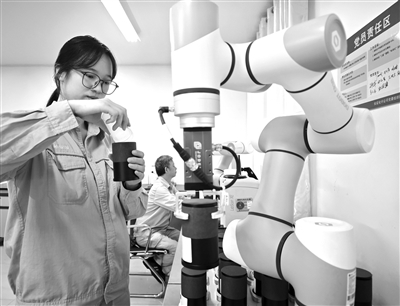
仪征化纤实现聚酯切片检测数智化
Zhong Guo Hua Gong Bao· 2025-08-08 03:31
Core Viewpoint - China Petrochemical's Yizheng Chemical Fiber Testing Center has become the first company in China to implement standardized, procedural, and unmanned operations for polyester chip color value testing by introducing two intelligent robotic arms [1] Group 1: Technological Advancements - The introduction of industrial-grade robotic arms replaces manual operations, addressing issues such as inconsistent placement, poor repeatability, and low efficiency in polyester chip color value detection [1] - The second robotic arm was put into operation in June, allowing for digital evaluation and screening of each sample cup, effectively eliminating systematic errors caused by container differences, achieving "zero difference" in containers [1] - Recent upgrades to the robotic arms optimized their path nodes, increasing the number of test positions from 12 to 20, thereby enhancing detection throughput per unit time [1] Group 2: Operational Efficiency - The testing platform's compatibility has been expanded to support both new and old instruments, providing a smooth transition for equipment upgrades [1] - The combination of intelligent devices and optimized testing technology has improved detection efficiency and data accuracy, leading to a digital transformation of the testing process [1]