
经济增长

Search documents
美银逆势看好美元:下半年跌不动了!
Jin Shi Shu Ju· 2025-07-11 09:07
Core Viewpoint - Bank of America predicts limited downside for the US dollar in the second half of 2025, contrasting with some current market sentiments [2][10] Supporting Factors for Dollar Resilience - Key factors supporting the view of limited downside for the dollar include interest rate differentials, economic performance, and global liquidity demand [3] - Despite potential Fed rate cuts, if US rates remain higher relative to the Eurozone or Japan, the dollar will still attract yield-seeking investors [3] - The US economy shows remarkable resilience and growth, providing fundamental support for the dollar [3] - The dollar remains the dominant global reserve currency, with structural demand particularly strong during periods of global uncertainty [3] Core Drivers of Dollar Trends in 2025 - Understanding the factors influencing the dollar's outlook in 2025 is crucial, with monetary policy, economic growth, and geopolitical stability being primary drivers [4] - The pace of Fed rate cuts compared to other central banks will be critical; a slower Fed cut could maintain dollar strength [4] - Even amid global economic slowdowns, the US's robust performance may attract capital inflows, supporting the dollar [4] - Geopolitical tensions often increase demand for the dollar as a safe-haven asset [4] - The inflation trajectory in the US will directly impact central bank policies and currency valuation [4] Interconnectedness of Dollar and Forex Markets - The dollar's performance is interconnected with broader forex market trends, influencing and being influenced by other major currencies and emerging market currencies [5][6] - If the ECB or BoJ maintain a more accommodative stance, the euro and yen may face continued pressure against the dollar [5] - Strong dollar often exerts pressure on emerging market currencies, particularly those with dollar-denominated debt [6] Basis of Analysis and Potential Challenges - Bank of America's analysis is based on a comprehensive approach, considering macroeconomic indicators and policy expectations [7] - Key aspects include labor market data, inflation trends, global trade, and capital flows, all of which significantly impact dollar demand [7] - While the analysis is compelling, potential challenges include unexpected global economic recovery leading to capital outflows from the US [7] Implications for Investors - Understanding these currency forecasts is crucial for investors, affecting portfolio construction and risk management [9] - A strong dollar can be a double-edged sword, enhancing the value of dollar-denominated assets while making US exports more expensive [9] - Companies and investors with significant international exposure should consider hedging strategies to mitigate currency risk [9]
欧央行官员释放降息信号:视经济增长与通胀而定
news flash· 2025-07-11 08:56
欧央行官员释放降息信号:视经济增长与通胀而定 金十数据7月11日讯,欧洲央行执委帕内塔表示,如果经济扩张不及预期,并过度拖累通胀,欧洲央行 应进一步降息。他同时强调,决策者将在政策制定上保持灵活和务实的态度,根据最新信息及其对通胀 前景的影响,逐次会议做出判断。市场目前普遍预期欧洲央行将暂时停止降息步伐。原因之一是欧美贸 易关系仍不明朗,而俄乌和中东冲突也加剧了经济前景的不确定性。尽管如此,投资者仍押注年底前欧 洲央行还将再降息一次。帕内塔重申了央行此前的说法:"我们目前处于一个可以谨慎权衡下一步行动 的位置。" ...
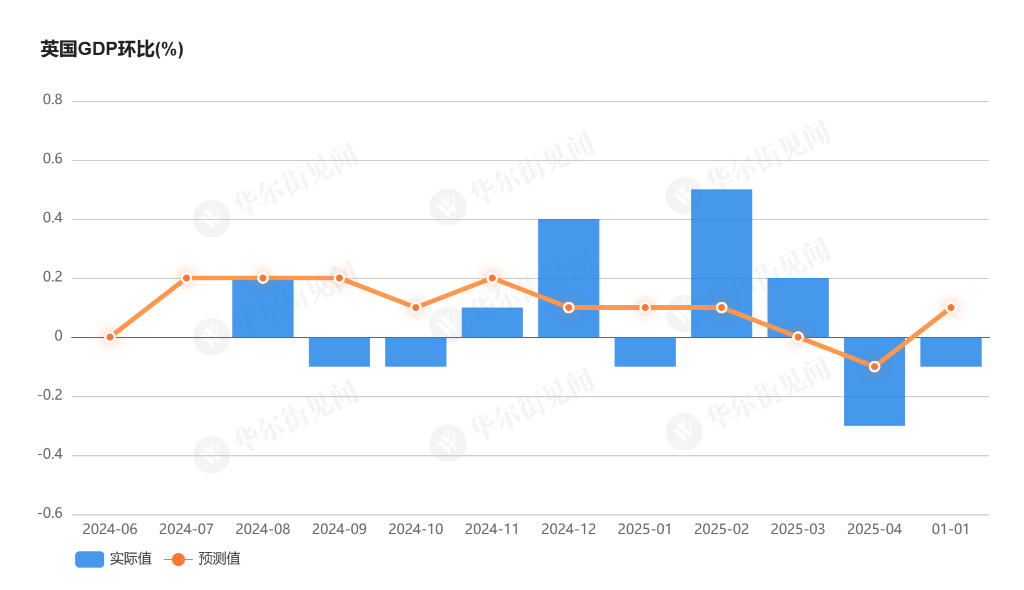
英国经济连续第二个月萎缩,5月GDP意外下滑0.1%,央行降息压力陡增
Hua Er Jie Jian Wen· 2025-07-11 08:40
Economic Performance - The UK economy unexpectedly contracted by 0.1% in May, marking the second consecutive month of decline, indicating a loss of earlier strong growth momentum [1] - This contraction follows a 0.3% decline in April, suggesting a significant slowdown in the second quarter compared to a 0.7% growth in the first quarter [1][8] - If June output falls by 0.4% or more, the UK economy will experience an overall contraction in the second quarter [1] Sector Performance - The contraction in May was primarily driven by significant declines in the production and construction sectors, which were only partially offset by growth in the services sector [8] - The downturn in production was concentrated in oil and gas extraction, automotive manufacturing, and the volatile pharmaceutical industry [8] Market Reactions - Following the data release, the British pound fell by 0.2% against the US dollar, reaching $1.35 [4] - Investors slightly increased bets on a 25 basis point rate cut by the Bank of England in August, with expectations for two rate cuts by the end of the year [9] Government Response - Chancellor Rachel Reeves acknowledged the disappointing GDP data and expressed determination to stimulate economic growth [7] - The Labour government is relying on stronger growth to fund its spending plans, but fiscal conditions are tightening due to changes in welfare payments and winter fuel subsidies [7] Economic Outlook - Economists predict that even if June GDP stabilizes, overall growth for the second quarter will slow to just 0.1% [8] - Concerns about the health of the UK economy have increased, with the Bank of England previously warning of weak potential growth [10]

美联储戴利:劳动力市场正在降温,经济增长趋于温和,但数据尚未出现实质性疲软。
news flash· 2025-07-10 18:41
Core Insights - The labor market is cooling down, indicating a shift in economic conditions [1] - Economic growth is trending towards moderation, suggesting a more stable economic environment [1] - However, there has not been any substantial evidence of economic weakness in the data [1] Labor Market - The cooling of the labor market suggests a potential easing of inflationary pressures [1] - This shift may impact wage growth and employment rates in the near future [1] Economic Growth - The moderation in economic growth reflects a balanced approach to recovery post-pandemic [1] - The current economic indicators show stability rather than volatility [1] Data Analysis - Despite the cooling labor market and moderate growth, the data does not indicate any significant downturn [1] - Continuous monitoring of economic indicators will be essential to assess future trends [1]
美联储戴利:经济状况良好,增长和就业稳健,通胀压力正在缓解。
news flash· 2025-07-10 18:37
Core Viewpoint - The Federal Reserve's Daly indicates that the economic conditions are strong, with robust growth and employment, while inflationary pressures are easing [1] Economic Conditions - Economic growth is described as steady, suggesting a positive outlook for various sectors [1] - Employment levels are reported to be stable, indicating a healthy job market [1] Inflation Trends - Inflationary pressures are noted to be alleviating, which could impact monetary policy decisions moving forward [1]

筑牢经济韧性底座 多维施策稳增长谋长远
Shang Hai Zheng Quan Bao· 2025-07-10 18:29
Economic Overview - The overall economic performance in the first half of the year is stable, supported by strong external demand and improving internal demand, with GDP growth expected to exceed 5% [2][3] - The first quarter saw a GDP growth rate of 5.4%, and the positive trend continued into the second quarter [2][3] - Key drivers of economic growth include the "old-for-new" consumption policy, large-scale equipment updates, and robust infrastructure investment [3][4] Consumption and Investment - The "old-for-new" policy significantly boosted consumption, with retail sales of consumer goods growing by 5% year-on-year from January to May [4][5] - Fixed asset investment increased by 3.7% during the same period, driven by strong service sector investment and equipment upgrades [4][6] - Exports grew by 6% from January to May, supported by "grabbing exports" and "turning exports" strategies [4][6] Monetary and Fiscal Policies - Monetary policy remained flexible and moderately loose, with a 0.5 percentage point reduction in the reserve requirement ratio in May, releasing approximately 1 trillion yuan in long-term liquidity [7][8] - Fiscal policy showed a high intensity and rapid pace, with government debt net financing increasing by 3.8 trillion yuan year-on-year from January to May [9][10] - The issuance of special bonds and ultra-long-term treasury bonds accelerated, with nearly 2.2 trillion yuan in new special bonds issued by the end of June [9][10] Future Outlook - In the second half of the year, there is still room for further interest rate cuts and reserve requirement ratio reductions to lower financing costs for the real economy [16][20] - New policy financial tools are expected to be introduced in the third quarter, focusing on technology innovation and digital economy sectors [16][17] - The government plans to dynamically adjust budgets and expand fiscal spending to counter global trade uncertainties and support employment [17][20]
美国圣路易联储主席Musalem:经济处于良好状态,或接近充分就业。通胀存在一些上行风险。货币政策略带限制性。金融环境支持经济增长。关税将导致通胀上升。关税可能会对价格产生暂时或持续的影响。高利润率为吸收关税提供了一些空间。
news flash· 2025-07-10 14:10
金融环境支持经济增长。 关税将导致通胀上升。 关税可能会对价格产生暂时或持续的影响。 美国圣路易联储主席Musalem:经济处于良好状态,或接近充分就业。 通胀存在一些上行风险。 货币政策略带限制性。 高利润率为吸收关税提供了一些空间。 ...
美联储穆萨莱姆:货币政策适度限制。金融环境有利于经济增长。
news flash· 2025-07-10 14:10
Core Viewpoint - The Federal Reserve's Musalem indicates that monetary policy is moderately restrictive, but the financial environment remains conducive to economic growth [1] Group 1 - The current monetary policy is described as moderately restrictive, suggesting a balanced approach to managing inflation and supporting growth [1] - The financial environment is characterized as favorable for economic growth, indicating that despite the restrictive policy, conditions are still supportive for expansion [1]
财政政策前置加码 助力经济实现“开门红” | 宏观经济
清华金融评论· 2025-07-10 10:35
Core Viewpoint - The fiscal policy for 2025 is characterized by increased counter-cyclical adjustments, significant enhancement in fiscal spending, and proactive policy implementation, which is expected to support China's economic growth target of around 5% [2][3][5]. Fiscal Policy Characteristics - The fiscal deficit rate for 2025 has historically exceeded 4%, with a total fiscal deficit of 5.66 trillion yuan, an increase of 1.6 trillion yuan from 2024 [5][6]. - The issuance of special bonds has been raised to 4.4 trillion yuan, with an increase of 500 billion yuan compared to 2024, aimed at addressing local government debt and stimulating investment [4][6]. Economic Context - The global economic recovery remains weak, and external pressures such as tariffs and trade disturbances from the U.S. are affecting demand. The internal demand is also struggling to recover fully, necessitating a robust fiscal response [3][4]. - The central economic work conference at the end of 2024 emphasized the need for a more proactive fiscal policy to ensure sustained economic growth amidst these challenges [3]. Budgetary Allocations - The budget growth rates for general public revenue and expenditure in 2025 are projected at 0.1% and 4.4%, respectively, reflecting ongoing fiscal pressures and the need to expand domestic demand [5]. - Expenditure on health, education, and social security has increased, with a total share of 37.1% in the budget, indicating a focus on social welfare [5]. Special Bonds and Debt Management - The issuance of ultra-long special bonds has increased to 1.3 trillion yuan, with allocations for major national strategies and consumer goods replacement programs, enhancing both short-term demand and long-term sustainability [6]. - The new special bond issuance allows for the acquisition of existing housing for affordable housing projects and debt management, which helps alleviate liquidity pressures on real estate companies and supports small businesses [6].

惠誉上调摩洛哥2025年经济增长预期
Shang Wu Bu Wang Zhan· 2025-07-10 02:59
Economic Growth Outlook - Morocco's GDP growth forecast for 2025 has been raised from 4.3% to 4.5% by Fitch, driven by strong investment, recovering consumer markets, and improving foreign trade conditions [1][2] Investment Dynamics - Productive investment is the main driver of the current economic recovery, with total capital formation in Q1 showing a significant year-on-year increase of 17.5%, marking a post-pandemic high [1] - The Moroccan central bank has cut interest rates by a total of 75 basis points, with expectations for further reductions, facilitating credit expansion across various sectors, including consumer loans [1] Infrastructure and Major Events - Preparations for major international events such as the 2025-2026 Africa Cup of Nations and the 2030 World Cup are underway, leading to increased investments in infrastructure, transportation, and hospitality [1] - Fixed asset investment growth is expected to reach 7.9% in 2025, with a slight decline to 5.9% in 2026, still significantly above historical averages [1] Consumer Spending Trends - Consumer spending is showing signs of recovery, driven by low inflation, agricultural recovery boosting farmer incomes, rapid tourism growth, and declining financing costs [2] - Private consumption growth is projected to reach 4.5% in 2025, with continued positive momentum expected in 2026 [2] Inflation and Trade Balance - Inflation expectations for 2025 have been revised down from 1.1% to 0.7%, benefiting from stable energy prices, a weaker dollar, and improved domestic food supply [2] - The trade deficit is expected to improve in 2025 due to reduced agricultural import demand and a recovering European market, supported by Morocco's deep integration with European supply chains [2]