房地产市场修复

Search documents
信和置业(00083):潮回香江,厚积薄发:兼具弹性与底盘的港资标杆
Hua Yuan Zheng Quan· 2026-03-29 08:46
Investment Rating - The investment rating for the company is "Buy" (首次) [5] Core Views - The report emphasizes that the company, as a benchmark Hong Kong developer, possesses both resilience and a solid foundation, benefiting from the recovery of the Hong Kong residential market [5][7] - The company has a diversified business model that includes property development, investment properties, and hotel operations, with a significant portion of its land reserves located in Hong Kong [7] - The report highlights the company's strong financial position, with substantial cash reserves and low debt levels, which enhance its ability to capitalize on market opportunities and maintain dividend sustainability [7] Summary by Sections Market Performance - The closing price as of March 27, 2026, is HKD 11.48, with a market capitalization of HKD 108,882 million [3] Financial Forecast and Valuation - Revenue projections for the company are as follows: - 2024: HKD 8,765 million - 2025: HKD 8,183 million - 2026E: HKD 9,185 million - 2027E: HKD 10,261 million - 2028E: HKD 10,848 million - The expected growth rates are -26.2% for 2024, -6.6% for 2025, and positive growth starting from 2026 [6][8] - The projected net profit for the years 2026 to 2028 is as follows: - 2026E: HKD 4,067 million - 2027E: HKD 4,356 million - 2028E: HKD 4,624 million - The corresponding P/E ratios are projected to be 26.77 for 2026, 24.99 for 2027, and 23.55 for 2028 [6][8] Business Operations - The company’s property development segment is expected to recover significantly, with property sales revenue reaching HKD 69.1 billion in the first half of 2026, a year-on-year increase of 172% [7] - The rental income from investment properties is projected to contribute approximately 50% of the operating profit, demonstrating resilience despite market pressures [7] - The company maintains a strong rental occupancy rate of 89.5% across its investment property portfolio, with retail and office occupancy rates at 92.9% and 84.1%, respectively [7] Cash Flow and Financial Health - The company reported a net cash position of HKD 514 billion as of the first half of 2026, indicating minimal debt pressure [7] - The company has consistently maintained a dividend of HKD 0.58 per share from 2023 to 2025, reflecting strong shareholder return stability [7]

房地产行业报告(2026.3.16-2026.3.22):交易修复强于价格修复,边际改善信号增多
China Post Securities· 2026-03-24 04:07
Investment Rating - The industry investment rating is "Outperform the Market" and is maintained [1] Core Insights - The market in March has shown increased activity compared to January and February, indicating that the "small spring" phenomenon is not a false narrative, particularly with strong volume in second-hand housing in Shanghai [3] - The structural characteristics of the current recovery are distinct: second-hand housing is outperforming new housing, Shanghai is outperforming other first-tier cities, low total price properties are outperforming high total price properties, core areas are outperforming peripheral areas, and transaction recovery is stronger than price recovery [3] - The industry index has not yet escaped downward pressure, with low land acquisition premium rates and willingness indicating a lack of confidence in the sustainability of sales recovery and profit realization [3] - Signs of marginal improvement in the industry fundamentals are increasing, suggesting that the bottom is gradually approaching [3] Industry Fundamentals Tracking New Housing Transactions and Inventory - Last week, the new housing transaction area in 30 major cities was 186.28 million square meters, with a cumulative year-to-date transaction area of 1,562.67 million square meters, down 17.7% year-on-year [4] - The average transaction area over the past four weeks in 30 major cities was 146.34 million square meters, down 21.4% year-on-year but up 43.6% month-on-month [4] - First-tier cities saw an average transaction area of 38.85 million square meters, down 30.2% year-on-year, but up 46.2% month-on-month [4] Second-Hand Housing Transactions and Listings - Last week, the second-hand housing transaction area in 20 cities was 266.5 million square meters, with a cumulative year-to-date transaction area of 2,282.91 million square meters, down 6.7% year-on-year [5] - The average transaction area over the past four weeks in these cities was 209.16 million square meters, down 21.6% year-on-year but up 46.6% month-on-month [5] Land Market Transactions - Last week, 100 major cities saw 21 new residential land supplies and 27 residential land transactions, with an average transaction price of 9,567 yuan per square meter and a premium rate of 8.26% [24] - The average transaction price for commercial land was 1,431.25 yuan per square meter, with a premium rate of 0.25% [24] Market Review - Last week, the A-share real estate index fell by 4.21%, while the CSI 300 index fell by 2.19%, indicating that the real estate index underperformed the CSI 300 by 2.02 percentage points [27] - The Hong Kong Hang Seng property services and management index fell by 1.39%, while the Hang Seng composite index fell by 1.69%, with the property services and management index outperforming the composite index by 0.3 percentage points [27]
高频数据跟踪:春节出游人次及花费创新高
China Post Securities· 2026-02-26 03:05
1. Report Industry Investment Rating No information provided in the given content. 2. Core Viewpoints of the Report - High - frequency economic data focuses on four aspects: production seasonally cools down; the Spring Festival movie box - office drops nearly 40% year - on - year while tourist trips and spending hit new highs due to an extra holiday day; overall prices decline with oil, coking coal, and rebar prices falling, non - ferrous prices rising slightly, and agricultural products entering a seasonal downward trend; affected by the Spring Festival, subway ridership and peak congestion index in first - tier cities are low, while flight volume is high. Short - term attention should be paid to the progress of front - loaded fiscal efforts and the recovery of the real estate market [2][31]. 3. Summary by Relevant Catalogs Production: Seasonal Obvious Cooling - Steel: In the week of February 20, the coke oven capacity utilization rate decreased by 0.11 pct, the blast furnace operating rate increased by 0.6 pct, and the rebar output increased by 1.22 tons. The inventory of rebar increased by 57.48 tons [9]. - Petroleum Asphalt: In the week of February 11, the operating rate of domestic petroleum asphalt plants decreased by 2.8 pct at a low level [9]. - Chemicals: On February 24, the PX operating rate remained flat compared with the previous week, while the PTA operating rate decreased by 3.86 pct [9]. - Automobile Tires: In the week of February 19, the full - steel tire operating rate decreased by 28.2 pct, and the semi - steel tire operating rate decreased by 45.2 pct [10]. Demand: Spring Festival Tourism and Consumption Hit New Highs, Movie Box - Office Drops Significantly Year - on - Year - Real Estate: In the week of February 22, the commercial housing transaction area decreased, the inventory - to - sales ratio increased significantly, the land supply area dropped sharply, and the residential land transaction premium rate decreased [13]. - Movie Box - Office: In 2026, the Spring Festival movie box - office was 5.752 billion yuan, a year - on - year decrease of 39.5%; the number of moviegoers was 120 million, a year - on - year decrease of 35.8% [13]. - Tourism Consumption: Due to an extra day of the Spring Festival holiday, the number of tourist trips and spending both hit new highs. During the 9 - day Spring Festival holiday, there were 596 million domestic tourist trips and the total domestic tourism spending was 803.483 billion yuan [14]. - Automobile Sales: In the week of February 8, the average daily retail sales of passenger cars decreased by 9,218 units, and the average daily wholesale sales decreased by 15,720 units [18]. - Shipping Freight Rates: In the week of February 13, the SCFI index decreased by 1.19%, and the CCFI index decreased by 3.03%. On February 24, the BDI index increased by 1.62% compared with the previous week [20]. Prices: Non - ferrous Prices Rise, Agricultural Products Enter a Seasonal Downward Trend - Energy: On February 24, the Brent crude oil price decreased by 1.38% to $70.77 per barrel [22]. - Coking Coal: On February 24, the coking coal futures price decreased by 1.74% to 1,100.5 yuan per ton [22]. - Metals: On February 24, the LME copper, aluminum, and zinc futures prices increased by 1.78%, 0.26%, and 0.15% respectively, while the domestic rebar futures price decreased by 0.98% [23]. - Agricultural Products: On February 24, the overall agricultural product price declined, with the agricultural product wholesale price 200 index decreasing by 0.81%. The prices of pork, eggs, vegetables, and fruits changed by - 0.17%, - 2.46%, - 2.33%, and + 1.50% respectively compared with before the festival [25]. Logistics: Flight Volume is High, Spring Festival Personnel Flow Hits a New High - Subway Ridership: On February 24, the seven - day moving average of subway ridership in Beijing decreased by 125.34 million person - times, a week - on - week decrease of 18.32%; in Shanghai, it decreased by 171.29 million person - times, a week - on - week decrease of 23.57% [26]. - Personnel Flow: During the 2026 Spring Festival holiday, the cross - regional personnel flow in the whole society reached 2.81 billion person - times, a new high. The daily average was 310 million person - times, an 8.2% increase compared with the same period last year [29]. - Flight Volume: On February 24, the seven - day moving average of domestic (excluding Hong Kong, Macao, and Taiwan) flight volume increased by 3.37%, that of domestic (Hong Kong, Macao, and Taiwan) increased by 1.08%, and that of international flights increased by 0.35% [29]. - Urban Traffic: On February 24, the seven - day moving average of the peak congestion index in first - tier cities decreased by 5.79% compared with the previous week [29].
小阳春提前开启,交易信心走强
GF SECURITIES· 2026-01-25 05:48
Investment Rating - The report maintains an "Buy" rating for the real estate industry, consistent with the previous rating [2]. Core Insights - The real estate market is showing signs of recovery, with a notable increase in second-hand home subscriptions and a strengthening of transaction confidence [7][15]. - The average daily subscription for second-hand homes in 79 cities reached 3,404 units from January 1 to January 22, 2026, representing a year-on-year increase of 33.1% compared to the same period in 2025 [16][27]. - The report highlights that the market is experiencing a self-driven recovery without significant large-scale stimulus policies being implemented [16]. Summary by Sections 1. Second-Hand Homes: Significant Growth in Subscriptions and Record High Conversion Rates - Overall transactions show a recovery in lower-tier cities, although this has not yet fully translated into net signing [15]. - In key cities, second-hand home subscriptions in first-tier cities like Guangzhou are relatively stable, while many lower-tier cities are experiencing growth [31]. - The conversion rate of visits to transactions has reached a new high, with a 5.6% conversion rate in 70 cities, up from the previous quarter [35]. 2. New Homes: Low Net Signing Levels Across All Tiers - The average daily net signing for new homes in 45 cities was 250,000 square meters, a year-on-year decrease of 42.1% [29]. - All tiers of cities are experiencing varying degrees of decline in new home net signing, with first-tier cities seeing the most significant drops [29]. 3. Price Trends and Market Dynamics - As of January 22, 2026, the average price of second-hand homes in 33 cities has decreased by 17.9% year-on-year compared to 2025 [41]. - The report indicates that the price adjustments in lower-tier cities are more pronounced, aligning closer to residents' psychological expectations, which has led to increased subscriptions [42]. - The report notes a decline in the number of second-hand listings, particularly in key cities, due to factors such as the removal of ineffective listings by agents and homeowners withdrawing listings amid falling prices [41].




清华大学房地产研究中心主任吴璟:中国房地产市场修复取得重大成绩
Cai Jing Wang· 2026-01-19 07:54
Core Viewpoint - The stability of the real estate market in China is contingent upon the completion of market recovery and clarity in transformation, with significant achievements noted in 2025 and a positive outlook for 2026 [1] Short Cycle Analysis - The total transaction scale in the real estate market showed a clear stabilization trend in the first eleven months of 2025, with some major cities even experiencing slight year-on-year growth, indicating that sales stabilization precedes price stabilization [1] - Market differentiation has intensified, with more active performance in cities with faster-growing new economic drivers and areas with lower supply and inventory pressures, influenced by localized government policies [2] - Policies aimed at controlling supply growth and reducing inventory have been effective, leading to rational behavior among enterprises, with real estate development investment indicators, such as new construction area, declining in 2025 and likely continuing into 2026 [2] - The inventory reduction measures have shown results, with the nationwide unsold commercial housing area decreasing by approximately 3 million square meters from the end of October to the end of November 2025, reflecting the effectiveness of supply-side control measures and demand-side stimulus [2] Long Cycle Analysis - The real estate market is gradually maturing through transformation, with risk clearance efforts in 2025 leading to social and economic stability, laying a solid foundation for future development [3] - Debt restructuring among some real estate companies has achieved positive results, contributing to market recovery [3] - The focus on meeting residents' needs for quality living has become a key theme in the 2025 real estate market, with developers recognizing this as a crucial growth point for the industry's future [3] - Urban renewal initiatives are expected to provide significant new development opportunities for traditional industries, including real estate and construction [3]
2026年房地产行业年度策略:市场逐步探底向稳,龙头房企率先修复
Soochow Securities· 2025-12-19 12:08
Industry Overview - The real estate market is entering a phase of stabilization after significant adjustments, with signs of recovery becoming evident as new home sales decline at a slower rate compared to previous periods. In the first eleven months of 2025, the cumulative sales area of commercial housing reached 78,702 million square meters, a year-on-year decrease of 7.8%, compared to a 12.9% decline in 2024 [10][4][16] - The new home price decline has narrowed, with the average price drop in 70 large and medium-sized cities decreasing to 2.6% year-on-year by November 2025. First-tier cities performed better than second and third-tier cities in both year-on-year and month-on-month price changes [13][20] - The inventory of residential properties is being effectively reduced, with the narrow inventory (completed but unsold area) decreasing for nine consecutive months, leading to a narrowing of the inventory cycle to 20.5 months [16][17] Policy Environment - The central government continues to emphasize the goal of stabilizing the real estate market, implementing policies to support recovery through measures such as reducing interest rates and optimizing credit conditions. Local governments are also taking targeted actions to stimulate market demand [4][52] - The policy framework is evolving from "stabilizing the decline" to "high-quality development," focusing on both revitalizing existing stock and optimizing new supply. The construction of high-quality housing has been elevated to a strategic priority [51][52] 2026 Outlook - Key indicators for the real estate sector are expected to gradually stabilize and improve marginally in 2026. Under a neutral assumption, new construction area is projected to be 508 million square meters, a year-on-year decrease of 14.2%, while sales area is expected to be 835 million square meters, down 6.4% [4][10] - The overall development investment is anticipated to be 7.64 trillion yuan, reflecting an 8.5% year-on-year decline, but with a narrowing of the decline compared to 2025 [4][10] Investment Recommendations - The report suggests focusing on financially stable developers with a strong presence in core cities, such as China Resources Land, China Merchants Shekou, and New City Holdings. In the property management sector, companies like China Resources Mixc Life and Greentown Service are recommended [4][10]
深圳新房单周成交破千套 二手房需求攀升
Sou Hu Cai Jing· 2025-11-12 10:40
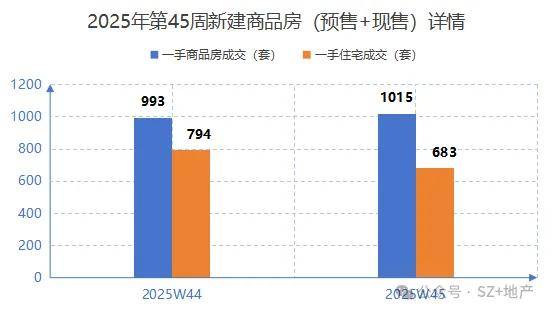
Core Insights - The new housing market in Shenzhen shows a steady increase in transactions, with a notable rise in commercial properties, indicating growing interest in non-residential real estate [1][3] - The second-hand housing market recorded a nearly 10% increase in contract registrations, reflecting a subtle shift in supply and demand dynamics [4][6] - The market outlook remains stable, supported by favorable policies and an increase in new supply, although challenges such as declining seller willingness may impact future supply [9] New Housing Market - In the week of November 3-9, 2025, Shenzhen's new housing market recorded 1,015 transactions, a 2.2% increase from the previous week, maintaining a weekly transaction volume above 1,000 units [1] - The commercial property segment saw a significant surge, with transaction volume increasing by 66.8% compared to the previous week, highlighting a rising interest in non-residential properties [1] Supply Side - The fourth quarter is expected to see a supply peak in Shenzhen's new housing market, with over 10,000 new units anticipated, including high-demand projects in prime locations [3] Second-Hand Housing Market - The second-hand housing market recorded 1,452 contract registrations, a 9.5% increase week-on-week, indicating a high level of market activity [4] - The demand side shows a 4.6% increase in new buyer contracts, while the supply side experienced a 2.5% decrease in new seller contracts, suggesting a potential impact on future pricing trends [6] Regional Analysis - Longgang district continues to lead in transaction volume, with several areas making it to the top ten list, underscoring its significance in Shenzhen's real estate market [7] Market Outlook - The overall real estate market in Shenzhen remains stable, with new housing supply expected to rise and second-hand housing showing resilience [9] - Positive factors include ongoing financial support for reasonable housing demand and low mortgage rates, while challenges such as reduced seller willingness may limit second-hand supply [9]

渤海证券研究所晨会纪要(2025.11.12)-20251112
BOHAI SECURITIES· 2025-11-12 02:23
Fixed Income Research - The issuance rates for credit bonds have decreased, with overall changes ranging from -10 BP to -3 BP during the period from November 3 to November 9 [2] - The issuance scale of credit bonds has increased on a month-on-month basis, with net financing amounts also rising, except for corporate bonds which showed negative net financing [2] - Secondary market transactions for credit bonds have decreased, while short-term financing bonds saw a slight increase in transaction amounts [2] - Credit spreads have generally narrowed, with most varieties at historical low levels; 1-year credit spreads are within 1%, 3-year and 5-year within 5%, and 7-year around 10% [2] Metal Industry Research - The steel industry is entering a consumption off-season, leading to increased pressure on steel prices; some steel mills are planning maintenance, which may reduce supply [6] - Copper prices are supported by tight supply due to overseas mining accidents, while the impact of U.S. government actions on economic data is being monitored [6] - Aluminum prices are expected to remain volatile due to low alumina prices and domestic demand shifting from strong to weak [6] - Gold prices are influenced by U.S. government actions and geopolitical factors, with long-term trends favoring gold due to central bank purchases and a weakening dollar [6] - Lithium prices are under pressure from production resumption expectations, but strong fundamentals may support prices [6] - Rare earth prices are expected to improve as demand increases with anticipated growth in neodymium-iron-boron production [6][7] Investment Strategy - In the steel sector, policies aimed at stabilizing growth are expected to improve industry profitability, with demand in shipbuilding and construction likely to increase [7] - The copper industry is expected to benefit from tightening global supply and improving demand from key sectors like electric power and new energy vehicles [7] - The aluminum sector is projected to see improved profitability due to strict capacity limits and demand growth from new energy vehicles [8] - Gold remains attractive in the long term due to macroeconomic factors and geopolitical tensions [8] - The rare earth sector is poised for reevaluation due to export controls and strategic importance, with ongoing demand from robotics and new energy sectors [8][9] - Cobalt supply is expected to be constrained, while demand from electric vehicles and energy storage will likely keep the market tight [9]





房地产行业2025年Q3土地市场总结:土地市场压力仍大,一线城市溢价率上升
ZHONGTAI SECURITIES· 2025-10-22 02:33
Investment Rating - The industry investment rating is "Overweight (Maintain)" [2][9] Core Viewpoints - The report indicates that the land market pressure remains significant in Q3 2025, with a year-on-year decline in land supply, transaction area, and land transfer revenue. Despite a decrease in land transfer revenue in first-tier cities, the premium rate has significantly increased. The average premium rate for land transfers in Q3 2025 is 4.56%, up by 0.81 percentage points compared to Q3 2024. The report suggests that the market is returning to rationality, with both supply and demand showing moderate declines [9][44]. Summary by Sections 1. National Land Supply and Transaction Situation in Q3 2025 - The planned land supply area in Q3 2025 is 760 million square meters, with a year-on-year growth rate of -9.42%. The total land transfer revenue is 0.68 trillion yuan, down by 9.74% year-on-year [12][19]. - The average premium rate for land transfers in Q3 2025 is 4.56%, with first-tier cities averaging 18.18%, second-tier cities at 2.60%, and third and fourth-tier cities at 3.02% [26][30]. 2. Analysis of High Total Price and High Premium Rate Land Parcels - High total price land parcels are primarily located in first-tier cities, with four parcels exceeding 5 billion yuan in total price in Q3 2025 [33][37]. - The number of cities with a premium rate exceeding 20% was 13 in July 2025, increasing to 19 in August, and then decreasing to 12 in September [40][42]. 3. Investment Recommendations - The report recommends focusing on leading real estate companies with stable performance and high safety, such as China Merchants Shekou, Binjiang Group, and China Vanke. Beneficiary stocks include Yuexiu Property, Greentown China, China Overseas Development, and China Resources Land. For the property sector, recommended companies include China Resources Mixc Life, China Overseas Property, Poly Property, China Merchants Jinling, and Greentown Service [9][44].


前三季度全国新房销售6.3万亿
3 6 Ke· 2025-10-20 03:45
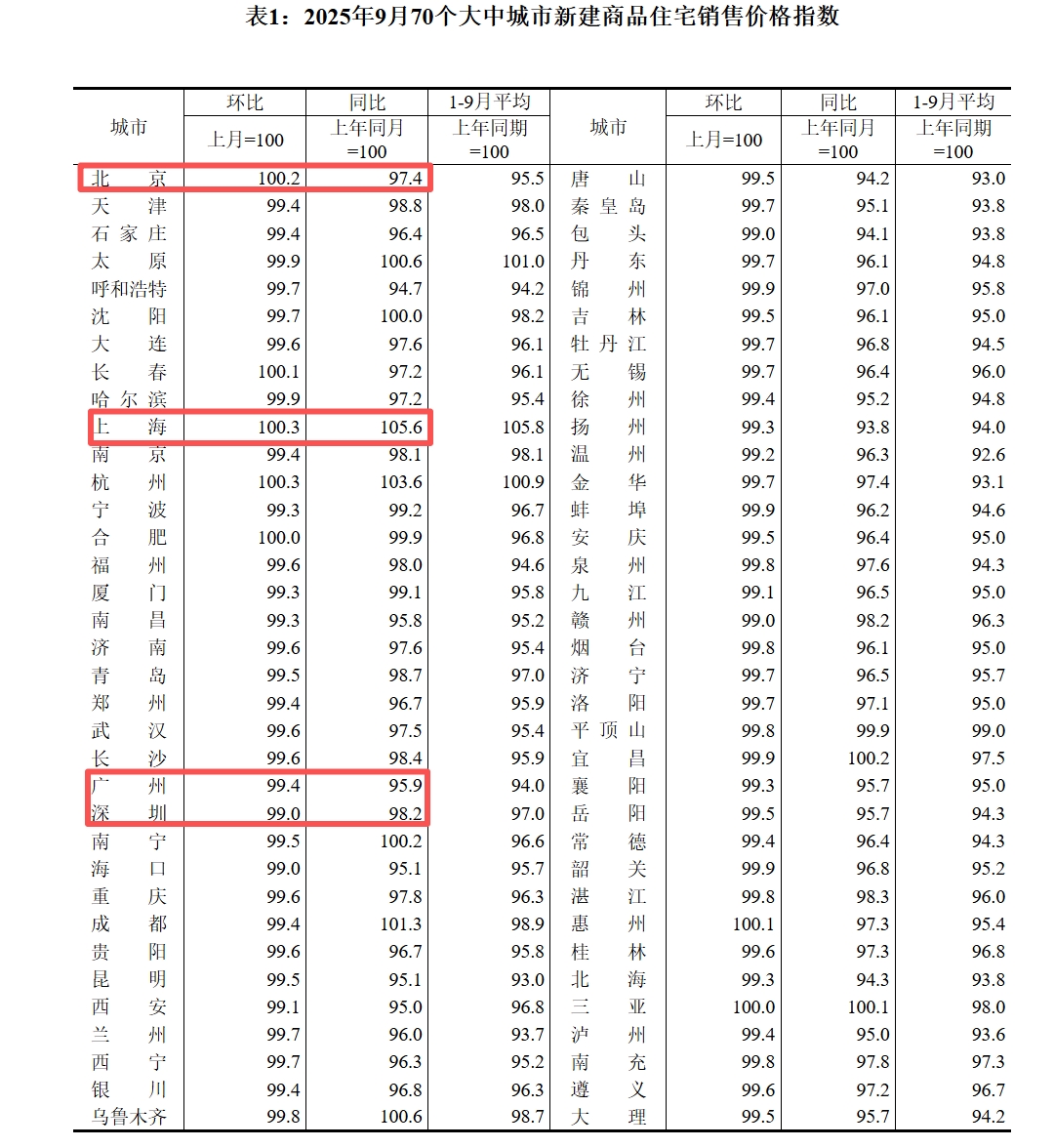
Core Insights - The real estate market in China is experiencing a downward trend in new home prices, with first-tier cities seeing a month-on-month decline of 0.3% and second-tier cities a decline of 0.4% in September [1][3] - The total sales area of new residential properties from January to September reached 65.835 million square meters, with a sales revenue of 630.40 billion yuan, both showing a year-on-year decline [1][7] - The overall expectation for new home sales revenue for the year is projected to be between 8.5 trillion and 9 trillion yuan, down from 9.68 trillion yuan last year [1] New Home Market - First-tier cities are showing a mixed performance, with Beijing and Shanghai experiencing slight increases in new home prices of 0.2% and 0.3%, while Guangzhou and Shenzhen saw declines of 0.6% and 1.0% respectively [3][4] - Second-tier cities also faced a decline, with notable increases in prices in cities like Hangzhou and Changchun, which rose by 0.3% and 0.1% respectively [3][4] Second-Hand Home Market - The second-hand home market is under pressure, with prices in 70 major cities showing no increases in September, and first-tier cities experiencing a month-on-month decline of 1.0% [5] - The average price decline in second and third-tier cities was 0.7% and 0.6% respectively, indicating a broader market trend [5] Inventory and Sales Dynamics - The total inventory of unsold residential properties decreased by 39.63 million square meters by the end of September, with residential inventory specifically down by 32.37 million square meters [7] - The sales area of new residential properties saw a year-on-year decline of 5.6%, while the sales revenue dropped by 7.6% [7][8] Construction and Investment Trends - Real estate development investment from January to September was 677.06 billion yuan, a year-on-year decrease of 13.9%, with residential investment down by 12.9% [7][8] - The area under construction decreased by 9.4%, with new construction area dropping by 18.9%, indicating a significant contraction in development activity [8]