避险资产配置

Search documents
中东区域冲突延续,建筑怎么配?
Changjiang Securities· 2026-03-24 08:44
Investment Rating - The investment rating for the construction and engineering industry is "Positive" and maintained [8] Core Insights - The ongoing conflicts in the Middle East present significant investment opportunities in the construction industry, particularly in areas such as rising energy prices, energy security construction, safe-haven asset allocation, and regional reconstruction themes [2][6] - The report emphasizes the importance of monitoring the chain reactions caused by the Middle East conflicts, including infrastructure damage, rising global energy prices, and declining market risk appetite [12] - The report highlights the potential for performance elasticity in companies like Northern International due to rising energy prices, with a notable increase in European electricity prices observed [12] - The economic viability of coal chemical projects is expected to improve, leading to accelerated capital expenditures, with key companies like China Chemical and Donghua Technology being highlighted [12] - The report suggests focusing on high-dividend, large-cap state-owned enterprises as safe-haven investments amid rising oil prices and increased market risk aversion [12] - The regional reconstruction theme is underscored, with recommendations for companies like Northern International, which has a history of benefiting from changes in the Middle East situation [12] Summary by Sections - **Energy Price Increase**: The report notes that the last round of the Russia-Ukraine conflict led to a significant rise in European electricity prices, with a year-on-year increase of 138% in Croatia's average electricity price in 2022 [12] - **Energy Security Construction**: The report indicates that the current high international oil prices and relatively abundant domestic coal supply are enhancing the economic viability of coal-to-chemical projects [12] - **Safe-Haven Asset Allocation**: Companies such as China State Construction and Sichuan Road and Bridge are highlighted for their defensive attributes and stable cash flows, with projected dividend yields of 5.4% and 5.6% respectively [12] - **Regional Reconstruction Theme**: Northern International is recommended due to its historical performance during Middle Eastern conflicts, with significant stock price increases following geopolitical developments [12]

特朗普:或向中东再派一支航母打击群!内塔尼亚胡紧急访美!“商品大王”:绝不会卖掉金银铜
Qi Huo Ri Bao· 2026-02-11 00:19
Group 1 - The core viewpoint of the article is that President Trump is considering deploying an additional aircraft carrier strike group to the Middle East if negotiations with Iran fail, emphasizing that any agreement must address both nuclear and ballistic missile issues [2] - Trump anticipates a second round of negotiations with Iran to take place the following week, expressing optimism about reaching a favorable agreement [2] - Israeli Prime Minister Netanyahu is traveling to the U.S. to provide Trump with new intelligence regarding Iran's military capabilities, particularly concerning its ballistic missile capabilities [2] Group 2 - Iranian Foreign Minister Zarif accuses Netanyahu of attempting to drag the U.S. into a war with Iran, asserting that Netanyahu does not support diplomatic solutions and has a history of military aggression in the region [4] - Zarif claims that Netanyahu's efforts to involve the U.S. in conflict with Iran have failed in the past and will continue to do so [4]
1月份期货市场成交额突破100万亿元同比实现翻倍增长
Xin Lang Cai Jing· 2026-02-09 23:02
Core Insights - The Chinese futures market saw significant activity in January, with a trading volume of 912 million contracts and a turnover of 100.26 trillion yuan, representing year-on-year increases of 65.09% and 105.14% respectively [1][4] Market Activity - The increase in market activity is attributed to several factors: the rotation effect among market sectors, heightened demand for hedging and asset allocation due to geopolitical risks, increased price volatility in certain commodities, and seasonal effects at the beginning of the year [1][4] - The influx of new capital at the start of the year has led to a significant increase in client equity and sustained liquidity in the market [4] Commodity Performance - As of the end of January, there are 165 listed futures and options products in China, with over 50 products, including silver, copper, aluminum, tin, and nickel, showing year-on-year volume growth exceeding 100% [2][5] - Nickel futures experienced a staggering year-on-year growth of 799.06%, while copper and aluminum futures grew by 403.75% and 395.39% respectively [5] Sector Analysis - The active trading in precious and non-ferrous metals is driven by product attributes and supply-demand dynamics, with strong industrial demand for silver and non-ferrous metals from sectors like photovoltaics, artificial intelligence, and new energy vehicles [5] - The demand for hedging tools among industrial enterprises has been increasing due to heightened price volatility in these commodities [5] Exchange Rankings - In terms of trading volume, the top commodities by exchange include silver, gold, and copper at the Shanghai Futures Exchange, while the Zhengzhou Commodity Exchange leads with PTA, cotton, and caustic soda [6] - The China Financial Futures Exchange recorded a trading volume of 30.05 million contracts in January, accounting for 3.29% of the national market, with a turnover of 2.635 trillion yuan [6]
ATFX:多空鏖战5000关口,趋势抉择进入关键窗口
Sou Hu Cai Jing· 2026-02-05 08:48
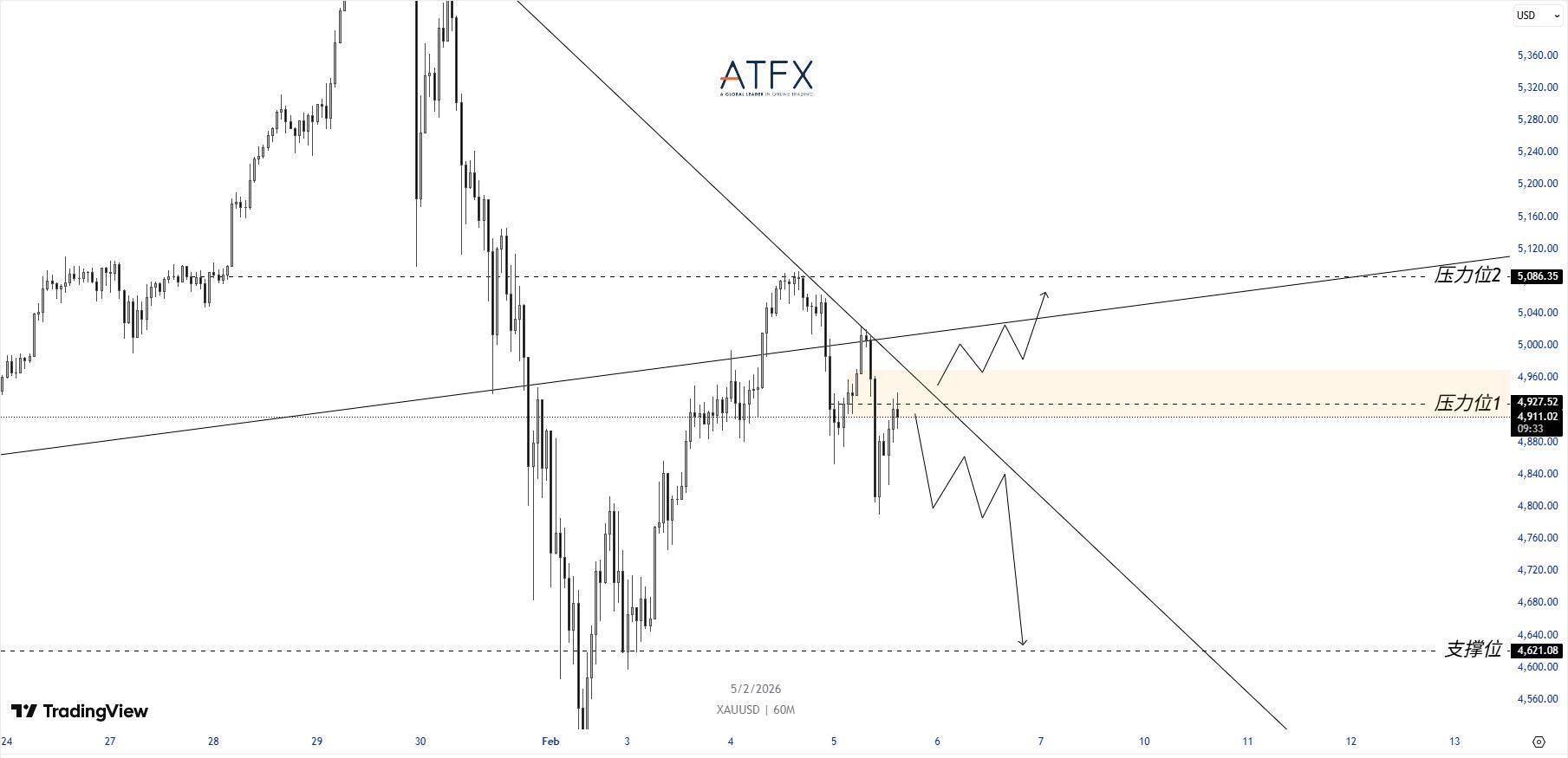
Core Viewpoint - The gold market has become a focal point for global capital, with significant fluctuations around the $5000 mark driven by a mix of risk sentiment and macroeconomic factors [1]. Group 1: Market Dynamics - Spot gold prices surged to over $5090 due to heightened risk aversion and low-level buying, but subsequently fell back to around $4850, indicating a substantial daily volatility [1]. - The recent rebound in the US dollar and profit-taking pressures contributed to the sharp decline in gold prices after reaching highs [1]. - Global uncertainties continue to support long-term demand for gold, while short-term macro data and dollar movements create volatility, leading to oscillations between bullish and bearish sentiments [1]. Group 2: Economic Indicators - The latest US services data showed resilience, with the ISM non-manufacturing PMI remaining in the expansion zone, prompting a reassessment of inflation persistence and Federal Reserve policy, which led to a temporary rebound in the dollar index [1]. - A marginal easing in geopolitical tensions has reduced some risk premiums, further weakening the momentum for gold's continuous rise [1]. Group 3: Technical Analysis - Current gold prices are operating below a descending trend line, with resistance observed in the $4920–$5000 range, indicating a critical short-term pressure zone [3]. - If gold can break through and stabilize above this resistance area, it may test higher levels around $5080; conversely, failure to do so could lead to a decline towards $4800, with further downside potential towards the $4620 support level [3]. - The market is currently in a phase of "high-level tug-of-war" as it digests previous rapid price movements, with short-term trends heavily reliant on US employment data and dollar fluctuations [3].

投资者需警惕暴涨崩盘 伦敦银进入技术性回调
Jin Tou Wang· 2026-01-30 06:28
Group 1 - The silver price reached a historical high of $121.66 on January 29, followed by a significant profit-taking, indicating a short-term correction despite a monthly increase of over 60% reflecting high demand for safe-haven assets [2] - Analysts suggest that the recent pullback in gold and silver futures may indicate that prices have hit recent peaks, with potential implications for market dynamics [2] - Historical patterns of price surges followed by crashes highlight economic uncertainty, inflation fears, speculative manipulation, and regulatory intervention as key factors to monitor [2] Group 2 - Recent trading in silver shows a downward trend, yet prices remain above the EMA50, indicating dynamic support and reinforcing the stability of the short-term bullish trend [3] - The current pullback is viewed as an attempt to regain upward momentum while addressing overbought conditions in relative strength indicators, which have entered an extreme oversold zone [3] - The silver market is experiencing ongoing tightness, with issues such as the domestic market's premium over London prices and significant volatility in investment funds [2]
“沸腾”的黄金!需求创纪录,金价连破关键关口!后市怎么走?
券商中国· 2026-01-29 15:04
Core Viewpoint - The global gold demand is projected to exceed 5000 tons for the first time in 2025, reaching a historic high of 5002 tons, with a total value soaring to $555 billion, a 45% year-on-year increase [1][2]. Group 1: Investment Demand - Investment demand is identified as the primary driver behind the record global gold demand in 2025, with a rise to 2175 tons, surpassing the 2000-ton milestone for the first time [3]. - Global gold ETFs saw a net increase of 801 tons, marking the second-highest annual increment in history, driven by geopolitical risks and economic uncertainties [3]. - Physical gold investment remains robust, with demand for gold bars and coins reaching 1374 tons, valued at approximately $154 billion, the highest in 12 years [3]. Group 2: Central Bank Purchases - Central banks and official institutions collectively increased their gold holdings by 863 tons in 2025, significantly above the long-term average, providing crucial support for global gold demand [3]. - The People's Bank of China added 2.8 tons in Q4 2025, raising its total gold reserves to 2306 tons, which now constitutes 8.5% of its total foreign reserves [4]. Group 3: Price Movements - On January 29, gold prices surged, with spot and futures prices both exceeding $5500 per ounce, and London gold prices reaching a monthly increase of 28% [1][5]. - Silver prices also experienced significant increases, with spot silver rising to $120 per ounce, marking a historical high [6]. Group 4: Market Dynamics - The current gold price surge is attributed to heightened risk premiums and a weakening dollar, influenced by geopolitical tensions and domestic political uncertainties in the U.S. [6]. - Analysts predict that gold prices may continue to exhibit a strong upward trend, with potential targets set at $5800 per ounce for gold and further increases for silver [7]. Group 5: Long-term Outlook - The increase in global gold demand reflects a profound shift in asset allocation logic amid high inflation, debt, and geopolitical risks, reinforcing gold's role as a safe-haven asset [8]. - Market volatility is expected to increase in the short term due to emotional trading, while the long-term trajectory of gold prices will depend on global risk dynamics and the sustainability of investment demand [8].
渣打:黄金史诗级涨势并非投机狂热,具备深厚的结构性支撑
Xin Lang Cai Jing· 2026-01-29 13:36
Core Viewpoint - Standard Chartered's global commodities research head, Suki Cooper, asserts that the recent unprecedented surge in gold prices is supported by strong structural factors rather than excessive speculation [1] Group 1: Market Dynamics - Institutional investors' positions have increased at a slower pace than the rise in gold prices, indicating a lack of over-speculation in the market [1] - The current speculative positions account for only about 26.4% of open contracts, significantly lower than the historical peak of 47.9% [1] Group 2: Driving Factors - The driving forces behind gold prices have shifted from traditional macroeconomic factors to structural drivers, including concerns over monetary policy independence and global trade tariff tensions [1] - Retail investors are actively allocating to safe-haven assets, further supporting gold prices [1] Group 3: Market Sentiment - The implied volatility and risk reversal indicators in the options market are leaning bullish, reflecting investor confidence in future price movements [1]
刹不住!金银迎“史诗级”大涨
Guo Ji Jin Rong Bao· 2026-01-26 14:10
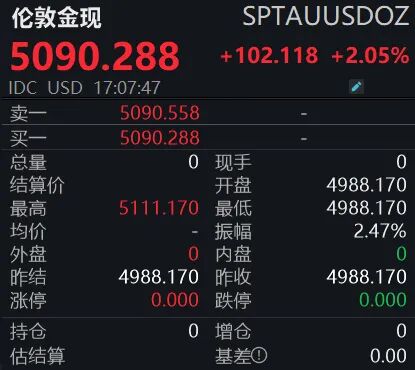
Core Viewpoint - The prices of gold and silver have surged to historic highs, with spot gold breaking the $5000 per ounce mark, driven by factors such as weakened dollar credibility, strong central bank demand for gold, and geopolitical premiums [1][11]. Market Performance - As of the report, spot gold rose by 2.05% to $5090.288 per ounce, reaching a peak of $5111.17, while spot silver surged by 6.06% to $109.6 per ounce, surpassing the $110 mark [3][5]. - In the futures market, COMEX gold futures increased by 2.02% to $5080.4 per ounce, with a peak of $5107.9, and COMEX silver futures rose by 7.54% to $108.97 per ounce, hitting a high of $110.065 [6][7]. Influencing Factors - The current gold price rally, which began in early 2025 at around $3000 per ounce, reflects significant changes in the macroeconomic environment [9]. - Short-term factors include ongoing geopolitical risks, such as tensions over Greenland's sovereignty and escalating US-Iran relations, which have heightened demand for safe-haven assets like gold [9]. - Mid-term factors involve the interplay between the Federal Reserve's policy path and its independence, with expectations of weakened monetary policy independence supporting gold prices [9][10]. - Long-term drivers include the structural weakening of the dollar credit system, with global central banks increasing gold reserves and a steady de-dollarization process [10]. Future Outlook - The long-term upward trend for gold remains intact, influenced by factors such as weakened dollar credibility, strong central bank demand, and geopolitical premiums [11]. - Analysts predict that gold prices could potentially reach $6000 per ounce by 2026, driven by ongoing geopolitical uncertainties and expectations of continued monetary easing [11]. - Investment strategies suggested include a diversified approach based on individual financial capacity and risk tolerance, with recommendations for different investment vehicles such as gold futures, ETFs, and physical gold [11].
地缘风险升温,铂钯双双大涨
Hua Lian Qi Huo· 2026-01-26 07:51
1. Report Industry Investment Rating - No information provided in the report. 2. Core Viewpoints of the Report - Platinum and palladium prices are still affected by the overall sentiment of the precious metals sector and geopolitical risks in the short term. Geopolitical risks remain high, driving up precious metals prices, and platinum and palladium fluctuate with the sector [8][9]. - Fundamentally, the global platinum market has been in short supply for two consecutive years. The supply of platinum is shrinking, industrial demand is rising, and low prices have stabilized jewelry and investment demand, highlighting the supply - demand contradiction. The supply - demand gap of platinum is expected to continue in the next few years, so the long - term fundamentals of platinum are optimistic [9]. - For palladium, automotive demand dominates. Due to the surge in the penetration rate of new energy vehicles in China, the growth of palladium demand is suppressed, and it is difficult to see improvement in the short term. Therefore, the fundamental support for palladium is limited, and its trend is affected by platinum linkage and the macro - environment [9]. - Overall, the industrial demand for platinum and palladium is concentrated in fuel - vehicle exhaust catalysts, and the fundamental support is insufficient. Their trends are mainly driven by the overall sector sentiment, and recently by safe - haven demand. They are expected to maintain high volatility and wide - range fluctuations. It is recommended to go long on platinum PT2606 and palladium PD2606 with light positions [9]. 3. Summary According to Relevant Catalogs 3.1 Weekly Views and Strategies 3.1.1 Weekly Views - **Price Trends**: Last Friday, there were fluctuations in the platinum and palladium markets. The sharp rise in the spot price of platinum in the external market drove the prices of domestic platinum and palladium to gap up on Friday. Platinum was relatively strong, with the platinum main contract closing at 685.9 yuan, up 10.39%; the palladium main contract closed at 497.95 yuan, up 3.98%. The spot price of external platinum reached a record high of 2704.3 at the early morning of Saturday. The weekly gains of domestic platinum and palladium were 12.4% and 6.1% respectively [8]. - **Macroeconomic Situation**: The number of initial jobless claims in the US in the week of January 17 was 200,000, lower than the expected 209,000. The number of continued jobless claims dropped to 1.85 million last week, lower than the expected 1.89 million, the lowest level since November, indicating a warming labor market. The final quarter - on - quarter growth rate of the US GDP in the third quarter was 4.4%, the fastest in two years, showing robust growth. In November, the overall PCE price index in the US increased by 2.8% year - on - year and 0.2% month - on - month, in line with expectations; the core PCE price index also increased by 2.8% year - on - year and 0.2% month - on - month, in line with expectations, indicating a mitigation of inflation risks. The market is focusing on the upcoming announcement of the new Fed Chairman, which may affect market expectations for the future interest - rate path of the Fed [8]. - **News**: The sharp rise in precious metals last week was mainly due to the intensification of geopolitical risks, which led to funds flowing into safe - haven assets. The US President's announcement of tariffs on eight European countries and Europe's strong response of selling US Treasuries, along with the deterioration of the situation in Greenland, initially increased geopolitical risks. Although the US President later cancelled the tariffs and gave up the idea of seizing the island by force, the tense relations between Europe and the US and the uncertain situation in Iran still stimulated the market's demand for safe - haven asset allocation [8]. - **Fundamentals**: In 2026, platinum and palladium are expected to show significant differences. The supply of platinum is continuously restricted, with South Africa accounting for over 70% of global production. Its demand structure is diverse, with automotive exhaust catalysts accounting for only about 40%, and the rest coming from investment, jewelry, and industrial fields. Against the background of rising platinum prices, investment demand has increased significantly. At the same time, emerging fields such as the hydrogen - energy industry and commercial spaceflight have opened up long - term growth prospects, and the supply - demand gap of platinum is expected to widen in 2026. The terminal demand for palladium is highly dependent on automotive exhaust catalysts, accounting for over 80%. Suppressed by the accelerating penetration of new energy vehicles and the substitution trend of platinum, the growth of palladium demand lacks imagination. Although there is still a short - term supply gap, it is expected to narrow significantly in 2026, with relatively limited fundamental support [8]. 3.1.2 Strategies - It is recommended to go long on platinum PT2606 and palladium PD2606 with light positions [9]. 3.2 Spot and Futures Markets - The report provides multiple sets of charts, including the trends of NYMEX platinum and palladium futures, London platinum and palladium spot prices, Guangzhou Futures Exchange platinum and palladium futures, and the Shanghai Gold Exchange platinum price [12][16][20][24]. 3.3 US Economy - The report presents charts of US GDP, PMI, new non - farm employment numbers, and the unemployment rate, which can be used to analyze the overall situation of the US economy [30][31]. 3.4 Inflation - The report provides charts of US CPI/PCE and core CPI/PCE to show the inflation situation in the US [36][39]. 3.5 Interest Rates - The report shows charts of US Treasury yields (including short - term and medium - to - long - term) and real interest rates, which can be used to analyze the interest - rate situation in the US [42][45][46]. 3.6 Fundamentals - **Platinum**: The report provides a global platinum supply - demand balance sheet from 2013 to 2026f, showing the supply from various regions (such as South Africa, Zimbabwe, North America, Russia), different types of demand (automotive, jewelry, IT, etc.), and the supply - demand gap and inventory changes in different years [51]. - **Palladium**: The report provides a global palladium supply - demand balance sheet from 2009 to 2025, showing the supply from different regions (South Africa, Russia, North America, etc.), different types of demand (automotive, chemical, dental and biomedical, etc.), and the supply - demand gap in different years [52]. 3.7 Futures Positioning - The report provides charts of the external platinum and palladium futures positionings, including non - commercial net long positions and total positions [53]. 3.8 Passenger Car Sales - The report provides charts of China's passenger - car market retail and wholesale data, including the number of vehicles sold and year - on - year changes [60]. 3.9 US Dollar Index and Exchange Rates - The report provides charts of the US dollar index and various exchange - rate pairs, including the US dollar against the Chinese yuan, the euro, the Japanese yen, the British pound, and the Canadian dollar [66][69][72][74]. 3.10 Platinum - Palladium Price Difference between Domestic and Foreign Markets - The report provides charts of the spot price trends of domestic and foreign platinum and the price difference between them [83]. 3.11 Platinum - Palladium Price Ratio - The report provides a chart of the platinum - palladium price ratio, including the ratios in NYMEX and LPPM [90].
美元信用裂缝中,资金用脚投票:狂买铜等实物资产,逃离比特币
智通财经网· 2026-01-26 04:46
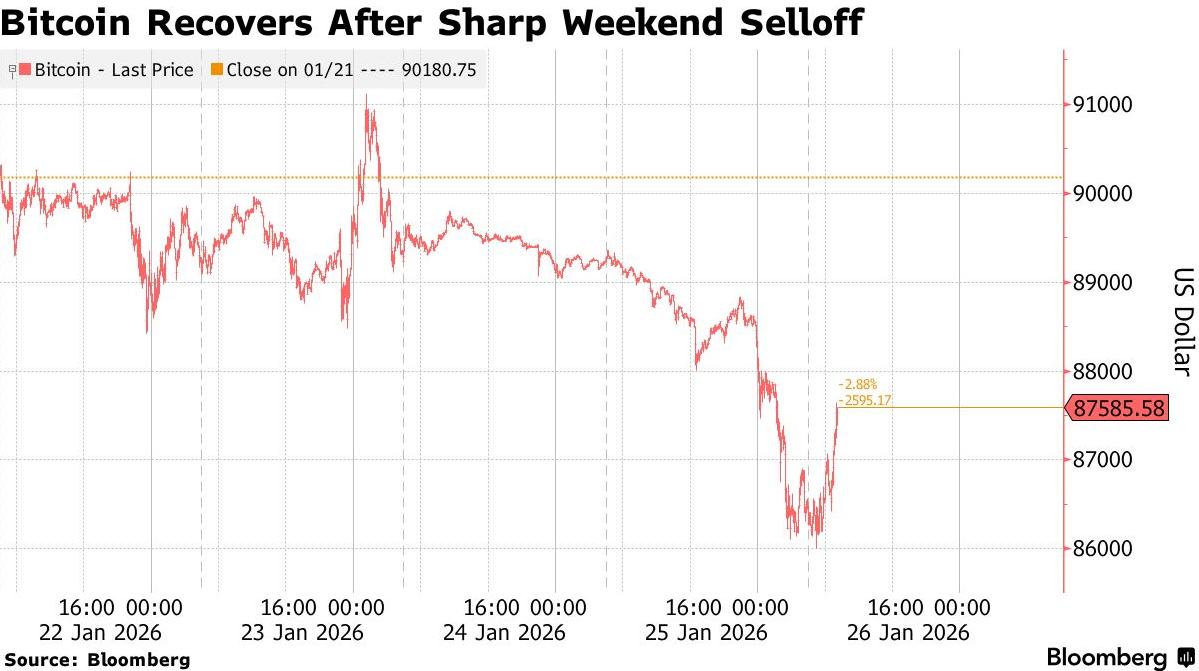
Group 1 - The article highlights a significant divergence in international market asset trends amid increasing global macro policy uncertainty, indicating a shift in investor behavior in response to a weakening US dollar [1] - The expectation of US involvement in coordinated currency intervention with Japan has pressured the dollar index, leading to a strong upward momentum in the commodity market, particularly in base metals like copper [1][8] - The rise in industrial metals is attributed not only to supply-demand dynamics but also to strategic allocation towards tangible assets amid accumulating dollar credit risks [1] Group 2 - In contrast to the booming physical asset market, the cryptocurrency market, particularly Bitcoin, has faced instability, demonstrating a lack of reliable safe-haven properties under heightened geopolitical tensions [1] - Bitcoin experienced a significant drop of 3.5% last Sunday, reaching its lowest point since 2026, before slightly recovering, while Ethereum also faced a decline of 5.7% [2] - The outflow of funds from Bitcoin exchange-traded funds in the US totaled $1.7 billion over five days, indicating a lack of substantial capital inflow despite a brief respite in prices [5] Group 3 - Geopolitical concerns, including potential tariffs on Canadian imports and military movements towards Iran, have dampened overall market sentiment, leading to a preference for physical assets like gold and copper over volatile digital assets [7] - Basic metals have collectively risen due to the continued weakness of the dollar, with copper prices jumping nearly 3% last Friday and continuing to climb [7][8] - The Bloomberg Dollar Spot Index fell by 0.4% on Monday and 1.6% over the previous week, marking the largest decline since May, as expectations of US-Japan currency intervention weigh on the dollar [8]