
谷歌Gemini3

Search documents
直击CES|不再死磕昂贵的大模型,硅谷创业者加码设备端AI
Di Yi Cai Jing· 2026-01-10 02:19
Core Insights - The trend in AI startups is shifting from large models to lightweight models, AI agents, and on-device AI, indicating a rational return driven by cost, commercialization, and capital logic [1][2][6] - The device-side AI is emerging as a new track for startups, allowing AI to run directly on devices without relying on cloud or internet, thus ensuring data privacy and reducing costs [2][8] Group 1: Industry Trends - The previous focus on "big model wars" is declining, with a consensus forming that large models are becoming a capital-intensive competition among a few wealthy giants [6] - The cost of training large models can reach tens of millions of dollars, and the marginal costs have not decreased as expected, leading to financial pressures for startups [6][7] - Many AI startups have blindly increased model sizes without achieving significant breakthroughs, prompting a shift towards more efficient and smaller AI systems [7][8] Group 2: Device-side AI Development - Device-side AI is gaining popularity, allowing applications to run on devices like smartphones and cameras, which enhances speed and security by processing data locally [8][9] - Aizip, a startup focused on device-side AI, aims to create efficient AI models that can operate independently of cloud services, utilizing data collection, purchase, and model distillation [2][8] - Current applications for device-side AI include karaoke voice solutions and smart cameras, which can perform complex tasks locally, ensuring user privacy and real-time responses [9][10] Group 3: Future Outlook - The market for device-side AI is expected to grow as more essential applications emerge, fostering user habits and emphasizing privacy protection [10] - The demand for AI model training talent and computational resources remains high, with a notable role played by Chinese engineers in the AI wave due to their strong mathematical foundation and problem-solving abilities [10]


?AI基建大爆发 高盛重塑TMT投行版图! 押注“算力时代”的交易洪流
Zhi Tong Cai Jing· 2025-12-17 01:07
Core Insights - The article discusses the significant restructuring of investment banking teams at major firms like Goldman Sachs, Morgan Stanley, and JPMorgan in response to the booming AI infrastructure market, particularly in the TMT (Technology, Media, and Telecommunications) sector [1][2] - Goldman Sachs' recent report indicates a strong demand for AI server clusters, which is expected to continue growing through 2026, alongside robust demand for optical networking equipment and a moderate supply increase in the DRAM storage chip market [1][3] Investment Banking Restructuring - Goldman Sachs is creating a new global infrastructure technology business unit, integrating its telecom and CoreTech teams, led by Yasmine Coupal and Jason Tofsky [1] - Another new unit, focused on global internet and media, will be led by Brandon Watkins and Alekhya Uppalapati, as the firm seeks to capitalize on large-scale investment opportunities in the AI sector [2] AI Infrastructure Demand - The demand for AI servers is projected to remain strong, with significant growth expected in AI ASIC clusters led by Google, outpacing AI GPU shipments, which will also see robust growth [2][3] - Nvidia's Rubin architecture AI GPU clusters are set to begin production in mid-2026, with strong capacity ramp-up anticipated in the latter half of that year [3] Market Predictions - Goldman Sachs' stock strategists predict that the S&P 500 index will reach around 7600 points next year, indicating a potential 10% upside from current levels, driven by widespread AI technology adoption and resilient economic growth [3][4] - The overall earnings per share for S&P 500 companies are expected to jump by 12% next year, with a further 10% increase in 2027, reflecting the positive impact of AI on corporate profitability [3][4] AI Investment Wave - The article highlights that the current wave of investment in AI infrastructure is just beginning, with projections estimating that the total investment could reach between $3 trillion to $4 trillion by 2030, driven by unprecedented demand for AI computing power [4]

利好预期仍在,小幅调整不改反弹之势!
Sou Hu Cai Jing· 2025-12-10 05:20
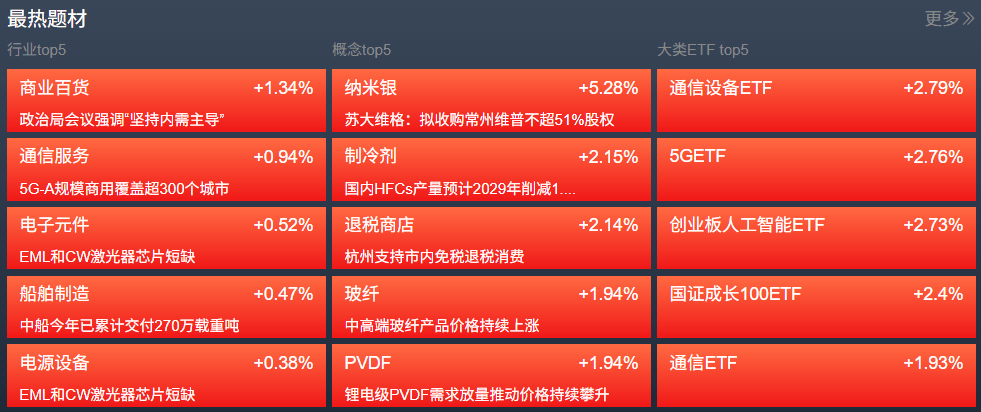
Market Overview - On December 9, the market experienced a volume contraction with mixed index performance, resulting in most stocks closing lower. The total trading volume across three markets was 1.92 trillion, a decrease of over 130 billion from the previous trading day, with more than 4,000 stocks declining. Northbound capital had a total transaction amount of 219.6 billion [1]. Sector Performance - The top-performing sectors included: - Commercial retail: +1.34% - Communication services: +0.94% - Electronic components: +0.52% - Shipbuilding: +0.47% - Power equipment: +0.38% [2]. - The top-performing concepts included: - Nano silver: +5.28% - Refrigerants: +2.15% - Tax refund stores: +2.14% - Glass fiber: +1.94% - PVDF: +1.94% [2]. Declining Sectors - The sectors with the largest declines included: - Forestry: -2.97% - Non-ferrous metals: -2.77% - Pharmaceutical commerce: -2.5% - Precious metals: -2.46% - Energy metals: -2.46% [3]. Market Sentiment - Following a series of market rebounds, a significant meeting led to some profit-taking, resulting in a slight market adjustment. The announcement by the U.S. allowing NVIDIA to sell H200 chips to China stimulated a rally in the AI computing industry chain. The market's slight adjustment is seen as a digestion of profit-taking, maintaining a trend of oscillating rebounds, with expectations for further positive momentum from upcoming meetings in December [3]. Future Outlook - The outlook for the Federal Reserve's interest rate cuts is gaining traction, with Kevin Hassett, a leading candidate for the next Fed chair, advocating for aggressive rate cuts. If he assumes the role, a more aggressive rate-cutting policy may begin in 2026. The focus is on AI computing concepts, with recent advancements in Google's TPU supporting significant model training, indicating a new direction for AI computing. The upcoming 20th China IDC Industry Annual Conference, themed "Reshaping Computing Power," is expected to stimulate related concepts [4].
GPU与TPU的竞争新局,AI基建浪潮下的双轨增长 | 投研报告
Zhong Guo Neng Yuan Wang· 2025-12-01 02:04
Group 1: Electronic Industry Performance - The electronic sector has shown significant recovery this week, with notable increases in various sub-sectors. The year-to-date performance for the semiconductor sector is +39.75%, other electronics II +43.95%, components +89.82%, optical optoelectronics +5.55%, consumer electronics +42.54%, and electronic chemicals II +38.20% [1] - Weekly performance for the electronic sub-sectors includes semiconductors at +5.72%, other electronics II +7.59%, components +8.10%, optical optoelectronics +5.23%, consumer electronics +6.08%, and electronic chemicals II +3.93% [1] Group 2: North American Stock Performance - Most major North American stocks have risen this week, with Apple at +2.71%, Tesla +9.99%, Broadcom +18.45%, Qualcomm +2.93%, TSMC +5.98%, Micron Technology +14.04%, Intel +17.57%, Marvell Technology +15.43%, NVIDIA -1.05%, Amazon +5.68%, Oracle +1.60%, Applied Optoelectronics +30.13%, Google A +6.85%, Meta +9.04%, Microsoft +4.21%, and AMD +6.75% [2] Group 3: Google TPU vs. NVIDIA GPU - Google's TPU v7 demonstrates cost advantages over GPU-based computing, challenging the GPU-dominated market. Google's Gemini3, trained entirely on TPU, is recognized as one of the best large models globally [3] - Despite TPU's theoretical chip parameters not necessarily surpassing NVIDIA's, Google achieves higher actual model compute utilization rates through superior system-level engineering, resulting in total cost of ownership (TCO) being approximately 30%-40% lower than NVIDIA's GB200 system [3] - TPU's client list includes major model developers like Anthropic and Meta, indicating a potential disruption to the NVIDIA GPU-centric market [3] Group 4: AI Infrastructure Demand - The demand for AI infrastructure is growing significantly, exceeding the capacity of any single technology route. NVIDIA reported that its cloud GPUs are sold out, indicating a supply-demand imbalance [4] - TrendForce forecasts that global AI server shipments will grow by over 20% annually by 2026, driven by increased capital expenditures from major North American cloud service providers and the rise of sovereign clouds [4] - The competition between GPU and TPU is seen as a redistribution of market share in a growing market, with both technologies expected to experience rapid growth [4] - Key companies to watch include overseas AI firms like Industrial Fulian, Huadian Technology, and domestic AI firms like Cambricon, Chipone, and others [4]


降息预期再获提振!美国9月零售增速放缓 市场焦点转向感恩节+黑五购物季
Sou Hu Cai Jing· 2025-11-25 15:12
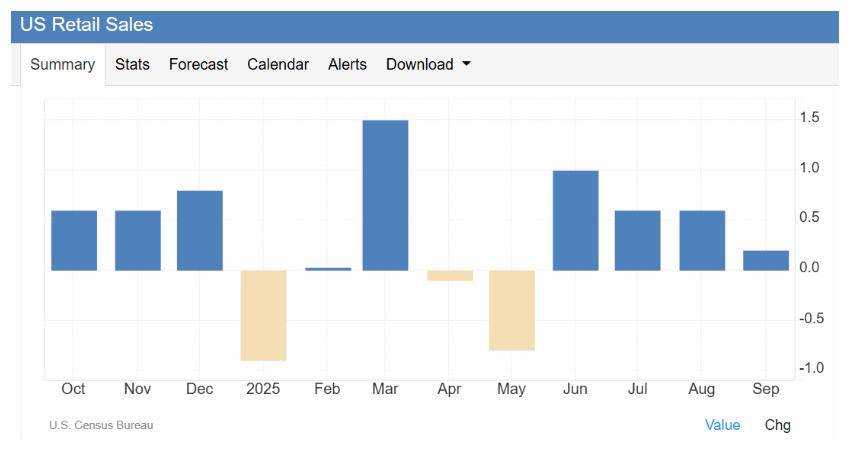
Core Viewpoint - The unexpected slowdown in U.S. retail sales growth highlights a decrease in consumer spending amid a weakening labor market and temporary inflation caused by tariffs, yet the resilience in retail sales supports the narrative of a "Goldilocks" economic environment in the U.S. [1] Retail Sales Data - In September, U.S. retail sales showed a modest increase of 0.2% month-over-month, falling short of the expected 0.4% growth, following a strong 0.6% increase in August. Excluding autos and gas, sales rose only 0.1% [5][6] - Among 13 categories, 8 recorded growth, primarily in gas stations and personal care stores, while auto sales declined for the first time in four months, and spending on electronics, clothing, and sports goods also decreased [6][8] Consumer Behavior - The data indicates that middle and low-income consumers are becoming more cautious due to rising inflation and employment challenges, leading to a pause in spending [5][7] - Retailers like Walmart and TJX have noted that shoppers are increasingly seeking discounts and essential goods, while Home Depot has warned of delayed large home purchases [7] Economic Outlook - Morgan Stanley economists predict that the OBBBA tax cuts from the Trump administration will significantly boost economic growth starting in 2026, alongside the temporary nature of inflation from tariffs and ongoing AI infrastructure investments by tech giants [1] - The NRF forecasts a record number of shoppers during the upcoming Thanksgiving and Black Friday shopping weekend, which could provide a significant boost to the U.S. economy in Q4 and 2026, as consumer spending accounts for 60%-70% of GDP [9][10] Federal Reserve and Interest Rates - Following the retail data release, expectations for a Federal Reserve rate cut in December have increased, with an 80% probability of a rate cut according to CME FedWatch Tool [3][4][7] - There is a notable division among Federal Reserve officials regarding the decision to cut rates, reflecting concerns over consumer affordability [7]
降息预期再获提振! 美国9月零售增速放缓 市场焦点转向感恩节+黑五购物季
智通财经网· 2025-11-25 14:32
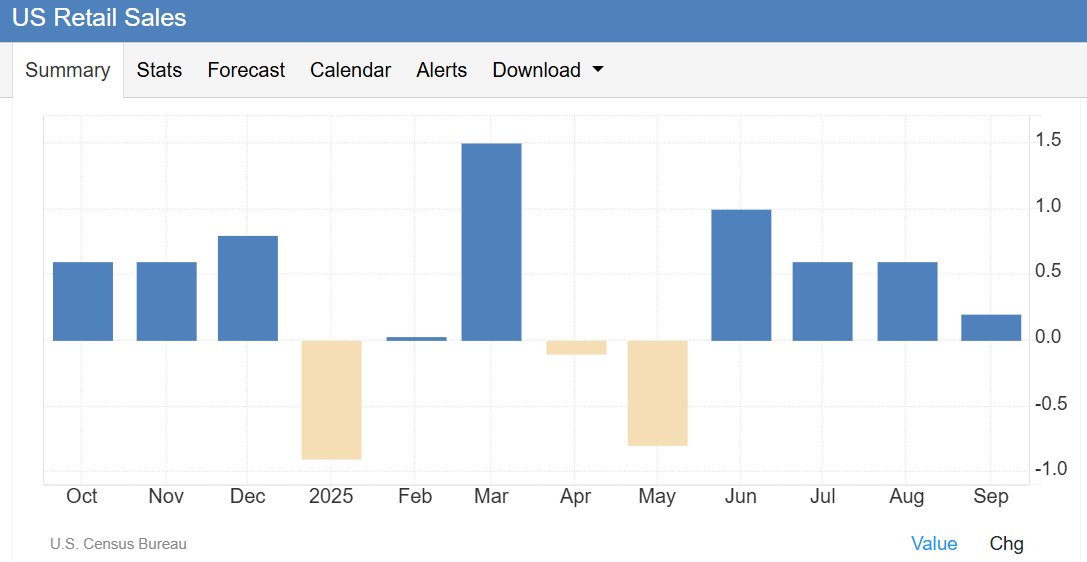
Core Viewpoint - The unexpected slowdown in U.S. retail sales growth highlights a cautious consumer spending environment amid a weakening labor market and temporary inflation due to tariffs, reinforcing the narrative of a "Goldilocks" soft landing for the economy [1][5][9] Retail Sales Data - In September, U.S. retail sales rose by only 0.2% month-over-month, falling short of the expected 0.4% increase, following a strong 0.6% growth in August [5][6] - Excluding autos and gas, sales increased by just 0.1%, indicating a slowdown in consumer spending momentum [5][6] - The "control group" sales, a key indicator for GDP calculations, declined by 0.1%, marking the first drop in five months [8] Consumer Behavior - The data suggests that middle and low-income consumers are feeling the pressure from inflation and employment challenges, leading to more cautious spending [5][7] - High-income consumers continue to support overall spending, but there are signs of strain among lower-income shoppers, with many seeking discounts and essential goods [7][9] Economic Outlook - Morgan Stanley economists predict that the OBBBA tax cuts and the temporary nature of inflation from tariffs will contribute to a strong economic growth effect starting in 2026, supporting the "Goldilocks" narrative [1] - The upcoming Thanksgiving and Black Friday shopping events are expected to significantly boost consumer spending, which accounts for 60%-70% of U.S. GDP [9][10] Federal Reserve and Interest Rates - Following the retail data release, expectations for a Federal Reserve rate cut in December have increased, with an 80% probability of a cut according to CME FedWatch Tool [3][4][7] - There is a notable division among Federal Reserve officials regarding the decision to cut rates, reflecting concerns over consumer affordability [7]
软件ETF等率先反弹,或预示着AI主线的变化?
Ge Long Hui· 2025-11-25 04:28
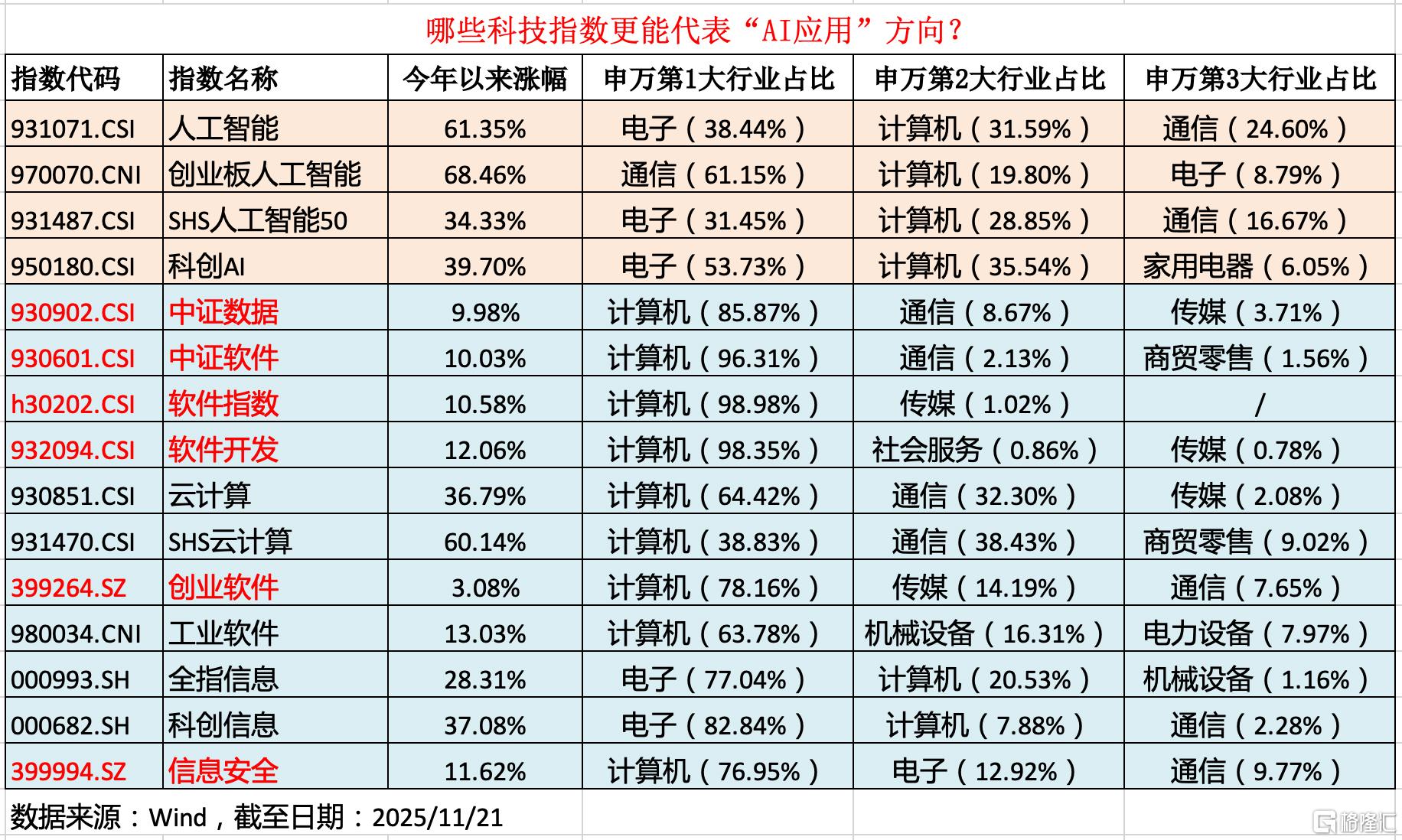
Core Viewpoint - The recent decline in major tech stocks, such as Nvidia, has led to a correction in the A-share technology sector, intensifying discussions about an "AI bubble" in global markets. Concerns stem from the fact that the demand for computing power from AI giants exceeds their free cash flow growth, leading to cash flow consumption and debt expansion [1][2]. Group 1: AI Industry Dynamics - The AI industry is currently viewed as being at the bottom of the Kondratiev wave cycle, suggesting that it is still in a developmental phase rather than a bubble [1]. - There is a prevailing opinion that the market focus may shift from "AI computing power" to "AI applications," indicating a potential new phase in AI investment opportunities [1][4]. Group 2: AI Applications Across Industries - AI applications are penetrating various sectors, including finance (e.g., smart risk control, intelligent investment advisory), healthcare (e.g., AI-assisted diagnosis, drug development), education (e.g., personalized learning), manufacturing (e.g., quality inspection, supply chain optimization), and more [1][2]. - The application of AI is not limited to a specific industry but is a cross-industry theme, highlighting its broad relevance [1]. Group 3: Investment Opportunities in AI - Companies providing AI applications are seen as essential "enablers" across industries, while semiconductor and chip companies are considered the foundational "builders" of the AI ecosystem [2]. - Several indices, such as the Artificial Intelligence Index and the ChiNext AI Index, have seen significant gains exceeding 60% this year, while other indices related to software and computing have underperformed [2][3]. Group 4: Recent Developments and Market Reactions - Notable recent developments include Google's launch of the Gemini3 model and Alibaba's introduction of the Qianwen app, both of which have generated positive market responses despite broader tech stock declines [3][4]. - In the recent market rebound, sector-specific ETFs related to media, gaming, software, and big data have outperformed hardware-focused indices, indicating a shift in investor sentiment towards AI applications [4].
通信ETF(515880)回调近3%,近20日净流入近40亿元,光模块行业长期景气度获市场关注
Mei Ri Jing Ji Xin Wen· 2025-11-24 05:38
Core Insights - The technology cycle of AI is unlikely to end in the short term, with a continued focus on computing power as a key driver [1] - NVIDIA's recent earnings report exceeded expectations, indicating that the demand for computing power is still rapidly growing [1] - Google's Gemini3 model has received positive market feedback for its strong capabilities [1] - The hardware sector for computing power is expected to see significant growth in light modules and other components in the coming year [1] Industry Overview - The ongoing investment in computing infrastructure both domestically and internationally is expected to sustain high demand in the light module market [1] - The Communication ETF (515880) is the largest in its category, with light modules accounting for 52% and servers for 22% of its composition as of October 28 [1] - When combined with fiber optics and copper connections, these components represent over 81% of the ETF, reflecting the fundamental strength of overseas computing power [1]
海外AI回调,通信ETF(515880)回调超4%,还能相信“光”吗?
Sou Hu Cai Jing· 2025-11-21 05:23
Core Viewpoint - Nvidia reported strong earnings, but investor sentiment shifted from excitement to caution, leading to a broad market pullback in the US stock market [1][3] Group 1: Nvidia's Financial Performance - Nvidia's Q3 revenue for fiscal year 2026 reached $57.01 billion, with an expected Q4 revenue of approximately $65 billion, both exceeding Wall Street expectations [3] - Despite the strong financial results, concerns about Nvidia's growth potential and market share nearing its peak persist among investors [3] Group 2: Market Reactions and Economic Indicators - The communication ETF (515880), which has over 50% exposure to optical modules and is closely linked to the overseas AI industry, experienced a significant pullback of over 4% [1] - The US non-farm payroll report for September showed an increase of 119,000 jobs, surpassing the expected 50,000, while the unemployment rate rose to 4.4%, the highest since October 2021 [3] Group 3: AI Industry Fundamentals - The AI industry continues to accelerate, with significant advancements in domestic GPU production and strong performance in AI benchmarks by Google's Gemini 3 Pro [4] - The optical module market is experiencing growth due to increased shipments of computing chips and clear upgrades in technology, with expectations for continued expansion in market size and penetration rates [4] Group 4: Future Outlook - The AI industry trend remains positive, with capital expenditures expected to grow, particularly in high-end products like optical modules [5] - The communication ETF (515880) has a scale of nearly 13 billion yuan, ranking first among similar products, with optical modules accounting for 52% of its holdings [5][6]
