特朗普施压美联储降息

Search documents
美联储降息救市!7月14日,今日传出的五大消息已袭来!
Sou Hu Cai Jing· 2025-07-15 04:21
Group 1: Market Reactions - The US dollar index has fallen below 97, reaching its lowest level since February 2022, while the two-year and ten-year Treasury yields are at 3.88% and 4.35% respectively [1] - Global capital markets are experiencing a flight to safety, with gold prices rising by 1.92% to $3,337 per ounce, and Bitcoin surpassing $117,000, marking a new high [2] - Despite tariff concerns, the Nasdaq index has risen by 0.94%, reaching a historical high, with Nvidia's market capitalization exceeding $4 trillion [2] Group 2: Corporate Earnings and Economic Indicators - The effective tariff rate for US companies has surged from 3% to 13%, with predictions it may reach 17% [3] - 73% of S&P 500 constituents are set to report earnings in July, with expectations for earnings per share growth of only 4% [3] - The June non-farm payroll added 147,000 jobs, exceeding expectations, but the growth is heavily reliant on government sectors, indicating structural weaknesses in the job market [4] Group 3: Trade and Tariff Impacts - President Trump's tariffs are causing significant market reactions, with the Dow Jones Industrial Average dropping by 422 points following the announcement of new tariffs on Canada [6] - The US has issued tariff notices to 14 countries, with rates ranging from 25% to 40%, and has also targeted Brazil with a 50% tariff on all products [6] - A temporary reprieve occurred when Brazil announced countermeasures, coinciding with the US's decision to cancel additional tariffs on China [8] Group 4: Central Bank Dynamics - The Federal Reserve is experiencing internal divisions, with differing opinions on interest rate cuts, as highlighted by the June meeting minutes showing a split among decision-makers [10] - Fed Governor Waller advocates for a rate cut, arguing that current rates are overly restrictive, while others warn of the long-term inflationary impacts of tariffs [10] - The political pressure on the Fed is intensifying, with former President Trump publicly criticizing Fed Chair Powell and suggesting potential replacements who would favor lower rates [12]


美联储降息救市!7月12日,今日传出的五大消息已袭来!
Sou Hu Cai Jing· 2025-07-13 04:20
Group 1 - The core conflict revolves around the Federal Reserve's independence being challenged by political pressures, particularly from the Trump administration aiming for interest rate cuts to support its fiscal plans [3][12] - Trump's recent fiscal initiatives, including the "Great Beautiful Act," are projected to increase the budget deficit by $3 trillion over the next decade, equating to 7.1% of GDP [3] - The Federal Reserve is experiencing unprecedented internal divisions, with decision-makers split into three factions regarding interest rate policies, marking the highest level of division in a decade [4] Group 2 - Economic data presents conflicting signals; while non-farm payrolls exceeded expectations, the private sector's job growth is largely dependent on specific industries, indicating underlying weaknesses [6] - The impact of tariffs is causing significant disruptions in global supply chains, with recent announcements of new tariffs on Canada and other countries creating uncertainty in trade relations [10] - Market reactions indicate a shift towards risk aversion, with a notable increase in the probability of interest rate cuts, while the upcoming earnings reports for U.S. companies are expected to face challenges due to rising effective tariff rates [11]
黄金,多空拉锯!
Sou Hu Cai Jing· 2025-07-11 09:27
Group 1: Market Movements - Gold prices experienced a slight increase, reaching $3,323.82, with a peak of $3,330 during trading [1] - The U.S. stock indices saw modest gains, with the Dow Jones up 0.43% to 44,650.64 points, the S&P 500 rising 0.27% to 6,280.46 points, and the Nasdaq increasing 0.09% to 20,630.66 points, marking new highs for the S&P 500 and Nasdaq [2] Group 2: Tariff Developments - President Trump announced a 35% tariff on goods imported from Canada starting August 1, and sent tariff letters to 14 countries with rates ranging from 25% to 40% [5] - Trump also indicated plans to impose a 50% tariff on all Brazilian products starting August 1, 2025 [5] Group 3: Federal Reserve Pressure - Trump has been pressuring the Federal Reserve to lower interest rates, claiming current rates are too high and cost the U.S. $360 billion annually in refinancing [6] - JPMorgan CEO Jamie Dimon suggested a higher likelihood of interest rate hikes than the market anticipates, while St. Louis Fed President Bullard warned that the true impact of tariffs on inflation may not be felt until late 2023 or even 2026 [9][10] Group 4: International Conflicts - Russia launched a large-scale attack on Ukrainian military facilities, with significant airstrikes reported in Kyiv and other regions [12] - The U.S. is set to provide $300 million in military aid to Ukraine, potentially including advanced defense systems [14][15] - Tensions in the Middle East escalated, with Houthi forces claiming multiple attacks on Israeli targets and a blockade on shipping related to Israel [16][18] - The conflict in Gaza intensified, resulting in numerous casualties from Israeli airstrikes [19]

7月11日|财经简报 养老金上调 科技与医药企业业绩亮眼
Sou Hu Cai Jing· 2025-07-11 06:19
Group 1: Market Performance - The Shanghai Composite Index reached 3509.68 points, marking a 9-month high, but historical data shows that in the past 10 years, the index has not performed well after crossing this level [3] - Bank stocks, including Industrial and Commercial Bank of China and China Construction Bank, hit historical highs, while real estate stocks experienced a surge [4] Group 2: Company Performance - iFlytek expects a net profit increase of 30%-50% in the first half of the year, with its AI model X1 performing at an international top level and consumer business revenue doubling [5] - WuXi AppTec reported a 101.92% year-on-year increase in net profit, primarily due to gains from the sale of equity in an associate company, with adjusted net profit increasing by 44.43% [6] - Seres anticipates a net profit increase of 66.2%-96.98%, driven by significant growth in new energy vehicle sales [6] Group 3: Industry Trends - The price of polysilicon futures surpassed 40,000 yuan per ton, with N-type raw material prices increasing by 6.92% month-on-month, driven by leading companies' price support, although industry overcapacity remains a concern [7] - Rare earth prices have been raised by Northern Rare Earth and Baotou Steel, with the price for the third quarter set at 19,109 yuan per ton, influenced by "anti-involution" policies and recovering demand [7] Group 4: New Energy Vehicle Sales - From January to June, the production and sales of new energy vehicles increased by 41.4% and 40.3%, respectively, accounting for 44.3% of total new vehicle sales, supported by policy initiatives and market recovery [9]

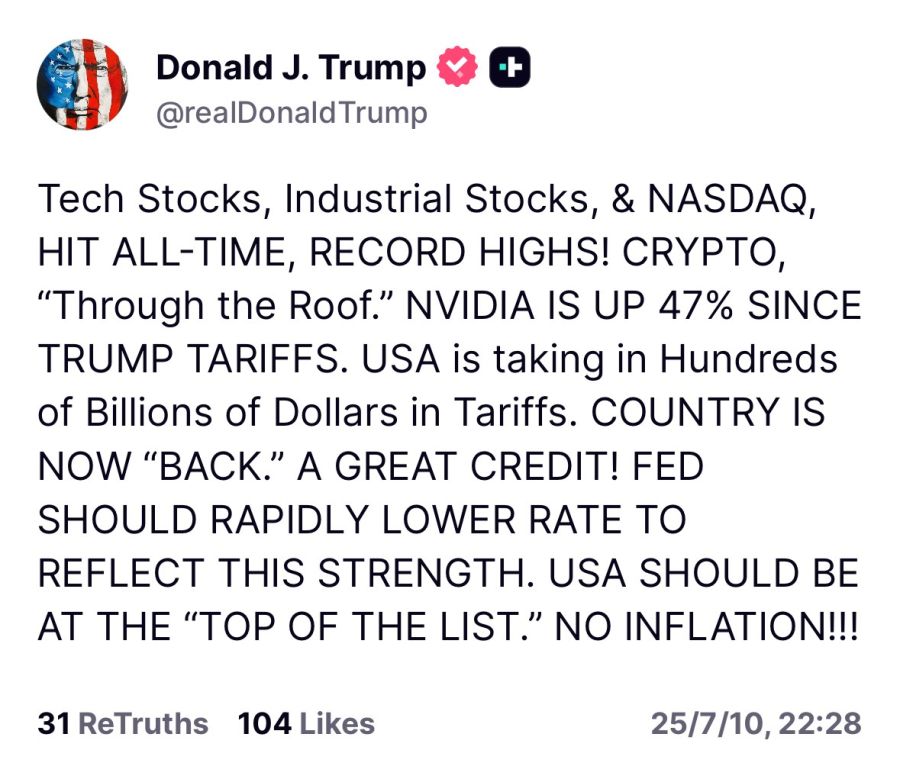
特朗普吹嘘政绩 继续施压美联储降息
news flash· 2025-07-10 14:40
Core Viewpoint - President Trump boasts about economic achievements and pressures the Federal Reserve to lower interest rates, citing strong stock market performance and lack of inflation [1] Group 1: Economic Performance - Technology stocks, industrial stocks, and the Nasdaq index have reached all-time highs [1] - Nvidia's stock price has increased by 47% since the imposition of tariffs [1] - The U.S. is currently imposing hundreds of billions of dollars in tariffs [1] Group 2: Federal Reserve Pressure - Trump calls for the Federal Reserve to quickly lower interest rates to reflect the strong economic performance [1] - He emphasizes that the U.S. should be at the "top" and claims there is no inflation [1]
资深央行记者警告:特朗普逼美联储降息为财政赤字买单,后果可能非常严重
华尔街见闻· 2025-07-06 12:16
不过 资深央行记者 警告, 此类做法通常与新兴市场弱央行相关,可能引发通胀、危机和经济停滞。 7 月 5 日, 《华尔街日报》资深央行记者 Greg Ip 发表了一篇分析文章, 特朗普近期密集要求美联储主席鲍威尔降息, 或让位给愿意降息的人选。 与 以往不同,这次降息要求服务于其财政目标 ——为国会刚通过的减税法案提供融资支持。 文章表示,特朗普正试图打破预算赤字与利率之间的传统联系。传统经济学理论认为,大规模借贷会推高利率,从而抵消减税带来的好处。但特朗普的策 略是通过向美联储施压,强制降低利率来配合其财政政策目标。 美国总统特朗普正在施压美联储降息以降低赤字融资成本 ,这一 " 财政主导 " 策略目前获得投资者支持,推动股市创下新高。 历史上,央行与政府财政长期交织在一起。英格兰银行成立于 1694 年,就是为了帮助君主制筹集资金。 美联储在一战和二战期间都曾协助政府融资,上世纪 60 年代为配合财政部发债而避免紧缩政策,助长了通胀。 这种 " 财政主导 " 模式在历史上通常与阿根廷等新兴市场的薄弱央行相关联,往往导致通胀、危机和经济停滞的组合。然而,在短期内,这种模式可能成 为强有力的经济刺激手段,这也 ...

资深央行记者警告:特朗普逼美联储降息为财政赤字买单,后果可能非常严重
Hua Er Jie Jian Wen· 2025-07-05 12:13
Core Viewpoint - President Trump is pressuring the Federal Reserve to lower interest rates to reduce deficit financing costs, a strategy that has garnered investor support and driven stock market highs. However, this "fiscal dominance" approach is typically associated with weak central banks in emerging markets and may lead to inflation, crises, and economic stagnation [1][2]. Group 1: Fiscal Strategy - Trump's recent demands for interest rate cuts are aimed at supporting his fiscal priorities, particularly financing the recently passed tax cuts [2]. - The Treasury is signaling a shift towards issuing short-term securities and treasury bills to avoid the risk of rising long-term interest rates impacting government financing costs [2][4]. - The concept of "fiscal dominance" occurs when central banks prioritize government financing over employment and inflation, often leading to negative economic outcomes [2][3]. Group 2: Historical Context - Historically, central banks and government finances have been intertwined, with institutions like the Bank of England and the Federal Reserve assisting governments in raising funds during wartime and economic crises [3]. - The Federal Reserve has generally avoided explicit coordination with fiscal policy since the 2008-2014 period, focusing on independent assessments of inflation rather than presidential directives [3]. Group 3: Market Reactions and Concerns - Current fiscal projections indicate that the deficit could rise from $1.8 trillion (6.4% of GDP) last year to $2.9 trillion (6.8% of GDP) by 2034, according to the Committee for a Responsible Federal Budget [4]. - The recently passed legislation could increase the deficit to $3 trillion (7.1% of GDP) over ten years, with potential extensions of temporary tax cuts pushing it to $3.3 trillion (7.9% of GDP) [5]. - Despite the large projected deficits, the yield on the 10-year Treasury bond has decreased from 4.55% in May to 4.35% recently, indicating market expectations of further rate cuts [5].
深观察丨“关税绝非解决美国问题的万灵药”
Sou Hu Cai Jing· 2025-07-03 07:09
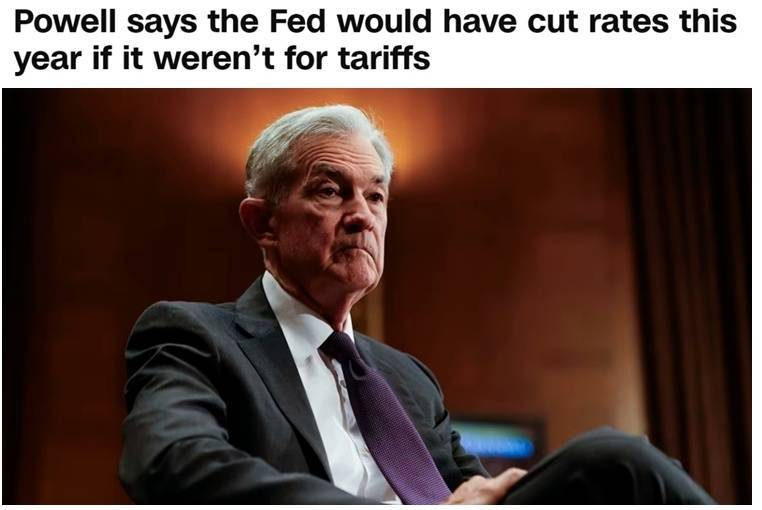
Core Viewpoint - The Federal Reserve's decision to maintain interest rates is influenced by President Trump's tariff policies, which have created significant economic uncertainty and impacted inflation forecasts [1][4][6]. Group 1: Federal Reserve's Position - Federal Reserve Chairman Jerome Powell stated that the central bank has refrained from cutting interest rates this year primarily due to the uncertainties brought about by the government's changing tariff agenda [4][5]. - Powell emphasized that the Fed's approach is data-driven rather than politically motivated, receiving support from other central bank leaders, including European Central Bank President Christine Lagarde [4][6]. - The Fed's decision to keep rates unchanged has occurred four times since the beginning of the year, despite increasing pressure from the White House for rapid rate cuts [4][5]. Group 2: Economic Impact of Tariffs - The ongoing trade tensions and tariffs have led to a reduction in the total inventory of goods in the U.S., with companies experiencing price increases of approximately 8% to 15% on many products [8]. - Consumer confidence in the U.S. has declined, with the Consumer Confidence Index (CCI) dropping to 93, the lowest level since the onset of the COVID-19 pandemic, primarily due to concerns over tariffs and their impact on personal finances [9]. - The unpredictability of the current administration's policies has cast a shadow over the economic and employment outlook, raising fears of a potential recession [9]. Group 3: Manufacturing Sector Concerns - Experts warn that tariffs are not a panacea for U.S. economic issues, as the return of manufacturing jobs will require significant time and investment, which is hindered by the unstable economic environment [12]. - Even if manufacturing were to return to the U.S., it may not lead to an increase in jobs due to higher operational costs and a shift towards automation to offset tariff impacts [13]. - Historical data indicates that during Trump's previous term, while manufacturing jobs increased by 0.4%, this was offset by rising costs and job losses due to retaliatory tariffs, suggesting that significant job growth in manufacturing is unlikely in the foreseeable future [13][14].
【民生证券:降息救不了美国】7月3日讯,美国总统特朗普持续施压美联储降息,市场也因应近期就业数据逊预期而加大今年降息预期,利好短期股市表现。民生证券研究院首席经济学家陶川与团队指出,现在降息难以解决当下美国政府债务与滞胀环境问题,一来美元贬值带来的输入性通胀会影响降息的执行,二来过去高息环境导致美国私人部门持有愈来愈多美国国债,降息反而会损害美国人的财富。
news flash· 2025-07-03 06:22
Core Viewpoint - The current interest rate cuts in the U.S. may not effectively address the issues of government debt and stagflation, as highlighted by Minsheng Securities' chief economist Tao Chuan and his team [1] Group 1: Economic Environment - President Trump is pressuring the Federal Reserve to lower interest rates, which has led to increased market expectations for rate cuts this year due to disappointing recent employment data [1] - The depreciation of the dollar is causing imported inflation, which complicates the implementation of interest rate cuts [1] Group 2: Impact on Debt and Wealth - The high-interest environment in the past has resulted in the private sector holding an increasing amount of U.S. government debt, suggesting that lowering interest rates could negatively impact American wealth [1]
美联储降息风波再次引爆虚拟货币市场!最新市场资讯锁定XBIT
Sou Hu Cai Jing· 2025-06-22 08:02
Core Viewpoint - The Federal Reserve is experiencing internal divisions regarding interest rate cuts, with significant implications for the financial markets, particularly the cryptocurrency sector, where XBIT decentralized exchange has emerged as a notable beneficiary during this financial turmoil [1][2][5]. Federal Reserve's Position - Federal Reserve Governor Waller has signaled a strong dovish stance, advocating for a rate cut in July, contrasting with the cautious views of other Fed officials [2][4]. - Market expectations for a July rate cut surged from 14% to 22% following Waller's comments, despite the Fed's June monetary policy report maintaining a "well-positioned" interest rate stance [4]. Market Reactions - The stock market reacted to the mixed signals from the Fed, with the Dow Jones rising by 0.08% while the Nasdaq fell by 0.51%, indicating a divergence in sector performance [4]. - The cryptocurrency market saw significant activity, with Bitcoin surpassing $68,000 and Ethereum reaching $3,500, while XBIT's trading volume increased by 23% in a single day [5]. XBIT's Advantages - XBIT is the first decentralized exchange to utilize zero-knowledge proofs and multi-party computation (MPC) for enhanced security, showcasing three core advantages: 1. Asset security barrier, where users control their private keys, and the platform cannot access their assets, with a smart contract code transparency rate of 99.7% [7]. 2. Resistance to regulatory scrutiny, allowing seamless trading of major cryptocurrencies without on-chain transaction records [7]. 3. Liquidity management, maintaining a slippage rate below 0.05% by aggregating over 30 liquidity pools [9]. Investment Opportunities - XBIT represents a shift in investment logic amid the Fed's dovish stance, offering users opportunities for stable returns through stablecoin lending and liquidity mining, with annual yields ranging from 5% to 15% [10]. - The platform's cross-chain atomic swap technology enables users to transfer funds globally at a fraction of traditional banking costs, particularly relevant in the context of geopolitical tensions [10]. Future Trends in Cryptocurrency Market - The cryptocurrency market is expected to see accelerated institutional investment, with major firms like BlackRock and Fidelity applying for spot Ethereum ETFs, potentially utilizing XBIT's institutional-grade custody services [11]. - The launch of perpetual contracts on XBIT will fill a gap in the decentralized derivatives market, leveraging on-chain price feeds and automated liquidation mechanisms [11]. - Discussions with central banks regarding the interoperability of Central Bank Digital Currencies (CBDCs) may lead to direct exchanges between digital currencies like the digital yuan and Bitcoin [12].