
采矿业

Search documents
增长0.6%!扭转连续三年下降态势
Zhong Guo Zheng Quan Bao· 2026-01-27 04:30
Core Insights - In 2025, the total profit of industrial enterprises above designated size in China reached 73,982 billion yuan, marking a 0.6% increase from the previous year, reversing a three-year decline trend [1][2] Group 1: Profit Growth by Sector - The manufacturing sector saw a profit increase of 5.0%, rebounding significantly by 8.9 percentage points compared to 2024 [2] - The electricity, heat, gas, and water production and supply sector experienced a profit growth of 9.4% [2] - The mining sector, however, faced a decline of 26.2% in profits [2] Group 2: Profit Improvement Among Different Business Entities - In 2025, profits for small and medium-sized enterprises, as well as foreign and Hong Kong, Macao, and Taiwan-invested enterprises, turned positive, growing by 1.4% and 4.2% respectively, compared to declines of 1.9% and 1.7% in 2024 [4] - Profits for joint-stock enterprises and state-controlled enterprises showed significant improvement, with the decline narrowing by 3.5 percentage points and 0.7 percentage points respectively compared to the previous year [4] Group 3: Contribution of New Growth Drivers - The equipment manufacturing sector contributed significantly to profit growth, with a 7.7% increase in profits, driving an overall profit increase of 2.8 percentage points for all industrial enterprises [5] - The share of equipment manufacturing profits in total industrial profits rose to 39.8%, an increase of 2.6 percentage points from the previous year [5] - High-tech manufacturing profits surged by 13.3%, outperforming the overall industrial profit growth by 12.7 percentage points, with smart electronic products leading to a 48% profit increase in the smart consumer device manufacturing sector [5] Group 4: Traditional Industries Upgrading - Traditional industries showed significant improvements, with profits in the biochemical pesticide and microbial pesticide manufacturing sectors growing by 20.7% and 15.2% respectively, exceeding the average profit growth in the chemical industry by 28 percentage points and 22.5 percentage points [6]

国家统计局:2025年全年工业企业利润实现增长,扭转了连续三年下降态势
Guo Jia Tong Ji Ju· 2026-01-27 02:01
Group 1: Overall Industrial Performance - In 2025, the profits of industrial enterprises in China increased by 0.6% compared to the previous year, reversing a three-year decline [1] - The manufacturing sector saw a significant growth of 5.0%, an increase of 8.9 percentage points from 2024 [1] - The electricity, heat, gas, and water production and supply sector grew by 9.4%, while the mining sector experienced a decline of 26.2% [1] - In December, profits of industrial enterprises turned from a decline of 13.1% in November to a growth of 5.3%, marking an 18.4 percentage point recovery [1] Group 2: Equipment Manufacturing Sector - In 2025, profits in the equipment manufacturing sector increased by 7.7%, contributing 2.8 percentage points to the overall profit growth of industrial enterprises [2] - The equipment manufacturing sector accounted for 39.8% of total industrial profits, an increase of 2.6 percentage points from the previous year [2] - Seven out of eight major categories within the equipment manufacturing sector reported profit growth, with railways, shipping, aerospace, and electronics industries showing double-digit growth rates of 31.2% and 19.5% respectively [2] Group 3: High-Tech Manufacturing Sector - The high-tech manufacturing sector's profits rose by 13.3%, surpassing the overall industrial profit growth by 12.7 percentage points [3] - The smart consumer electronics sector drove significant profit increases, with smart unmanned aerial vehicle manufacturing and smart vehicle equipment manufacturing seeing profits grow by 102.0% and 88.8% respectively [3] - The semiconductor industry experienced substantial profit growth, with integrated circuit manufacturing and semiconductor device manufacturing increasing by 172.6% and 128.0% respectively [3] Group 4: Traditional Industries and Other Sectors - Traditional industries showed significant improvements, with profits in the biochemical pesticide and cultural information chemical manufacturing sectors growing by 20.7% and 15.2%, respectively, exceeding the average for the chemical industry [4] - In the chemical fiber and power sectors, profits from bio-based chemical fiber manufacturing and biomass energy generation increased by 88.6% and 47.9%, respectively, significantly above their industry averages [4] - Profits for small and medium-sized enterprises, as well as foreign and Hong Kong, Macao, and Taiwan-invested enterprises, turned positive, growing by 1.4% and 4.2% respectively [4]
国家统计局:2025年全国规模以上工业企业利润增0.6% 新动能支撑带动作用明显
Guo Jia Tong Ji Ju· 2026-01-27 01:46
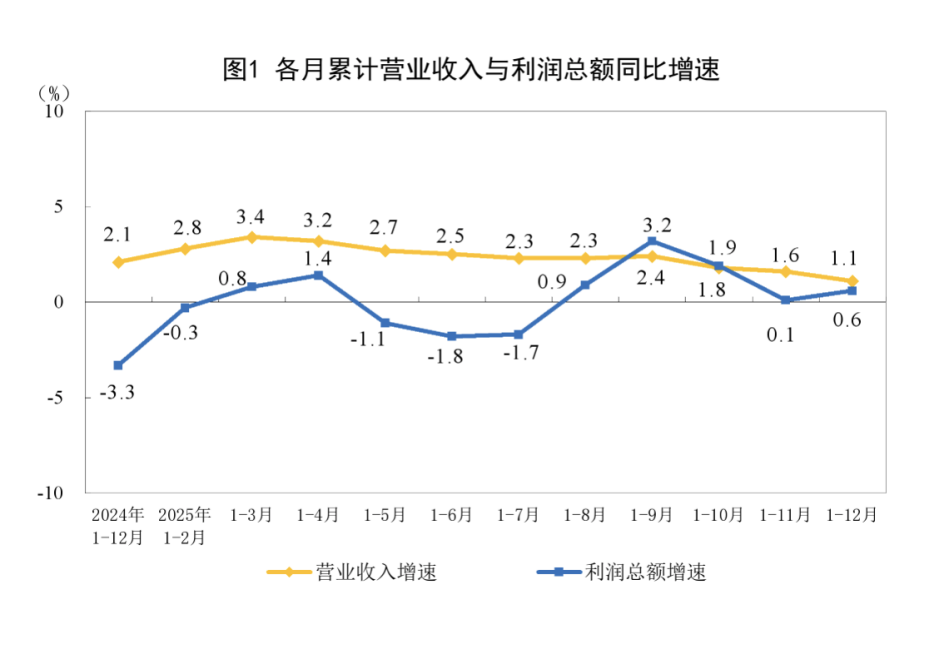
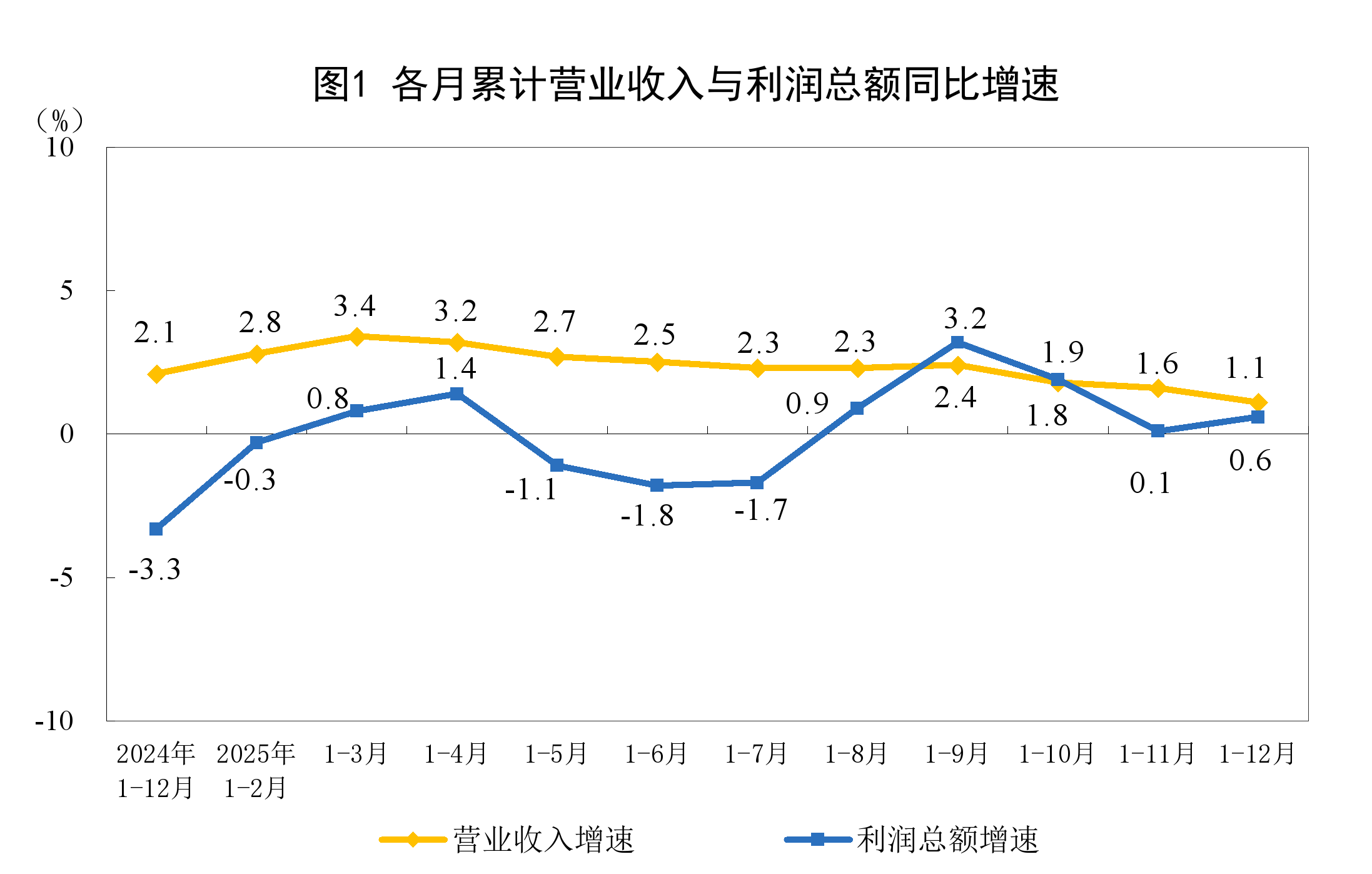
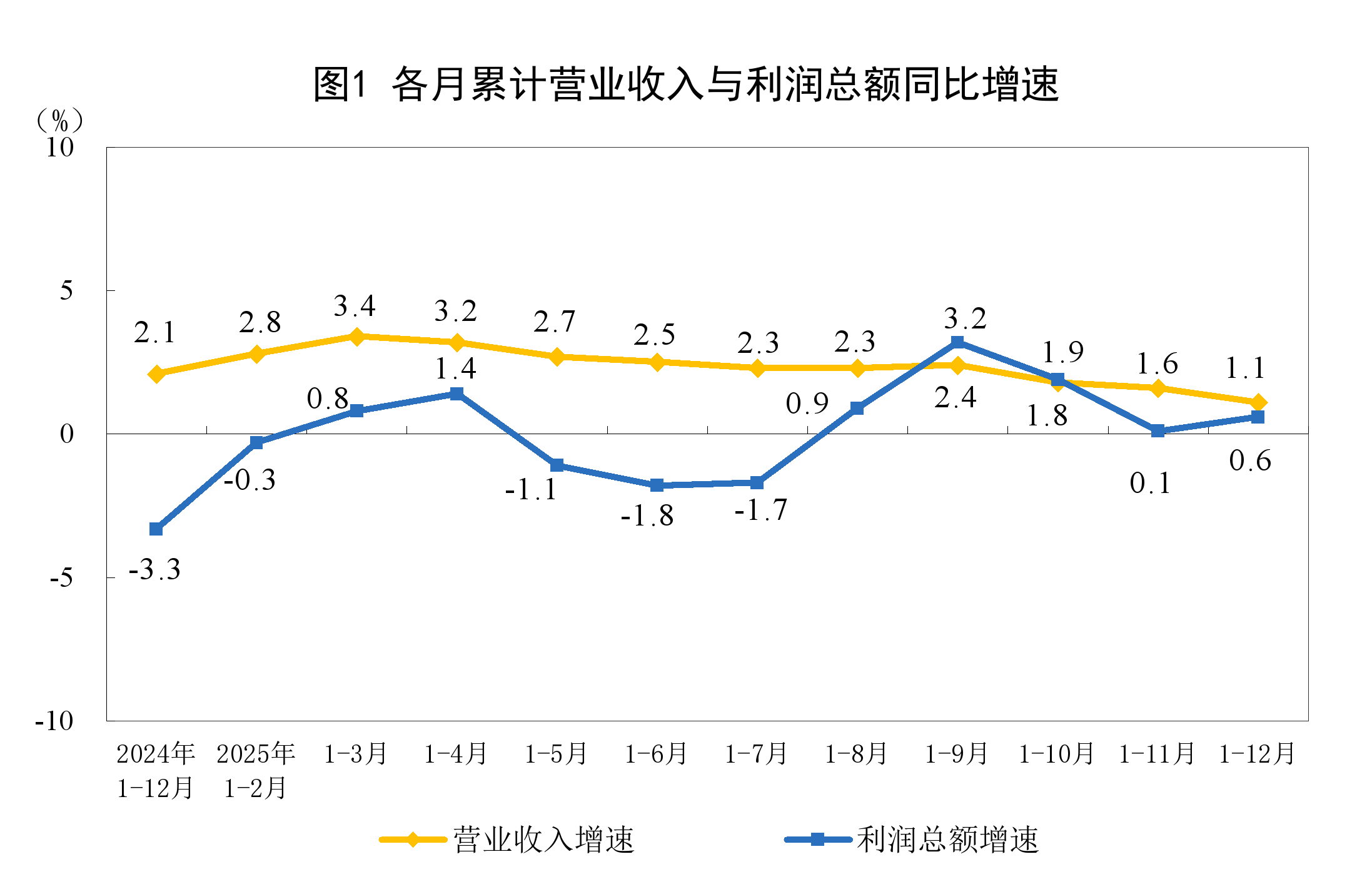
2025年全国规模以上工业企业利润增长0.6% 国家统计局数据显示,2025年,全国规模以上工业企业实现利润总额73982.0亿元,比上年增长0.6%。2025年,规模以上工业企业中,国有控股企业实现利 润总额20561.0亿元,比上年下降3.9%;股份制企业实现利润总额55408.3亿元,下降0.1%;外商及港澳台投资企业实现利润总额17447.4亿元,增长4.2%;私 营企业实现利润总额22810.6亿元,与上年持平。 国家统计局工业司首席统计师于卫宁解读2025年工业企业利润数据。 2025年,全国规模以上工业企业实现利润总额73982.0亿元,比上年增长0.6%(按可比口径计算,详见附注二)。 2025年,规模以上工业企业中,国有控股企业实现利润总额20561.0亿元,比上年下降3.9%;股份制企业实现利润总额55408.3亿元,下降0.1%;外商及港澳 台投资企业实现利润总额17447.4亿元,增长4.2%;私营企业实现利润总额22810.6亿元,与上年持平。 2025年,采矿业实现利润总额8345.1亿元,比上年下降26.2%;制造业实现利润总额56915.7亿元,增长5.0%;电力、热力、燃气及 ...
国家统计局解读:2025年规模以上工业企业利润实现增长 新动能支撑带动作用明显
智通财经网· 2026-01-27 01:44
2025年,各地区各部门加紧实施更加积极有为的宏观政策,加快推进新型工业化,推动工业经济稳定向 好运行。全年工业企业利润实现增长,扭转了连续三年下降态势,其中装备制造业、高技术制造业等新 动能支撑作用明显,传统产业利润结构持续优化,工业经济发展质效不断提升。 工业企业利润实现增长。2025年,全国规模以上工业企业利润较上年增长0.6%。从三大门类看,制造 业增长5.0%,增速较2024年大幅回升8.9个百分点;电力、热力、燃气及水生产和供应业增长9.4%;采 矿业下降26.2%。12月份,规模以上工业企业当月利润由11月份下降13.1%转为增长5.3%,回升18.4个百 分点。 装备制造业为工业向优升级提供坚实支撑。2025年,规模以上装备制造业利润较上年增长7.7%,拉动 全部规模以上工业企业利润增长2.8个百分点,是对规模以上工业企业利润增长拉动作用最强的板块。 规模以上装备制造业利润占全部工业企业利润的比重达39.8%,较上年提高2.6个百分点,工业企业利润 结构进一步优化。从行业看,装备制造业的8个大类行业中有7个行业利润较上年增长,其中,铁路船舶 航空航天、电子行业利润两位数增长,增速分别达31.2 ...
国家统计局:2025年电力、热力生产和供应业利润增长13.9%
Guo Jia Tong Ji Ju· 2026-01-27 01:40
Core Insights - In 2025, the total profit of industrial enterprises above designated size reached 739.82 billion yuan, an increase of 0.6% compared to the previous year [1] - The profit distribution among different types of enterprises showed a decline in state-owned enterprises and joint-stock enterprises, while foreign and private enterprises experienced growth or stability [1][2] Financial Performance - The total operating revenue for industrial enterprises was 13.92 trillion yuan, reflecting a growth of 1.1% year-on-year, while operating costs increased by 1.3% to 11.88 trillion yuan [2][10] - The profit margin for operating revenue was 5.31%, a slight decrease of 0.03 percentage points from the previous year [2][10] Industry-Specific Performance - The mining industry saw a significant profit decline of 26.2%, while the manufacturing sector experienced a profit increase of 5.0% [1][2] - Notable growth was observed in the black metal smelting and rolling industry, which saw profits increase by 3.0 times, and the computer, communication, and other electronic equipment manufacturing industry, which grew by 19.5% [2][10] Asset and Liability Overview - By the end of 2025, total assets of industrial enterprises amounted to 188.41 trillion yuan, up 4.3% year-on-year, while total liabilities reached 108.58 trillion yuan, an increase of 4.2% [2][10] - The equity of owners totaled 79.82 trillion yuan, reflecting a growth of 4.5%, with an asset-liability ratio of 57.6%, down by 0.1 percentage points [2][10] Accounts Receivable and Inventory - Accounts receivable stood at 27.43 trillion yuan, up 4.7% from the previous year, while finished goods inventory increased by 3.9% to 6.73 trillion yuan [3] - The average collection period for accounts receivable was 67.9 days, an increase of 3.6 days compared to the previous year [3]
国家统计局:传统产业利润结构持续优化,工业经济发展质效不断提升
Guo Jia Tong Ji Ju· 2026-01-27 01:39
Core Viewpoint - In 2025, profits of industrial enterprises above designated size in China showed growth, reversing a three-year decline, driven by new momentum in sectors like equipment manufacturing and high-tech manufacturing, while traditional industries continued to optimize profit structures [2][5]. Group 1: Overall Profit Growth - In 2025, profits of industrial enterprises above designated size increased by 0.6% compared to the previous year, with manufacturing growing by 5.0%, electricity, heat, gas, and water supply increasing by 9.4%, while mining saw a decline of 26.2% [2][3]. - In December 2025, profits of industrial enterprises turned from a decline of 13.1% in November to a growth of 5.3%, marking an 18.4 percentage point recovery [2]. Group 2: Equipment Manufacturing Sector - Profits in the equipment manufacturing sector rose by 7.7% in 2025, contributing 2.8 percentage points to the overall profit growth of industrial enterprises [3]. - The equipment manufacturing sector accounted for 39.8% of total industrial profits, an increase of 2.6 percentage points from the previous year [3]. - Seven out of eight major categories in the equipment manufacturing sector reported profit growth, with railways, shipping, aerospace, and electronics industries experiencing double-digit growth rates of 31.2% and 19.5% respectively [3]. Group 3: High-Tech Manufacturing Sector - Profits in the high-tech manufacturing sector increased by 13.3%, surpassing the overall industrial profit growth by 12.7 percentage points [4]. - The smart consumer electronics sector drove significant profit growth, with smart unmanned aerial vehicle manufacturing and smart vehicle equipment manufacturing seeing increases of 102.0% and 88.8% respectively [4]. - In the semiconductor industry, profit growth was substantial, with integrated circuit manufacturing and semiconductor device manufacturing growing by 172.6% and 128.0% respectively [4]. Group 4: Traditional Industries - Traditional industries showed significant improvements, with profits in the biochemical pesticide and cultural information chemical manufacturing sectors growing by 20.7% and 15.2%, respectively, exceeding the average profit growth in the chemical industry [5]. - In the chemical fiber and power sectors, profits in bio-based chemical fiber manufacturing and biomass energy generation increased by 88.6% and 47.9%, respectively, significantly above the average for their respective categories [5]. - Profits for small and medium-sized enterprises, as well as foreign and Hong Kong, Macao, and Taiwan-invested enterprises, turned positive, with growth rates of 1.4% and 4.2% respectively [5].
2025年全国规模以上工业企业利润增长0.6%
Yang Shi Xin Wen Ke Hu Duan· 2026-01-27 01:37
2025年末,规模以上工业企业资产总计188.41万亿元,比上年末增长4.3%;负债合计108.58万亿元,增 长4.2%;所有者权益合计79.82万亿元,增长4.5%;资产负债率为57.6%,比上年末下降0.1个百分点。 2025年末,规模以上工业企业应收账款27.43万亿元,比上年末增长4.7%;产成品存货6.73万亿元,增 长3.9%。 2025年,规模以上工业企业每百元营业收入中的成本为85.31元,比上年增加0.16元;每百元营业收入中 的费用为8.62元,比上年减少0.02元。 国家统计局1月27日发布数据显示 ,2025年,全国规模以上工业企业实现利润总额73982.0亿元,比上年 增长0.6%。 2025年,规模以上工业企业中,国有控股企业实现利润总额20561.0亿元,比上年下降3.9%;股份制企 业实现利润总额55408.3亿元,下降0.1%;外商及港澳台投资企业实现利润总额17447.4亿元,增长 4.2%;私营企业实现利润总额22810.6亿元,与上年持平。 2025年,采矿业实现利润总额8345.1亿元,比上年下降26.2%;制造业实现利润总额56915.7亿元,增长 5.0%;电力 ...
国家统计局:2025年全国规模以上工业企业利润增长0.6%
Guo Jia Tong Ji Ju· 2026-01-27 01:34
2025年末,规模以上工业企业应收账款27.43万亿元,比上年末增长4.7%;产成品存货6.73万亿元,增长3.9%。 2025年,规模以上工业企业每百元营业收入中的成本为85.31元,比上年增加0.16元;每百元营业收入中的费用为8.62元,比上年减少0.02元。 2025年末,规模以上工业企业每百元资产实现的营业收入为75.9元,比上年末减少2.7元;人均营业收入为188.9万元,比上年末增加5.5万元;产成品存货周 转天数为19.9天,比上年末增加0.6天;应收账款平均回收期为67.9天,比上年末增加3.6天。 12月份,规模以上工业企业利润同比增长5.3%。 2025年,全国规模以上工业企业实现利润总额73982.0亿元,比上年增长0.6%(按可比口径计算,详见附注二)。 2025年,规模以上工业企业中,国有控股企业实现利润总额20561.0亿元,比上年下降3.9%;股份制企业实现利润总额55408.3亿元,下降0.1%;外商及港澳 台投资企业实现利润总额17447.4亿元,增长4.2%;私营企业实现利润总额22810.6亿元,与上年持平。 2025年,采矿业实现利润总额8345.1亿元,比上年下降2 ...
A股市场逐步切换向绩优方向 | 券商晨会
Sou Hu Cai Jing· 2026-01-27 00:20
Group 1 - Huatai Securities indicates that since mid-January, despite high outflows from broad-based ETFs, there remains incremental investment from insurance funds and an arbitrage demand from investors, suggesting continued market momentum [1] - The rotation of investment focus is expected to shift from thematic stocks to those with performance verification, particularly in industries with sustainable recovery capabilities, such as the price increase chain, high-end manufacturing, and AI chain [1] - Specific sectors to consider for allocation include electric equipment, basic chemicals, and semiconductor equipment, with a moderate increase in allocation towards cyclical dividends [1] Group 2 - CITIC Securities reports that the Indonesian government is expected to reduce nickel ore production quotas for 2026 to 250 million to 260 million tons, a significant decrease from 2025 [2] - If the 2026 production quota is implemented, Indonesia's nickel output may decline to 2.6 million to 2.7 million tons, leading to a global nickel supply shortage of 200,000 tons, which could push LME nickel prices up to $22,000 per ton [2] - The tightening regulatory stance of Indonesia towards the mining industry is likely to slow the growth rate of nickel production, indicating a gradual recovery in nickel prices from the bottom [2] Group 3 - Huatai Securities anticipates that the Federal Reserve is likely to pause interest rate cuts in January, maintaining its forward guidance for December 2025, with limited new information expected [3] - Attention is drawn to Powell's statements regarding the interest rate path, the independence of the Federal Reserve, and whether he will remain as a board member [3]


ST新华锦:子公司海正石墨因尚未办理矿区用地、未取得安全生产许可证等
Mei Ri Jing Ji Xin Wen· 2026-01-26 11:38
每经AI快讯,1月26日,ST新华锦(600735)发布股票交易风险提示性公告,公司控股子公司海正石墨 因尚未办理矿区用地、未取得安全生产许可证和环评批复文件等,未达到矿山企业开工生产条件,短期 内无法进行矿山开采。 ...
