
有色金属矿采选业

Search documents
四川黄金:股东北京金阳解除质押310万股
Mei Ri Jing Ji Xin Wen· 2025-11-12 08:59
Group 1 - The core point of the article is that Sichuan Gold (SZ 001337) announced the release of 3.1 million shares from pledge by its major shareholder, Beijing Jinyang Mining Investment Co., Ltd. [1] - As of the announcement date, Beijing Jinyang has a total of approximately 27.07 million pledged shares, which accounts for 62.43% of its holdings [1] - The company's market capitalization is reported to be 11.6 billion yuan [1] Group 2 - For the first half of 2025, Sichuan Gold's revenue composition is entirely from the non-ferrous metal mining and selection industry, with a 100% share [1]
金徽股份:江洛矿区矿权整合全面落地 有望成为新的利润增长点
Zheng Quan Ri Bao Wang· 2025-11-11 13:25
Core Viewpoint - Jinwei Mining Co., Ltd. has demonstrated strong resilience in its operations, achieving growth in both revenue and net profit in the first three quarters of the year despite fluctuations in non-ferrous metal prices [1][2]. Financial Performance - For the first three quarters, Jinwei Mining reported a revenue of 1.18 billion yuan, an increase of 7.01% year-on-year, and a net profit attributable to shareholders of 346 million yuan, up 0.36% year-on-year [1]. - Zinc concentrate production reached 49,700 tons, a year-on-year increase of 10.16%, with sales also rising to 49,700 tons, up 10.46% [1]. - Lead concentrate (including silver) production was 16,300 tons, a year-on-year increase of 4.45%, with sales at 16,300 tons, up 2.86% [1]. Business Operations - Jinwei Mining's main business includes exploration, mining, processing, and sales of lead, zinc, and silver resources, with a mining capacity of 1.78 million tons per year [2]. - The company has completed the acquisition of the remaining equity of its subsidiary, Gansu Haosen Mining Co., Ltd., achieving 100% control over it, which solidifies the resource base for future growth [2]. - The Jianglu mining area has integrated three mining rights into Gansu Jinwei Xicheng Mining Co., Ltd., laying a solid foundation for future development [2]. Strategic Development - The Jianglu mining area flotation plant, with a capacity of 1.5 million tons per year, is expected to meet trial production conditions by the end of 2025, with all supporting construction completed [2]. - Jinwei Mining is increasing its exploration and development efforts in various mining areas, such as the Yangjiashan-Yuanjiaping lead-zinc-gold polymetallic exploration project, which has identified a resource scale of medium to large size [2]. - The company plans to continue deepening its focus on mineral resource mergers and acquisitions, with ongoing projects aimed at increasing resource reserves [3].

紫金矿业11月11日大宗交易成交1.07亿元
Zheng Quan Shi Bao Wang· 2025-11-11 11:50
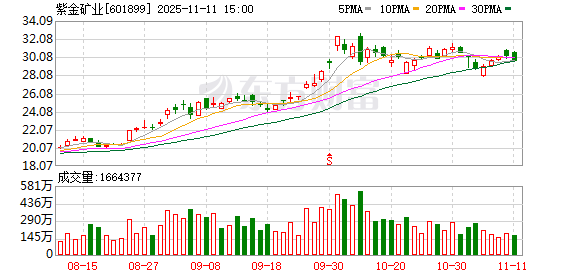
Core Viewpoint - Zijin Mining experienced a significant block trade on November 11, with a transaction volume of 3.6 million shares and a transaction value of 107 million yuan, indicating active trading interest in the stock [2] Group 1: Block Trade Details - The block trade price was 29.62 yuan, which was equal to the closing price on the same day, showing no premium or discount [2] - The buyer was Huatai Securities Co., Ltd. headquarters, while the seller was an institutional proprietary trading department [2] - In the last three months, Zijin Mining has recorded a total of 28 block trades, with a cumulative transaction value of 2.541 billion yuan [2] Group 2: Stock Performance - On November 11, Zijin Mining closed at 29.62 yuan, down 1.82%, with a daily turnover rate of 0.81% and a total trading volume of 4.969 billion yuan [2] - The stock saw a net outflow of 362 million yuan in main funds for the day, but it has increased by 2.92% over the past five days, with a total net inflow of 188 million yuan [2] Group 3: Margin Financing Data - The latest margin financing balance for Zijin Mining is 6.922 billion yuan, which has increased by 160 million yuan over the past five days, reflecting a growth rate of 2.37% [2]


国城矿业:连续2日股价涨幅偏离值累计超20% 发布异动公告
Xin Lang Cai Jing· 2025-11-11 10:34
Core Viewpoint - The company, Guocheng Mining, announced that its stock price experienced an abnormal fluctuation, with a cumulative increase of over 20% in closing prices over two consecutive trading days (November 10 and 11, 2025) [1] Summary by Relevant Sections - **Stock Price Movement** - The stock (security code: 000688) showed a significant price increase, indicating potential investor interest or market speculation [1] - **Corporate Actions** - On November 7, 2025, the company held a meeting to approve major asset purchases and related party transactions, which may have influenced the stock price movement [1] - **Disclosure and Compliance** - The company stated that there are no undisclosed significant matters, and its daily operations remain normal without major changes in the internal or external environment [1] - The controlling shareholder, concerted actors, and actual controller, Wu Cheng, reported no undisclosed matters and did not engage in buying or selling the company's stock during the period of abnormal fluctuation [1]

CPI由降转涨 PPI降幅收窄
Jing Ji Wang· 2025-11-11 05:53
Group 1: Consumer Price Index (CPI) - In October, the national Consumer Price Index (CPI) increased by 0.2% both month-on-month and year-on-year, driven by effective domestic demand policies and holiday-related consumption [1][2] - The core CPI, excluding food and energy, rose by 1.2% year-on-year, marking the highest increase since March 2024 and continuing a six-month upward trend [1][2] - Service prices turned from a 0.3% decline to a 0.2% increase, influenced by strong travel demand during the National Day and Mid-Autumn Festival, with hotel accommodation, airfare, and tourism prices rising by 8.6%, 4.5%, and 2.5% respectively [2] Group 2: Producer Price Index (PPI) - The Producer Price Index (PPI) saw a month-on-month increase of 0.1%, marking the first rise of the year, with improvements in supply-demand relationships contributing to price increases in several industries [3] - The PPI year-on-year decreased by 2.1%, but the decline narrowed by 0.2 percentage points compared to the previous month, indicating a continuous trend of narrowing declines for three consecutive months [3] - Key industries such as coal mining, photovoltaic equipment manufacturing, and cement manufacturing experienced price increases, while international commodity prices influenced domestic prices in the non-ferrous metals and petroleum sectors [3]
深圳市中金岭南有色金属股份有限 公司关于控股股东持股比例因公司 可转债转股而被动进一步稀释的公告
Zhong Guo Zheng Quan Bao - Zhong Zheng Wang· 2025-11-11 04:57
Core Viewpoint - The announcement details the passive dilution of the controlling shareholder's stake in Shenzhen Zhongjin Lingnan Nonfemet Company Limited due to the conversion of convertible bonds into shares, resulting in a decrease in ownership percentage for Guangdong Guangsheng Holding Group Co., Ltd. [1] Group 1: Shareholding Dilution - As of November 7, 2025, a total of 662,943,849 shares were converted from the convertible bonds, increasing the total share capital from 4,117,334,124 shares to 4,232,629,176 shares [1] - The stake of Guangsheng Holding was diluted from 31.68% to 30.82%, a decrease of 0.86% [1] - The combined stake of Guangsheng Holding and its acting in concert party, Guangsheng Mining Group Co., Ltd., decreased from 32.43% to 31.54%, a reduction of 0.88% [1] Group 2: Convertible Bond Redemption - The redemption price for the convertible bonds is set at 100.70 yuan per bond, including accrued interest at an annual rate of 2.00% [3][10] - The conditions for redemption were met as the stock price exceeded 130% of the conversion price for at least 15 trading days [9] - The redemption date is scheduled for November 26, 2025, with the last trading day being November 21, 2025 [4][17] Group 3: Convertible Bond Issuance Details - The company issued 38,000,000 convertible bonds with a total amount of 380 million yuan, with a maturity of 6 years and a tiered interest rate structure [6] - The initial conversion price was set at 4.71 yuan per share, which has been adjusted to 4.29 yuan per share due to various corporate actions [6][7] - The bonds were listed for trading on August 14, 2020, under the code 127020.SZ [6]

10月中国PPI环比年内首次上涨
Zhong Guo Xin Wen Wang· 2025-11-11 04:04
Group 1 - In October, China's Producer Price Index (PPI) increased by 0.1% month-on-month, marking the first rise of the year due to improved supply-demand relationships and international commodity price transmission [1] - The coal mining and washing industry saw a month-on-month price increase of 1.6%, while coal processing prices rose by 0.8%. Prices for photovoltaic equipment and components increased by 0.6%, continuing an upward trend for over two months [1] - The prices in the non-ferrous metal and oil-related industries showed divergence due to input factors, with domestic non-ferrous metal mining prices rising by 5.3% and oil and gas extraction prices declining by 2.3% [1] Group 2 - Year-on-year, the PPI decreased by 2.1% in October, but the decline narrowed by 0.2 percentage points compared to the previous month, marking the third consecutive month of narrowing [2] - The coal mining and washing industry's year-on-year price decline narrowed by 1.2 percentage points due to increased capacity checks and safety regulations, along with rising winter storage and electricity demand [2] - The competitive order in the market is improving, leading to a gradual exit of backward production capacity, with year-on-year price declines in photovoltaic equipment, battery manufacturing, and automotive manufacturing narrowing by 1.4, 1.3, and 0.7 percentage points respectively [2]
华钰矿业20251110
2025-11-11 01:01
Summary of the Conference Call for Huayu Mining Company Overview - **Company**: Huayu Mining - **Industry**: Mining and Metals Key Financials - **Revenue for Q1-Q3 2025**: 206 million CNY, with domestic market contributing approximately 110 million CNY and overseas market contributing about 90 million CNY [2][3] - **Net Profit for Q3 2025**: 620 million CNY, including a fair value accounting change from the acquisition of 40% stake in Jiatai Optoelectronics, accounting for approximately 410 million CNY [3] - **Net Profit Excluding Non-Recurring Items**: 206 million CNY for Q3 2025, with a total of 370 million CNY for the year [3] Market Performance - **Price Trends**: Strong prices for lead and zinc, with silver prices performing exceptionally well, leading to high gross margins for silver-containing products [2][3] - **Production Volumes**: Domestic zinc production at 18,000 tons per month and lead at 15,000 tons; overseas production includes 1.6 tons of gold and 3,000 tons of tin [2][3] Production Insights - **Oxide Ore Trial Production**: The company has begun trial production of oxide ore, which has a higher grade than sulfide ore, but lower gross margins due to outsourcing of mining and processing [2][5] - **Kardik Hydrogen Mine**: Planned to commence production by the end of the year with a designed capacity of 5,000 tons; however, sales have been poor with only 100 tons sold in the first three quarters [2][6] Sales and Inventory - **Sales Composition**: Q3 sales included lead, zinc concentrates, and silver-containing lead-antimony concentrates from the Zaxikang sulfide mine, as well as oxide zinc and lead-antimony concentrates from the oxide section [2][7] - **Inventory Levels**: Approximately 3,000 tons of hydrogen mine inventory remains unsold [6] Project Developments - **Asia-Pacific Mining Project**: Expected annual production of 3.7 tons of gold, with production anticipated to start in 2027 [4][11] - **Ethiopia Project**: Preparations completed but investment paused due to cash flow issues; plans to secure a 1.25 billion CNY bank loan for funding [4][13] - **Cost Structure**: Adjusted production costs for gold are approximately 300-334 CNY per ton, with final product prices discounted by 85%-88% due to processing fees and downstream profits [4][16] Pricing and Market Dynamics - **Pricing Strategy**: The company sells intermediate products at lower prices due to processing costs; for example, silver-lead-antimony concentrates priced at 30,000 to 40,000 CNY per ton [8][9] - **Market Price Trends**: Recent overseas market prices have shown a slight decline, but the decrease is less significant compared to domestic prices [23] Stakeholder Involvement - **Major Shareholder Participation**: The major shareholder is actively involved in the company's daily operations and management [20] Conclusion - **Future Outlook**: The company is focusing on optimizing production processes and addressing cash flow challenges to enhance profitability and production efficiency in the coming years [4][13][16]

国城矿业20251110
2025-11-11 01:01
Summary of Guocheng Mining Conference Call Industry and Company Overview - The conference call discusses Guocheng Mining, specifically its acquisition of a 60% stake in the Dasuji Molybdenum Mine, which is a significant move in the mining industry, particularly in lithium and molybdenum sectors [2][3]. Key Points and Arguments 1. **Acquisition Details**: Guocheng Mining is acquiring a 60% stake in the Dasuji Molybdenum Mine for 3.168 billion yuan, with a low price-to-earnings (PE) ratio of 5, indicating a cost-effective acquisition of high-quality assets [3][5]. 2. **Financial Impact**: The acquisition is expected to enhance the company's financial status and profitability, with the Dasuji Mine projected to contribute 1 billion yuan in profit for 2025, increasing Guocheng's overall profit by 600 million yuan [2][5]. 3. **Production Capacity Expansion**: The Dasuji Mine has the potential to expand its production from 5 million tons to 8 million tons, increasing annual output from 7,000 tons to approximately 10,000 tons, which will further enhance the company's growth prospects [2][5]. 4. **Cash Flow Improvement**: The injection of the molybdenum mine is anticipated to significantly improve Guocheng Mining's cash flow, facilitating investments in lithium projects such as the Danba Lithium Spodumene Mine and Guocheng Lithium Salt Plant [6][8]. 5. **Cost Reduction Strategies**: The company is implementing pipeline transportation to reduce mining costs, saving approximately 200 yuan per ton of raw ore by utilizing local geographical conditions [9]. Additional Important Insights 1. **Lithium Project Progress**: Guocheng Mining has made substantial progress in its lithium projects, with the Danba Lithium Spodumene Mine's extraction certificate increased from 50,000 tons to 1 million tons, aiming for a production scale of 5 million tons by the end of 2025 or early 2026 [7][8]. 2. **Profitability Projections**: Assuming lithium prices reach 100,000 yuan per ton and production costs drop to 50,000 yuan, the company anticipates a profit of 2.5 billion yuan from a 100,000-ton lithium carbonate project, alongside 600 million yuan from molybdenum, leading to a total expected profit exceeding 2.5 billion yuan [4][10]. 3. **Future Valuation Estimates**: Projections for 2026 and 2027 indicate profits of 1.2 billion yuan and 2 billion yuan, respectively. With a potential market capitalization of 400 billion yuan, the company is positioned for significant growth, supported by its strong resource endowment [11]. This summary encapsulates the critical aspects of Guocheng Mining's recent developments, focusing on its strategic acquisition, financial implications, production capacity, and future growth potential in the lithium and molybdenum sectors.
紫金矿业股东将股票由香港上海汇丰银行转入花旗银行 转仓市值41.30亿港元
Zhi Tong Cai Jing· 2025-11-11 00:20
Core Viewpoint - The recent stock transfer of Zijin Mining from HSBC to Citibank indicates a significant market movement, with a total value of HKD 41.30 billion, representing 2.11% of the company's shares [1] Group 1: Stock Transfer - On November 10, Zijin Mining's shares were transferred from HSBC to Citibank, with a market value of HKD 41.30 billion [1] - The transfer represents 2.11% of Zijin Mining's total shares [1] Group 2: Analyst Ratings - Morgan Stanley has resumed coverage on Zijin Mining, assigning an "Overweight" rating with a target price of HKD 46.1 [1] - The firm highlights Zijin Mining's unique position due to growth in copper and gold production, effective cost control, and attractive valuation [1] Group 3: Market Outlook - Morgan Stanley anticipates a widening copper supply-demand gap by 2026 due to three major copper mine incidents this year, leading to production halts [1] - The firm sees significant upside potential for copper prices and is optimistic about gold prices, projecting them to reach USD 4,500 per ounce by mid-next year [1]