
证券业

Search documents
2025年8月金融数据点评:资本市场活跃度提升
Ping An Securities· 2025-09-15 07:28
Group 1: Financial Data Overview - In August 2025, the total social financing (社融) stock increased by 8.8% year-on-year, a slight decrease of 0.2 percentage points from the previous month[2] - Loan stock grew by 6.8% year-on-year, down 0.1 percentage points from the previous month[2] - M1 increased by 6% year-on-year, up 0.4 percentage points from the previous month[2] - M2 maintained a year-on-year growth of 8.8%, unchanged from the previous month[2] Group 2: Fiscal Policy and Loan Structure - Government bond financing under social financing increased by 21.1% year-on-year, contributing 4 percentage points to the growth of social financing[2] - The growth rate of fiscal deposits was 7.1% year-on-year, down 1 percentage point from the previous month[2] - Total loans increased by 6.8% year-on-year, with corporate loans showing a significant increase of 540 billion yuan, up 240 billion yuan from the previous year[2] - The balance of inclusive small and micro loans reached 35.20 trillion yuan, growing by 11.8% year-on-year[2] Group 3: Capital Market Activity - Non-financial corporate stock financing in August continued to exceed the same period last year, indicating improved access to equity markets[2] - New household deposits slowed to 110 billion yuan, a decrease of 600 billion yuan year-on-year, marking the lowest growth rate since November 2018[2] - Non-financial corporate deposits increased to 1.18 trillion yuan, up 550 billion yuan year-on-year, suggesting a potential shift of household savings into the capital market[2] Group 4: Risks and Recommendations - Risks include potential underperformance of growth policies, escalation of geopolitical conflicts, and unexpected severity of overseas economic downturns[11] - Investment ratings suggest a strong recommendation for stocks expected to outperform the market by over 20% in the next six months[12]
存款搬家了吗?
Hu Xiu· 2025-09-15 02:26
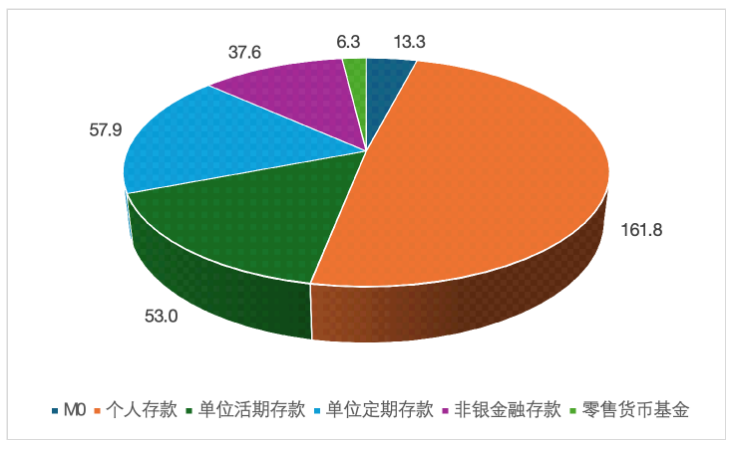
Core Viewpoint - The phenomenon of "deposit migration" refers to individuals transferring their savings into financial investments, such as stock investments or asset management products, leading to a shift from traditional bank deposits to non-bank financial deposits [1] Group 1: Deposit Migration Dynamics - The most direct manifestation of deposit migration is the conversion of personal retail deposits into non-bank financial deposits, which can be observed through changes in the structure of total deposits in the country [1] - It is suggested to focus on absolute growth amounts rather than growth rates to better reflect current changes, as growth rates can be influenced by base effects [2] - The structure of M2, a measure of money supply, is analyzed to understand the internal changes related to deposit migration [3][6] Group 2: M2 Structure Analysis - As of July 2025, the total M2 scale in China is 330 trillion yuan, with specific structural components needing to be examined to understand the migration issue [4] - Since 2018, there has been a notable decline in the proportion of corporate demand deposits, while personal deposits have increased, indicating a shift in individual saving behavior [8] - The increase in personal time deposits and other deposits suggests a trend towards "personalization of deposits" and "time depositization" among individuals [10] Group 3: Investment Behavior and Market Trends - The significant increase in personal time deposits in 2023, reaching a record increment of 16 trillion yuan, indicates a temporary shift in investment behavior, with a subsequent decline in growth in 2024 and 2025 [14] - The increment of non-bank financial deposits also rose from 2.29 trillion yuan in 2023 to 5.16 trillion yuan in the first seven months of 2025, suggesting a gradual shift towards financial investments [14] - The current investment behavior reflects a recovery in public confidence, although it has not yet translated into increased consumption or real investment in the economy [15]

宝城期货资讯早班车-20250915
Bao Cheng Qi Huo· 2025-09-15 02:08
1. Report Industry Investment Rating No relevant content provided. 2. Core Views of the Report - China's financial aggregates are large, and future monetary policy should focus on optimizing the structure while maintaining reasonable aggregate growth [2][18]. - China's fiscal policy still has sufficient room for maneuver, with a special treasury bond issuance expected to leverage significant credit [3][19]. - The Fed is expected to cut interest rates, but the policy path after September remains uncertain [4][5]. - Industrial product prices are unlikely to rebound sustainably, and PPI may decline again after the fourth quarter [33]. - The domestic bond market is expected to be highly volatile in August - September, and the RMB exchange rate is expected to be moderately strong [34]. 3. Summary by Directory 3.1 Macro Data Overview - GDP growth in Q2 2025 was 5.2% year - on - year, slightly lower than the previous quarter [1]. - In August 2025, the manufacturing PMI was 49.4%, and the non - manufacturing PMI for business activities was 50.3% [1]. - Social financing and credit in August 2025 showed significant changes, with an increase in M1 growth and a narrowing M1 - M2 gap [1][2][18]. - CPI in August 2025 was - 0.4% year - on - year, and PPI was - 2.9% year - on - year [1]. 3.2 Commodity Investment Reference 3.2.1 Comprehensive - China's financial aggregates are large, and future monetary policy will focus on structural optimization [2][18]. - China - US economic and trade talks will discuss issues such as tariffs and TikTok [2]. - China's fiscal policy has sufficient room, with a special treasury bond issuance to leverage credit [3][19]. - The Fed is expected to cut interest rates, but the post - September policy path is uncertain [4][5]. 3.2.2 Metals - Gold and silver prices reached new highs, and Thai gold exports to Cambodia increased [6]. - Metal inventories in the LME showed significant changes, with some increasing and some decreasing [7]. 3.2.3 Coal, Coke, Steel, and Minerals - A second round of coke price cuts is planned, and coal prices have fallen [9]. - Indonesia's seizure of a nickel mine has raised supply concerns [9]. 3.2.4 Energy and Chemicals - China's new LNG device was delivered, and international oil prices rebounded due to supply concerns [10]. - The EU may reduce its dependence on Russian natural gas [10]. - The US natural gas net long position increased, and the WTI crude oil net long position decreased [12]. 3.2.5 Agricultural Products - China's summer grain purchase was progressing smoothly, and US coffee prices rose [13]. - Most agricultural product prices in China declined, and Pakistan plans to purchase sugar [13][14]. - Speculators' net short positions in US soybeans and corn increased [14]. 3.3 Financial News Compilation 3.3.1 Open Market - The central bank adjusted the evaluation method for primary dealers in open - market operations and carried out reverse repurchase operations [16]. - The central bank will conduct a large - scale term reverse repurchase operation to maintain liquidity [16]. - There are large - scale reverse repurchase and treasury cash deposits maturing this week [17]. 3.3.2 Important News - China - US economic and trade talks were held in Spain [18]. - China's financial data showed strong support for the real economy, and there was a shift in household deposits [18][19]. - China's fiscal policy has sufficient room, and debt - related issues are being addressed [19][20]. - China opposes US export control measures and launches investigations [21][22][23]. - Policies to promote private investment and industry stability are being introduced [23][24]. - The real estate industry is in the stage of risk clearance, and banks have adjusted mortgage policies [25]. - Brokerage bond issuance reached a new high, and there were bond - related events and credit rating changes [26][27]. 3.3.3 Bond Market Summary - The inter - bank bond market showed a differentiated trend, with long - term bonds recovering [28]. - The exchange bond market had mixed performances, and convertible bond indices rose [28][29]. - Interest rates in the money market and bond issuance yields showed various changes [29][30][31]. - European and US bond yields generally increased [31]. 3.3.4 Foreign Exchange Market - The on - shore RMB against the US dollar rose, and the US dollar index showed a slight increase [32]. 3.3.5 Research Report Highlights - Industrial product prices are unlikely to rebound sustainably, and PPI may decline again [33]. - The domestic bond market will be volatile, and the RMB exchange rate is expected to be moderately strong [34]. - The market is in a complex situation with different signals from prices [34]. 3.3.6 Today's Reminders - A large number of bonds will be listed, issued, paid, and redeemed on September 15 [35]. 3.4 Stock Market News - The Beijing Stock Exchange will switch stock codes for listed companies [36]. - The pattern of the public fund market has changed, with growth in the bond - holding scale of some institutions [36][37].
每日投资策略-20250915
Guodu Securities Hongkong· 2025-09-15 02:07
Market Overview - The Hang Seng Index rose by 301 points, closing at 26,388.16, marking a weekly increase of 970 points or 3.82% [3][4] - The total market turnover for the day was 320.734 billion HKD, with a net inflow of 7.331 billion HKD from northbound trading [3] Key Companies Performance - Among the 88 blue-chip stocks, 55 saw an increase, with China Hongqiao (01378) rising by 7% to 26.84 HKD, making it the second-largest gainer [3] - HSBC Holdings (00005) increased by 1.1% to 106.3 HKD, while Hong Kong Exchanges and Clearing (00388) rose by 1% to 448.4 HKD [3] - Chow Tai Fook (01929) was the weakest blue-chip, declining by 2.9% to 16 HKD [3] Industry Insights - The automotive industry is projected to achieve annual sales of approximately 32.3 million vehicles in 2025, reflecting a year-on-year growth of about 3%, with new energy vehicle sales expected to reach around 15.5 million units, growing by about 20% [10] - The "impact investing" sector is gaining traction globally, with managed funds estimated to reach 1.6 trillion USD last year and expected to grow to 6 trillion USD by 2031 [7] Strategic Developments - Sai Crystal Technology (00580) has signed a strategic cooperation framework agreement with Sanan Semiconductor, ensuring stable supply and competitive pricing for semiconductor products [13] - 361 Degrees (01361) is exploring the use of stablecoins for payments and settlements in overseas markets, aiming to enhance payment efficiency and reduce costs for cross-border e-commerce [14]
现在到底是现金为王还是资产为王?告诉大家答案,早了解早受益
Sou Hu Cai Jing· 2025-09-14 23:41
Group 1 - The core debate in wealth management for 2024 revolves around whether to prioritize cash or diversify into assets, with individuals like Aunt Li facing dilemmas in their investment strategies [1][3] - The macroeconomic environment in 2024 is prompting a reevaluation of wealth management strategies among the public, emphasizing the need for personalized approaches based on individual circumstances [3][5] Group 2 - Cash is highlighted for its liquidity and stability, with data showing that as of 2024, household savings in China reached 143.8 trillion yuan, growing at a rate of 7.8% [5][6] - The potential income from cash holdings is illustrated, with a million yuan yielding 32,000 yuan in interest at a 3.2% annual rate, emphasizing the low risk of capital loss [5][6] - However, inflation poses a risk to cash's purchasing power, with the CPI increase at 2.4% in 2024, indicating a gradual erosion of cash value [6] Group 3 - Asset allocation is presented as a strategy to combat inflation and enhance value, with historical data showing that stocks, real estate, and gold have outperformed inflation over the past decade [7][8] - Real estate, despite recent price adjustments, has an average annual growth rate of 8.7% over the last twenty years, indicating its long-term investment value [8] - The stock market shows significant variability, with some stocks reaching new highs while others decline, underscoring the importance of stock selection and long-term investment [8] Group 4 - Gold has performed well in 2024, with prices rising from $2,000 to $2,180 per ounce, a 9% increase, reflecting its status as a safe-haven asset amid economic uncertainty [8] - The mutual fund industry has grown significantly, with total public fund assets reaching 28.7 trillion yuan by 2024, providing diverse investment options for ordinary investors [10] Group 5 - Different age groups exhibit distinct preferences for cash versus assets, with younger individuals favoring higher-risk investments, while older individuals tend to prefer cash and low-risk products [11] - Income levels also influence asset allocation strategies, with higher-income individuals diversifying more, while lower-income households tend to hold more cash [11] Group 6 - A recommended "core-satellite" investment strategy suggests maintaining 6 to 12 months of living expenses in cash while diversifying the rest into stocks, funds, and real estate [12] - The "100 minus age" rule is proposed as a guideline for asset allocation, adjusting the proportion of risk assets based on age [12] Group 7 - Investment knowledge and experience are crucial, with a recommendation for those less familiar with investing to maintain a higher cash ratio while gradually increasing asset allocation [13] - Market timing is emphasized, suggesting that increasing asset allocation during downturns and cash during booms can yield better returns [13] Group 8 - Liquidity needs, tax implications, and inflation expectations are critical factors in asset allocation decisions, with a focus on maintaining sufficient cash for upcoming large expenses [14] - Economic cycles should inform investment strategies, with risk assets performing well in expansion periods and cash becoming more valuable during contractions [14] Group 9 - Policy changes can significantly impact asset performance, necessitating regular reviews and adjustments to investment strategies based on evolving regulations [15] - Personal circumstances, such as income changes or health issues, should prompt reassessment of asset allocation [15] Group 10 - Successful wealth management often involves a combination of clear financial goals, reasonable asset allocation, and a commitment to continuous learning [16] - Technological advancements are transforming wealth management, making it more accessible and efficient [16] Group 11 - Investing in education and health is increasingly recognized as vital, with returns on knowledge investments potentially surpassing traditional financial assets [17] - Building and maintaining a strong social network can also yield unexpected opportunities and benefits [17] Group 12 - The most effective wealth managers adapt their strategies flexibly to changing environments, avoiding extremes of cash hoarding or asset liquidation [18] - Diversification is a key principle, with recommendations against concentrating investments in a single asset type [18] Group 13 - A practical investment strategy for Aunt Li involves allocating 200,000 yuan in cash for emergencies, 200,000 yuan in stable mixed funds, and 100,000 yuan in gold ETFs, balancing liquidity and growth potential [19] - This gradual approach to investing is encouraged as a learning process, emphasizing the importance of patience and strategy refinement over time [19]

这个趋势信号要关注,居民存款搬家已经连续两个月了
第一财经· 2025-09-14 15:44
Core Viewpoint - The article discusses the recent trend of "deposit migration" in China, where residents are moving their savings from traditional bank deposits to non-bank financial institutions, correlating this behavior with the performance of the domestic stock market [3][6]. Financial Data Summary - In August, resident deposits decreased by 110 billion yuan, a year-on-year decline of 600 billion yuan, marking two consecutive months of negative growth [5][6]. - Non-bank deposits increased by 1.18 trillion yuan in August, showing a significant year-on-year increase of 550 billion yuan, despite a month-on-month decline [5][6]. - The M1-M2 gap narrowed to -2.8%, the lowest since June 2021, indicating enhanced liquidity and a shift towards more active funds [5][6]. Deposit Structure Changes - The structure of deposits shows a clear trend of residents moving funds into the stock market, as evidenced by the contrasting changes in resident and non-bank deposits [6][7]. - The increase in non-bank deposits is interpreted as a signal of residents preparing to invest in capital markets, reflecting a shift in asset allocation [6][9]. Market Dynamics - The article highlights that the increase in non-bank deposits is often linked to a bullish stock market, with the performance of the stock market influencing the flow of funds into non-bank financial products [9][10]. - Analysts suggest that the current trend of deposit migration is likely to continue, driven by declining deposit attractiveness and a robust capital market [10][11]. Consumer Behavior Insights - Despite the increase in non-bank deposits, there remains a cautious attitude among residents regarding future economic conditions, with a strong inclination towards saving rather than spending or investing [11][12]. - The report indicates a persistent trend of deleveraging among residents, with a notable decrease in household loans, reflecting a broader economic caution [11][12]. Policy Implications - The article emphasizes the importance of government policies aimed at stimulating consumer spending, including direct incentives and loan support measures [12]. - It suggests that sustained improvements in employment and income are crucial for reviving consumer demand and stabilizing retail loan growth [12].

流动性与机构行为跟踪:资金收敛,基金抛券
ZHONGTAI SECURITIES· 2025-09-14 12:42
Report Summary 1. Report Industry Investment Rating The document does not provide the industry investment rating. 2. Core Viewpoints - This week (9.8 - 9.12), the capital interest rate increased, the average daily lending of large - scale banks decreased, and funds reduced leverage. - The maturity of certificates of deposit increased, and the yields to maturity of certificates of deposit at various tenors rose. - In the spot bond trading, the main buyers were large - scale banks, with a significant increase in net buying compared to last week, mainly increasing holdings of 1 - 5Y interest - rate bonds. Insurance companies increased their allocation of 20 - 30Y interest - rate bonds, rural commercial banks increased holdings of 7 - 10Y bonds, securities firms reduced their interest - rate bond holdings, and funds were the main sellers, mainly reducing holdings of 7 - 10Y interest - rate bonds. [4] 3. Summary by Directory 3.1 Monetary Fundamentals - **Open Market Operations**: There were 1.0684 trillion yuan of reverse repurchases maturing this week. The central bank conducted reverse repurchase operations of 191.5 billion, 247 billion, 304 billion, 292 billion, and 230 billion yuan from Monday to Friday, with a total investment of 1.2645 trillion yuan and a net liquidity injection of 196.1 billion yuan for the whole week. Next Monday, 600 billion yuan of outright reverse repurchases will be invested. [7] - **Funding Rates**: As of September 12, R001, R007, DR001, and DR007 were 1.4%, 1.47%, 1.36%, and 1.46% respectively, changing by 3.7BP, 0.85BP, 4.83BP, and 2.03BP compared to September 5, and were at the 17%, 7%, 15%, and 3% historical percentiles respectively. [10] - **Large - scale Bank Lending**: From September 8 to September 12, the total lending scale of large - scale banks was 20.31 trillion yuan, with a maximum daily lending scale of 4.2 trillion yuan and an average daily lending scale of 4.1 trillion yuan, a decrease of 0.1 trillion yuan compared to the previous week's average. [13] - **Pledged Repurchase Transactions**: The trading volume of pledged repurchases increased, with an average daily trading volume of 7.49 trillion yuan and a maximum daily trading volume of 7.64 trillion yuan, a 2.46% increase compared to the previous week's average. The proportion of overnight repurchase transactions increased, with an average daily proportion of 88.4% and a maximum daily proportion of 89.1%, an increase of 0.08 percentage points compared to the previous week's average, and was at the 86.7% percentile as of September 12. [15] 3.2 Certificates of Deposit and Bills - **Issuance and Financing of Certificates of Deposit**: The issuance scale of inter - bank certificates of deposit increased this week, and the net financing turned negative. The total issuance was 782.06 billion yuan, an increase of 200.36 billion yuan compared to the previous week; the total maturity was 1252.02 billion yuan, an increase of 921.97 billion yuan compared to the previous week. The net financing was - 469.96 billion yuan, a decrease of 721.41 billion yuan compared to the previous week. [17] - **Issuance by Bank Type**: This week, the issuance scales of inter - bank certificates of deposit by state - owned banks, joint - stock banks, city commercial banks, and rural commercial banks were 239.28 billion, 243.47 billion, 241.39 billion, and 38.11 billion yuan respectively, changing by 80.94 billion, 79.24 billion, 19.62 billion, and 2.97 billion yuan compared to the previous week. [17] - **Issuance by Tenor**: The issuance scales of 1M, 3M, 6M, 9M, and 1Y inter - bank certificates of deposit were 68.6 billion, 262.94 billion, 230.26 billion, 100.51 billion, and 119.75 billion yuan respectively, changing by 50.79 billion, 31.44 billion, 96.37 billion, - 14.46 billion, and 36.22 billion yuan compared to the previous week. The 3M certificates of deposit accounted for the highest proportion of the total issuance of certificates of deposit by different types of banks, at 33.62%, mainly due to more issuances by state - owned banks; the 6M tenor accounted for 29.04%, mainly due to more issuances by joint - stock banks. [17][18] - **Yields to Maturity of Certificates of Deposit**: As of September 12, the yields to maturity of 1M, 3M, 6M, 9M, and 1Y inter - bank certificates of deposit of AAA - rated commercial banks were 1.55%, 1.56%, 1.64%, 1.67%, and 1.67% respectively, changing by 10.6BP, 1BP, 0.95BP, 0.55BP, and 0.5BP compared to September 5. [30] - **Bill Rates**: As of September 12, the 3M direct discount rate of national - owned and joint - stock banks, 3M transfer discount rate of national - owned and joint - stock banks, 6M direct discount rate of national - owned and joint - stock banks, and 6M transfer discount rate of national - owned and joint - stock banks were 1.27%, 1.15%, 0.83%, and 0.79% respectively, changing by 1BP, - 3BP, 5BP, and 6BP compared to September 5. [32] 3.3 Institutional Behavior Tracking - **Inter - bank Leverage Ratio**: As of September 12, the total inter - bank leverage ratio in the bond market decreased by 0.05 percentage points to 106.51% compared to September 5, at the 34.5% historical percentile since 2021. [35] - **Leverage Ratios of Different Institutions**: As of September 12, the leverage ratios of banks, securities firms, insurance companies, and broad - based funds were 103.5%, 187.9%, 130.6%, and 104.5% respectively, changing by 0.02BP, - 0.33BP, 2.51BP, and - 0.41BP compared to September 5, and were at the 27%, 1%, 83%, and 8% historical percentiles respectively. [37] - **Duration Adjustment**: As of September 12, the weighted average duration of net purchases by funds (MA = 10) was - 3.00 years, turning negative from 3.42 years on September 5 and at the 4% historical percentile; the weighted average duration of net purchases by wealth management products (MA = 10) was 1.28 years, an increase compared to September 5 and at the 63% historical percentile; the weighted average duration of net purchases by rural commercial banks (MA = 10) was 1.78 years, an increase compared to September 5 and at the 63% historical percentile; the weighted average duration of net purchases by insurance companies (MA = 10) was 13.17 years, an increase compared to September 5 and at the 93% historical percentile. [39]
宏观与大类资产周报:中美谈判的预期回摆-20250914
CMS· 2025-09-14 11:34
Domestic Economic Outlook - August exports fell short of expectations, indicating a potential slowdown in China's export growth, with a trade surplus of $98.24 billion, up 11.8% year-on-year[19] - The Producer Price Index (PPI) in August showed a year-on-year decline of 2.9%, a narrowing from the previous month's 3.6%[20] U.S. Economic Indicators - Following the release of non-farm employment, PPI, and CPI data, market expectations for rapid interest rate cuts by the Federal Reserve have increased, with initial jobless claims rising significantly in the week of September 14[17] - The U.S. Supreme Court is set to hear oral arguments on Trump's tariff case in November, which may accelerate tariff adjustments[17] Currency and Trade Relations - The upcoming U.S.-China talks from September 14-17 may influence the RMB exchange rate; if tariffs are reduced, the RMB could strengthen past the 7 mark[18] - A weak dollar trading environment has temporarily ended, with the U.S. significantly revising down employment data, reinforcing the case for Fed rate cuts[18] Market Performance - The A-share market showed a weekly increase of 1.52%, while the Hang Seng Index rose by 3.82%[45] - Gold prices have been fluctuating upwards, and international crude oil prices have rebounded[43] Monetary Policy and Liquidity - The overall liquidity shifted from tight to loose, with a net injection of 196.1 billion yuan through reverse repos this week[24] - The weighted issuance rate of interbank certificates of deposit rose to 1.6264%, reflecting a slight increase from the previous week[27]
芦哲:M2增速或见顶——2025年8月金融数据点评
Sou Hu Cai Jing· 2025-09-14 08:07
Core Viewpoint - In August 2025, the People's Bank of China reported a new social financing scale of 2.57 trillion yuan, a year-on-year decrease of 463 billion yuan, with the total social financing stock growth rate falling to 8.8% [1][2] Social Financing - The new social financing in August 2025 was 2.57 trillion yuan, which is 463 billion yuan less than the same month last year, marking a decline in growth rate [1] - Government bond financing in August was 1.37 trillion yuan, down 251.9 billion yuan year-on-year, indicating a seasonal decrease in government bond issuance [5] - The total amount of new loans from financial institutions was 590 billion yuan, a decrease of 310 billion yuan year-on-year, reflecting weak effective demand [4][6] Loan Issuance - The new RMB loans in August amounted to 590 billion yuan, which is 310 billion yuan less than the previous year, with a year-on-year growth rate of 6.80% [4][6] - Short-term loans for enterprises increased by 700 billion yuan, showing a recovery in short-term financing demand [6] - The issuance of corporate bonds was 1.34 trillion yuan, down 360 billion yuan year-on-year, while stock financing increased by 457 billion yuan, indicating a rise in market activity [4][5] Monetary Supply - As of the end of August 2025, M2 growth rate remained stable at 8.8%, while M1 grew by 6.0%, reflecting a narrowing gap between M2 and M1 [2][7] - The total new RMB deposits in August were 2.06 trillion yuan, a decrease of 1.6 trillion yuan year-on-year, with significant shifts in deposit structures [2][7] - The government bond financing is a key factor in maintaining the synchronization of M2 and social financing growth rates, but a slowdown in government bond issuance may lead to a peak in M2 growth [7][8] Financial Data Outlook - The next four months may see an improvement in direct financing due to an active stock market, with policies aimed at boosting consumer loans and corporate financing potentially leading to a seasonal increase in loan financing [8]
8月金融数据点评:资金延续活化,但信贷仍弱
Shenwan Hongyuan Securities· 2025-09-14 07:43
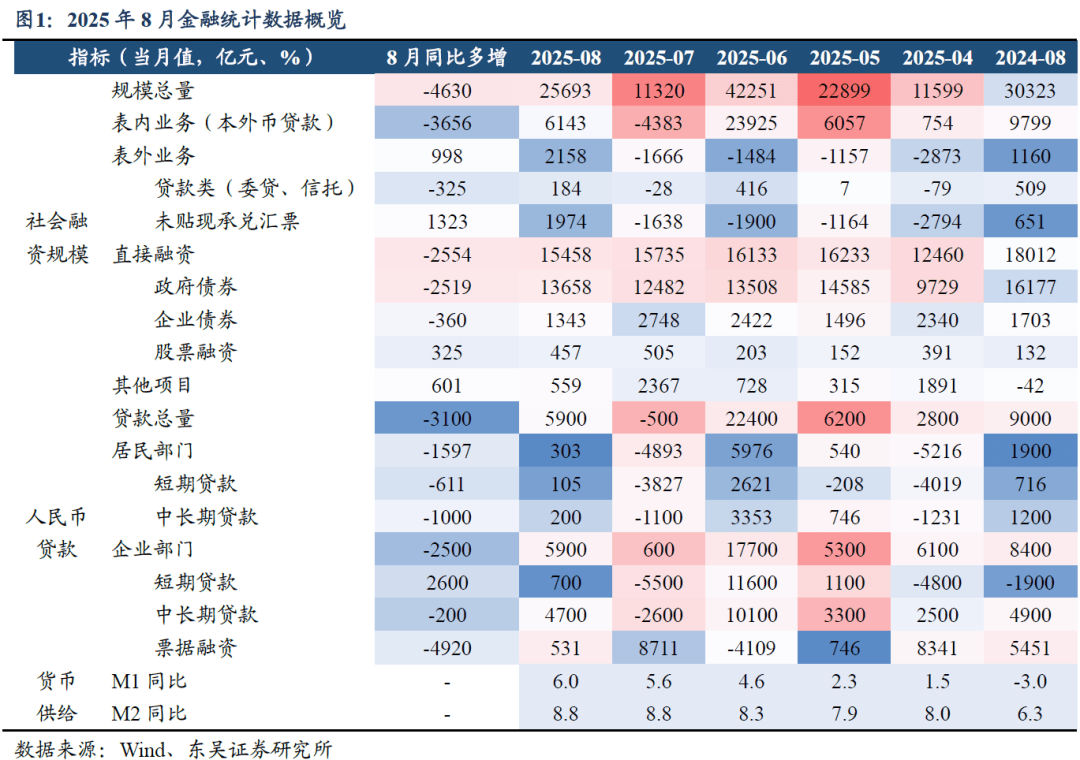
Group 1 - The core viewpoint of the report indicates that while funding remains active, credit demand is still weak, with August 2025 seeing new RMB loans of 0.59 trillion (compared to 0.9 trillion in August 2024) and new social financing of 2.57 trillion (down from 3.03 trillion in August 2024) [2][3] - The decline in the year-on-year growth rate of social financing is attributed to both a high base effect and weak credit demand from the real economy. Government bonds continue to support the growth rate, but the net financing scale of government bonds in August 2025 (1.33 trillion) is still lower than that in August 2024 (1.84 trillion) [3][4] - The report highlights that while the equity market remains active, the trend of residents investing their broad deposits continues. The new non-bank deposit scale in August increased significantly, while new household deposits fell from the low base in July [3][4] Group 2 - The report notes that M1 growth has increased, with the M1-M2 spread narrowing to the lowest level since 2022. However, the correlation between M1, M2, and economic activity has weakened, necessitating further observation of fundamental data [4][5] - Structural highlights in August's financial data are noted, but demand from the real economy remains weak. The report suggests that the current pressure in the bond market has partially eased, but further observation is needed regarding the release of this pressure [5][6] - The report emphasizes the need to monitor three dimensions for the bond market: the persistence of loose funding conditions, the net buying strength of long-term bonds by insurance funds, and the performance of credit spreads [5][6]